Presentation
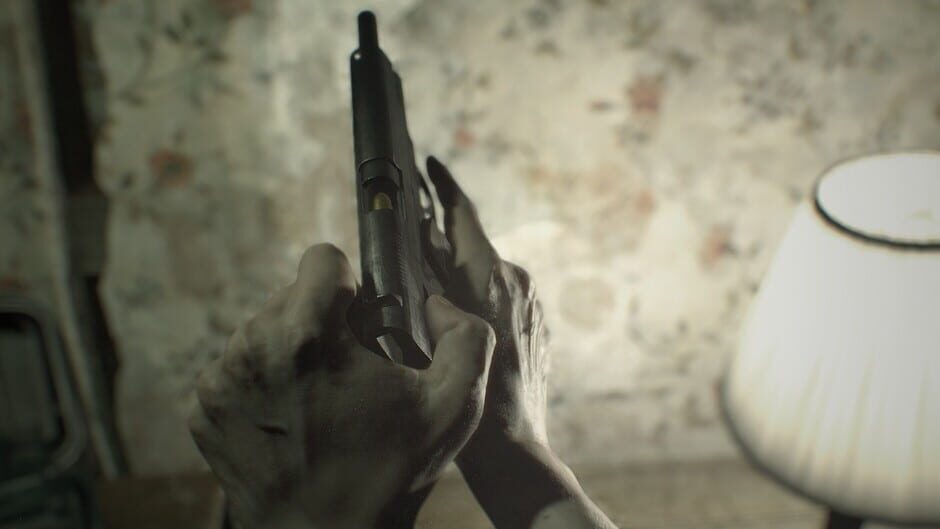
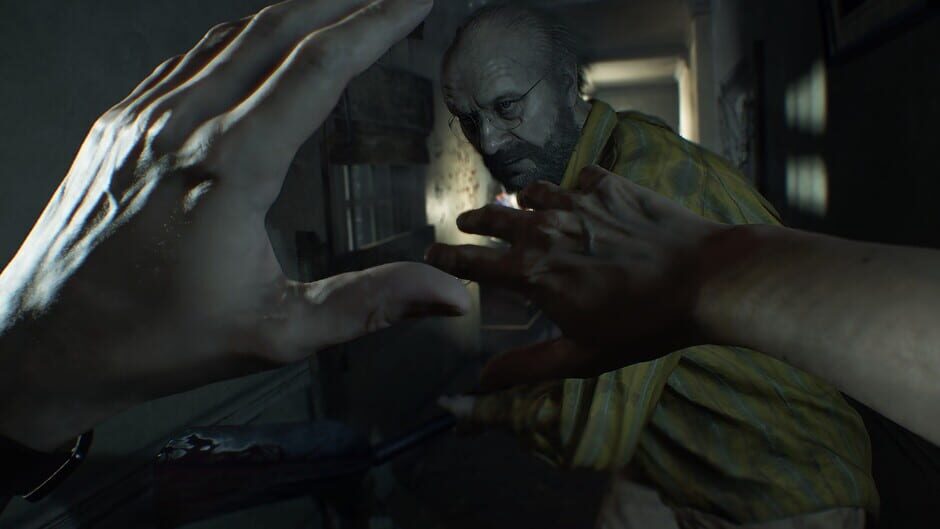
Resident Evil 7: Biohazard marks an important break after the escalating spectacle of Resident Evil 5 and Resident Evil 6. Capcom puts horror, exploration and tension back at the center of the experience and abandons the third-person camera for a first-person perspective. The change immediately transforms the relationship with space: narrow corridors, half-open doors and sounds coming from another room feel much closer to the player.
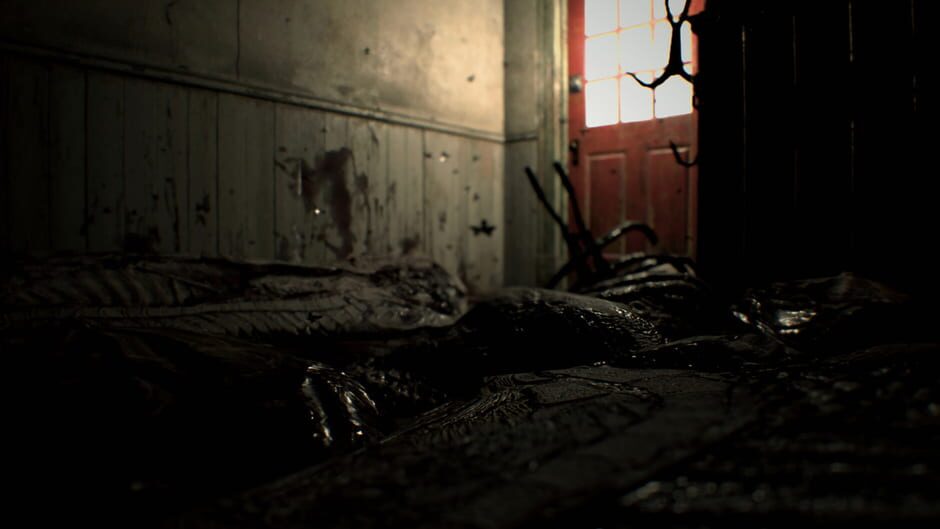
The Baker estate is essential to this direction. The main house functions as an interconnected environment where certain doors remain locked until Ethan finds the correct key or item. He regularly returns to previously visited rooms to open a new route, recover resources or solve a puzzle, returning to a structure strongly reminiscent of the earliest Resident Evil games.
Exploration is built around a deliberately limited economy. Ammunition, healing items and crafting components must be searched for in drawers, cupboards and side rooms. Chem Fluid can be combined with different materials to create medicine or ammunition, sometimes forcing the player to choose between several immediate needs.
Inventory management also becomes important again. Weapons, healing items and other supplies occupy a limited number of slots, while item boxes allow Ethan to store anything that is not immediately necessary. Backpacks found during the adventure gradually increase available capacity and reward careful exploration.
Puzzles complete this structure. Some involve keys associated with different symbols, while others depend on manipulating objects or observing the environment. The game does not return to the complexity of every puzzle found in the earliest entries, but it gives movement and objects a purpose that goes well beyond combat.
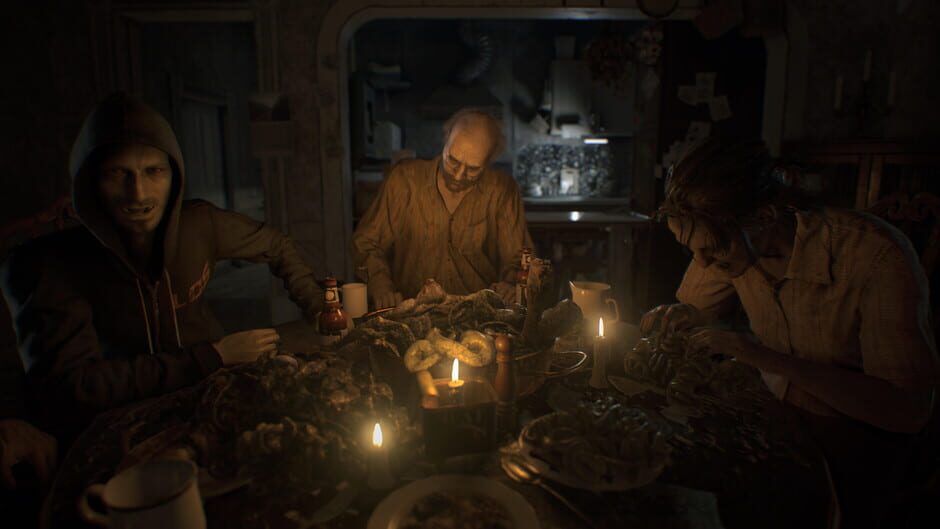
Each member of the Baker family brings a different form of threat. Jack pursues Ethan through several parts of the house and uses his regenerative abilities to return after injuries that should be fatal. Marguerite dominates an area overrun by insects and organic growth, while Lucas favors traps, cruel games and mechanisms designed to manipulate his victims.
These pursuers create particular tension during the opening hours because Ethan cannot always solve an encounter with firepower. Avoiding an enemy, closing a door, changing route or simply gaining enough distance can sometimes be more useful than shooting. Gradually learning the layout of the estate therefore becomes a genuine resource.
The Molded serve as the more regular enemies. These creatures created by the Mold appear in several forms and force Ethan to decide when ammunition is worth spending. Pistols, shotguns, grenade launchers and other weapons gradually make him more capable of defending himself, but the arsenal remains limited enough through much of the campaign to maintain pressure.
The balance eventually shifts noticeably toward action. Later areas feature more frequent combat and reduce some of the vulnerability felt during the opening hours. This creates a clear contrast between the oppressive exploration of the Baker residence and a final stretch more directly focused on eliminating creatures.
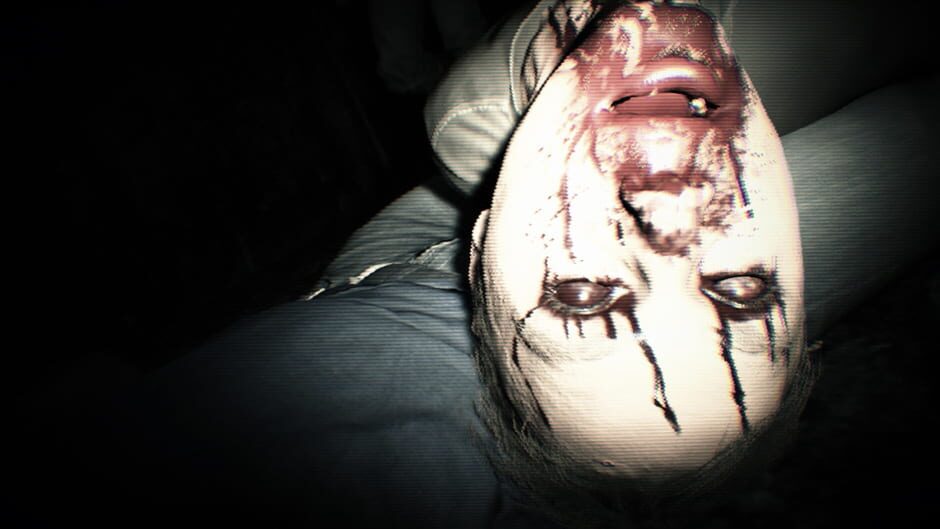
Videotapes introduce another interesting idea. Some can be played on VCRs and allow the player to experience events that occurred before Ethan arrived. They provide information about locations and characters while sometimes allowing the player to discover a danger before Ethan has to face it directly.
The story also works through a gradual change in perspective. The Bakers initially appear to be an almost incomprehensible family of torturers, but information found around the estate shows that they are also victims of the infection. Eveline gradually replaces the family as the real source of the threat and reconnects the personal story of Ethan and Mia with the series’ wider theme of bioterrorism.
Technology supports this new direction as well. Resident Evil 7 is the first game developed with Capcom’s RE Engine, designed in part to produce highly detailed environments and characters. On PlayStation 4, the entire campaign can also be played with PlayStation VR, further intensifying the closeness created by the first-person view.
Additional content expands several elements left open by the campaign. Not a Hero follows Chris Redfield after the main story as he pursues Lucas Baker. End of Zoe focuses on Zoe’s fate and introduces Joe Baker, while the Banned Footage episodes show different victims and experiments connected to the family.
What to remember
- A major shift away from the action-heavy previous entries, with a clear return to horror, exploration and resource management.
- Ethan Winters travels to Dulvey, Louisiana, after receiving a message from Mia, who has been missing for three years.
- A first-person perspective that increases proximity to the environments and represents one of the major changes of this entry.
- The Baker estate as an interconnected space where keys, puzzles, shortcuts and revisiting previously explored areas shape progression.
- Limited ammunition, healing items, crafting components and inventory space that give resource gathering real importance.
- Jack, Marguerite and Lucas Baker as threats with their own methods and territories.
- Eveline and the Mold as the biological source of the contamination that transformed the Baker family.
- The first entry in the series developed with the RE Engine, and the beginning of Ethan Winters’ story later continued in Resident Evil Village.
Conclusion
Resident Evil 7: Biohazard renews the series by deliberately reducing its scale. After entries in which bioterrorism took the form of international conflicts and increasingly massive battles, Mia’s disappearance simply leads Ethan to an isolated house whose inhabitants and rules he does not understand. That concentration allows Capcom to make every corridor, every door and every bullet matter again.
The first-person perspective clearly plays a major role, but the return to horror does not depend on the camera alone. The interconnected estate, limited resources, item boxes, keys and the need to revisit certain areas reintroduce an exploration structure very close to the historical foundations of Resident Evil.
The Baker family gives this formula a more personal dimension. Jack, Marguerite and Lucas have enough personality to make each part of the plantation distinct, while discovering their real history gradually changes how they are perceived. The threat no longer comes only from monstrous individuals, but from whatever turned them into those creatures.
The final third gives more room to combat and loses some of the oppression built within the residence. That rise in power nevertheless fits Ethan’s progression and allows the story to move beyond the family mystery to reveal the biological nature of the disaster.
Resident Evil 7 therefore occupies a pivotal place in the modern era of the franchise. It recovers several principles of classic survival horror without trying to reproduce the older games exactly, introduces the RE Engine and establishes Ethan Winters in a story that Village continues four years later. Its change of perspective is immediately visible; its real success comes from the way it uses that change to make exploration dangerous again.
Good to know
- Resident Evil 7: Biohazard was developed and published by Capcom.
- The game was released on January 24, 2017, in Europe and North America for PlayStation 4, Xbox One and PC.
- It is the first main entry in the series to use a fully first-person perspective.
- It introduced the RE Engine, Capcom’s proprietary game engine.
- The PlayStation 4 version allows the entire campaign to be played with PlayStation VR.
- Resident Evil 7 biohazard Gold Edition, released in December 2017, includes the main game and Season Pass content; Not a Hero was released separately as free content.
- PlayStation 5 and Xbox Series X|S versions were released on June 14, 2022.
- The game has also been available on Nintendo Switch 2 since February 27, 2026.