Presentation
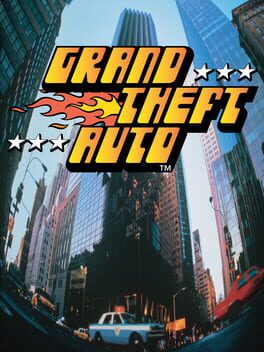
Developed by DMA Design and initially published by BMG Interactive, Grand Theft Auto was released in 1997 for MS-DOS, Windows and PlayStation. The project was led at DMA Design by Keith Hamilton, who also served as lead programmer, while studio founder David Jones remained closely associated with its overall development. The game became the starting point of a series that would progressively reshape open-world action games across later hardware generations.
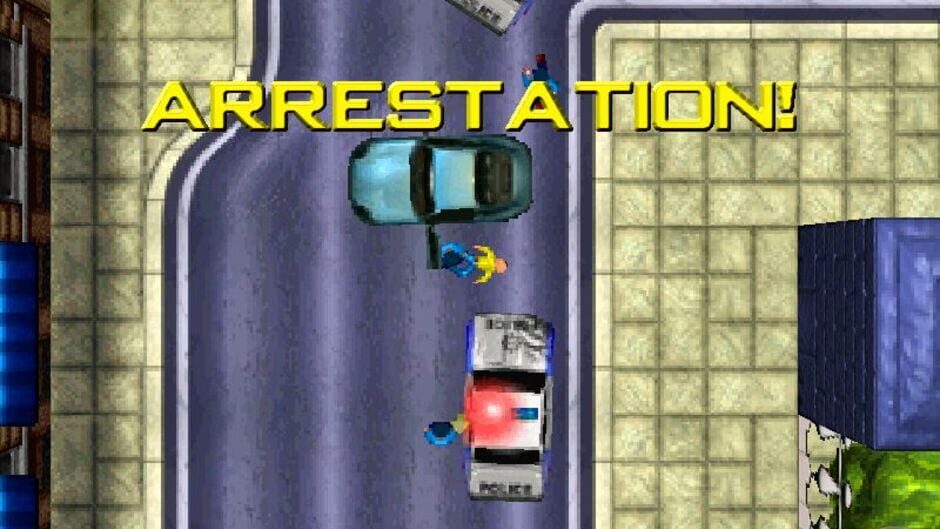
Its design already revolves around an essential idea: placing players inside a city where they can move freely instead of restricting them to a succession of tracks or enclosed levels. The camera observes the action from a top-down perspective, far enough away to display the streets, vehicles, pedestrians and numerous intersections making up each environment.
Three cities structure the campaign: Liberty City, San Andreas and Vice City. They are inspired respectively by New York, San Francisco and Miami, but already use the fictional names that would become fundamental to the Grand Theft Auto universe. In this first installment, San Andreas is still represented as a city rather than the large state depicted in later games.
Players can move on foot, but driving naturally occupies a central role. Almost any vehicle encountered on the street can be stolen and used to cross the city, complete a mission or simply escape law enforcement. Cars, service vehicles and other forms of transport behave differently and can be destroyed through collisions or combat.
Missions are notably obtained through public telephones positioned around the different areas. Criminal employers provide instructions such as recovering or delivering a vehicle, eliminating a target, transporting a character, causing destruction or escaping a dangerous situation. Players are generally free to choose their route and decide how to use the city to reach the objective.
Progression relies on a points and money system. Completing missions, destroying certain vehicles and performing various criminal actions increases the score, and reaching a sufficient total unlocks the next section of the campaign. The structure therefore resembles a series of contracts taking place within a free environment more than a strictly linear narrative.
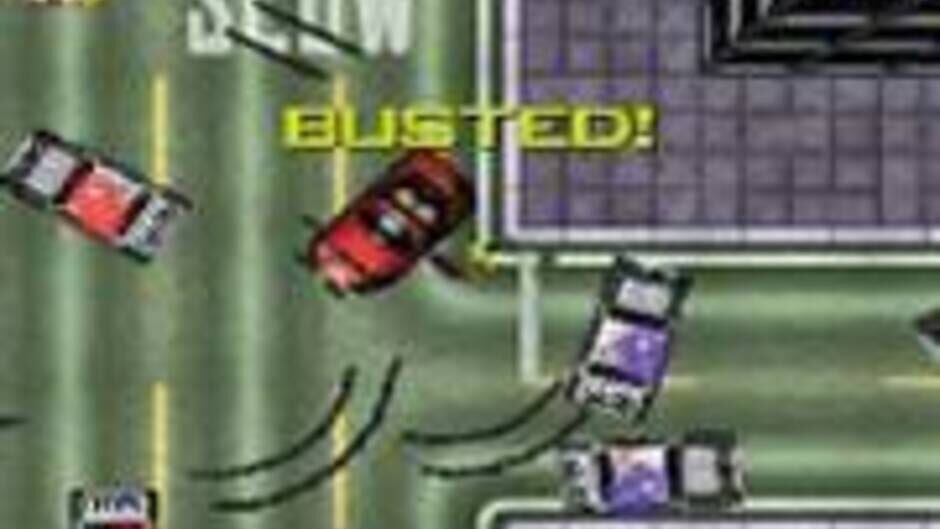
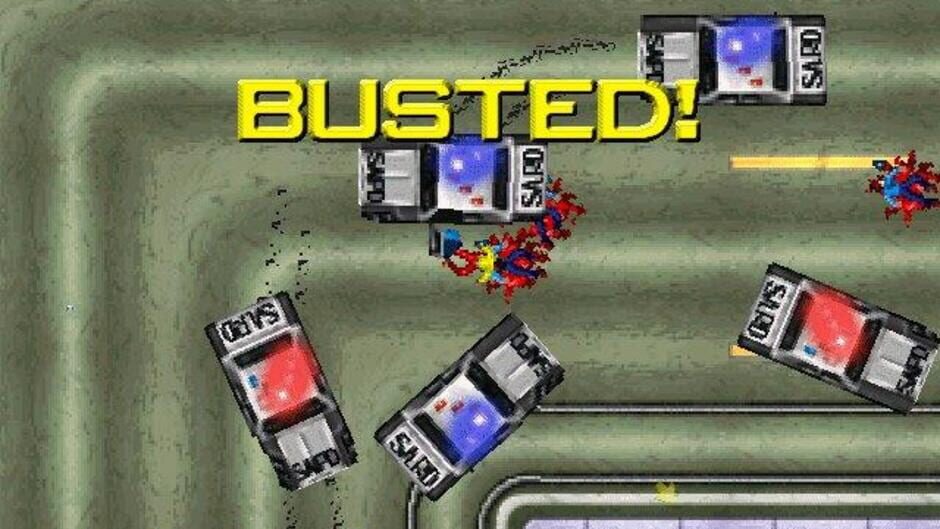
Illegal activity nevertheless attracts the police. Grand Theft Auto introduces a wanted level system in this first installment, increasing when players commit offenses in view of law enforcement. As the pressure rises, the police response becomes more difficult to escape, requiring effective use of streets, available vehicles and parts of the environment to disappear.
This relationship between freedom and consequences already forms one of the fundamental principles of the series. The game permits many actions that are not directly required by missions but integrates them into a system capable of reacting. A collision, stolen vehicle or attack can therefore transform an ordinary journey into an improvised pursuit and completely change what the player originally intended to do.
The city also has an important audio dimension. Vehicles play different stations or pieces of music when the player enters them, giving journeys a different identity depending on the car being driven. The soundtrack combines several styles and anticipates the increasingly important role radio stations would play in later installments.
Grand Theft Auto already adopts a deliberately satirical and exaggerated representation of urban crime. Dialogue, character names, missions and violence are presented with a humorous distance rather than as a realistic simulation. This approach would gradually become one of the defining characteristics of the franchise.
Despite its technical limitations and straightforward storytelling, the game therefore establishes a remarkably durable structure: several open cities, vehicles that can be stolen almost freely, missions integrated into the world, reactive police and criminal progression organized around money and score. Later installments would radically transform the presentation and scale, but much of their gameplay vocabulary is already present here.
What to remember
- The first Grand Theft Auto, developed by DMA Design before the studio later became Rockstar North.
- Three open cities, Liberty City, San Andreas and Vice City, introducing in 1997 several locations that would become iconic throughout the series.
- A top-down perspective allowing players to move freely on foot or steal numerous vehicles found throughout the streets.
- Criminal missions mainly obtained by telephone and completed with considerable freedom in the choice of routes and vehicles.
- A police wanted system that escalates according to the player's crimes and turns illegal activity into increasingly difficult pursuits.
- A structure built around score, money, driving and improvisation that establishes several essential principles of the franchise's future open worlds.
Conclusion
Grand Theft Auto looks very different today from the image associated with the modern installments. Its top-down view, minimalist visual representation and score-based progression clearly belong to the late 1990s. Yet beneath that presentation lies much of the logic that would eventually define the series.
The ability to steal almost any vehicle turns the city into a system of movement rather than a simple backdrop. A car is not merely a way to reach a mission: it can be used to escape the police, cause collisions, quickly change districts or create a situation that was never part of the original objective.
The wanted system reinforces this freedom by giving it immediate consequences. Players can ignore their mission and create chaos, but the world responds to those actions. This mechanic creates a form of improvisation that would become progressively more sophisticated in later installments.
Liberty City, San Andreas and Vice City also give the first game particular importance in building the universe. All three names would return and be extensively reimagined throughout the series, eventually becoming associated with some of its most significant entries.
Grand Theft Auto therefore represents less a primitive version of the later three-dimensional games than the first definition of their underlying principles. An open urban world, accessible vehicles, criminal missions, reactive police, radio and freedom of action are already combined in a game whose technology would change dramatically while its central idea remained at the heart of the franchise.
Good to know
- Grand Theft Auto was developed by DMA Design, the Scottish studio that would eventually become Rockstar North.
- The game was originally released in 1997 for MS-DOS and Windows, followed by PlayStation the same year.
- Keith Hamilton is credited as Team Leader and Lead Programmer, while Ian McQue served as Lead Artist.
- The three main maps are built around Liberty City, San Andreas and Vice City, with Paul Farley, Steve Banks and Billy Thomson credited for map design and mission programming.
- The project previously carried the name Race'n'Chase before becoming Grand Theft Auto during development.
- A Game Boy Color adaptation was released in 1999, translating the original formula to Nintendo's handheld system.
- The first Grand Theft Auto received two London-based expansions, Grand Theft Auto: London 1969 and London 1961, before Grand Theft Auto 2 was released in 1999.
```