Synopsis
In 1274, the Mongol army lands on the Japanese island of Tsushima. The samurai attempt to repel the invasion on Komoda Beach, but their forces are quickly crushed by an enemy that shares neither their rules nor their conception of honor.
Among the few survivors is Jin Sakai, samurai of Clan Sakai and nephew of Lord Shimura. Wounded but determined to free his island and rescue his captured uncle, Jin quickly realizes that the traditional methods that shaped his entire life will not be enough against the Mongols.
He then begins adopting tactics his upbringing had taught him to despise: stealth, assassinations, diversion, poison and weapons designed to strike before the enemy can even engage in a duel.
To save Tsushima, Jin must gradually become the Ghost — even if it means losing part of the man and samurai he believed he had to remain.
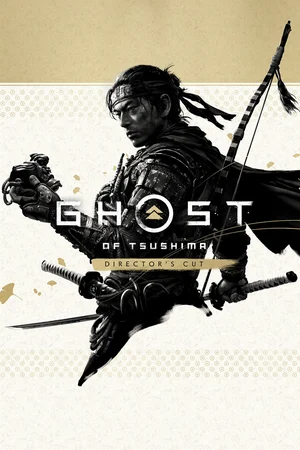
The Director's Cut also extends his story on Iki Island. When Jin discovers that a new Mongol force has settled there under the authority of Ankhsar Khatun, known as the Eagle, he travels to the neighboring island and finds himself confronted not only with a new enemy, but also with memories deeply connected to the history of Clan Sakai.
Overview
Ghost of Tsushima begins by opposing two ways of fighting. Then it spends almost all of its time showing that neither is as simple as its protagonist would like to believe.
Jin Sakai was raised according to a precise ideal. A samurai faces his opponent openly. He masters his sword. He does not crawl through the shadows or kill someone before they have had the chance to defend themselves.
The Mongols arrive with a far more pragmatic understanding of warfare.
And suddenly, tradition becomes a gameplay mechanic.
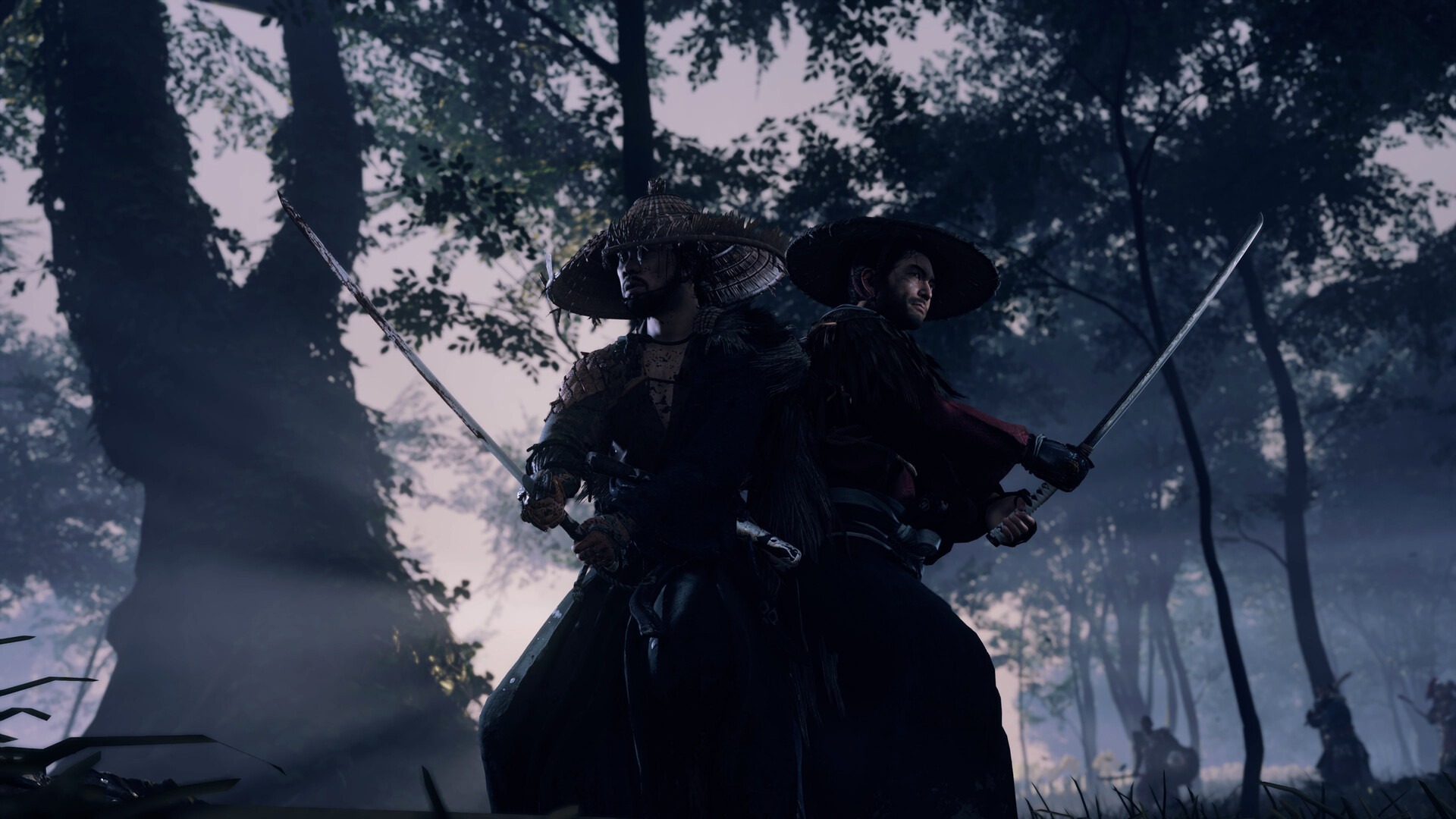
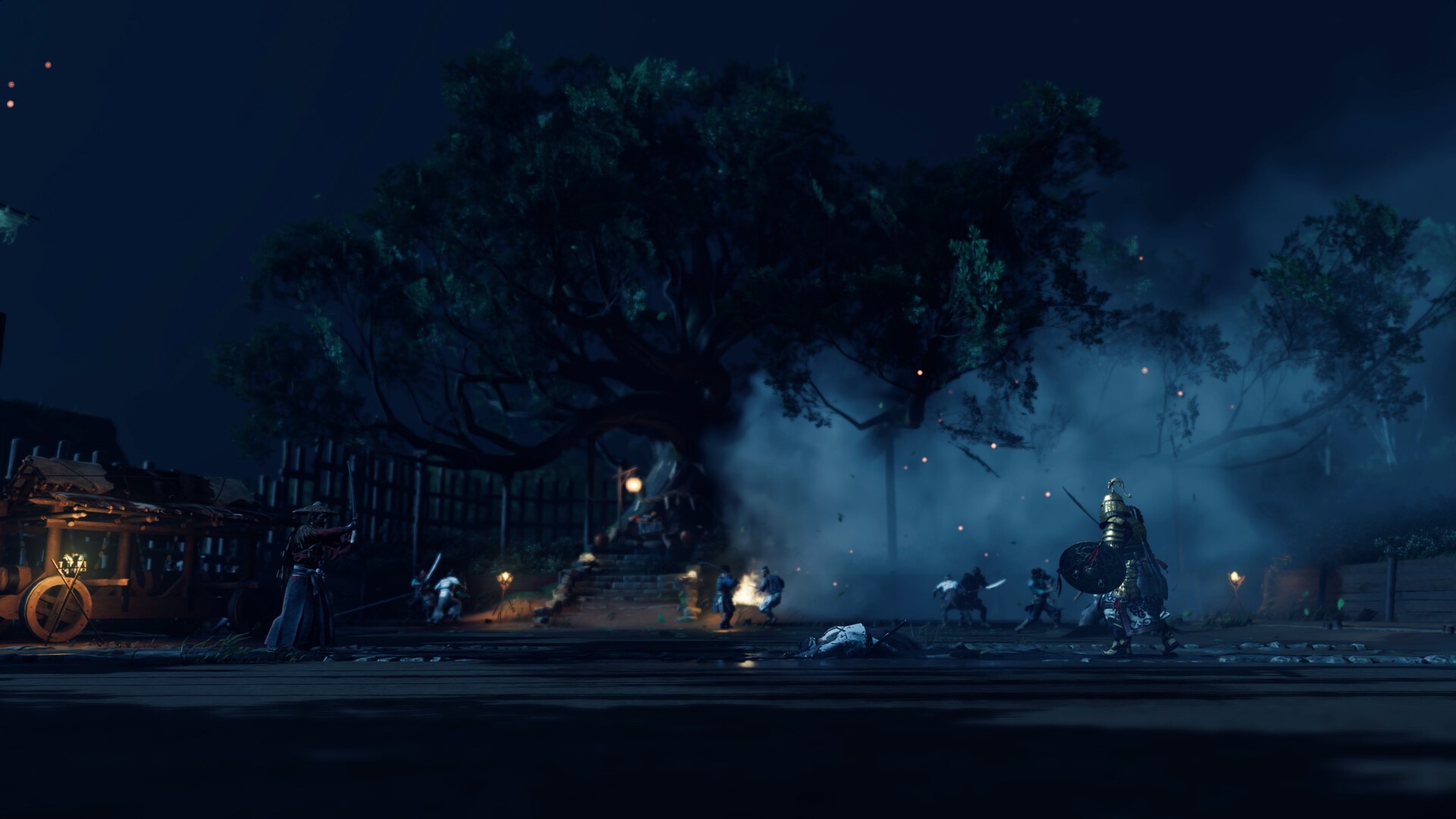
The player can confront certain enemies directly, initiate standoffs and master several stances adapted to different enemy types. But they can also disappear into tall grass, use kunai, distract a guard or silently eliminate an opponent.
This opposition could have remained a simple choice of playstyle. Sucker Punch instead makes it the heart of the character.
The more effective Jin becomes, the further he moves away from the image of the samurai his uncle taught him to embody.
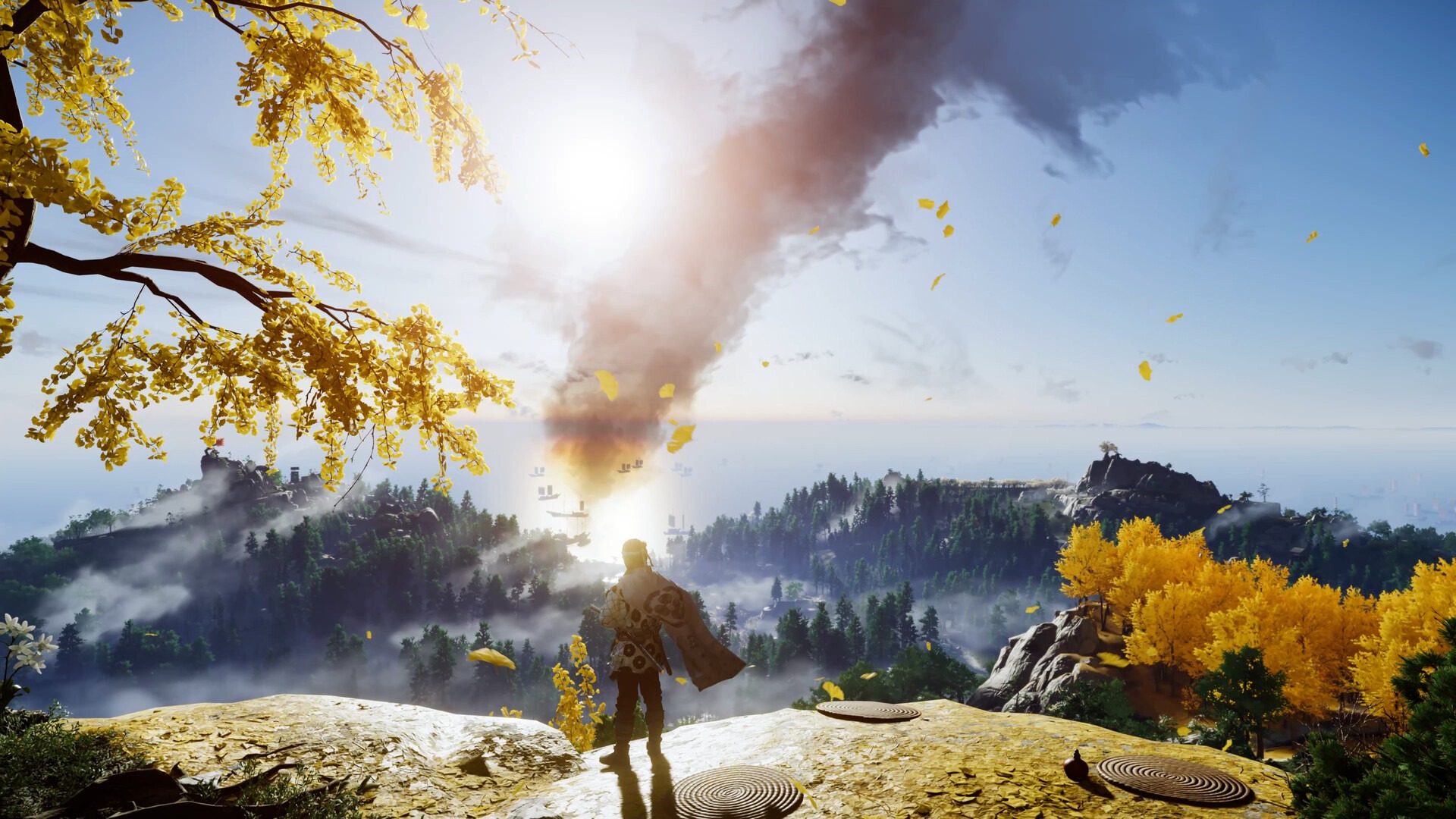
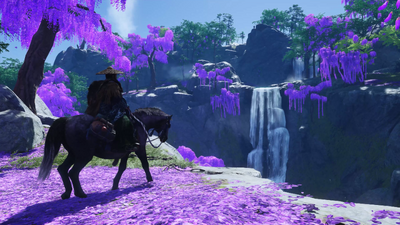
The open world accompanies this transformation with a particularly recognizable visual philosophy. Ghost of Tsushima deliberately reduces the presence of traditional interface elements and uses the wind as a navigation system. A gust indicates the direction of an objective. A fox may lead toward a shrine. A bird sometimes draws the player's attention toward an interesting location.
Not everything is invisible, of course: the map still contains activities, resources and objectives. But the game regularly tries to bring the player's attention back to the landscape rather than to an arrow placed in the middle of the screen.
And the landscape does a great deal of work.
Grass bending in the wind. Red or golden forests. Fields covered in flowers. Temples drowned in mist. Leaves crossing the screen during a duel.
Tsushima is not built as a documentary recreation of the historical island. It is a highly romanticized interpretation designed to create images that are almost immediately readable.
The Director's Cut adds Iki Island, a more compact but also more personal area. Where the main campaign primarily confronts Jin with his identity as a samurai, Iki forces him to revisit the history of his father and Clan Sakai.
That shift works well: the expansion does not simply offer more Mongol camps and new landscapes. It uses a new territory to question what Jin believed he knew about his own family.
Key takeaways
- The story takes place during the first Mongol invasion of Japan in 1274. The game uses this historical context as a starting point while telling a fictional story centered on Jin Sakai.
- Combat opposes samurai tradition and the Ghost's methods. Duels, stances and mastery of the katana coexist with stealth, assassinations and tools used to surprise enemies.
- The wind serves as a navigation system. Rather than relying on a permanent arrow, the player can summon the Guiding Wind to recover the direction of an objective.
- The open world places a strong emphasis on contemplation. Shrines, hot springs, haiku, animals and landscapes regularly encourage the player to slow down between encounters.
- Iki Island is the main narrative expansion. Accessible from Act 2, it develops a new Mongol threat while revisiting Jin's past and his relationship with his father.
- Legends adds a genuine multiplayer component. Inspired by Japanese folklore, the mode notably includes two-player story missions, survival for up to four players and Rivals mode.
- The PS5 Director's Cut improves the technical experience. It notably adds haptic feedback, adaptive triggers, lip sync for Japanese voices, 3D audio, improved loading and options targeting up to 60 frames per second.
- The PC version includes the complete experience. The main game, Iki Island and Legends are all included alongside multiple graphics options and ultra-wide display support.
PANACHES review
Ghost of Tsushima has a strange quality for a game that is essentially about war: it knows when to ask nothing of the player.
A field moves in the wind.
A few leaves cross the road.
Jin dismounts beside a lake and, for a few seconds, the game adds no urgency.
No enemy.
No countdown.
No character explaining that the world will collapse if you do not immediately run toward the next marker.
That breathing space probably matters as much to the game's identity as the katana.
Because on paper, Ghost of Tsushima uses many structures already familiar from open-world games: occupied territories, resources, upgrades, enemy camps, side activities, collections and skill trees.
Sucker Punch does not constantly reinvent the structure.
It mainly works on how the player experiences it.
The Guiding Wind is the best example.
Replacing a GPS line with particles carried through the landscape does not fundamentally change the objective: you still have to travel from point A to point B.
But your gaze changes.
You look at the trees.
The grass.
The leaves.
The general movement of the landscape.
An interface function suddenly becomes part of the art direction.
It is a simple idea, but almost all of the game's visual success relies on decisions like this.
Combat possesses a similar precision.
The katana does not need to produce hundreds of numbers on screen to create a sense of progression. Jin learns stances, improves his techniques and gradually becomes capable of reading a group of enemies almost like a composition.
Shield.
Spear.
Swordsman.
Brute.
Changing stance becomes a rhythm.
And when the game abandons groups for a duel, everything tightens.
A few meters.
Two characters.
Leaves.
A sword.
These moments work because they understand that spectacle does not necessarily come from the number of elements displayed, but from the way those elements occupy space.
Stealth is more conventional. Enemies are not always the sharpest opponents in the genre, and progression turns Jin into an extremely effective machine fairly quickly.
But that effectiveness has a narrative function.
Every new method that makes life easier for the player makes Jin Sakai's life more complicated.
A silent assassination is practical.
For Jin, it is also a rupture.
A bomb is effective.
For his uncle, it is a humiliation.
The game sometimes uses this opposition a little too rigidly. There are moments when the story condemns the Ghost's methods even if the player has spent several hours confronting almost everyone with the katana.
Gameplay and narrative do not always communicate perfectly.
But the conflict remains strong enough to give the adventure real direction.
Jin does not become the Ghost because he suddenly discovers that stealth is fun.
He becomes the Ghost because a code built to give meaning to his world no longer gives him the tools he needs to save it.
And that is where Ghost of Tsushima moves beyond the simple samurai fantasy.
The game does not really say that honor is useless.
It asks instead what a principle is worth when it demands the sacrifice of the people it was supposed to protect.
Iki Island develops this idea further.
The main campaign asks Jin to look at what his upbringing taught him.
Iki asks him to look at who taught it to him.
His father.
His clan.
Memories gradually transformed over time into almost untouchable truths.
The expansion works particularly well because it understands that Jin does not necessarily need a more powerful enemy. He needs a territory where some of his certainties become uncomfortable.
Not everything escapes repetition.
The foxes become numerous.
So do the camps.
Even the most poetic moments can eventually become categories of activities when a map decides to offer several dozen of them.
That is the familiar paradox of the open world: turning wonder into a system can eventually teach the player to consume it.
Ghost of Tsushima regularly comes close to that point.
Then it produces an image.
A duel in the middle of a red field.
A horse crossing a white forest.
A silhouette facing a storm.
And for a few seconds, the checklist disappears.
That is probably where the game remains strongest.
Not when it tries to simulate 13th-century Japan with perfect accuracy.
Not when it tries to be the largest.
But when it embraces being a visual legend.
Ghost of Tsushima does not merely tell how Jin Sakai becomes the Ghost. It tells what happens when a man realizes that perfectly preserving the rules of his old world may be the best way to let that world disappear.
And the Director's Cut gives that idea one final, particularly relevant detour: before deciding what we want to preserve, we sometimes have to accept looking at what we have actually inherited.
Good to know
- Ghost of Tsushima: Director's Cut was released on August 20, 2021 for PlayStation 4 and PlayStation 5.
- This edition brings together the original Ghost of Tsushima game, previously released additional content, the Legends multiplayer mode and the Iki Island narrative expansion.
- The main game was developed by Sucker Punch Productions and published by Sony Interactive Entertainment.
- The main story takes place in 1274, during the first Mongol invasion of Japan, but Jin Sakai and many of the characters are fictional creations made for the game.
- The Iki Island expansion becomes accessible from Act 2, once the Toyotama region has been reached.
- On Iki, Jin investigates a new Mongol presence led by Ankhsar Khatun, known as the Eagle, while confronting memories connected to the history of Clan Sakai.
- The PS5 Director's Cut notably offers dynamic 4K resolution targeting 60 frames per second, haptic feedback, adaptive triggers, improved 3D audio and lip sync for the Japanese voice track.
- Save data from the PS4 version can be transferred to the PS5 version.
- Ghost of Tsushima: Legends is a multiplayer experience inspired by Japanese folklore and mythology. It includes two-player story missions, survival missions for up to four players and a two-versus-two Rivals mode.
- A PC version of Ghost of Tsushima Director's Cut was released on May 16, 2024.
- The PC port was developed by Nixxes Software in collaboration with Sucker Punch Productions.
- The PC version uses Sucker Punch's internal engine, adapted by Nixxes for Windows, and notably offers unlocked frame rates, multiple graphics settings, several upscaling technologies and support for ultra-wide displays.
- Legends mode on PC supports cross-play with PlayStation 4 and PlayStation 5 players.
- Kurosawa Mode allows the game to be played with a black-and-white presentation, cinematic grain and Japanese dialogue, as a tribute to the visual style associated with filmmaker Akira Kurosawa.