Presentation
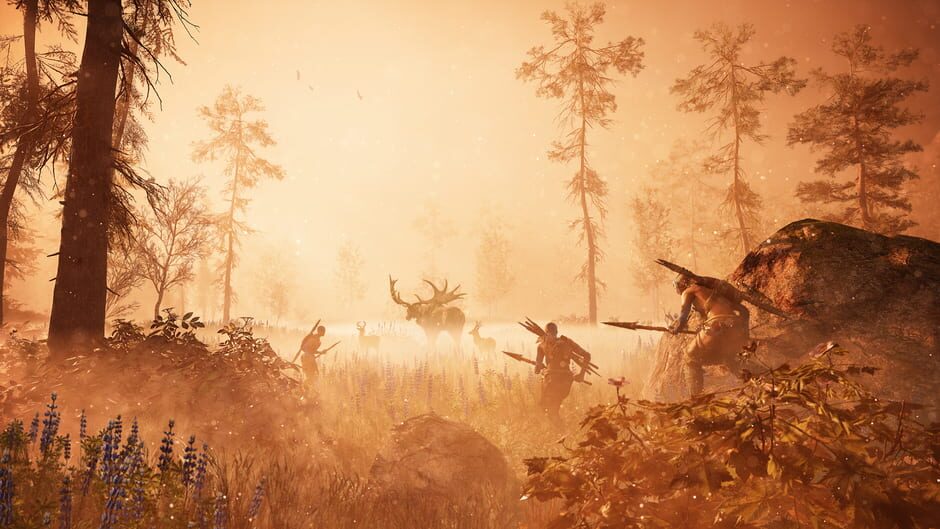
Far Cry Primal takes a risk that appears simple but is considerable for the series: removing firearms. There are no assault rifles, rocket launchers or motorized vehicles. Instead, the player uses clubs, bows, spears, traps and primitive projectiles crafted from wood, stone, bone and animal hides.
This absence immediately changes the relationship with danger. An animal only a few meters away is no longer a target that can be eliminated with a few bursts of gunfire. The player must judge the distance, prepare a spear, aim carefully or decide that avoiding the threat is the wiser choice. Encounters become more physical, particularly with clubs, while the bow preserves a silent and precise approach.
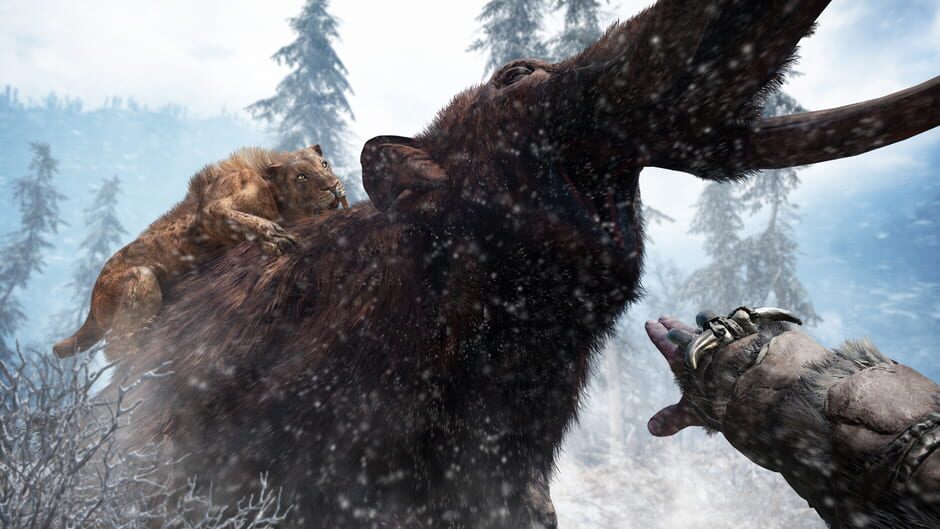
The world of Oros is built around this vulnerability. Forests, rivers, caves, swamps and mountains contain abundant wildlife that does far more than decorate the landscape. Wolves, bears, great cats and other predators can attack the player, pursue their own prey or suddenly enter the middle of a battle between tribes. Herbivores are equally important as sources of food, hides and materials.
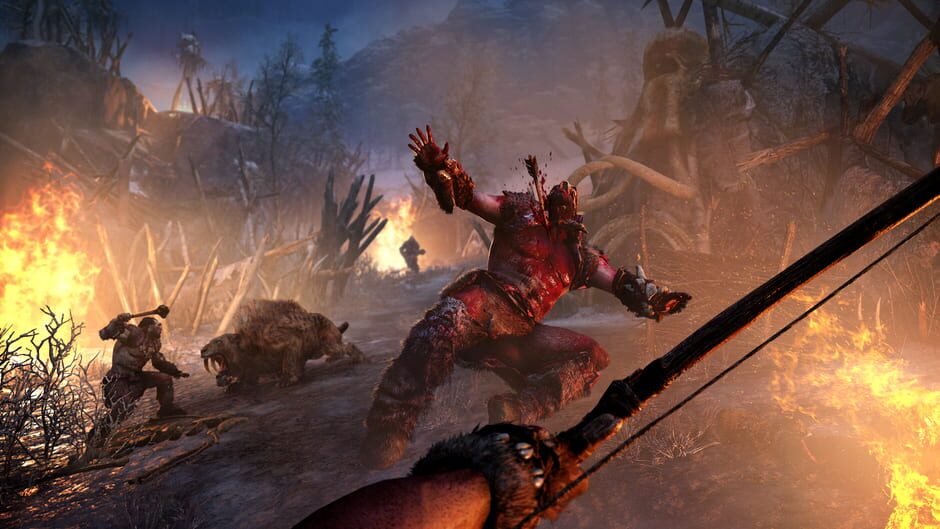
Night reinforces this feeling. Visibility drops, predators become more active and fire gains new importance. A torch is not merely a source of light: it can keep certain animals away, set vegetation ablaze or become a weapon itself. In a game where available technology is deliberately basic, mastering fire feels almost as important as obtaining a new weapon.
Takkar’s defining ability, however, is taming. Several predators can become companions and receive simple commands: follow a trail, attack a target or accompany the player during exploration. Not every species serves the same purpose. Some favor stealth, others strength or tracking, allowing the player to adapt their companion to the situation.
An owl complements this approach by serving as an aerial scout. It can observe an enemy camp from above, mark opponents and, after certain upgrades, intervene more directly. Primal therefore retains part of the tactical observation found in the modern entries, but translates it into its prehistoric setting without binoculars or drones.
Enemy camps and outposts also preserve the freedom of approach associated with Far Cry. Players can identify guards, advance quietly, order an animal to attack a target or launch a far more direct assault. The absence of automatic weapons therefore does not eliminate the series’ characteristic chaos: it simply changes the tools used to create it.
Takkar’s progression is closely tied to rebuilding the Wenja village. Finding certain characters and upgrading their huts grants access to new skills, recipes and possibilities. The development of the hero and his community therefore move forward together. The village gradually fills with inhabitants, giving tangible form to an objective that goes beyond simply gaining levels.
This reconstruction also distinguishes the story. Takkar is not only trying to eliminate two enemy leaders. His goal is to create enough security for the Wenja to live, hunt and pass on their knowledge. In a world where no institution yet protects individuals, survival depends directly on the ability to form a group.
The Udam and Izila give this struggle two different faces. The former represent particularly brutal physical strength and a people facing difficulties of their own. The latter possess an organization and practices that clearly distinguish them from the Wenja. These cultural differences are reinforced by languages created specifically for the game, avoiding the impression of prehistoric people simply speaking like modern characters dressed in animal skins.
Far Cry Primal obviously does not attempt to become a scientific reconstruction of prehistory. Oros deliberately combines different influences, animals and forms of human development in order to create a world that is immediately readable and spectacular. But this work allows the familiar formula of the series to function without making the Stone Age feel like nothing more than a visual layer placed over Far Cry 4.
What to remember
- A Far Cry game set entirely in the Stone Age, in 10,000 BCE, within the fictional valley of Oros.
- Takkar, a Wenja hunter who gradually reunites his people and becomes Beast Master.
- An arsenal without firearms, built around bows, spears, clubs, traps and items crafted from natural resources.
- A taming system that allows several predators to become hunting and combat companions.
- Wildlife directly integrated into survival, hunting and open-world encounters.
- A Wenja village that develops as specialists are found and the community becomes stronger.
- Two rival peoples, the Udam and the Izila, who threaten the Wenja’s attempts to settle in Oros.
Conclusion
The best idea in Far Cry Primal is ultimately not that it removed firearms. It is that it understood everything those firearms represented had to be replaced.
Where other entries give the player the power of a modern arsenal, Primal gradually gives them mastery over their environment. A piece of wood becomes a spear, a flame transforms a situation, and an animal once feared becomes a companion. The sense of increasing power therefore remains familiar while using a completely different vocabulary.
This transformation works particularly well during the opening hours, when crossing a forest at night or hearing a predator nearby is still enough to remind the player that Takkar is not automatically the most dangerous creature in Oros. As his abilities and companions develop, that relationship gradually reverses.
Some structures remain very recognizable to anyone familiar with the series: enemy camps, resource gathering, unlockable skills and territory to conquer. The prehistoric setting does not completely hide this legacy. But the absence of modern technology, the constant presence of animals and the role of the village are enough to change the rhythm and the way the world is perceived.
Takkar’s progression then tells a story consistent with the mechanics. He begins alone, with almost no resources, then learns to exploit what surrounds him, gathers other people and eventually transforms a hostile environment into habitable territory.
Far Cry Primal therefore builds its own version of the conquest central to the series. It is no longer simply about taking a map back from an enemy army. It is about earning a place in a world where humanity is still far from being the undisputed master.
Good to know
- Far Cry Primal was primarily developed by Ubisoft Montreal with contributions from other Ubisoft studios.
- The game was released on February 23, 2016, on PlayStation 4 and Xbox One, followed by PC on March 1, 2016.
- The adventure takes place in 10,000 BCE in the fictional valley of Oros.
- Takkar belongs to the Wenja people and gradually gains the ability to tame several species of predators.
- The two main rival peoples are the Udam, led by Ull, and the Izila, led by Batari.
- Ubisoft worked with specialists in prehistory and anthropologists to develop the different cultures represented in the game.
- The languages spoken by the tribes were developed with linguists from Proto-Indo-European rather than using a modern language.