Presentation
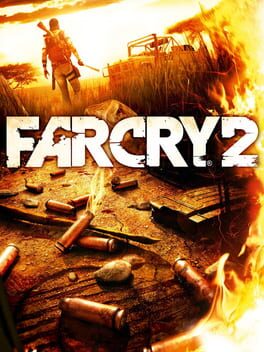
Developed by Ubisoft Montreal and published by Ubisoft, Far Cry 2 was released in 2008 for Windows, PlayStation 3 and Xbox 360. Clint Hocking served as Creative Director, Bertrand Hélias as Senior Producer, Louis-Pierre Pharand as Producer and Patrick Redding as Story Designer. Following Crytek's Far Cry, Ubisoft radically reshaped the franchise by abandoning the tropical archipelago and scientific experiments in favor of an open-world FPS built around a civil war.
The game takes place in a fictional African country whose government has collapsed. Two organizations dominate the conflict: the UFLL, United Front for Liberation and Labour, and the APR, Alliance for Popular Resistance. Their leaders employ mercenaries and compete for control of the territory while much of the civilian population simply attempts to escape.
Players take the role of a mercenary, selected from several characters at the beginning of the game. The other candidates do not disappear from the world: several can later be encountered and become buddies. This structure builds the character system around a collection of independent professionals rather than a single imposed protagonist.
The central mission is to find the Jackal, an arms dealer accused of supplying both factions. The investigation nevertheless advances by regularly working for both the UFLL and APR. Far Cry 2 does not present them as clearly opposed moral paths: the protagonist operates between two sides whose methods and interests often become difficult to distinguish.
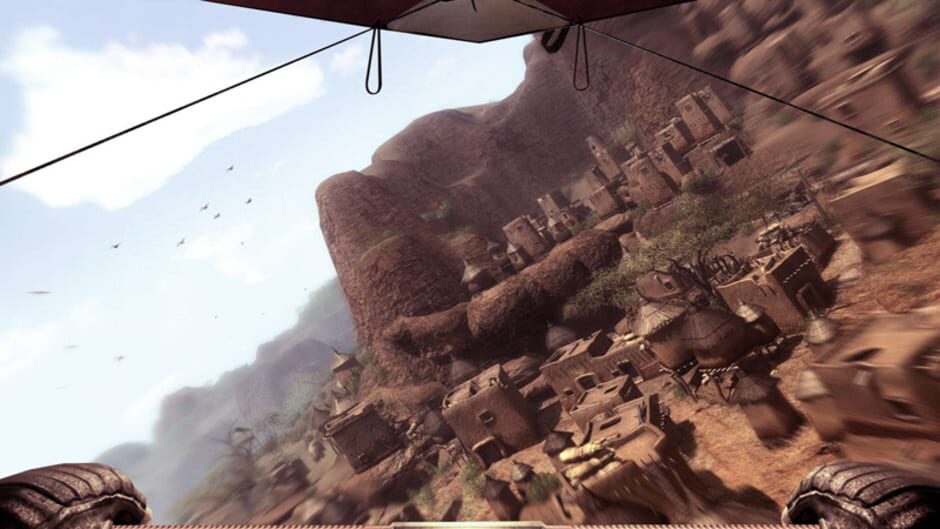
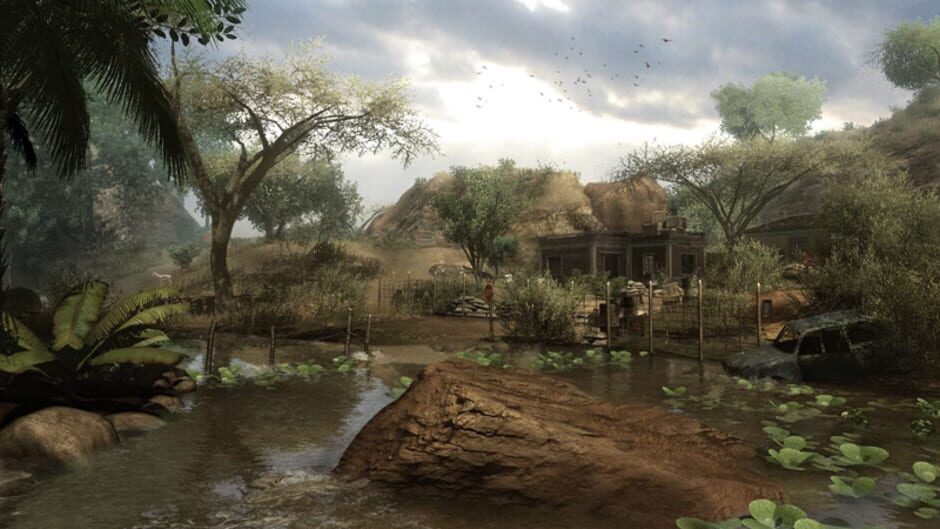
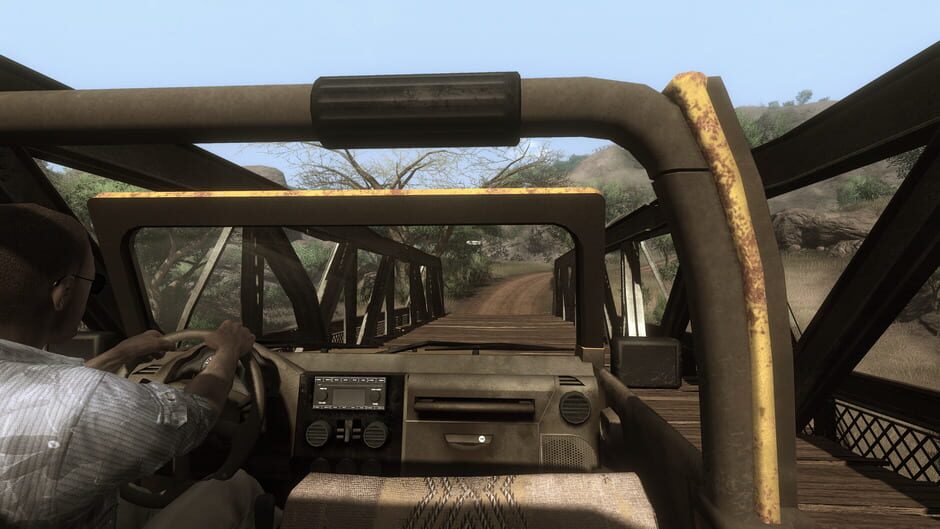
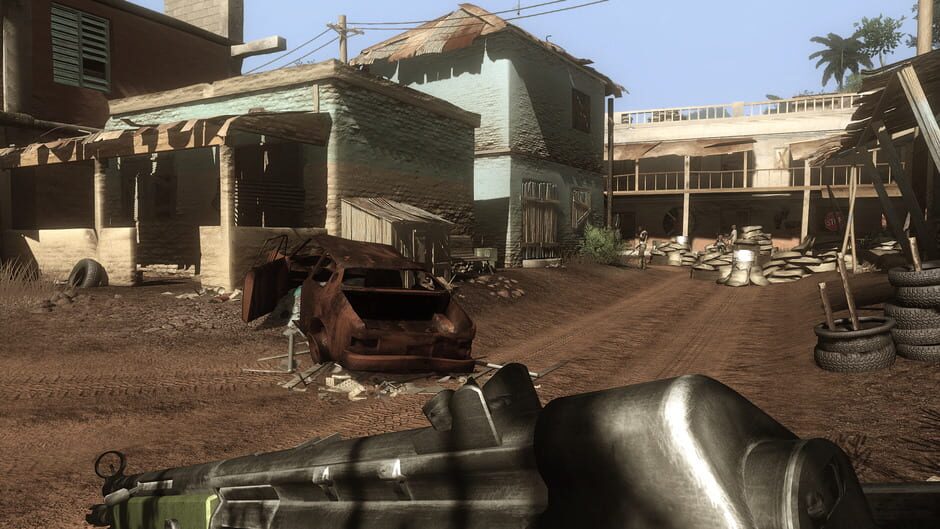
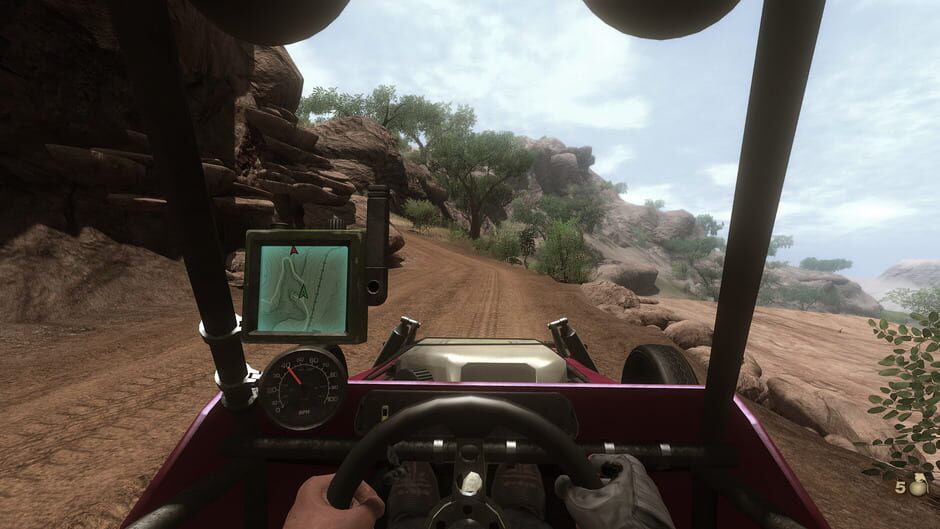
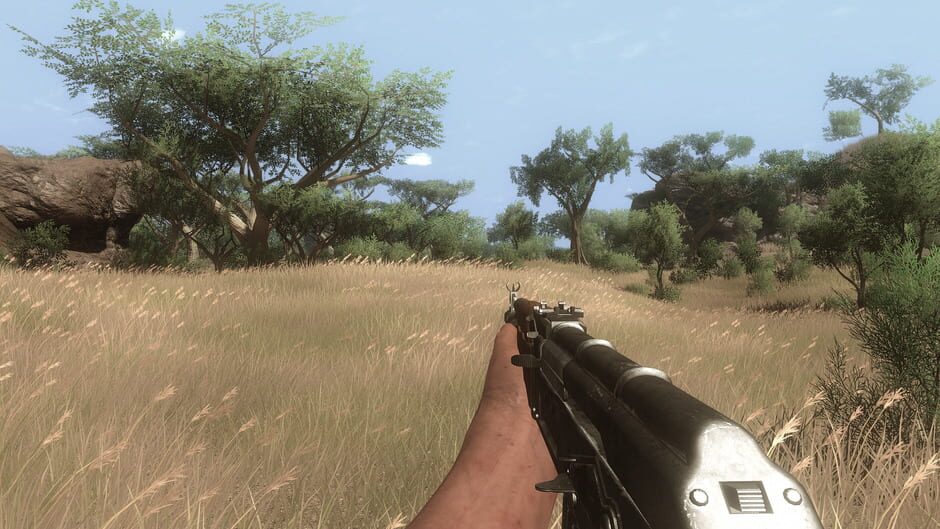
The open world is divided into two major regions connected during the campaign. Roads, savannas, wooded areas, settlements, rivers and desert landscapes can be explored freely on foot or using different land vehicles and boats. Buses also provide rapid travel between several terminals and reduce some of the longer journeys across the territory.
Combat uses a familiar FPS arsenal but adds a significant weapon reliability system. Guns picked up from enemies are often already worn: their appearance deteriorates, they can jam and may eventually become unusable. Purchasing new weapons provides more reliable equipment, while different manuals can improve particular characteristics.
Purchases use rough diamonds, the game's primary currency. They can be earned through certain missions or discovered inside briefcases hidden throughout the world. Weapon shops then allow guns, upgrades, ammunition capacity and other equipment to be unlocked and made available from their storage buildings.
Malaria also remains with the character throughout the campaign. Attacks can occur during exploration or combat and require medication. To replenish the supply, the mercenary must assist civilian networks and complete different tasks, integrating the illness into progression rather than restricting it to a single scripted event.
The buddy system provides another form of continuity. Mercenaries who have been rescued or encountered can offer side missions and alternative approaches to assignments. A buddy with a sufficiently developed relationship can also intervene when the player is incapacitated and allow the fight to continue.
Far Cry 2 gives particular importance to fire. Flames can spread through vegetation according to terrain and wind, create new routes or surround opponents. A Molotov cocktail or explosion can therefore start a blaze that progressively changes the organization of a battle and forces both the player and enemies to move.
This systemic approach also applies to travel and injuries. Vehicles can be damaged and sometimes need to be repaired directly in the field, while severe wounds trigger animations in which the protagonist removes bullets, resets limbs or treats injuries. The HUD remains relatively restrained so that information is often communicated through weapons, the map, the watch and the character's physical actions.
Far Cry 2 finally runs on the Dunia Engine, derived from technological work surrounding CryEngine but extensively developed by Ubisoft Montreal for the project. Day-night cycles, weather, vegetation, spreading fire and large environments contribute to a world whose systems continue operating around the player rather than functioning only as scenery.
What to remember
- An open world set in a fictional African country during a civil war, dominated by the rival UFLL and APR factions.
- The hunt for the Jackal, an arms dealer supplying both sides, forcing the mercenary to work with organizations whose interests gradually become difficult to separate.
- A collection of physical and survival systems including malaria, injuries, weapon degradation and jamming, vehicle repairs and a day-night cycle.
- Dynamic fire capable of spreading through vegetation according to environmental conditions and wind, directly changing movement and combat.
- Mercenary buddies who can offer missions, alter certain objectives and intervene to rescue the player when the relationship permits.
- Progression based on rough diamonds, weapon shops, new firearms and equipment upgrades rather than the skill trees used by later installments.
Conclusion
Far Cry 2 breaks sharply with the first game while preserving its interest in large spaces and freedom of approach. Ubisoft Montreal turns that principle into a true open world where missions, travel and combat are connected by the same underlying systems.
Weapon degradation, malaria and injuries give the player an unusual level of vulnerability for a first-person shooter. These mechanics can interrupt carefully prepared plans, but more importantly they reinforce the idea that neither equipment nor situations ever remain completely under control.
Fire represents this philosophy particularly well. It can provide an immediate tactical solution and then become a problem when it spreads in an unexpected direction. Vehicles, patrols, vegetation and weapons similarly produce situations that regularly exceed the intended course of a mission.
Factions and buddies add a human dimension to these systems. The mercenary works for different actors without forming a straightforward alliance, while relationships with other fighters can change certain assignments and the character's chances of survival. The civil war appears less as a clearly defined confrontation than as an environment in which everyone is attempting to protect their own interests.
Far Cry 2 therefore establishes several principles that would influence the series for years while remaining very different from its successors. Open worlds, vehicles and freedom of approach would remain, but its emphasis on friction, unpredictability and player vulnerability still gives it a distinctive identity within the franchise.
Good to know
- Far Cry 2 was developed by Ubisoft Montreal and published by Ubisoft for Windows, PlayStation 3 and Xbox 360.
- Clint Hocking is credited as Creative Director, Bertrand Hélias as Senior Producer, Louis-Pierre Pharand as Producer and Patrick Redding as Story Designer.
- Ubisoft's current pages list the release as October 22, 2008; the commercial rollout took place on October 21 in North America and October 24 in Europe depending on territory.
- The story primarily involves the UFLL and APR, two factions that offer the player contracts while the search for the Jackal continues.
- Weapons have a genuine degradation and jamming system, while malaria can trigger attacks requiring medication.
- Far Cry 2 uses the Dunia Engine and notably features dynamic fire propagation affected by its environment.
- Ubisoft currently states that multiplayer and online features are no longer available for Far Cry 2.