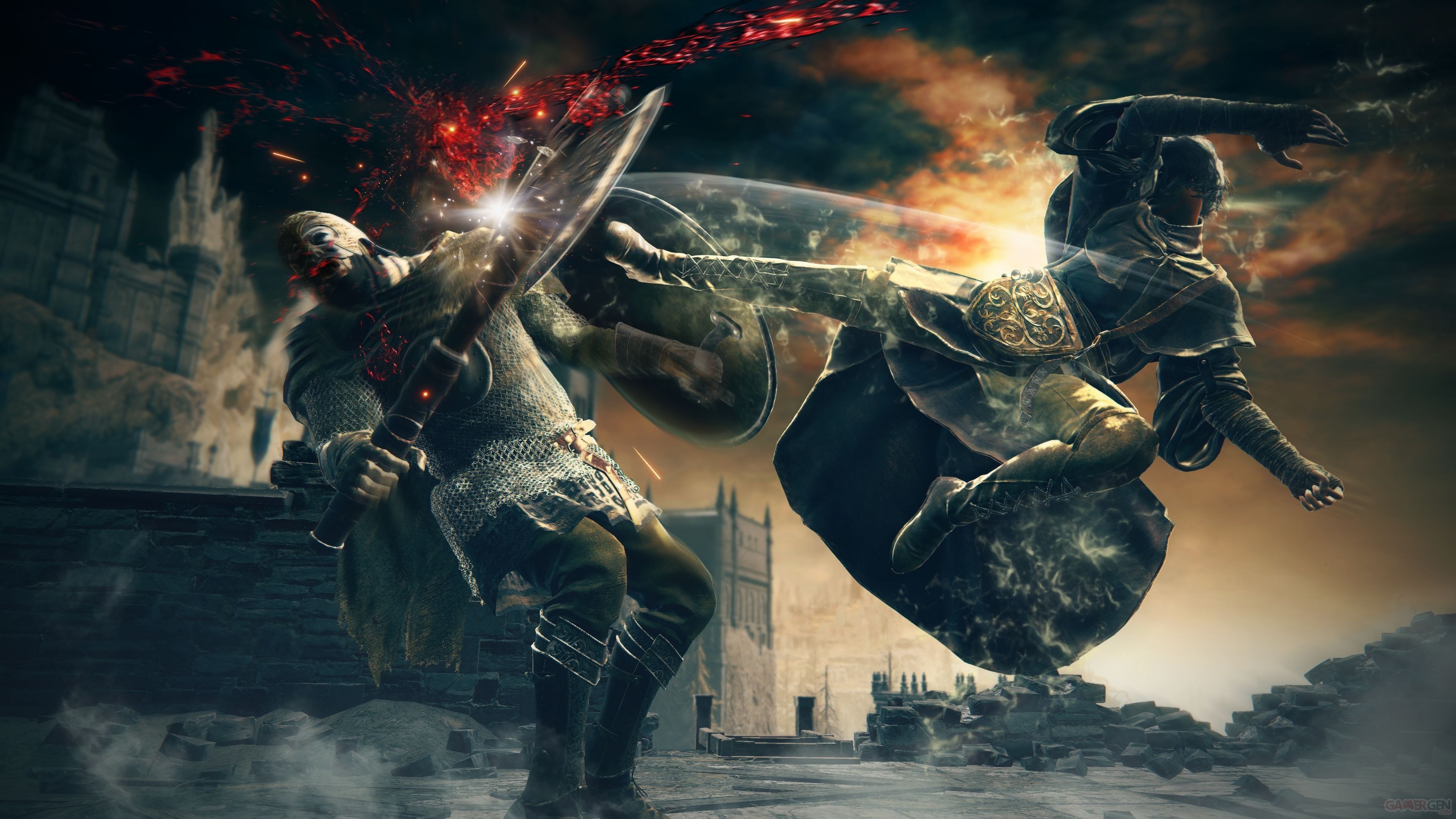
Synopsis
After journeying through the Lands Between, the Tarnished discovers a new trail connected to Miquella, one of the most enigmatic Empyreans in Elden Ring.
The demigod has left the Lands Between for a territory separated from the known world: the Realm of Shadow. Marika is said to have once set foot there, and the traces of an ancient war remain visible despite the efforts of official history to bury them. That war notably bears the mark of Messmer the Impaler, a figure surrounded by flame, violence and secrets closely tied to the origins of the Golden Order.
Miquella entered this realm while gradually abandoning what defined him: his body, his strength, his heritage and several signs of his divine nature. The Tarnished decides to follow his path, but is not alone. Several followers of Miquella are also traveling through these lands, each drawn to the Empyrean for different reasons, somewhere between faith, admiration, the search for answers and more ambiguous motives.
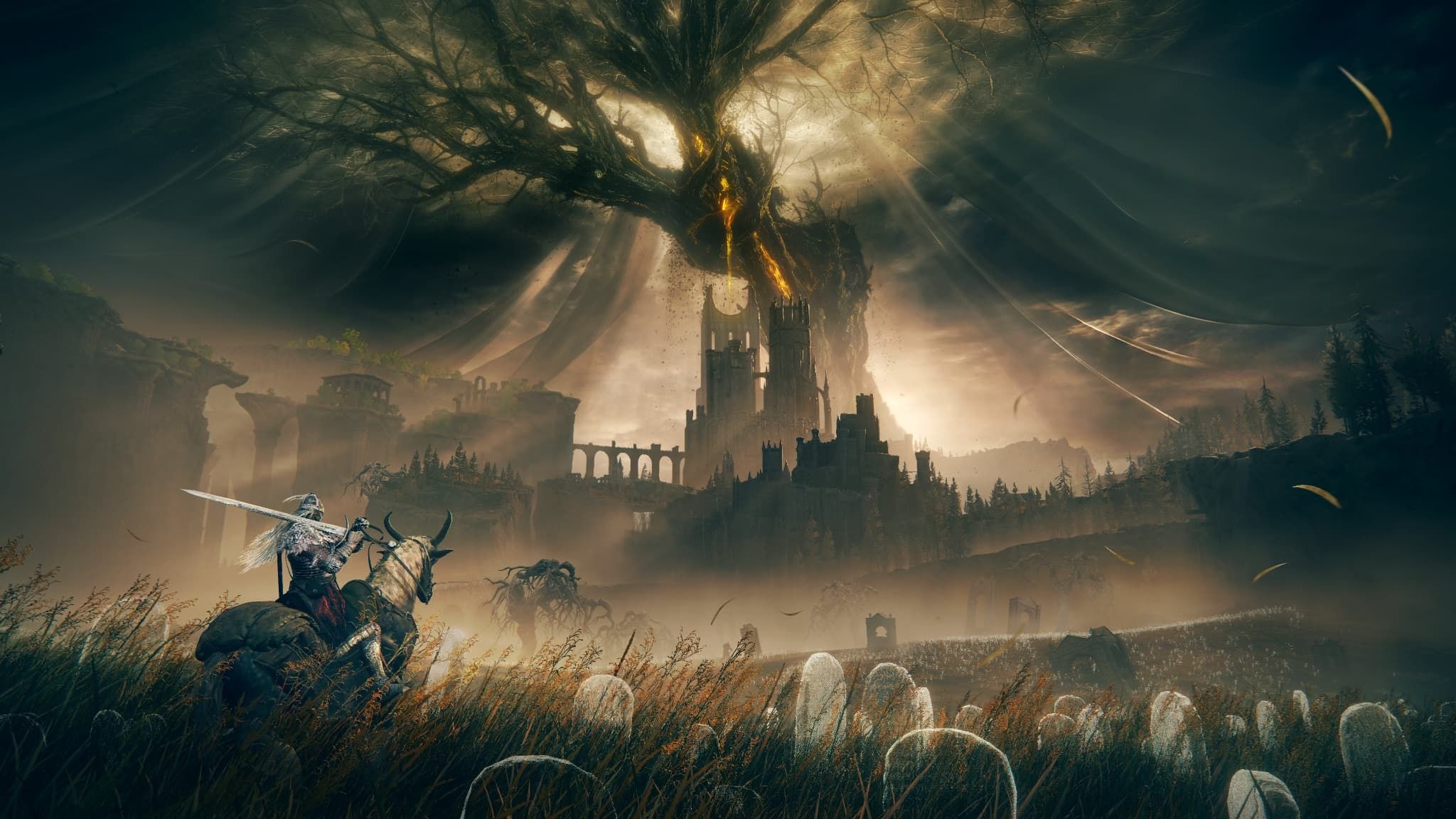
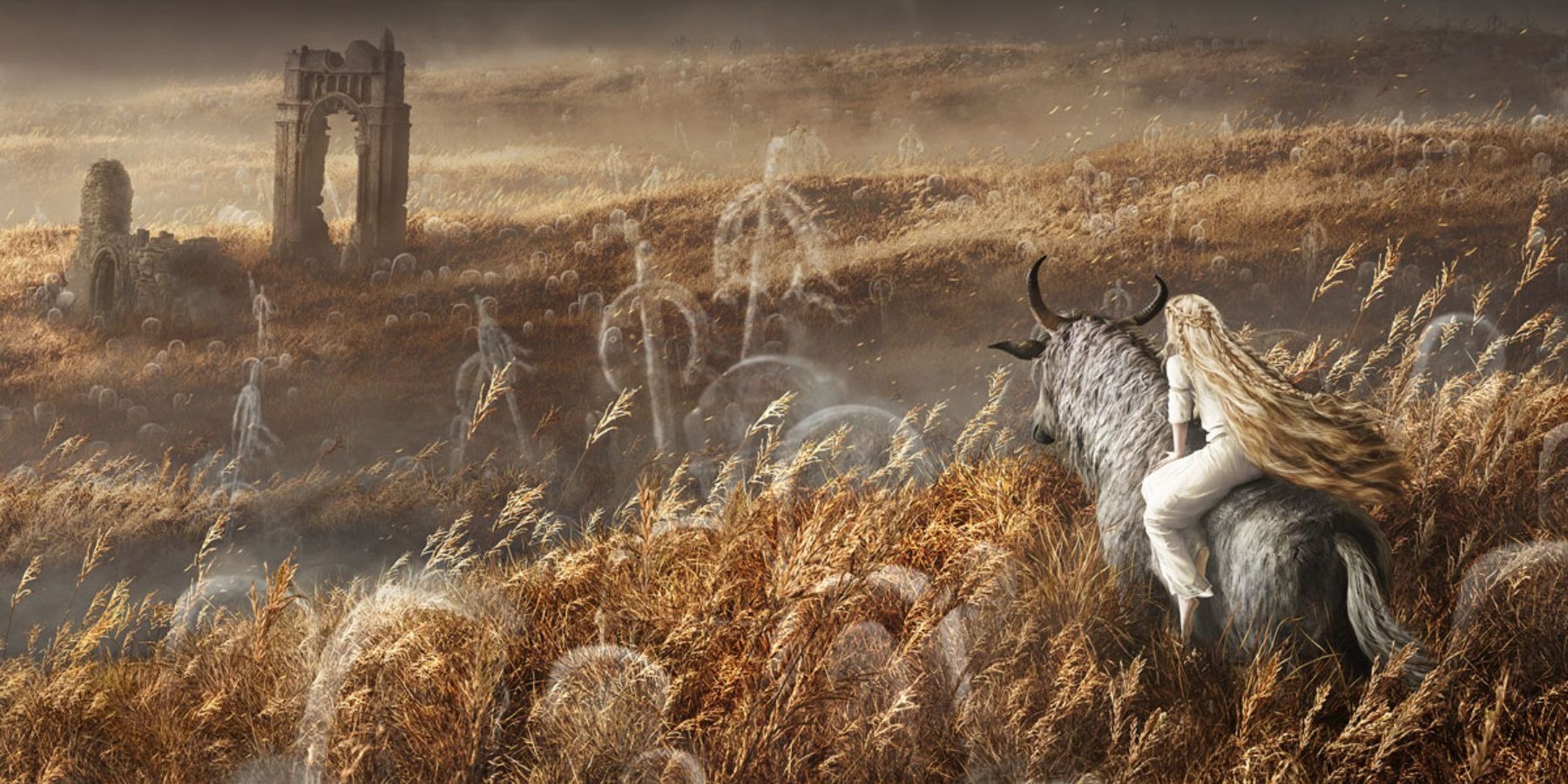
The journey crosses plains covered in graves, monumental fortresses, abandoned villages, unsettling forests and ruins deeply connected to the past of the Lands Between. As the traces of Miquella accumulate, the question gradually changes.
Shadow of the Erdtree is no longer only asking where Miquella went. It is increasingly interested in what had to be hidden for the Lands Between to become the world we know.
Overview
An open world folded in on itself
Elden Ring felt like discovering a continent. Shadow of the Erdtree sometimes feels like discovering what had been buried underneath it.
FromSoftware is not simply trying to reproduce the structure of the original game in a new region. The Realm of Shadow keeps Elden Ring's fundamental principles of exploration, but compresses and layers them. Distances can feel shorter while verticality becomes far more important.
A cliff seen from a plain may hide an entire region hundreds of meters below. An apparently minor path can circle a mountain, pass through a cave and emerge somewhere that has been visible for hours without revealing how to reach it. The map represents the territory accurately, but it does not immediately reveal all of its layers.
This structure gives observation far more importance. A tower, bridge, valley or stretch of land seen in the distance is no longer merely scenery: it becomes a question posed to the player. Can that place actually be reached? And if so, how?
The answer is often yes, but rarely by the most obvious route.
Progression specific to the Realm of Shadow
The new region also has its own progression system. Arriving with an extremely powerful character from the base game does not necessarily make the adventure comfortable.
Scadutree Fragments increase the corresponding blessing, improving the character's damage output and resistance within the Realm of Shadow. Revered Spirit Ashes strengthen summons in a similar way.
The system effectively creates a second progression track alongside traditional character levels. A highly advanced character with an almost fully upgraded weapon can therefore discover that their accomplishments in the Lands Between do not solve everything. Exploration once again becomes directly connected to power: finding another fragment can have a tangible effect on the difficulty of upcoming encounters.
This allows FromSoftware to preserve a sense of discovery and progression even for players who have already spent dozens or hundreds of hours with the main game.
New weapons for new habits
Shadow of the Erdtree adds a large number of weapons, skills, spells, armor sets and Ashes of War, but the interest is not purely quantitative.
Several new weapon categories open playstyles that feel noticeably different from those available in the base game. Martial arts, backhand blades, great katanas, perfumes used as actual weapons and shields capable of taking on a more offensive role all meaningfully expand build possibilities.
At times, the expansion feels as though FromSoftware is using this new territory to explore combat ideas that never found a place in Elden Ring. The result remains instantly recognizable while still being different enough to encourage even an established character to reconsider their equipment.
An expansion that no longer teaches Elden Ring
The fundamental loop remains unchanged: explore, observe, fight, fail, understand and return better prepared. The difference is that Shadow of the Erdtree barely needs to introduce these rules anymore.
The game assumes its audience already understands Sites of Grace, flasks, summons, status effects, builds and the way FromSoftware bosses punish reactions that come too early.
The expansion therefore does not reteach Elden Ring's language. It immediately starts playing with its grammar.
Key takeaways
- Shadow of the Erdtree is an expansion for Elden Ring. The base game is required to access it.
- The adventure takes place in the Realm of Shadow, a territory distinct from the Lands Between and deeply connected to the past of Marika, Miquella and the Golden Order.
- Miquella provides the narrative thread. The player follows the traces left by the Empyrean and encounters several characters engaged in the same search.
- Messmer the Impaler plays an important role in the history of the region. His presence is notably connected to an ancient war left outside the dominant history of the Lands Between.
- Exploration is more vertical and condensed than in the main game. Several regions overlap, and some routes are difficult to infer from the map alone.
- The Realm of Shadow has its own progression. Scadutree Fragments and Revered Spirit Ashes strengthen the player and certain summons respectively.
- New equipment substantially expands build possibilities. Weapons, weapon categories, spells, skills, armor and Ashes of War extend the existing systems.
- The difficulty remains high, even for advanced characters. Exploration and the blessings specific to the expansion quickly become important.
- Elden Ring's single-player and multiplayer features remain available, including co-op and invasion systems.
PANACHES review
When geography becomes a puzzle
Shadow of the Erdtree sometimes feels less like a conventional expansion than a new experiment in how one world can be hidden inside another.
Elden Ring had already transformed the traditional exploration of the Souls games into a true open world. The risk was therefore obvious: create a second map, add more bosses and regions, and assume that scale alone would be enough to renew the experience.
FromSoftware chooses a more interesting direction. The Realm of Shadow is not merely denser; it is more thoroughly folded in on itself. Areas overlap, wrap around one another and sometimes connect through passages discovered long after the player has given up on finding a route.
This architecture regularly turns geography itself into a problem to solve. A road seen from a plateau, a distant castle or a valley far below becomes something to investigate, not by following a marker but by reading the terrain and trying to understand how its pieces connect. Sometimes the reward arrives before the chest or battle: simply discovering how to reach a location that has been visible for several hours is satisfying in itself.
The drawback is equally obvious. FromSoftware can hide its routes with enough enthusiasm to turn curiosity into wandering. Some destinations appear almost reachable even though the actual entrance requires a considerable detour, perhaps through a cave or path located far from the place the player is trying to reach.
The game loves letting players discover things for themselves. It is considerably less interested in explaining how to get there.
What the shadow is really hiding
This philosophy of secrecy also shapes the story. Miquella is everywhere without constantly being present on screen. His crosses mark his path, characters speak about him and each person projects a different mixture of hope, loyalty or doubt onto the Empyrean.
The portrait grows more complicated because Shadow of the Erdtree is not simply trying to add another antagonist to Elden Ring. The expansion returns to questions the base game had already left partially exposed: Marika, the Golden Order, the origins of certain acts of violence and, above all, the people or events that dominant history had pushed outside the frame.
The title therefore becomes more interesting than a simple change in atmosphere. The shadow also represents what the world chose not to look at.
The Lands Between were already a realm built upon ruins and contradictory versions of the past. The Realm of Shadow reveals additional layers needed to understand what was sacrificed, erased or displaced in order to produce that official history.
As usual with FromSoftware, very little is explained directly. Items, ruins, enemies and landscapes contribute to the story as much as dialogue does. The player reconstructs, interprets and accepts that some conclusions remain uncertain.
This approach is fascinating when several clues eventually connect. It can also become frustrating when an important piece of information depends on an easily missed item description or a visual detail subtle enough to sustain months of debate.
But that is also part of what keeps this world alive long after the adventure ends.
Combat designed for players who already know the game
Shadow of the Erdtree follows a base game that had already pushed character-building possibilities extremely far. By the time the player enters the Realm of Shadow, they may have access to dozens of weapons, spells, summons, status effects and synergies capable of producing enormous damage.
The new enemies therefore have to respond to that power if they are going to remain threatening.
Bosses are often faster and more aggressive, with longer attack chains. Delayed attacks continue to manipulate habits built over the course of Elden Ring: some animations begin early enough to provoke an immediate dodge, only for the actual impact to arrive after the player has already spent their defensive movement.
This design can be extremely satisfying once an encounter finally makes sense. What initially looked chaotic becomes readable: a posture, a shoulder movement, a sound, a flash of light or a pause gradually forms a recognizable rhythm.
It remains one of FromSoftware's most consistent strengths: changing the player's perception without changing the enemy. The boss is exactly the same; what has changed is our understanding.
The philosophy does occasionally reach its limits. The general escalation in power pushes certain encounters toward a level of aggression where openings become scarce and finding permission for a single attack can feel like a negotiation.
The base game gave the player an enormous number of tools. The expansion responds by giving bosses an enormous number of tools as well. In its best encounters, this escalation creates remarkable tension. In others, it can push learning dangerously close to frustration.
Blessings: putting exploration back at the center
The Scadutree Blessing system is largely FromSoftware's answer to the problem of designing an expansion for characters who may already be extremely advanced.
The idea is coherent: a player who has accumulated dozens of additional levels in Elden Ring cannot simply turn the Realm of Shadow into a sightseeing tour. Everyone has to explore in order to regain a new margin of progression.
This gives the territory real mechanical value. Searching for a route, discovering a side area or following a road away from the main objective may lead to a Scadutree Fragment and therefore make future encounters more manageable.
The system nevertheless creates an interesting tension. Shadow of the Erdtree preserves Elden Ring's freedom, but more directly reminds the player that some of that freedom depends on the strength gained through exploration. You can go almost anywhere, but certain battles very clearly suggest that you may want to go somewhere else first.
This is not foreign to the base game, but the difference can be significant enough to make traditional character progression feel temporarily less important than progression specific to the expansion. The balance adjustments released after launch also show that FromSoftware continued to refine this system.
The underlying idea remains strong because it once again connects discovery and progression. The world is not simply scenery placed between bosses; it becomes a direct part of preparation.
A territory built through silhouettes
The Realm of Shadow also has an exceptionally strong visual identity. FromSoftware continues to mix the grotesque and the sublime, but does so here with almost constant concentration: black fortresses, colored plains, flowers, submerged ruins, mist-covered forests, dead trees and monumental structures create a territory that regularly changes atmosphere without losing coherence.
One of the studio's greatest strengths remains its ability to build horizons. A castle, mountain, tower or tree visible from miles away can give the player direction before the map or interface ever needs to intervene.
This work with silhouettes explains part of why exploration remains so effective. The environment creates the desire to move forward before explaining what will be found there. It does not merely contain content; it creates the desire to search for it.
Some regions are nevertheless less rich than they appear. A large area can look spectacular before revealing relatively few activities, some enemies are reused and not every reward feels proportionate to the detour required to obtain it.
These weaknesses do not erase the strength of the world, but they do show that visual density and gameplay density are not always perfectly aligned.
An expansion that feels as though it was always there
One of Shadow of the Erdtree's strangest strengths is how naturally it fits into the existing narrative. Despite releasing two years after Elden Ring, the Realm of Shadow sometimes feels less like an addition than a revelation.
Much of that feeling comes from the way the expansion works with questions that already existed in the original game. It does not create an isolated parallel universe; it returns to Marika, the Golden Order, Miquella and several mysteries old enough for this new territory to feel as though it had always existed somewhere behind the known story.
The fragmented storytelling strengthens that effect. As in Elden Ring, the answers are not neatly gathered inside a single scene. The player has to read, observe and connect scattered elements, then accept that some interpretations remain open to debate.
This also explains why the ecosystem around the game immediately comes back to life with every new discovery. An item description, statue or architectural detail can trigger new interpretations months after release.
Shadow of the Erdtree therefore does not entirely end when the player leaves the Realm of Shadow. Part of the experience continues in the way the community reconstructs what it has seen.
What you learn matters more than the number on the screen
FromSoftware's strongest memories are often created very close to frustration. Shadow of the Erdtree is no exception.
A difficult fight can feel excessive before gradually becoming understandable. An impossible-to-find route can produce a long period of wandering before revealing a path that seems perfectly logical once discovered. A region that appeared inaccessible becomes familiar after the player learns how it connects to the rest of the map.
In all these cases, the reward is not limited to runes, items or levels. It comes from knowledge gained.
Every shortcut understood, boss animation recognized, system mastered or piece of the world recontextualized contributes to a form of progression that the character sheet cannot measure.
The player's true level is therefore never only the number displayed in the menu. It also includes everything they now understand about the game.
That may be the best way to understand Shadow of the Erdtree. The expansion does not treat the dozens of hours already spent in Elden Ring as a problem to work around. It uses them as a starting point.
It assumes the player already knows the rules and simply asks how much further they can still be pushed.
Two years after a world that already felt enormous, FromSoftware therefore achieves something more difficult than adding another region: it makes the player believe, once again, that they do not quite know where they are going.
Good to know
Access and progression
- Elden Ring: Shadow of the Erdtree was released on June 21, 2024 for PlayStation 5, PlayStation 4, Xbox Series X|S, Xbox One and PC.
- The expansion was developed by FromSoftware and published by Bandai Namco Entertainment.
- The base game Elden Ring is required to use Shadow of the Erdtree.
- To access the Realm of Shadow, the player must have defeated Starscourge Radahn and Mohg, Lord of Blood in their save.
- After defeating Mohg, access is obtained by interacting with the arm protruding from Miquella's cocoon in Mohgwyn Dynasty Mausoleum.
- Once a Site of Grace has been activated in the Realm of Shadow, the player can fast-travel between this territory and the Lands Between.
- Two systems specific to the expansion govern progression: the Scadutree Blessing and Revered Spirit Ash Blessing.
- Scadutree Fragments notably increase the character's attack power and damage negation within the Realm of Shadow.
- Revered Spirit Ashes primarily strengthen the offensive and defensive capabilities of summoned spirits.
- These expansion-specific blessings do not apply when the player returns to the Lands Between.
Content and balancing
- Shadow of the Erdtree adds new equipment, weapons, weapon categories, skills, spells and Ashes of War, along with new enemies and bosses.
- FromSoftware released several balance updates after launch.
- Calibration update 1.12.2 notably strengthened the effectiveness of the early levels of the Scadutree Blessing.
- Patch 1.14, released in September 2024, modified certain behaviors, damage values, ranges and visual effects associated with the expansion's final boss.
- Elden Ring continued to receive support after the DLC's release; version 1.16.1, published in August 2025, is the latest patch note listed on Bandai Namco's official site as of the verification date.
Sales and editions
- Shadow of the Erdtree surpassed 5 million units sold within three days of release.
- In July 2025, Bandai Namco announced that the expansion had surpassed 10 million units worldwide.
- ELDEN RING Tarnished Edition is scheduled for Nintendo Switch 2 on August 28, 2026 and will include both the base game and Shadow of the Erdtree.
- Nintendo Switch 2 does not appear in the
plateformesfield because PANACHES' current taxonomy does not yet contain anintendo-switch-2value. - Tarnished Edition remains a new edition of Elden Ring incorporating existing content. It therefore does not turn Shadow of the Erdtree into a new work or a new expansion, and the entry retains
statut_parution: completed.