Presentation
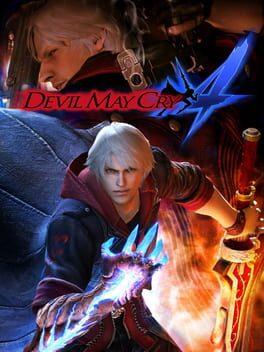
Developed and published by Capcom, Devil May Cry 4 was released in 2008 under the direction of Hideaki Itsuno, with Hiroyuki Kobayashi serving as producer. After three installments primarily centered on Dante, the game introduces Nero as a new protagonist and uses this transition to provide a different approach to the combat system that defines the series.
The game takes place mainly in Fortuna, a city controlled by the Order of the Sword. This religious organization worships Sparda as a god and claims to continue his legacy by fighting demons. The setting allows Capcom to explore the influence left by the father of Dante and Vergil beyond characters directly connected to his family.
Nero has three primary tools. The Red Queen is a sword equipped with a mechanism that can temporarily increase its power, while the Blue Rose is a double-barreled revolver used for ranged attacks. His supernatural right arm, the Devil Bringer, is nevertheless the major new component of his gameplay.
The Devil Bringer allows Nero to grab enemies, pull them toward him or throw certain creatures away. Its behavior changes depending on the opponent, and several bosses feature specific interactions with the ability. The arm can also use grapple points to pull Nero toward certain positions during exploration or combat.
The Red Queen has its own Exceed system. By revving its mechanism like a motorcycle throttle, players can charge the sword and strengthen subsequent attacks. Perfectly timing the action with certain strikes allows a much faster offensive rhythm and becomes one of the main elements of mastering Nero.
Nero also gains access to Devil Trigger, temporarily increasing his abilities and modifying several attacks. As in previous installments, the transformation depends on a limited gauge that primarily recharges during combat and must be used at the appropriate moment.
The second part of the adventure allows players to control Dante. His mechanics remain closer to Devil May Cry 3 but become considerably more flexible through the ability to change styles directly during combat. Trickster, Swordmaster, Gunslinger and Royalguard can therefore be selected instantly according to the situation.
Dante also carries several melee and ranged weapons, including Rebellion, Ebony & Ivory, Gilgamesh, Lucifer and Pandora. The ability to combine weapons and styles without interrupting the action gives his combat system considerable depth, although it requires more mastery than Nero's initially more direct approach.
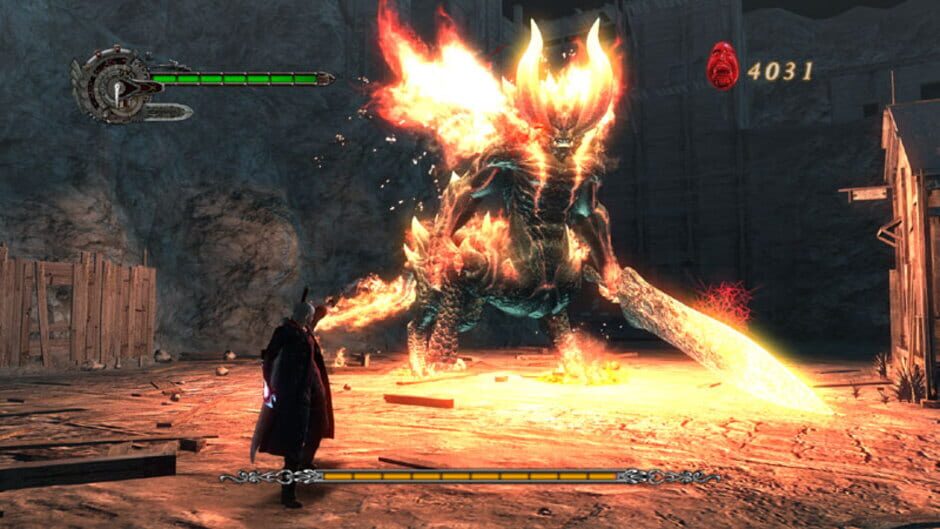
Combat continues to be evaluated through Devil May Cry's characteristic Stylish Rank system. Varying attacks, avoiding damage and maintaining combos increases the ranking, while constantly repeating the same actions restricts progress. The game therefore encourages experimentation with the full moveset rather than focusing exclusively on immediate efficiency.
Progression notably uses Proud Souls to acquire new techniques and red orbs to obtain different items or upgrades. Players can gradually expand Nero and Dante's capabilities while experimenting with them in previously completed missions and higher difficulty levels.
Devil May Cry 4 retains a mission-based structure with performance rankings, encounters against groups of enemies, light puzzles and boss battles. Some of the environments initially crossed by Nero are later revisited with Dante, but the differences between their combat systems give these locations a different rhythm.
The game also marks the series' transition to high-definition consoles and uses Capcom's MT Framework engine. The PlayStation 3 and Xbox 360 versions target 60 frames per second to preserve the responsiveness required for combos, while the Windows version later introduces additional technical options.
What to remember
- The introduction of Nero, a new protagonist equipped with the Red Queen, Blue Rose and especially the Devil Bringer.
- The Devil Bringer, capable of pulling, grabbing or throwing enemies and also used during certain traversal sequences.
- The Red Queen's Exceed system, rewarding precise timing by strengthening attacks and accelerating offensive combinations.
- The return of Dante as a playable character, with instant switching between Trickster, Swordmaster, Gunslinger and Royalguard.
- Fortuna and the Order of the Sword as the new narrative setting, built around the worship of Sparda and the organization's secrets.
- A combat system still centered on style, combo variety and technical mastery, with two characters offering clearly different approaches.
Conclusion
Devil May Cry 4 succeeds primarily in its transition between Dante and Nero by avoiding turning the new protagonist into a simple copy of his predecessor. The Devil Bringer and Exceed immediately give Nero his own rhythm, built around pulling enemies into range and precisely controlling his sword.
Dante represents almost the opposite approach. Real-time style switching and a larger arsenal provide an enormous number of combinations but require players to understand several systems simultaneously. The two characters therefore cover different levels of complexity without changing the fundamental principles of Devil May Cry.
The ranking system reinforces this philosophy. Simply defeating an enemy is not enough to define a successful encounter: varying techniques, controlling space and maintaining a combo become objectives in themselves. The same battles therefore change considerably as players gain greater command of the available moves.
Fortuna also expands the universe beyond adventures focused directly on Dante. The Order of the Sword, its worship of Sparda and Nero's introduction establish new connections with the demonic legacy at the center of the franchise while preparing several elements that later installments would develop further.
By combining an accessible but technical new protagonist with a particularly flexible version of Dante, Devil May Cry 4 establishes an important foundation for the future of the series. Several of its ideas, particularly Nero's mechanics and Dante's instant style switching, would become central to the evolution of Devil May Cry's combat system.
Good to know
- Devil May Cry 4 was developed and published by Capcom, with Hideaki Itsuno as director and Hiroyuki Kobayashi as producer.
- The game was released in 2008 for PlayStation 3 and Xbox 360, followed by Windows later the same year.
- It is the first main installment in the series to feature Nero as a playable protagonist, alongside Dante.
- The game uses Capcom's MT Framework engine, with the console versions designed around 60 frames-per-second action.
- Johnny Yong Bosch voices Nero in English, while Reuben Langdon returns as Dante.
- Devil May Cry 4: Special Edition was released in 2015 for PlayStation 4, Xbox One and Windows and notably adds Vergil, Lady and Trish as playable characters.
- The Special Edition also adds options such as Legendary Dark Knight Mode and Turbo Mode depending on the version, but the 2008 original remains the reference version for this entry.
```