Presentation
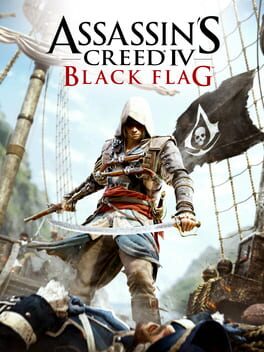
Assassin’s Creed IV: Black Flag begins by shifting the center of gravity of the series.
The city is no longer the only space connecting the missions.
The sea is.
The Caribbean becomes a vast territory made up of islands, ports, small settlements, jungles, forts and major cities such as Havana, Kingston and Nassau. Between them stretches a maritime world the player crosses directly aboard the Jackdaw.
This continuity profoundly changes the rhythm of the adventure.
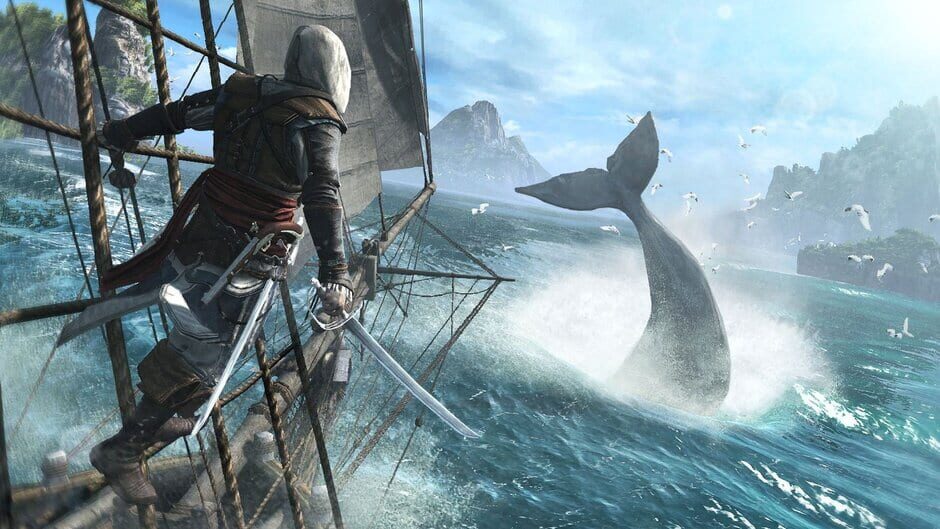
Edward can leave an island, return to his ship, take the helm and head toward an objective several kilometers away without navigation being reduced to an abstract transition. Along the way, a merchant vessel may appear, a far more dangerous frigate may cross his path, or a small island may tempt him to interrupt the journey.
The sea therefore becomes a space of decision.
The Jackdaw naturally stands at the heart of this new structure.
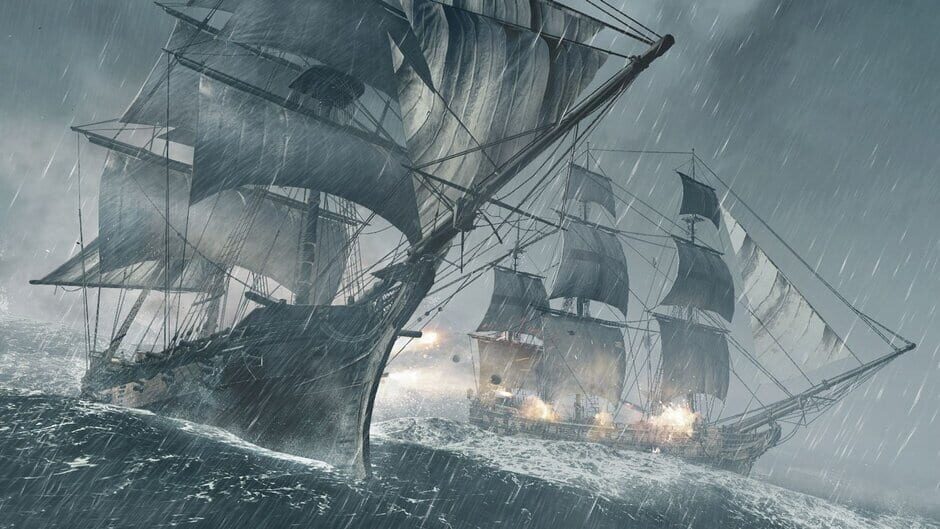
Edward can reinforce its hull, improve its weapons and increase different capabilities in order to gradually challenge more powerful vessels. Broadside cannons, precision shots, mortars and other weapons offer several ways to damage an enemy depending on its position.
Wind and waves contribute to the feeling of sailing, but the system primarily aims to remain immediately readable. The ship must be positioned correctly, shots timed well, and its own broadside kept from being exposed at the wrong moment.
A battle does not necessarily end once the enemy ship has taken enough damage.
Edward can board it.
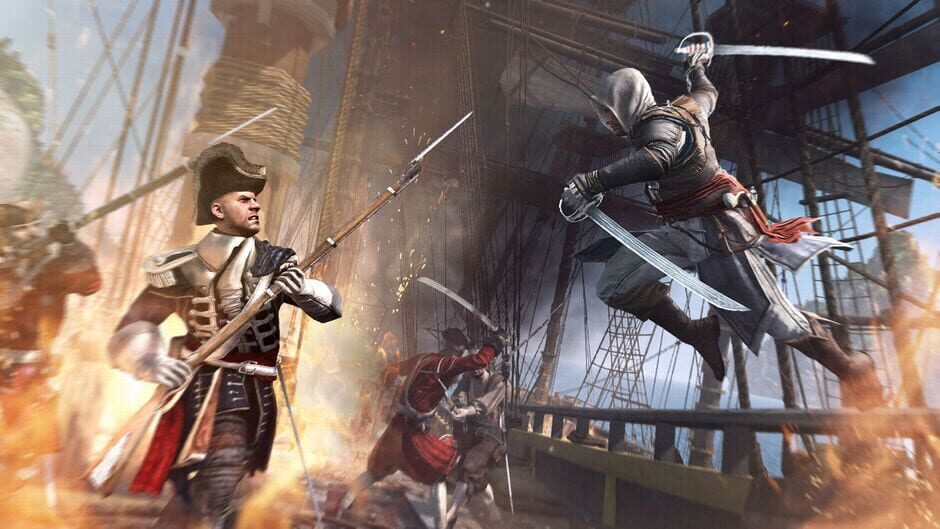
The Jackdaw then pulls alongside the opposing vessel and its crew attacks. The player leaves the helm, sometimes swings across to the enemy deck and joins the fighting directly until the opposing crew surrenders.
The loot recovered is used in particular to improve the Jackdaw.
This loop gives progression a distinctive coherence: attacking ships provides the resources needed to strengthen Edward’s own vessel, which then opens the possibility of taking on more dangerous targets.
Black Flag thus transforms a system that was still relatively separate in Assassin’s Creed III into one of its central mechanics.
Sailing does not, however, replace the Assassin gameplay.
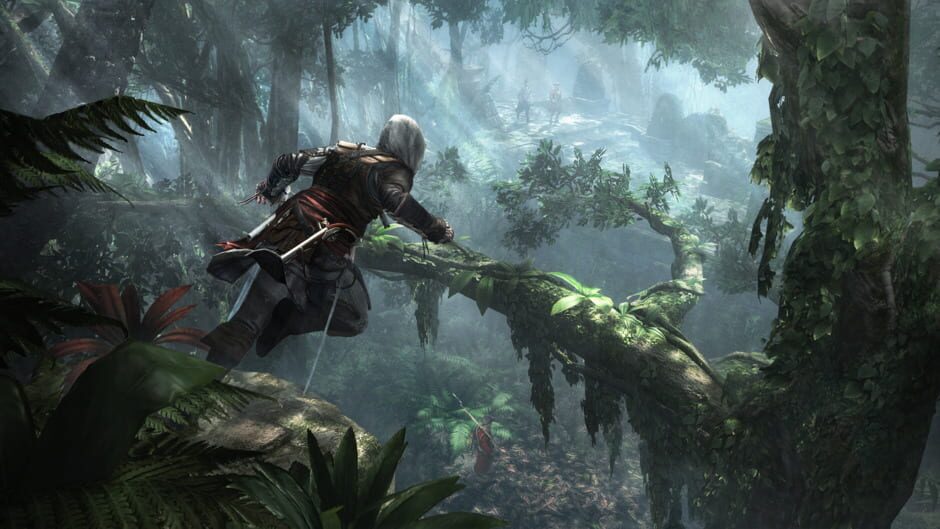
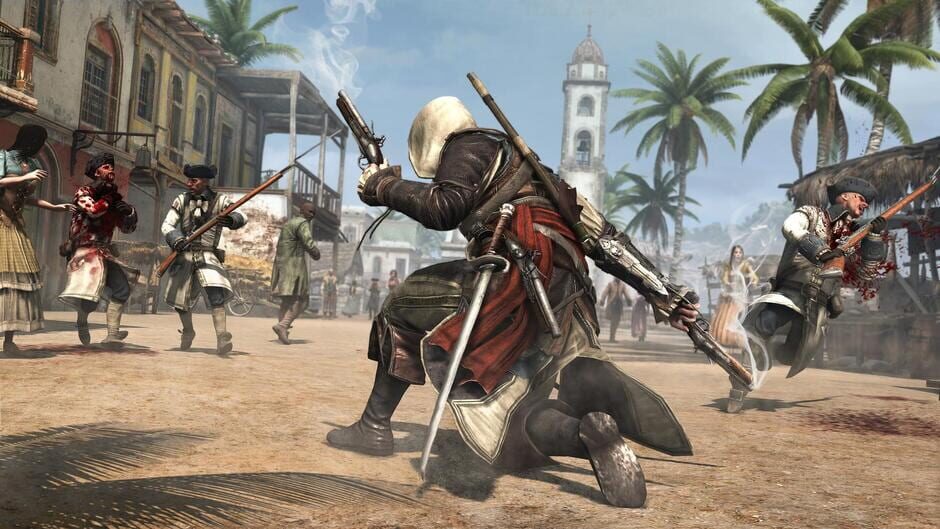
On land, Edward retains the parkour, Hidden Blade, aerial assassinations and social stealth inherited from previous entries. Havana offers streets and rooftops particularly suited to urban movement, while plantations, jungles and smaller settlements require greater use of vegetation and natural features.
Edward also has an arsenal matching his dual identity.
Two swords can be used in close combat, while several pistols allow him to chain shots rapidly. The Hidden Blades remain available for stealth kills, and the blowpipe adds several infiltration options, including temporarily incapacitating certain enemies or provoking chaos among them.
The result suits the character perfectly.
Edward can silently infiltrate a plantation, eliminate a target from above and then, only a few minutes later, draw his swords and pistols during the middle of a boarding action.
He is never only a pirate or an Assassin.
That ambiguity also lies at the heart of his story.
Unlike Altaïr, Ezio or Connor, Edward does not begin his adventure with a genuine connection to the Brotherhood. He first takes an Assassin’s clothes because they are useful to him and pursues its secrets because they seem capable of making him money.
The Creed comes later.
This choice allows the game to present the war between Assassins and Templars from a different perspective. Edward initially has no reason to consider either side his own. He meets their representatives, observes their methods and gradually discovers the consequences of his own opportunism.
The pirates then form a third ideological space.
Nassau embodies their desire to build a society free from the authority of the great European empires. Their project is based on independence, shared spoils and the rejection of an order imposed from outside.
That freedom obviously has its contradictions.
The pirates may defend their autonomy while remaining violent, unstable and deeply divided. Their improvised republic depends on personalities whose ambitions and temperaments do not always move in the same direction.
The game uses several historical figures to give this era a human face.
Blackbeard is not merely a spectacular figure used to decorate the Golden Age of Piracy. His relationship with Edward explores the gap between the legend pirates build around themselves and the far less romantic reality of their lives.
Anne Bonny, Mary Read and Adéwalé also play important roles in Edward’s evolution and in the way he eventually begins to look at his own choices.
Because beneath the immediate pleasure of sailing through the Caribbean lies a far more melancholic story.
Edward initially seeks enough money to obtain the life he dreams of. Yet every success seems to push satisfaction a little further away. A stronger ship leads to a greater prize; another fortune leads to another opportunity.
The open world translates that temptation perfectly.
It is easy to abandon the current objective to chase a sail on the horizon, explore a wreck, search for treasure, attack a fort or land on a new island.
Naval forts are precisely an interesting extension of maritime conquest. Their defenses must first be weakened from the Jackdaw before Edward can land and finish the operation on foot. Once captured, they reduce hostile presence in their sector and make the surrounding region easier to read.
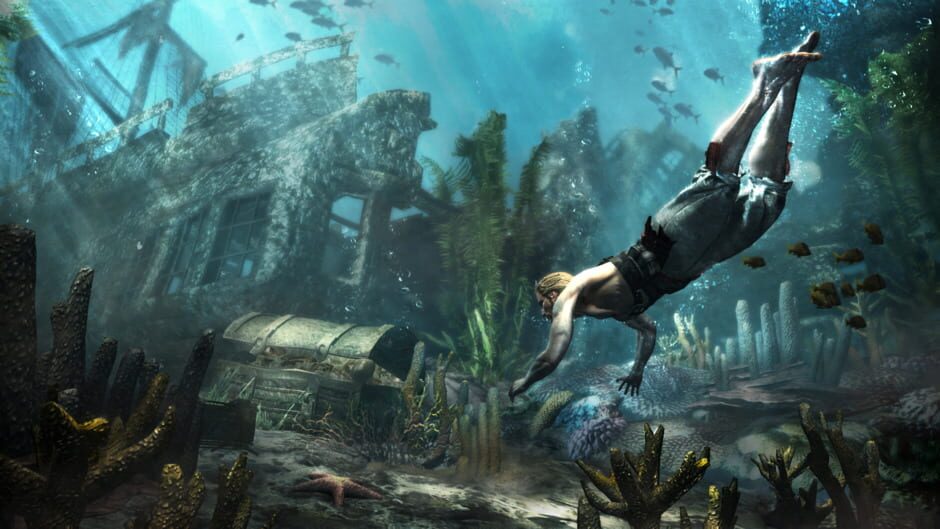
Underwater exploration also opens several particular sites. Using a diving bell, Edward can descend toward shipwrecks and search for resources while facing environmental dangers.
This variety gives the Caribbean a sense of travel that few previous entries possessed.
Sea shanties reinforce that identity even further. While sailing, the crew can sing songs collected during exploration. They serve almost no mechanical purpose, but quickly become inseparable from the pleasure of crossing the sea.
The modern-day narrative also changes significantly after the conclusion of Desmond’s arc.
The player now takes the role of an Abstergo Entertainment employee tasked with exploring Edward Kenway’s genetic memories. The modern offices can be explored between sessions, gradually revealing links between Abstergo’s entertainment branch and the older goals of the Templars.
This part remains more understated than Desmond’s story.
The true heart of Black Flag remains Edward.
And it is precisely because he enters the world of the Assassins without wanting to become one that his journey holds a distinctive place in the series.
What to remember
- An entry set mainly in the Caribbean beginning in 1715, during the Golden Age of Piracy.
- Edward Kenway, a privateer turned pirate whose search for fortune gradually draws him into the conflict between Assassins and Templars.
- A vast maritime world connecting Havana, Kingston, Nassau, numerous islands, plantations and natural territories.
- The Jackdaw as Edward’s personal ship, which can be upgraded to fight, pursue and board increasingly powerful vessels.
- Sailing as a central part of the open world, with naval battles, boarding actions, forts and exploration of different maritime locations.
- The return of parkour, social stealth and the Hidden Blades, complemented by swords, multiple pistols and the blowpipe.
- A story where the pirates’ pursuit of freedom echoes the Assassin Creed without making their motivations identical.
Conclusion
Assassin’s Creed IV: Black Flag could easily be summarized as “the pirate entry” in the series.
That would miss what makes Edward Kenway interesting.
Edward wants to be free, but his first definition of freedom is extremely simple: depend on no one and become wealthy enough to live as he chooses.
The Caribbean seems to offer exactly that possibility.
The Jackdaw can sail in almost any direction. A sail on the horizon can become a battle, a small beach can become the starting point for exploration, and an improvised detour can turn into an hour of adventure. Rarely had the series offered such an immediate sense of movement and independence.
But Edward gradually discovers that being able to go anywhere does not necessarily mean knowing where to go.
Around him, the Golden Age of Piracy begins to crack. The men who wanted to live without masters do not always manage to build something capable of surviving their own divisions. Fortunes vanish, alliances change and the almost legendary figures encountered at the beginning of the journey remain mortal.
That is where the conflict between Assassins and Templars truly begins to matter to him.
Edward does not become interesting because a pirate learns to use a Hidden Blade. He becomes interesting because a man who rejected any cause greater than his own ambitions eventually understands that freedom also comes with responsibilities.
The game retains some of the weaknesses of entries from this period. Tailing and eavesdropping sequences imposed by several main missions can disrupt the rhythm, while land combat becomes relatively forgiving once Edward’s arsenal has been developed.
But when Black Flag opens the sea, its formula finds remarkable freedom.
The greatest treasure Edward pursues for most of his journey is a life in which no one can tell him what to do.
It takes almost the entire adventure for him to understand that freedom is not defined only by what it allows someone to take.
It is also defined by what they choose to do with it.
Good to know
- Assassin’s Creed IV: Black Flag was developed primarily by Ubisoft Montreal and published by Ubisoft.
- The original game was released in 2013, and its historical adventure begins in 1715 during the Golden Age of Piracy in the Caribbean.
- Edward Kenway is the father of Haytham Kenway and the grandfather of Ratonhnhaké:ton, also known as Connor, protagonist of Assassin’s Creed III.
- Edward commands the Jackdaw, a ship the player can upgrade to improve its durability and offensive capabilities.
- Havana, Kingston and Nassau are among the main cities visited during the adventure.
- Blackbeard, Anne Bonny, Mary Read, Calico Jack and Charles Vane are among the historical figures incorporated into the story.
- The game greatly expands the naval mechanics introduced in Assassin’s Creed III and makes sailing and boarding central parts of its open world.