Presentation
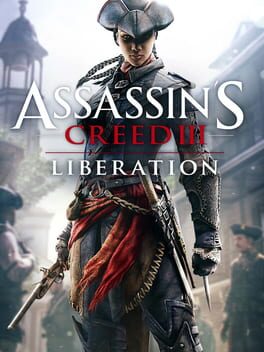
Assassin’s Creed III: Liberation brings the main principles of Assassin’s Creed III into an independent adventure originally designed for PlayStation Vita. Ubisoft Sofia retains parkour, infiltration, assassinations, combat and open-world exploration, but builds the game’s identity around Aveline and a Louisiana setting very different from the colonies explored by Connor.
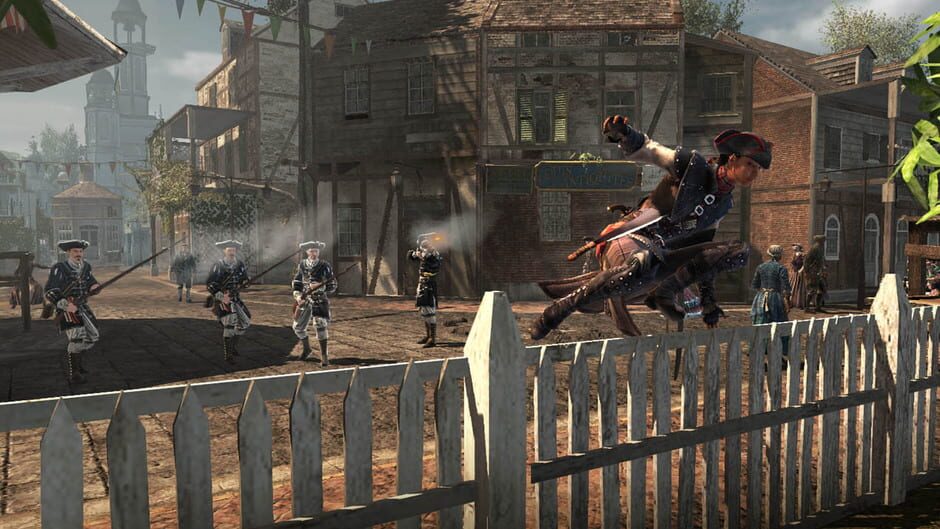
New Orleans is its main urban environment. Commercial streets, residential districts, docks and mansions support rooftop movement and crowd-based infiltration, while the coexistence of French, Spanish, African and Creole populations gives the city a personality distinct from Boston or New York.
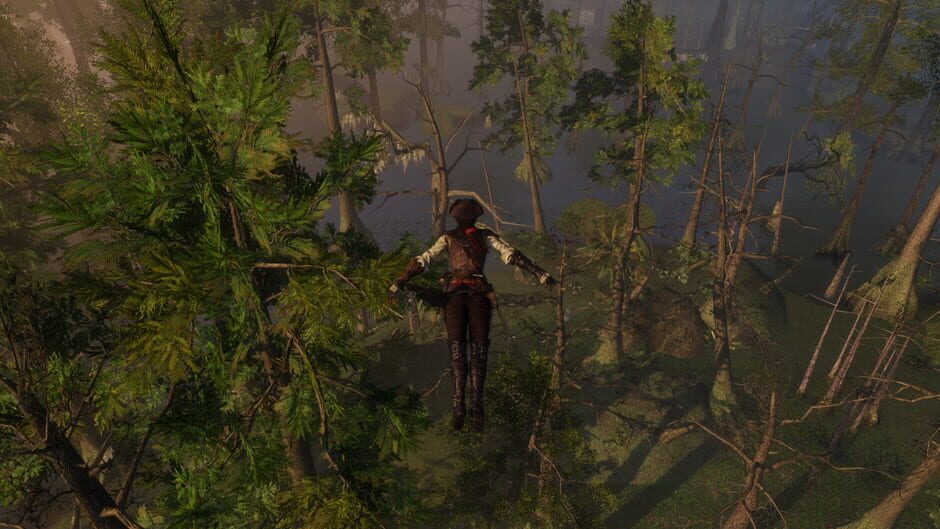
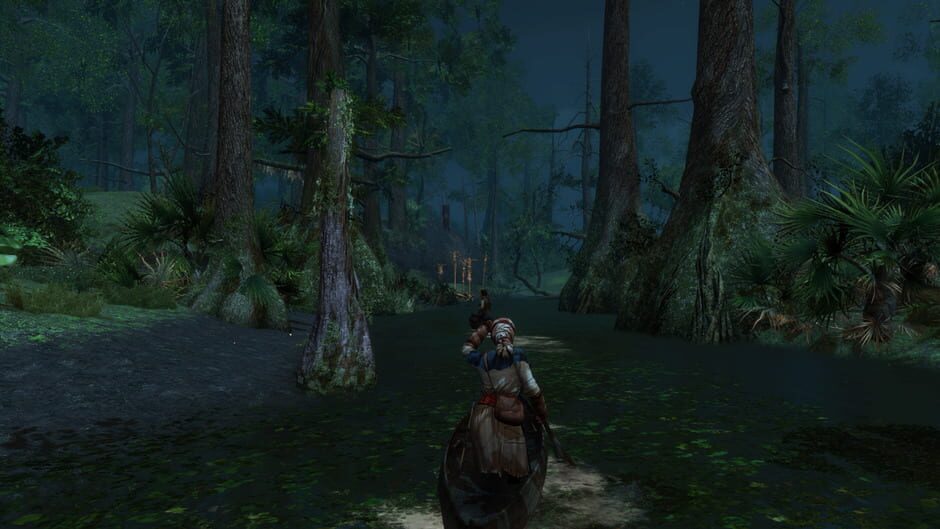
The bayou offers a more natural structure. Aveline moves through swamps, settlements, trees and waterways, with verticality making greater use of branches and natural elements. Chichén Itzá provides a third major setting through its Maya ruins, work sites and locations connected to the Templars’ research.
The game’s most distinctive mechanic remains its persona system. Aveline can adopt three identities with their own possibilities: the Assassin, the Slave and the Lady. They are more than cosmetic disguises, since available weapons, mobility, infiltration methods and the reactions of surrounding characters change with each one.
The Assassin persona provides the most complete access to parkour and weapons. Hidden Blades, firearms, a machete, blowpipe and other tools allow Aveline to approach dangerous situations directly. This freedom comes with notoriety that is harder to conceal, making her presence immediately suspicious to the authorities.
As the Slave persona, Aveline can blend in among workers, carry crates to avoid suspicion or create certain diversions. Her mobility remains high, but her equipment is more limited. The game therefore turns the social perception of other characters into a genuine infiltration tool.
The Lady persona instead exploits the privileged social status available to Aveline. Her movement and combat abilities are much more restricted, but she can enter certain social circles, charm men or bribe people who would immediately react with hostility toward the Assassin. This identity turns infiltration into social interaction rather than simple concealment.
The three personas also have separate notoriety systems. Changing identity does not automatically erase the consequences of actions committed while using another one. The player must manage the reputation associated with each role and use different methods to reduce the attention Aveline attracts.
This mechanic directly reflects the character’s position. Aveline belongs to a wealthy family but remains a woman of French and African descent in a colonial society structured by class, ancestry and slavery. Liberation uses this situation to give gameplay consequences to the different ways she is perceived depending on her appearance and the environment she enters.
Combat remains close to that of Assassin’s Creed III, with parries, counterattacks, ranged weapons and chained eliminations. Aveline nevertheless has several tools of her own, particularly the whip, which can be used in combat and in certain traversal situations, as well as the blowpipe and equipment associated with her different personas.
Exploration retains the secondary activities and collectibles familiar to the series, while certain missions focus more directly on Aveline’s opposition to slavery. A trading system also allows her to manage maritime expeditions and generate income, reflecting the fact that her civilian life remains connected to her family’s commercial activities.
The story also contains a distinctive metafictional element. Aveline’s memories are presented as a product of Abstergo Entertainment, a version of her history intended for public consumption and therefore potentially altered by the Templars. Citizen E anomalies reveal censored fragments and expose a more complete version of certain events.
This device gives the Animus a new function. It no longer serves only to justify access to historical memories: the game draws direct attention to the way an institution can select, remove or rewrite information in order to produce a narrative compatible with its interests. Searching for Citizen E therefore questions the very version of history the player is experiencing.
Aveline’s relationship with Agaté reinforces this question of authority. Agaté trained her as an Assassin and shares her opposition to the Templars, but increasingly struggles with her willingness to question his orders. Their disagreement prevents the Brotherhood from being presented as an institution that always understands the individual decisions of its members.
The experience retains some limitations connected to its handheld origins. Several areas and missions are less developed than those of the major console entries produced during the same period, and certain ideas, particularly the personas, could have been exploited with greater freedom. They nevertheless give Liberation an identity that does not depend solely on its status as a parallel story to Assassin’s Creed III.
What to remember
- A standalone adventure set mainly in Louisiana beginning in 1765, parallel to the period covered by Assassin’s Creed III.
- Aveline de Grandpré is the series’ first main playable female protagonist and an Assassin of French and African descent.
- New Orleans, the Louisiana bayou and Chichén Itzá form the three major environments of the journey.
- Three personas — Assassin, Slave and Lady — alter mobility, equipment, infiltration methods, notoriety and social reactions.
- Agaté is Aveline’s mentor, but their relationship deteriorates as she increasingly follows her own judgment against the Templars.
- The investigation into the disappearance of enslaved people leads to a Templar network and the search for a First Civilization artifact.
- Aveline meets Connor Kenway during a mission that directly connects her story to Assassin’s Creed III.
- Citizen E sequences reveal information censored by Abstergo Entertainment and make the manipulation of historical narratives part of the story.
Conclusion
Assassin’s Creed III: Liberation finds its strongest idea in Aveline’s three personas. The system genuinely changes how certain situations can be approached, but more importantly it turns the character’s unusual position within New Orleans society into gameplay. The same woman is not watched, permitted to move or regarded as dangerous in the same way depending on the identity she presents.
This mechanic gives Aveline an identity distinct from Connor despite the historical proximity of the two games. Her struggle takes place less at the center of the major battles of the American Revolution than within the social and commercial structures of a Louisiana where slavery, status and changes in colonial authority directly shape daily life.
The story also finds an interesting idea in its presentation through Abstergo Entertainment. Citizen E reminds the player that the historical memories shown by the Animus are not necessarily neutral when an organization controls their distribution. The conflict between Assassins and Templars therefore briefly extends to the ability to preserve an unaltered version of the past.
Aveline’s journey remains somewhat constrained by an adventure more compact than the major entries of the period. Missions do not always exploit the differences between her three identities as deeply as they could, and several plotlines move quickly. The diversity of New Orleans, the bayou and Mexico nevertheless provides enough variety for the experience to establish its own rhythm.
Liberation therefore goes beyond its origins as a handheld companion to Assassin’s Creed III. Aveline, her personas and Abstergo’s manipulation of memories give the game ideas that belong fully to it. Its connection with Connor places her story within the same conflict, but its perspective on freedom, slavery and socially imposed roles gives it a distinct place within the series.
Good to know
- Assassin’s Creed III: Liberation was primarily developed by Ubisoft Sofia and published by Ubisoft.
- The original version was released for PlayStation Vita on October 30, 2012, in North America and October 31 in Europe, alongside Assassin’s Creed III.
- Aveline de Grandpré is the first main playable female protagonist in an Assassin’s Creed game.
- The PlayStation Vita version used several features specific to the handheld, including its touchscreens, sensors and camera.
- Assassin’s Creed Liberation HD was released in January 2014 for PlayStation 3, Xbox 360 and PC with revised visuals, gameplay adjustments and new missions connected to Aveline’s personas.
- Assassin’s Creed III Liberation Remastered is included with Assassin’s Creed III Remastered, released for PlayStation 4, Xbox One and PC on March 29, 2019, followed by Nintendo Switch on May 21, 2019.
- Aveline meets Connor Kenway during her adventure, but Liberation tells an independent story centered on Louisiana and does not feature Desmond Miles as its modern-day protagonist.
- The soundtrack is composed by Winifred Phillips.