Presentation
Assassin’s Creed II begins with a hero who still knows almost nothing about the Assassins.
That is a fundamental difference from Altaïr.
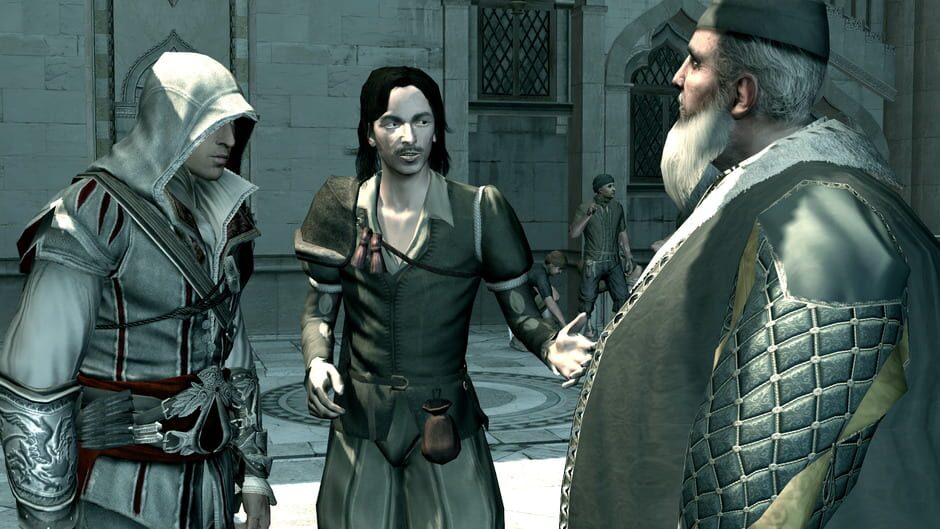
Ezio is not introduced as an already trained professional. The player meets him young, impulsive and deeply attached to his family. The opening hours show Florence through his everyday life before the execution of the Auditore family brutally changes his path.
Learning the mechanics therefore accompanies the character’s own education.
Parkour retains the vertical freedom of the first game, but Renaissance Italy gives it a different architecture. Tiled rooftops, palaces, bell towers, towers and tightly packed façades create routes where Ezio can run above the streets, quickly change elevation and search for alternative paths when an area becomes dangerous.
Viewpoints remain important for gradually revealing the cities, followed by the inevitable Leap of Faith. Movement, however, becomes more fluid, and the environments gain variety through travel between several territories.
Florence and Venice are the two major urban centers of the adventure.
Florence offers its squares, palaces and monuments during the beginning of Ezio’s journey. Venice later changes movement more significantly through its canals, districts and denser architecture. Ezio also learns to swim, adding water to his options for escape and infiltration.
Between these cities, Tuscany, Monteriggioni and other regions give the journey a scale the first game possessed to a lesser degree. Assassin’s Creed II therefore feels more like a journey across Italy than a succession of repeated missions in three major cities.
Assassinations also evolve.
The highly ritualized structure of the first game — investigation, information gathering, assassination and escape — gives way to missions more closely integrated into the story. A target may require a particular infiltration, a chase, the use of social groups or progression through a specific event.
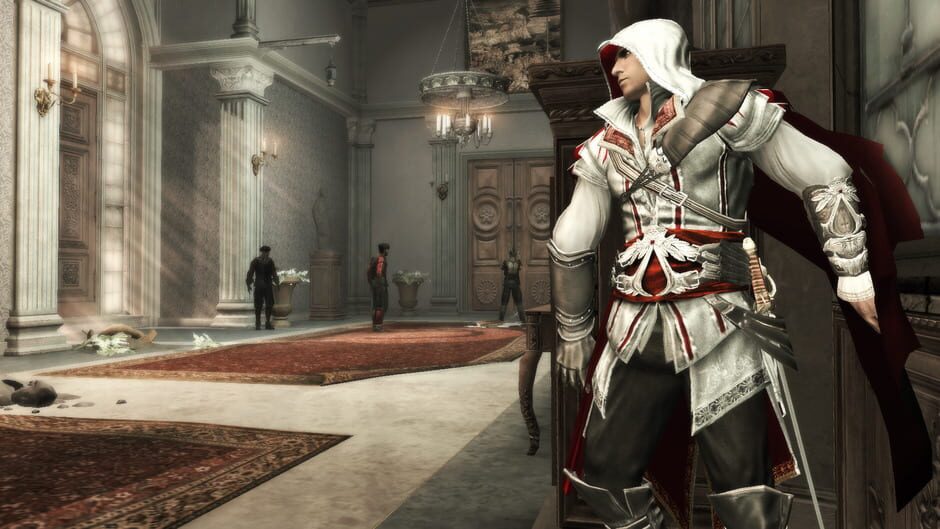
Social stealth remains central, but Ezio has more ways to manipulate the people around him.
He can blend with different groups, hire courtesans to distract attention, use thieves to lure guards away or call on mercenaries when direct confrontation becomes preferable to infiltration.
A notoriety system completes this logic. Highly visible actions gradually increase the attention focused on Ezio. Tearing down posters, bribing certain characters or eliminating officials allows him to become less recognizable again.
The arsenal expands considerably.
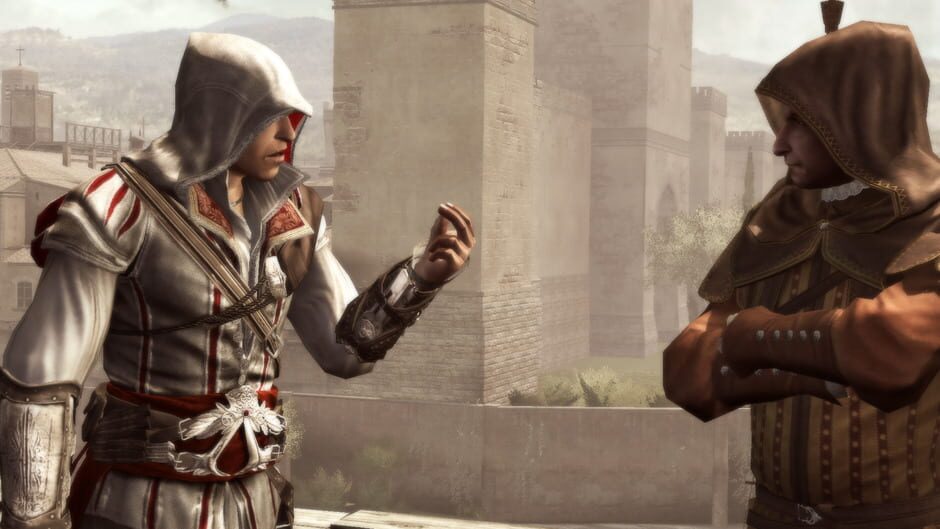
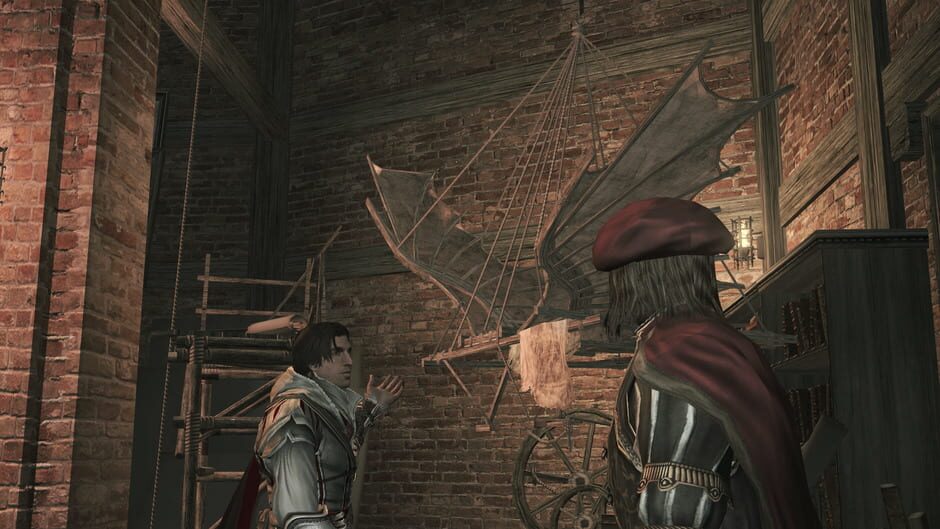
The Hidden Blade remains the Assassin’s iconic tool, but Leonardo da Vinci helps Ezio improve the inventions described in the pages of Altaïr’s Codex. He notably gains a second Hidden Blade and several devices that expand his options.
Two nearby targets can therefore be eliminated simultaneously, while the hidden pistol provides a particularly powerful ranged option at the cost of making noise.
Swords, daggers, throwing knives and different weapons taken from enemies complete the arsenal. Ezio can also disarm certain opponents and turn their own equipment against them.
Combat remains based on timing and counters, but the greater variety of enemies requires more adaptation. Fast guards, heavily armored soldiers and opponents equipped with long weapons cannot all be handled in exactly the same way.
The economy also takes on a much larger role.
The Auditore villa in Monteriggioni can be renovated using the money collected during the adventure. Investing in shops, buildings and improvements gradually increases the value of the estate and the income it generates.
The mechanic remains simple, but it gives the florins earned a purpose beyond purchasing weapons and equipment. Monteriggioni visibly changes as Ezio invests in its development, creating a refuge that grows alongside his own progression.
Assassin Tombs are another major addition.
Hidden inside several monuments, they offer sequences built mainly around parkour, observation and finding the correct path. Exploring them reveals traces of former members of the order and contributes to an objective connected to Altaïr’s armor.
These areas use verticality in a more directed way than the open world. Rather than simply asking the player to reach a point on the map, they build complete traversal challenges where every beam, wall and platform belongs to a specific route.
The game also multiplies the number of historical figures incorporated into its fiction.
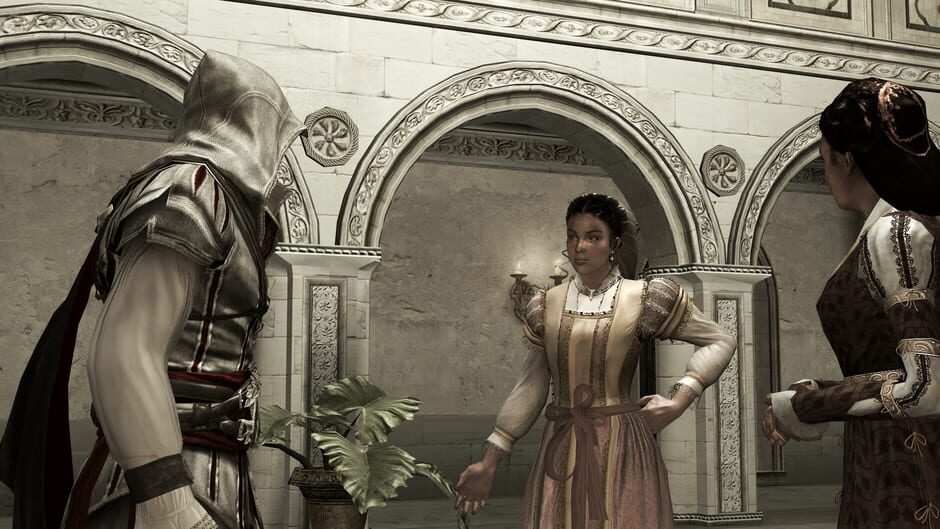
Leonardo da Vinci becomes one of Ezio’s closest friends and accompanies his development over several years. Lorenzo de’ Medici, the Pazzi and Borgia families and other political figures of the Renaissance appear within a plot blending historical events with the fictional conflict between Assassins and Templars.
This use of History becomes one of the series’ defining signatures.
The Animus allows Ubisoft to transform a historical period into a fictional playground while preserving the modern-day storyline. Desmond is no longer simply watching an ancestor’s life because Abstergo forces him to.
He is training.
The Bleeding Effect gradually allows abilities developed through the Animus to influence his own skills. Ezio’s story therefore serves both to explore the past and prepare Desmond for the modern conflict.
But the most important transformation remains Ezio’s.
His revenge begins in urgency and anger. Yet the years pass. New cities appear, faces change and his understanding of the conflict expands.
Assassin’s Creed II does not simply tell the story of a man learning to use a Hidden Blade.
It tells how Ezio Auditore gradually becomes the Assassin whose maturity will define the following games.
What to remember
- The second main entry in the series, set during the Italian Renaissance and centered on Ezio Auditore da Firenze.
- A story beginning with the execution of Ezio’s father and two brothers before revealing a vast Templar conspiracy.
- Several Italian territories to explore, notably Florence, Tuscany, Monteriggioni and Venice.
- More fluid parkour and expanded social stealth through different groups capable of distracting or fighting guards for Ezio.
- A broader arsenal including two Hidden Blades, melee weapons, throwing knives and a hidden pistol, with several improvements linked to Leonardo da Vinci.
- The villa at Monteriggioni as a headquarters that can be renovated to develop the estate and increase its income.
- A progression spanning several years, taking Ezio from a family vendetta to genuine commitment within the Assassin Brotherhood.
Conclusion
Assassin’s Creed II understands that expanding on its predecessor requires more than building additional streets and placing more targets on a map.
It needs to give a life to the Assassin moving through them.
Ezio is that change.
The player meets him before the Hidden Blade, before the Creed and before he even understands what his father had been hiding from him. Revenge initially gives the adventure a very simple direction, but that certainty gradually fractures as the conspiracy proves older and far larger than the tragedy of the Auditore family.
This evolution also gives greater meaning to the game’s variety.
Florence is not Venice. An assassination mission no longer repeats the same ritual every time. The Tombs isolate parkour and turn it into a challenge of its own, while Monteriggioni gives purpose to the money accumulated throughout the adventure.
Not everything is perfectly balanced. Combat can become fairly easy once counters are mastered, some side activities become repetitive and the abundance of new mechanics does not mean that all of them have equal depth.
But the world feels far more alive than in the first game.
And above all, time exists.
Ezio does not become an Assassin by finishing a single mission. Several years separate the young Florentine hunting those responsible for his family’s death from the man beginning to understand the scale of the conflict in which he is involved.
That is probably the most important transformation introduced by Assassin’s Creed II.
Altaïr showed what an Assassin could be.
Ezio now shows how someone becomes one.
Good to know
- Assassin’s Creed II was developed primarily by Ubisoft Montreal and published by Ubisoft.
- The game was originally released on November 17, 2009, on PlayStation 3 and Xbox 360, before later coming to PC.
- Ezio Auditore da Firenze is a young Florentine nobleman whose journey begins during the Italian Renaissance.
- The adventure notably travels through Florence, Tuscany, Monteriggioni and Venice across several years of Ezio’s life.
- Leonardo da Vinci becomes an important ally and helps Ezio make use of several devices described in the pages of Altaïr’s Codex.
- Monteriggioni and the Auditore villa can be restored to gradually increase the value and income of the estate.
- Assassin’s Creed II is the first chapter of the Ezio trilogy, continued in Assassin’s Creed Brotherhood and Assassin’s Creed Revelations.