Overview
A character can be visually successful and still unusable in a production.
It still needs coherent topology, a skeleton, facial expressions, materials, several levels of detail, and an export that the next software can actually interpret.
This is precisely where Character Creator 5 finds its place.
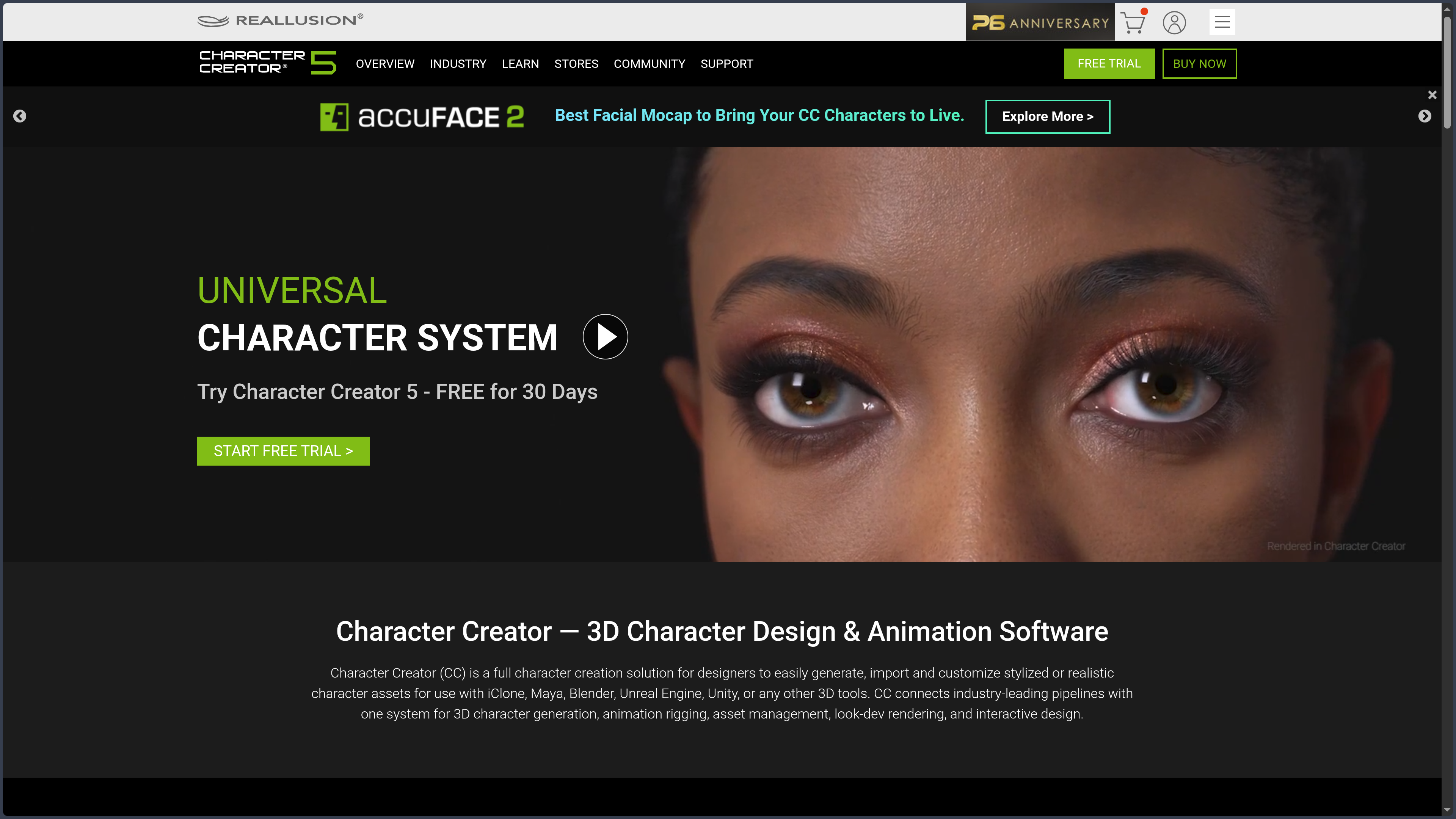
Developed by Reallusion, the software specializes in creating, customizing, and above all the technical preparation of 3D characters.
Character Creator does not stop at the visible character. It prepares the usable character.
The software starts from human bases that are already modeled, rigged, and configured.
Morphology, skin, hair, clothing, and accessories make it possible to quickly build an identity.
Rigging, expressions, optimization, and export then prepare the rest of the pipeline.
This position places it between two families.
On one side, Daz Studio makes character assembly extremely accessible.
On the other, Blender, Maya, or ZBrush give much more manual freedom.
Character Creator deliberately occupies the middle:
less free than a general-purpose 3D workshop, but far more production-oriented than a simple character generator.
This compromise is its real value.
The base framework limits certain topology freedoms.
In return, it preserves compatibility between morphologies, clothing, expressions, rigs, and animations.
A face modification does not automatically require rebuilding the entire character from scratch.
Character Creator is therefore particularly useful when the question is no longer just:
"Is this character beautiful?"
but:
"Can it talk, move, wear clothing, be optimized, and leave the software correctly?"
The character can be created in Character Creator, sculpted or textured elsewhere, animated in iClone or Maya, then sent to Blender, Unity, Unreal Engine, or other environments.
It is a software specialized in the handover.
Features
Building an identity with morphologies
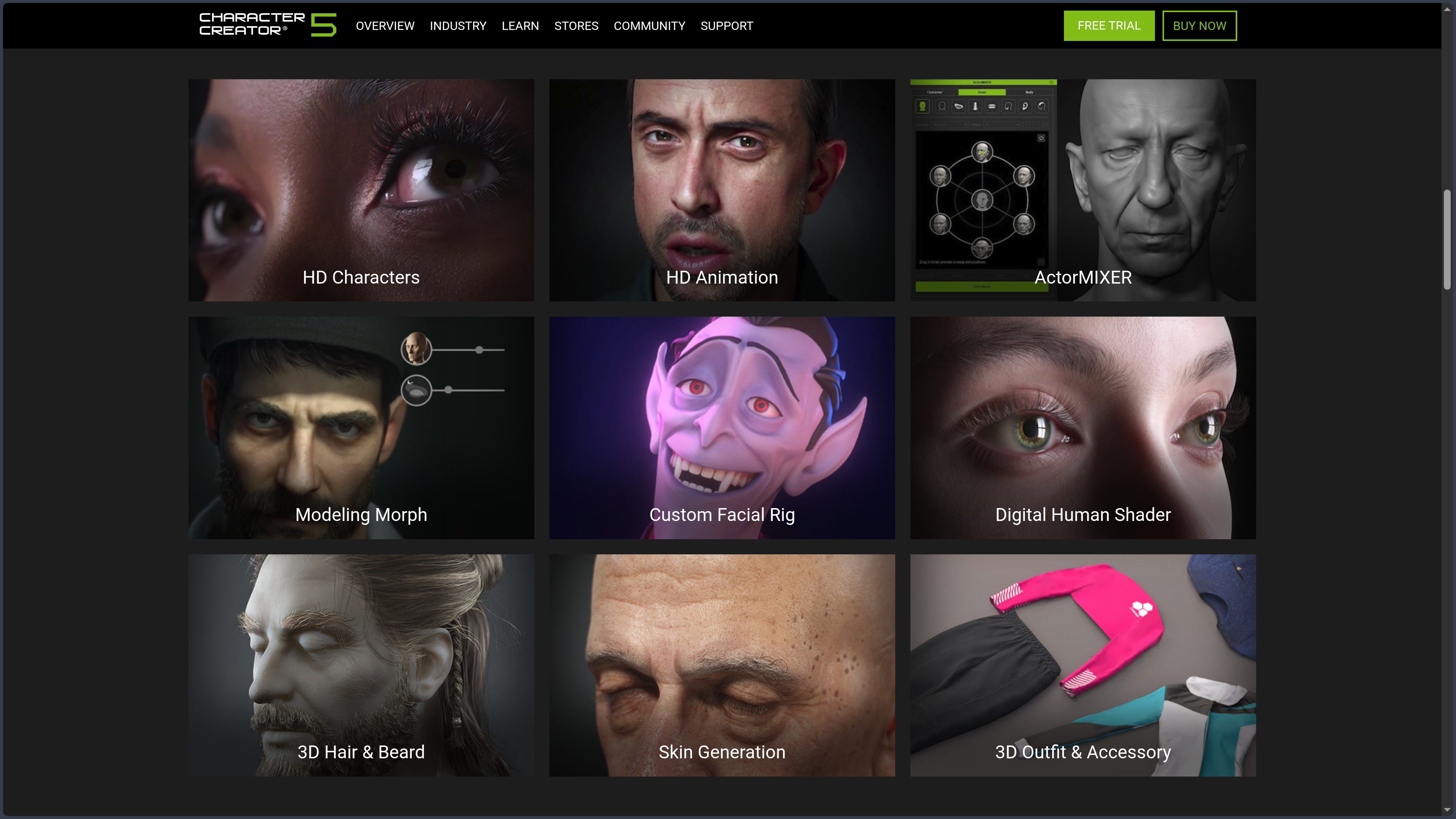
Human bases can be transformed with morphs for face, body, and proportions.
Skull, jaw, nose, eyes, lips, torso, arms, or legs can be adjusted and combined.
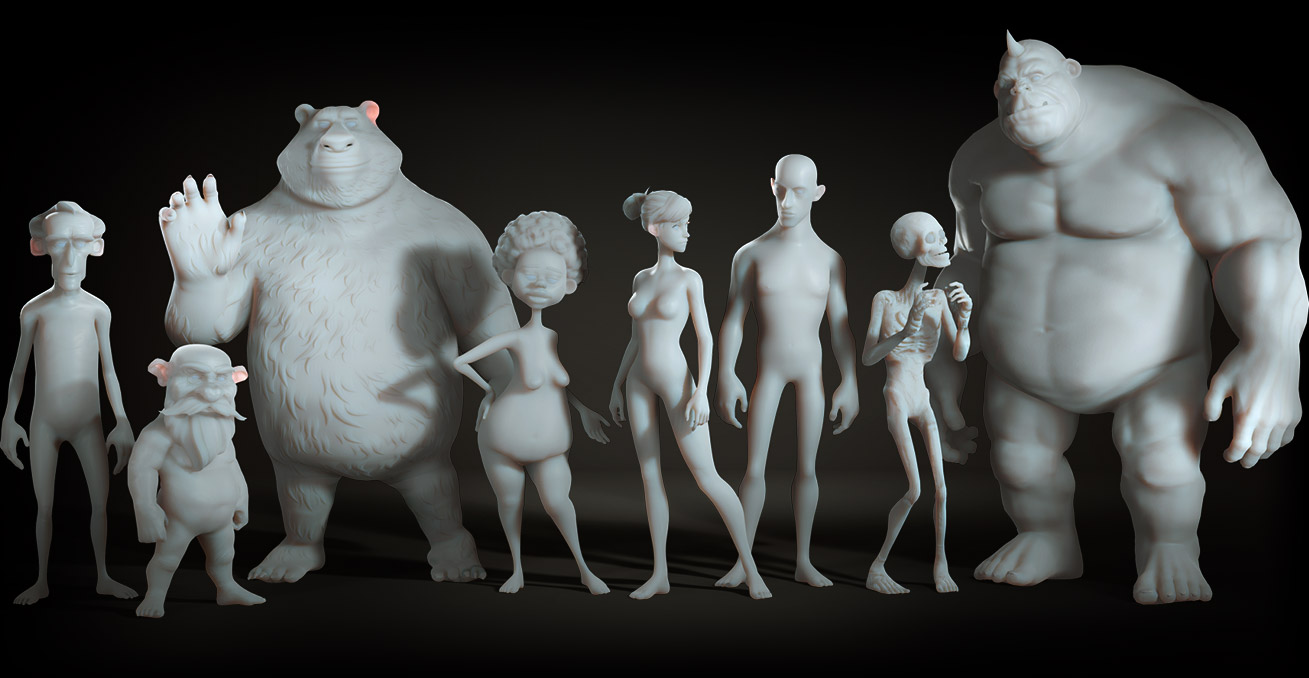
This approach makes it possible to quickly create a realistic, stylized, or deliberately exaggerated character without starting from an empty mesh.
The logic remains non-destructive across much of the workflow.
A character can therefore evolve as its art direction becomes clearer.
This method does not offer the absolute freedom of full sculpting.
It mainly offers much greater speed and continuity.
ActorMIXER and building variants.
ActorMIXER mixes several faces, bodies, or features to create new identities.
This feature becomes interesting when seeking to avoid the "single preset" effect.
Multiple bases can be combined rather than simply choosing a ready-made character.
This logic also suits producing families or variations:
- secondary characters;
- crowd;
- members of the same family;
- variants of an archetype;
- realistic or stylized characters.
Coherence comes from the common structure.
Identity comes from the mix and adjustments.
Headshot and digital doubles
Headshot-style tools start from photographs to create a character base closer to a real individual.
This layer targets digital doubles, avatars, or characters inspired by photographic references.
A photograph does not automatically produce a perfect double.
Lighting, angle, image quality, and proportions strongly influence the result.
The workflow must then correct geometry, skin, hair, and sometimes expressions.
The main interest is obtaining a credible base much more quickly.
Skin and materials.
Character Creator offers systems for working on skin, details, textures, and human materials.
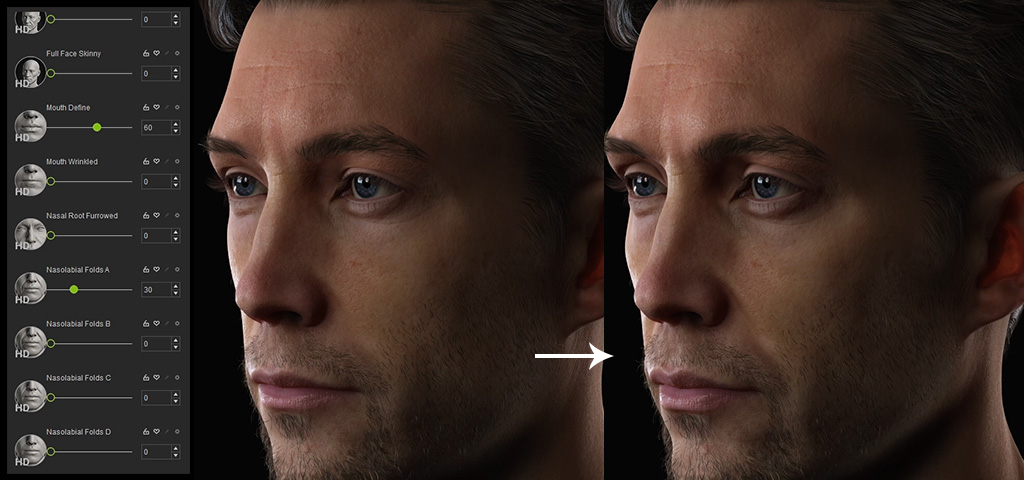
Specialized extensions can go further into pores, color variations, imperfections, and anatomical details.
This depth matters because a realistic character depends enormously on skin.
A technically accurate model can still look artificial if the material is too uniform.
The counterpart is the modular ecosystem.
Some advanced capabilities may depend on additional extensions.
The real cost of the workflow can therefore be higher than the base software price.
Hair, clothing, and accessories
The character can receive compatible hair, beard, clothing, and accessories.
Clothing can follow body transformations and receive corrections when deformations become harder.
This compatibility is one of the advantages of the structured base.
A morphology change can propagate to clothing rather than requiring a full remodel.
This automation has its limits.
Extreme silhouettes, complex clothing, or difficult poses can produce collisions and require manual rework.
Rigging with AccuRIG
Character Creator provides already rigged characters.
It can also help prepare certain imported humanoids through AccuRIG.
This capability changes its role.
The software no longer only serves to create a character from Reallusion bases.
It can also become a normalization step for characters created elsewhere.
An imported model can receive a structure more compatible with animation libraries and the rest of the ecosystem.
This automation does not replace a specialized rig for a complex creature or highly atypical character.
It greatly speeds up standard humanoids.
Expressions and facial preparation
The face must be able to survive animation as much as the body.
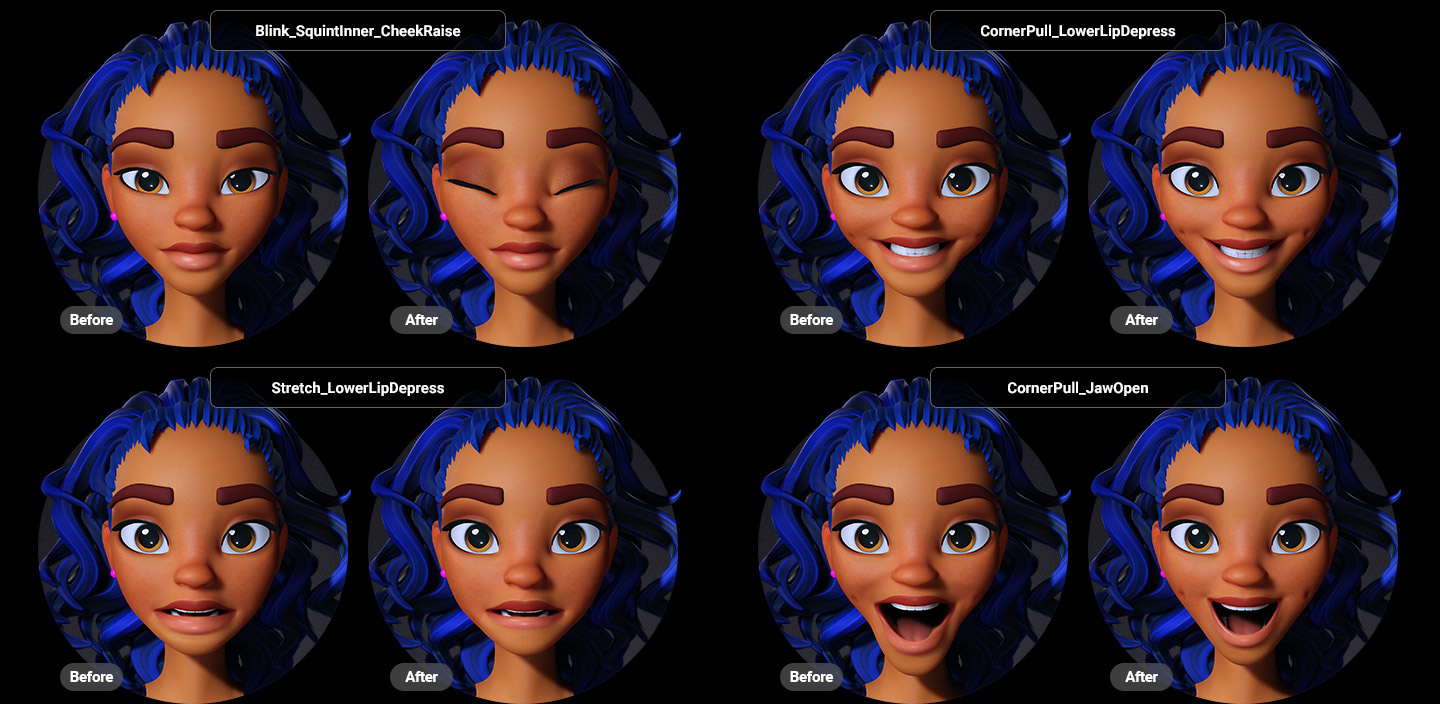
Character Creator therefore prepares expressions, facial morphs, and various profiles intended for speech or animation.
The character can receive a base capable of handling gaze, mouth, eyebrows, and other expressions.
This layer becomes particularly important for dialogues, avatars, or cinematics.
A face meant for close-up has much stronger requirements than an NPC seen at a distance.
Facial preparation must therefore be designed according to destination.
High definition and details.
Character Creator 5 deepens the HD character logic.
Subdivision, high-definition textures, surface details, and advanced morphs allow more precision for close-ups.
This depth must be used with discernment.
A cinematic character can exploit more detail.
A real-time game with many characters must instead master geometry and textures.
High definition is therefore a production option, not a universal goal.
Optimization and levels of detail
Character Creator can reduce or adapt geometry to prepare different uses.
A main character, a real-time avatar, and a crowd do not have the same needs.
This capability is particularly important for game engines.
The notion of "production ready" always depends on the target.
Optimizing too early can remove useful details.
Optimizing too late can make the character impossible to run correctly on the target hardware.
Export and Auto Setup
The software is designed to send characters to Blender, Maya, Unreal Engine, Unity, or other environments.
Export systems and Auto Setup aim to preserve rig, materials, expressions, and other elements as much as possible.
This continuity is one of the product's real strengths.
It does not guarantee a perfect transfer.
Shaders, hair, clothing, morphs, or units may behave differently in the target software.
Exports must always be validated in their actual destination.
Library and content
The Reallusion ecosystem includes many contents: morphs, clothing, hair, animations, and accessories.
This library accelerates creation.
It also raises questions of compatibility, licensing, and cost.
A workflow built around multiple extensions and packs can become much more expensive than the initial purchase.
Content licenses must be distinguished from the software license itself.
Use Cases
Creating the main character of a game
The character can be built, facially prepared, optimized, then exported to a real-time engine.
Producing a family of characters
Morphologies and mixing systems make it possible to create several related individuals without starting from scratch.
Creating a digital double
A photograph can become the base of a character before correction and preparation work.
Rigging a character created elsewhere
An imported humanoid model can receive a structure compatible with Reallusion animations and tools.
Preparing a cinematic
Body, face, clothing, and levels of detail can be prepared before moving to an animation tool or real-time engine.
Building a stylized character
Bases can be pushed toward less realistic proportions while retaining a usable architecture.
Creating compatible clothing
Clothing can be adapted to the character's morphology and prepared to follow its deformations.
Preparing several levels of detail
The same character can be adapted to several distances or performance constraints.
PANACHES Review
Its value is the continuity between creation and technique
Many tools know how to produce a striking face.
Character Creator becomes useful when that face must then speak, move, wear clothing, and survive an export.
It occupies a rather rare middle ground
Against Daz Studio, Character Creator goes further in preparation, optimization, and game engine workflows.
Against Blender or Maya, it offers less freedom but automates far more work.
It trades a share of freedom for a share of continuity.
Structured bases are both a strength and a constraint
Compatibility between morphs, clothing, expressions, and rig makes it possible to work very fast.
It also requires respecting the system architecture more.
A production that demands completely atypical topology or a creature far removed from human may prefer a freer tool.
The modular ecosystem increases the real cost
The base software already provides a lot.
Headshot, SkinGen, content, animations, and other extensions can deepen the workflow.
The real cost therefore depends on the full pipeline, not just the entry price.
The universal character does not exist
A cinematic hero, a real-time avatar, and a secondary character do not have the same needs.
Character Creator facilitates adaptation.
It does not remove the need to choose what is actually necessary for the project.
It becomes better when it remains a pipeline step
The character can continue to Blender, Maya, Unreal Engine, or another tool.
It is precisely this ability to let the result leave that prevents Character Creator from becoming a closed environment.
Points of Attention
- Character Creator remains a software specialized in characters, not a generalist modeler.
- The software can require significant hardware for HD characters and heavy textures.
- Some advanced features are tied to additional extensions or content.
- The cost of the full workflow can be noticeably higher than the base software price.
- The free trial has export or usage limits.
- Very atypical silhouettes may fall outside the humanoid bases' comfort zones.
- Full animation usually happens in iClone, Blender, Maya, or Unreal Engine.
- Software and content licenses must be distinguished.
- Redistribution of models derived from Reallusion bases is governed.
- Some application uses or character generators may require specific licenses.
- Rules regarding the use of content for AI training must be verified.
- Exports must be checked in the target software.