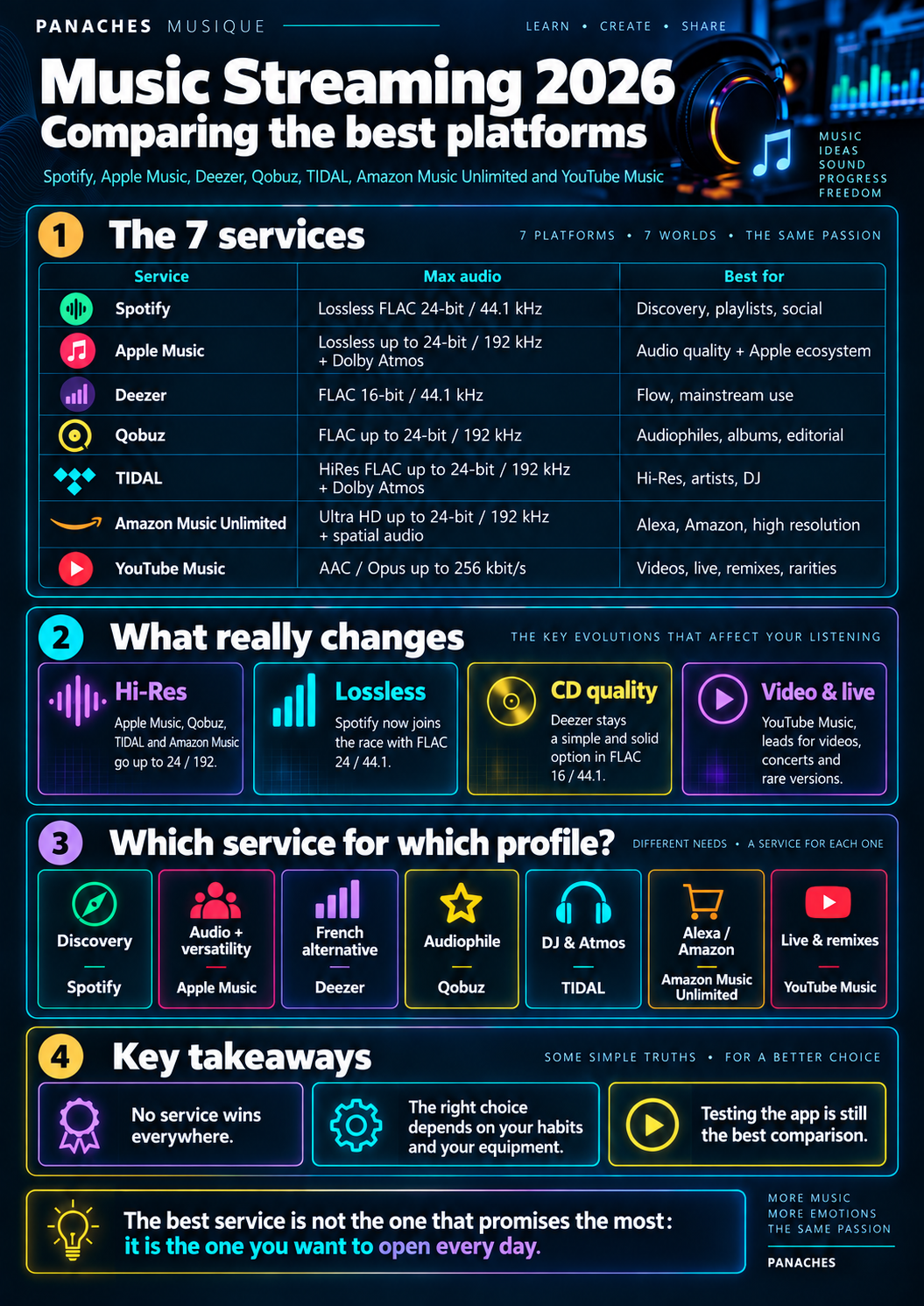
Seven platforms, but very different philosophies
Music streaming platforms now provide access to catalogs large enough that the sheer number of tracks is no longer, on its own, a decisive criterion.
The differences are increasingly found in audio quality, music discovery, interface design, device compatibility, additional content and the ecosystem each service belongs to.
In 2026, seven services occupy a particularly important position:
Spotify — Apple Music — Deezer — Qobuz — TIDAL — Amazon Music Unlimited — YouTube Music
All of them provide on-demand music and offer ad-free subscriptions with offline listening.
But their priorities are far from identical.
Spotify focuses heavily on personalization and social features. Apple Music combines mainstream streaming, Lossless audio and spatial audio. Qobuz concentrates on high fidelity and music editorial content. YouTube Music takes advantage of the enormous YouTube ecosystem.
Choosing a platform is therefore less about deciding which one is objectively “the best” and more about identifying the service that best matches the way you listen to music.
The seven services at a glance
Prices can change and some promotions depend on the subscription method. The amounts below correspond to the main individual subscriptions observed in France in September 2026.
| Service | Individual plan | Maximum advertised quality | Main positioning |
|---|---|---|---|
| Spotify Premium | approx. €12.14/month | Lossless FLAC up to 24-bit / 44.1 kHz | Discovery, playlists, ecosystem |
| Apple Music | €11.99/month | Lossless up to 24-bit / 192 kHz + Dolby Atmos | Strong audio quality / price balance |
| Deezer Premium | €11.99/month | FLAC 16-bit / 44.1 kHz | Mainstream service, Flow, French experience |
| Qobuz Studio | €14.99/month | FLAC up to 24-bit / 192 kHz | Audiophile listening and editorial content |
| TIDAL | approx. €12.99/month | HiRes FLAC up to 24-bit / 192 kHz + Dolby Atmos | High fidelity, artists and DJ features |
| Amazon Music Unlimited | approx. €12.14/month | Ultra HD up to 24-bit / 192 kHz + spatial audio | Amazon, Alexa and high resolution |
| YouTube Music Premium | €10.99/month | AAC / Opus up to 256 kbit/s | Videos, rarities, live performances and recommendations |
On paper, Apple Music, Qobuz, TIDAL and Amazon Music therefore have a clear advantage for users looking for high-resolution audio beyond CD quality.
Spotify has nevertheless significantly reduced the gap with the arrival of Lossless, while Deezer still provides lossless CD quality.
YouTube Music remains the only one of these major services to still prioritize compressed streaming rather than true Lossless audio.
Spotify: the most versatile platform
Spotify remains a reference when it comes to discovering and organizing music on a daily basis.
Its main advantage does not come only from its catalog, but from everything built around it: personalized playlists, artist radio, recommendations, listening history, sharing, collaborative playlists and social features.
Well-known selections such as Discover Weekly and Release Radar helped establish a model in which the platform is no longer used only to search for an album: it continuously suggests new things to listen to.
Spotify also benefits from a particularly broad ecosystem built around Spotify Connect, making it easy to control playback across many compatible devices.
Lossless changes the situation
For a long time, audio quality was one of Spotify’s main weaknesses compared with Apple Music, Qobuz or TIDAL.
That is no longer really the case.
Spotify Premium now offers Lossless FLAC playback up to 24-bit / 44.1 kHz on compatible equipment.
This remains below the 24-bit / 192 kHz streams offered by several competitors, but it is already a major change for users who enjoy Spotify’s interface and recommendations without wanting to stay limited to compressed audio.
Who is it for?
Spotify is particularly suitable for users who want a highly complete mainstream platform, with excellent discovery, sharing and multi-device features.
It has also become much more credible for Hi-Fi listening since the arrival of Lossless.
Apple Music: one of the best balances between price and audio quality
Apple Music has a rather different positioning.
The service does not offer a permanent ad-supported free plan, but its individual subscription directly includes several advanced audio features.
The catalog is available in Lossless, with files reaching up to 24-bit / 192 kHz when the source and equipment support it.
Apple also offers a large catalog in Spatial Audio with Dolby Atmos.
There is therefore no need to subscribe to a separate Hi-Fi tier.
Not only for iPhone users
Apple Music naturally integrates with iPhone, iPad, Mac, Apple Watch, HomePod and Apple TV.
But the service is also available on Android, Windows, several consoles, smart TVs and audio systems.
The Apple ecosystem remains its most natural environment, especially through Siri, AirPlay and integration between devices.
But Apple Music is now much less closed than people sometimes assume.
A real strength for classical music
The subscription also includes Apple Music Classical, an application specifically designed for classical music with organization adapted to composers, works, performers and recordings.
This is a fairly unique advantage for listeners interested in the genre.
Who is it for?
Apple Music is an excellent option for users looking for a mainstream service with very high audio quality at no extra cost, particularly if they already use several Apple devices.
Deezer: a particularly balanced mainstream alternative
Created in France, Deezer remains one of the main European alternatives to the large American services.
Its Premium plan includes HiFi playback in FLAC 16-bit / 44.1 kHz, corresponding to CD quality.
Deezer therefore does not reach the same maximum resolution as Apple Music, Qobuz, TIDAL or Amazon Music, but its Lossless stream is already perfectly suited to traditional Hi-Fi listening.
Flow at the center of the experience
One of Deezer’s signature features remains Flow.
The idea is to mix tracks the user already likes with new recommendations in a continuous music stream.
Rather than constantly asking the listener to choose an album or playlist, Flow can become a kind of personal radio that evolves with listening habits.
Deezer also combines algorithmic recommendations, editorial playlists, radio and podcasts.
A platform that tries to remain focused on music
Deezer has also started to distinguish certain AI-generated content more clearly and to work on identifying it within its catalog.
This direction may become increasingly important as platforms need to manage a growing quantity of music produced or modified by generative systems.
Who is it for?
Deezer is particularly suitable for users looking for a mainstream alternative to Spotify, with strong personalization and Lossless included, without necessarily needing 24-bit Hi-Res audio.
Qobuz: the platform designed for music lovers
Qobuz probably has the clearest audiophile positioning in this comparison.
The French platform offers Lossless and Hi-Res streaming in FLAC up to 24-bit / 192 kHz.
But Qobuz is not only about technical specifications.
The platform also places a strong emphasis on music editorial content, with articles, selections, reviews, digital booklets and additional information surrounding albums.
The experience feels closer to a digital record store than to an endless algorithmic feed.
Streaming and purchasing music
Qobuz also preserves a feature that has become rare: a genuine download store.
Albums can be purchased in CD quality or Hi-Res, allowing users to keep the files independently of a streaming subscription.
The Sublime plan even combines streaming with discounts on certain Hi-Res purchases.
This combination is particularly appealing to people who do not want to depend exclusively on a catalog rented through a subscription.
The algorithm is not the center of the experience
Qobuz naturally provides recommendations and curated selections.
But the experience emphasizes albums, artists and editorial discovery more than consumption driven entirely by algorithmic playlists.
That can be either a strength or a limitation depending on the listener’s habits.
Who is it for?
Qobuz is particularly suited to audiophiles, album listeners and music lovers who appreciate editorial curation, as well as people who still want to purchase music in high resolution.
TIDAL: Hi-Res, Dolby Atmos and tools for enthusiasts
TIDAL historically built its identity around high-fidelity audio.
The platform now mainly uses FLAC for stereo playback, with HiRes FLAC reaching up to 24-bit / 192 kHz.
For immersive content, TIDAL has chosen to focus its offer on Dolby Atmos.
The older MQA format is no longer used by the service.
A strong connection with artists
TIDAL places a strong emphasis on its artist-centered positioning and music culture.
Its editorial playlists, detailed credits and content around musicians contribute to this approach.
For listeners who like knowing who produced, wrote, recorded or contributed to a track, this can be particularly interesting.
An offer also designed for DJs
TIDAL also provides specific features and integrations with several DJ applications.
Depending on the compatible software, users can directly access the catalog from within their mixing environment.
This remains a fairly distinctive feature among the major mainstream services.
Who is it for?
TIDAL is an excellent option for users looking for Hi-Res audio, Dolby Atmos and a strongly music-focused experience, as well as some DJs using compatible software.
Amazon Music Unlimited: more interesting than it first appears
Amazon Music Unlimited is sometimes less visible in comparisons than Spotify or Apple Music.
Yet its audio offering is particularly comprehensive.
The service provides its catalog in HD Lossless, with millions of tracks also available in Ultra HD up to 24-bit / 192 kHz.
A catalog of Dolby Atmos and 360 Reality Audio content completes the offer.
High quality is therefore not locked behind a separate premium tier.
The Amazon ecosystem as its main advantage
The platform becomes particularly interesting for users who already own Echo devices, Fire TV products or other equipment compatible with Alexa.
Voice control and integration with Amazon devices are naturally very extensive.
Amazon Music Unlimited also benefits from the wider Prime ecosystem, although it is important to distinguish Amazon Music Prime, included with a Prime subscription but more limited in how it works, from Amazon Music Unlimited, which is the full on-demand service.
Who is it for?
Amazon Music Unlimited makes the most sense for users already invested in Alexa and the Amazon ecosystem, while still providing audio quality high enough to appeal to Hi-Fi listeners.
YouTube Music: the hardest catalog to reproduce elsewhere
YouTube Music works differently from the other services.
Its greatest strength comes from its close relationship with YouTube.
Alongside traditional official releases, users can access a huge quantity of music videos, concerts, live versions, covers, remixes, older videos and content that can be difficult to find in conventional catalogs.
This is particularly useful for certain independent scenes, electronic music, remixes, live performances and archives.
Discovery powered by the YouTube ecosystem
Google can draw on the user’s history and habits across the YouTube ecosystem to deliver highly effective recommendations.
It therefore becomes easy to move from an official track to a live version, cover or alternate version.
The Premium subscription removes ads in YouTube Music, enables background playback and allows offline downloads.
Audio quality remains its main weakness
YouTube Music currently provides a maximum quality of around 256 kbit/s in AAC or Opus.
For everyday listening, this remains perfectly usable.
But it places the platform behind every other service in this comparison for users specifically looking for Lossless or Hi-Res audio.
Who is it for?
YouTube Music is particularly interesting for users who prioritize discovery, videos, concerts, remixes and hard-to-find versions rather than high fidelity.
Audio quality does not depend only on the service
Seeing “24-bit / 192 kHz” in a specification sheet does not automatically guarantee a dramatic improvement.
The entire listening chain matters:
Original master → available file → platform → device → DAC → connection → headphones or speakers → room acoustics
A track available only in CD quality does not genuinely become Hi-Res simply because a subscription supports 192 kHz.
Devices also play a role.
A smartphone connected to wireless earbuds through Bluetooth may apply another layer of compression.
By contrast, a computer connected to a DAC and then to good speakers or wired headphones can make better use of Lossless and Hi-Res streams.
The quality of the original mastering also remains fundamental.
An excellent CD-quality master can be more enjoyable than a poor master offered in 24-bit / 192 kHz.
Maximum quality should therefore be treated as a technical possibility rather than an automatic guarantee of better sound.
Lossless, Hi-Res and spatial audio do not serve the same purpose
These terms are often grouped together even though they describe different things.
| Technology | Principle |
|---|---|
| Lossy compressed audio | Removes data to reduce stream size |
| Lossless | Compresses without discarding information from the source file |
| CD quality | Generally 16-bit / 44.1 kHz |
| Hi-Res | Resolution above CD quality |
| Dolby Atmos | Immersive mix in a multidimensional sound space |
| 360 Reality Audio | Another immersive playback format |
Hi-Res is therefore not simply “a better MP3.”
And Dolby Atmos is not simply a more precise version of stereo.
It is a different mix, specifically created for an immersive environment.
The best service depending on the listener profile
It is more useful to choose according to use case than to establish an absolute ranking.
| Profile | Particularly interesting platform | Why |
|---|---|---|
| Discovery and recommendations | Spotify | Personalization, playlists and social features |
| Audio quality + mainstream service | Apple Music | Lossless Hi-Res and Dolby Atmos included |
| Balanced French alternative | Deezer | Flow, HiFi and mainstream experience |
| Audiophile and album listener | Qobuz | Hi-Res, editorial content and download store |
| Hi-Res, Atmos and DJ | TIDAL | High-resolution FLAC, Atmos and DJ integrations |
| Alexa / Amazon user | Amazon Music Unlimited | Ultra HD and Amazon ecosystem integration |
| Videos, live recordings and rarities | YouTube Music | Direct connection to YouTube’s enormous catalog |
This table mainly summarizes their strongest points.
It does not mean Spotify cannot be used on a Hi-Fi system or that Qobuz cannot help users discover new artists.
The differences reflect their respective priorities more than strict limitations.
What about SoundCloud?
SoundCloud deserves to be mentioned, but it is difficult to compare directly with the seven services above.
Its main interest lies in its enormous creator community.
Demos, remixes, DJ sets, independent tracks and creations uploaded directly by artists have a much larger presence there.
For certain music scenes, SoundCloud can therefore be essential.
But it functions more like a community publishing and discovery platform than a perfectly equivalent competitor to Apple Music, Spotify or Qobuz.
It is therefore more relevant to consider it a complementary service.
No service wins on every criterion
The music streaming market has become much more homogeneous than it was a few years ago.
Almost every major platform now provides huge catalogs, offline downloads, personalized playlists and apps for many devices.
Even the audio quality gap has narrowed with the arrival of Lossless on Spotify.
The differences are therefore more subtle.
Spotify remains extremely effective for discovery and continuity across devices.
Apple Music probably offers one of the best balances between mainstream pricing and advanced audio technologies.
Deezer is a balanced alternative with a French identity and lossless CD-quality audio.
Qobuz remains especially compelling for audiophiles and listeners who appreciate an editorial approach.
TIDAL combines Hi-Res, immersive audio and interesting tools around artists and DJing.
Amazon Music Unlimited combines very good audio quality with the Alexa ecosystem.
YouTube Music offers unmatched richness once you move beyond the official catalog alone.
Testing remains the best way to choose
Technical comparison tables help narrow down the options.
They do not reveal which application will actually make you want to listen to music every day.
Library organization, recommendation quality, search, available apps, devices and personal habits can matter more than a difference in audio resolution.
The trial periods offered by most services are therefore particularly useful.
Importing a few playlists, listening to the same albums, testing recommendations and using each application for several days is often enough to determine which one best matches your habits.
The best platform is not necessarily the one with the most impressive specification sheet: it is the one that lets you find, listen to and enjoy your music in the most natural way.