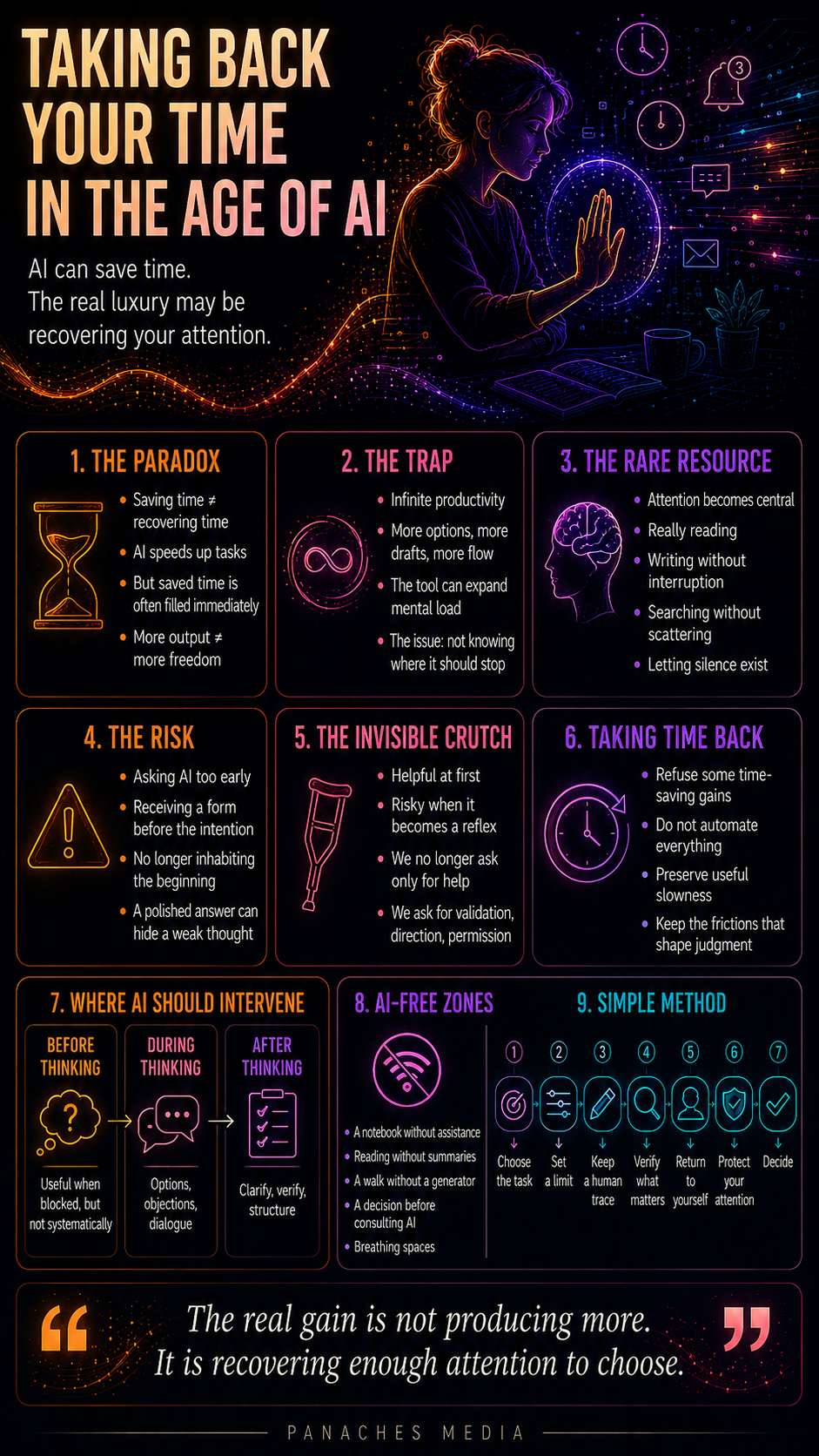
AI promises to save us time
This is one of the great promises of artificial intelligence.
Saving time.
Summarizing a document in a few seconds. Writing a draft in one minute. Turning notes into an outline. Generating code. Sorting ideas. Preparing an email. Creating an image. Automating a repetitive task. Getting an answer without searching for an hour.
On paper, it sounds beautiful.
And in many cases, it is true.
AI can genuinely reduce a long task to a few minutes. It can unblock work, accelerate research, give a first structure, and prevent us from starting from zero.
But a strange question appears very quickly:
If AI saves us so much time, why do we sometimes feel like we have even less?
That may be where the topic becomes interesting.
Because the issue is not only the time AI saves.
It is what we do with that time.
Saving time does not mean recovering time
There is a difference between saving time and recovering time.
Saving time means completing a task faster.
Recovering time means regaining mental space, calm, choice, availability.
AI can do the first.
It does not guarantee the second.
We can summarize a text faster, then read ten more texts. Write an email faster, then answer three times as many messages. Code faster, then launch more corrections. Produce more content, then publish it, adapt it, translate it, measure it, recycle it. Automate a task, then spend the evening configuring the automation.
This is the classic paradox of powerful tools.
When a task becomes easier, we do not always do less.
We often do more.
Faster. More often. Longer. With more pressure.
AI does not automatically free time.
It increases our production capacity.
And if that capacity is not framed, it can simply make the cage bigger.
The trap of infinite productivity
AI arrives in a world that is already saturated.
Too many tabs. Too many apps. Too many notifications. Too many messages. Too much content. Too many tasks. Too many open projects. Too many things to “quickly check”.
It does not arrive in a silent monastery with three neatly arranged notebooks.
It arrives in a permanent flow.
And if we use it without distance, it can add even more flow.
More ideas. More drafts. More variations. More paths. More files. More decisions. More things to sort.
AI can produce ten options when we were already struggling to choose one.
It can turn a simple question into a branching tree.
It can open doors.
Then doors behind the doors.
Then doors into rooms where someone has already installed Notion, three Kanban boards, and a chatbot asking whether you want to optimize your morning.
Infinite productivity then becomes fatigue.
Not because the tool is bad.
But because we have not decided where it should stop.
Attention becomes the scarce resource
For a long time, productivity was discussed as if the main problem were organization.
Planning better. Sorting better. Automating better. Prioritizing better. Synchronizing better.
All of that remains useful.
But with AI, another resource becomes central: attention.
Being able to stay with an idea.
To truly read.
To write without interrupting yourself.
To search without scattering.
To create without asking for an answer too quickly.
To take the time not to know.
Attention is not only a mental capacity.
It is an inner space.
And that space is fragile.
AI can protect it when it reduces noise, simplifies a task, clarifies a mass of information.
But it can also damage it if it becomes an automatic answer to every friction.
As soon as something blocks, we ask.
As soon as something is blurry, we ask.
As soon as something is slow, we ask.
As soon as something requires effort, we ask.
Little by little, we no longer tolerate the silence between the question and the answer.
Yet this silence is often where thought works.
The risk: no longer inhabiting the beginning
Creating, learning, writing, or deciding often begins in an uncomfortable zone.
We do not know yet.
We circle around.
We search.
We write a bad sentence.
We cross it out.
We reread.
We doubt.
We feel there is something there, but it is not clear yet.
That zone is slow.
And AI is very good at shortening it.
That is convenient.
But sometimes dangerous.
Because the beginning of a piece of work is not only an unpleasant step to remove.
It is also the moment when we discover what we are really looking for.
If we ask AI to begin too quickly, we may receive a form before we have clarified the intention.
And a clean form can hide a weak intention.
The text exists.
The outline exists.
The image exists.
The answer exists.
But is it still our thought that has started moving?
Or only a proposal we are now trying to inhabit afterwards?
AI can become an invisible crutch
A crutch is useful when we need it.
The problem begins when we forget we are walking with one.
AI can become that invisible crutch.
We ask it to reformulate. Then to begin. Then to structure. Then to decide between two options. Then to tell us what to think about a topic. Then to reassure us about our idea. Then to give us a direction. Then to check whether our direction is good.
At each step, the use seems reasonable.
But the whole can shift our center of gravity.
We are no longer only asking for help.
We are asking for permission.
Validation.
Constant support.
And this can touch very different areas: work, writing, personal choices, organization, learning, relationships, creativity, confidence.
AI then becomes less a tool than a reflex.
And a reflex is not always freedom.
The problem is not asking for help
Let us be clear: asking AI for help is not a problem in itself.
We already use tools to think.
Books. Notebooks. Search engines. Conversations. Mind maps. Software. Teachers. Friends. Notes stuck everywhere with questionable optimism.
Human thought has always been equipped.
So the problem is not assistance.
The problem is automatic delegation.
Using AI to clarify an idea is useful.
Systematically asking it to produce the idea before us is something else.
Using AI to compare options is useful.
Asking it to choose because we no longer want to carry uncertainty is something else.
Using AI to summarize a document is useful.
Never reading slowly anymore is something else.
The boundary is not always obvious.
But it exists.
And it deserves to be looked at.
“Saved time” can become colonized time
When a tool saves time, two things can happen.
First possibility: we recover that time to breathe, learn, create, walk, read, sleep, think, live.
Second possibility: that time is immediately filled with something else.
One more task.
One more project.
One more correction.
One more notification.
One more optimization.
One more “while we’re at it”.
In many professional environments, the second option wins.
Productivity creates a new norm.
What took a day must now take two hours.
What took two hours must now take ten minutes.
What took ten minutes becomes automatic.
And what becomes automatic sometimes disappears from the recognition of work.
The time saved does not always return to the person.
It can be absorbed by the system.
This is a social question as much as a personal one.
AI does not only change our relationship to tasks.
It changes our relationship to expectations.
Reclaiming time begins by refusing some gains
It may sound paradoxical.
But reclaiming time in the age of AI sometimes requires refusing certain time gains.
Not all of them.
Some of them.
Refusing to automate a task that helps us understand. Refusing to generate a text when we need to hear our own voice. Refusing to summarize a book we truly want to read. Refusing an immediate answer to let an idea mature. Refusing ten variations when two are enough. Refusing to optimize every minute.
This is difficult, because our era loves efficiency.
But not all efficiency is good.
There are useful slownesses.
Frictions that shape judgment.
Repetitions that train the hand.
Empty moments that allow an idea to surface.
Silences that are not wasted time.
AI can accelerate many things.
But not everything deserves to be accelerated.
Knowing where AI should intervene
A good method is to decide when AI intervenes.
Before thought?
During thought?
After thought?
These three positions do not produce the same effect.
Before thought
We ask AI to start.
This is useful if we are blocked, tired, or facing a very mechanical task.
But it can weaken intention if used systematically.
During thought
We use AI as a partner.
We ask for options, objections, reformulations, examples.
This is often the richest use.
The human remains in motion.
After thought
We already have an idea, a note, an outline, a draft.
AI helps improve, verify, clarify, translate, structure.
This is often the safest use.
The direction already exists.
The tool comes to help, not to take the wheel.
So the question is not only:
Am I using AI?
But:
At what moment do I let it enter?
Building AI-free zones
As AI becomes available everywhere, it may become necessary to create AI-free zones.
Not out of rejection.
Out of hygiene.
A notebook where we write without assistance. A first half-hour of research without a generator. Reading without a summary. A walk without asking for ideas. A sketch without generated references. A moment of decision before consultation. A human conversation without automatic mediation.
These zones are not anti-technological.
They are breathable spaces.
They remind us that thought can still begin alone.
They help distinguish what comes from us, what comes from the tool, and what is born from the dialogue between both.
In an assisted world, having unassisted spaces can become a form of lucidity.
Not a step backward.
A way to keep a center.
Do not turn every problem into a prompt
This is probably one of the simplest rules.
Not every problem deserves a prompt.
Some questions deserve to be written slowly.
Some answers deserve to be searched for in a book.
Some emotions deserve to be spoken to someone.
Some decisions deserve a night of sleep.
Some ideas deserve to remain blurry a little longer.
AI is available.
That is not a reason to invite it everywhere.
There is a form of maturity in asking:
Do I need an answer right now?
Sometimes, yes.
Sometimes, no.
And sometimes, the immediate answer is precisely what prevents the real answer from appearing.
Mental autonomy as a new luxury
For a long time, luxury was associated with access.
Access to more information. More tools. More content. More speed. More services. More automation.
But when everything becomes available, luxury changes shape.
Luxury may become:
- knowing how to cut;
- knowing how to wait;
- knowing how to read slowly;
- knowing how to choose little;
- knowing how not to answer immediately;
- knowing how not to optimize everything;
- knowing how to preserve attention;
- knowing how to think without constant assistance.
In a world saturated with intelligent tools, mental autonomy can become a form of wealth.
Not because we should refuse AI.
But because we must avoid abandoning the center to it.
AI can be everywhere around.
It does not have to be everywhere inside.
The right use: accelerating without getting lost
So how can we use AI without being absorbed by it?
A simple method can help.
Choose the task
Before opening the tool, say what you want to do.
Not “I’m going to ask AI”.
Rather:
I want to summarize this document. I want to compare two options. I want to clarify this outline. I want to find objections. I want to translate this version.
The task should come before the tool.
Set a limit
Time, number of answers, number of variations, level of detail.
For example:
Give me three options, not twenty.
Limiting protects attention.
Keep a human trace
Write down your own criteria before reading the answer.
This prevents AI from silently imposing its own.
Verify what matters
Facts, sources, dates, logic, consequences, decisions.
The higher the stakes, the more serious the verification.
Return to yourself
After AI’s help, ask:
What do I keep? What do I refuse? What do I really think now?
That is where the work becomes personal again.
AI should serve human rhythm
The rhythm of the machine is not the rhythm of thought.
AI can answer immediately.
But not everything should be immediate.
An idea may need a night. A text may need a slow reread. A drawing may need several attempts. A decision may need silence. An intuition may need time to become clear.
Speed is a tool.
Not an absolute value.
We can use AI to accelerate what deserves to be accelerated.
But we must also protect what requires slowness.
Creation, learning, understanding, judgment, relationship to the world cannot be reduced to execution time.
Some things do not become better because they are faster.
They become better because they were given enough space.
Reclaiming time is not refusing the present
This is not about becoming anti-AI.
Nor about playing the digital monk in a rough robe, stern gaze, and Wi-Fi switched off on principle.
AI is here.
It is useful.
It can help us create, understand, organize, code, learn, search, translate, produce.
The point is not to refuse the tool.
The point is to refuse absorption.
Using AI without giving it all the space.
Accelerating without dissolving into speed.
Receiving help without losing the ability to begin.
Automating without forgetting what shapes judgment.
Saving time without immediately giving it to something else.
It is a balance.
Not a heroic posture.
A daily practice.
Keeping control of attention
In the age of AI, reclaiming time does not only mean organizing a calendar better.
It means keeping control of attention.
Knowing when to ask.
Knowing when to search by yourself.
Knowing when to let something rest.
Knowing when to read slowly.
Knowing when to refuse an answer that is too fast.
Knowing when the tool truly helps.
Knowing when it only fills the void.
AI can become a remarkable instrument of clarity.
But only if it stays in its place.
Around thought.
With thought.
Sometimes after thought.
Not always instead of thought.
The real gain may not be producing more.
Nor answering faster.
Nor automating every gesture.
The real gain is recovering enough inner time to choose what deserves our attention.
Because in the end, reclaiming your time in the age of AI is not slowing down out of nostalgia.
It is taking direction back.
It is deciding what enters.
What waits.
What matters.
And what, despite all the machines in the world, still has to pass through us.