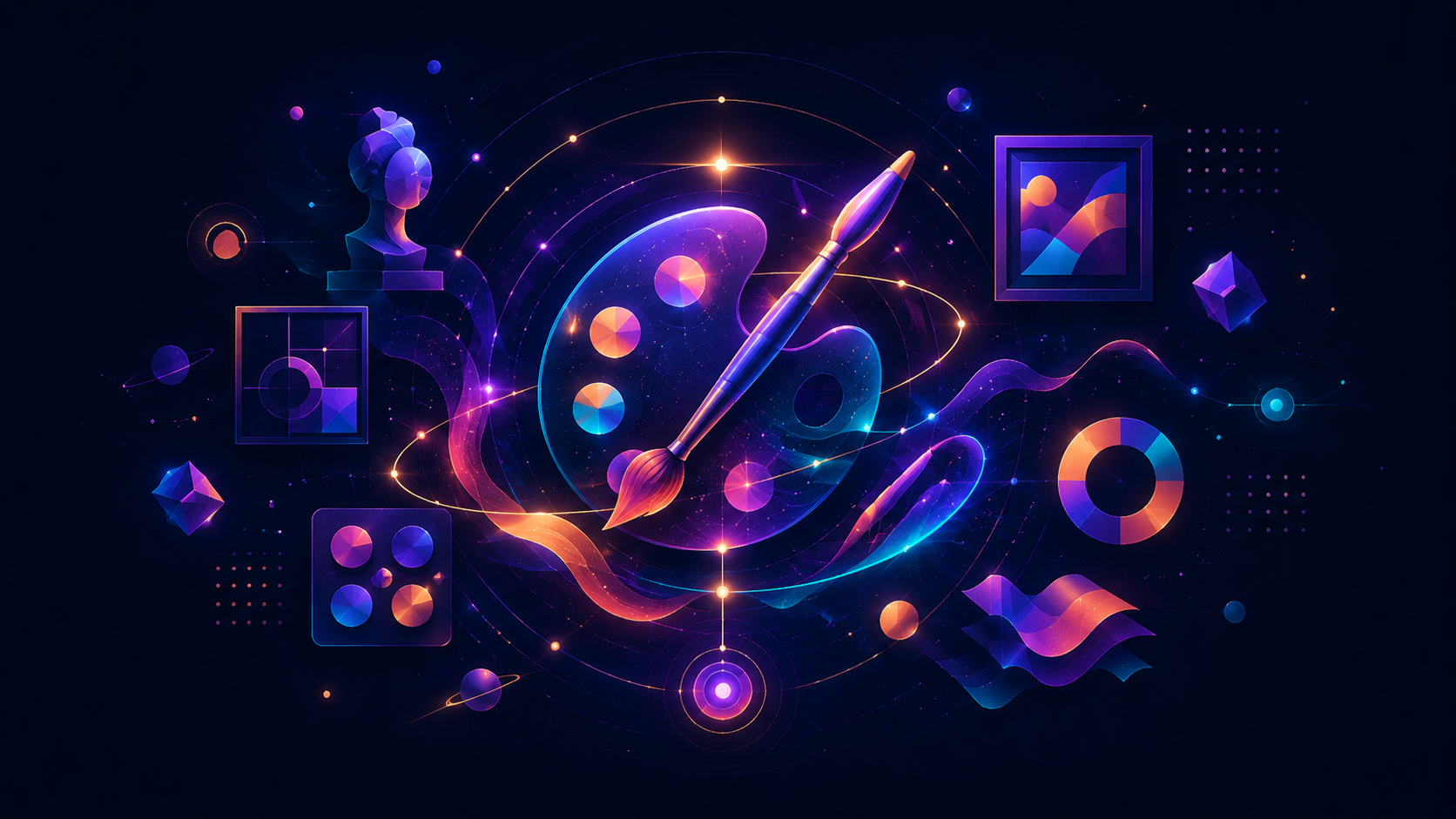
An artwork does not only give us something to see.
It opens a way of looking.
A color we would not have dared to use. A form that resists. A material that tells almost as much as the subject. A gesture, a composition, a light, a silence, a tension.
Art does not only decorate the world.
It shifts it a little.
Entering visual thought
Looking at a painting, a sculpture, an installation, a photograph, a print or a textile work is not only about consuming an image.
It is entering visual thought.
There, we encounter choices: what was shown, what was left outside the frame, what was repeated, erased, enlarged, simplified or made strange.
An artwork carries a way of deciding.
It shows a relationship to the world, to matter, to the body, to light, to time, to silence.
And sometimes, it teaches us to see what we were looking at too quickly.
A living reserve for creators
For a creator, these encounters matter.
An artist can teach us how to look at a color. A movement can help us understand an era. An ancient work can illuminate a very contemporary question. A material can make us want to write. A composition can feed an image, a poster, a scene, an interface or a universe.
Art then becomes a living reserve.
Not an image bank to copy.
A space for dialogue.
We observe. We compare. We annotate. We keep a reference. We search for a lineage. We discover a detail that changes everything.
Little by little, visual culture becomes a working tool.
Building a way of seeing
Panaches can support this exploration.
An artwork, an artist, an exhibition or a reference can join an article, a note, a moodboard, an image library or a knowledge base.
The important thing is not to collect everything.
The important thing is to build a way of seeing that can make connections.
Why does this image hold my attention? Which color often returns in my references? Which tension interests me? Which gesture, material or composition could I study? What does this work make me want to understand or create?
These questions turn a reference into active material.
Returning to creation by another path
Looking at art is not moving away from creation.
It is returning to it by another path.
We do not look only to accumulate names, dates or images.
We look to refine our attention.
To recognize intensity. To feel structure. To understand a choice. To open a possibility.
Art feeds creation because it expands the field of what we believe is possible.
It reminds us that an image, a material or a form can think differently than a speech.
Key takeaways
Looking at art is not only about admiring artworks.
It is learning to build a way of seeing: observing, comparing, annotating, connecting and understanding what an artwork shifts in the way we look.
For creators, art becomes a living reserve: a source of forms, colors, materials, compositions, gestures and ideas.
Panaches can help organize this exploration by connecting artworks, artists, notes, moodboards, articles and references inside the same workspace.