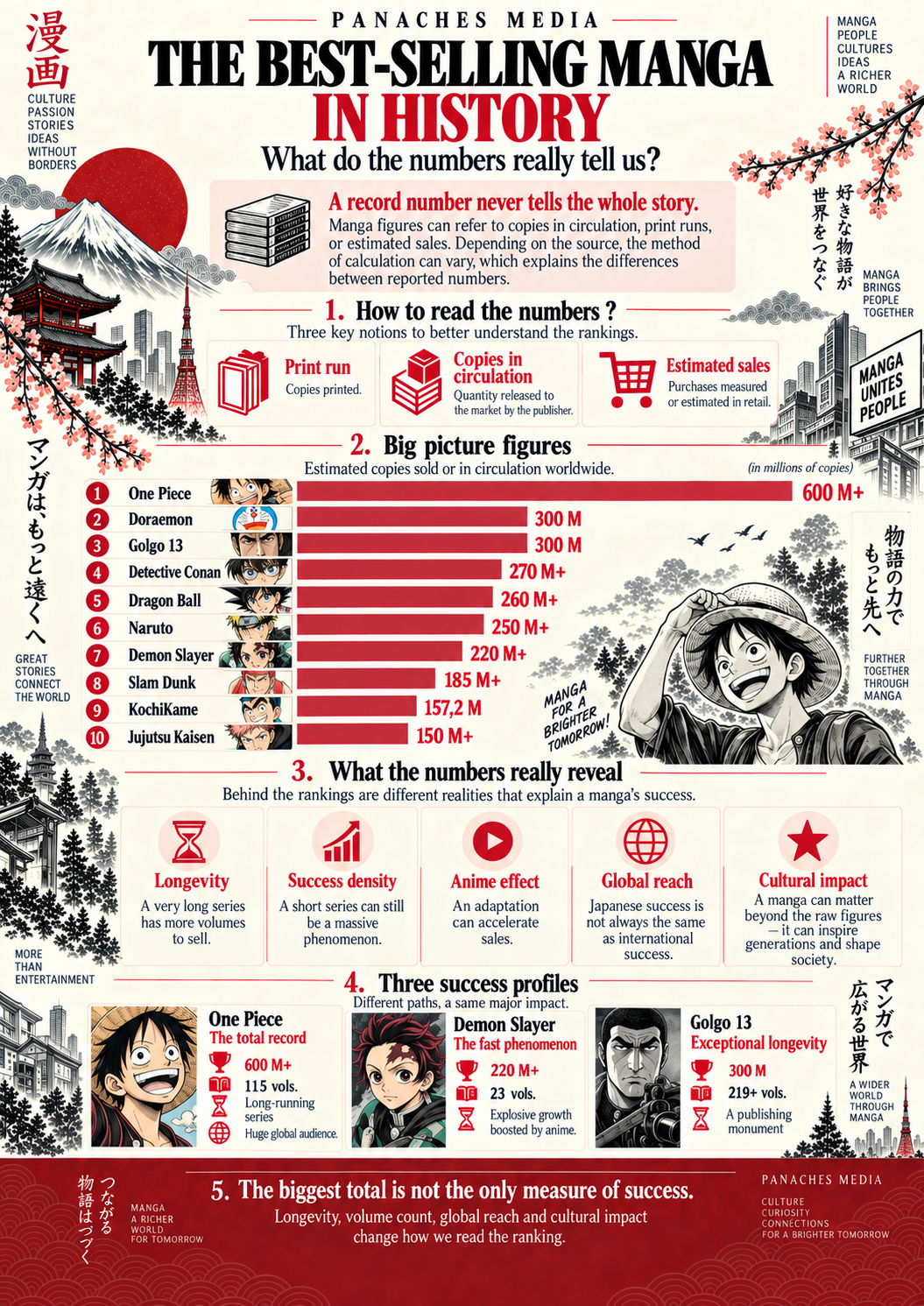
600 million copies… but what exactly are we measuring?
In March 2026, One Piece crossed a threshold that would have seemed almost unreal only a few decades ago: more than 600 million copies in circulation worldwide.
The figure is staggering.
It allows Eiichiro Oda’s series to strengthen its position at the top of manga publishing history, far ahead of most other works. It is also very tempting to immediately turn that figure into a simple ranking: 600 million must surely mean “twice as successful” as 300 million, while a series at 100 million would be six times less popular.
Reality is much more interesting.
A manga published for fifty years and spanning more than 200 volumes cannot be compared directly with a work completed in only 23 volumes. A series distributed mainly in Japan does not tell the same story as a franchise translated into dozens of languages. A figure announced as “copies in circulation” is not necessarily equivalent to purchases recorded at the checkout.
And a work that becomes a cultural monument can sell far fewer books than another without being less important.
Manga figures are not simply a podium. They tell stories of longevity, catalogue strength, the speed of a phenomenon, the impact of adaptation and a work’s ability to cross borders.
Before looking at who dominates, we therefore need to understand what is actually being counted.
Sales, print runs and circulation: three concepts that are often confused
The huge figures associated with manga are regularly presented as “sales”.
That term, however, is often used rather loosely.
When a Japanese publisher announces a cumulative number of copies in circulation, it generally indicates how many copies of the work have been put onto the market, with methods that may vary depending on the period and the company. Some announcements now include digital editions; others concern mainly or exclusively printed copies.
That is not exactly the same thing as a purchase measured from the final reader.
By contrast, organizations such as Oricon work from data collected across thousands of Japanese retail outlets in order to estimate actual retail sales. These statistics are extremely useful for tracking a volume or series over a given period, but they cannot perfectly reconstruct several decades of worldwide sales.
Several indicators therefore need to be distinguished:
| Indicator | What it mainly measures |
|---|---|
| Print run | Number of copies printed |
| Circulation / copies published | Quantity put into circulation according to publisher data |
| Estimated sales | Copies actually purchased, estimated from retail data |
| Digital | Downloads or digital sales when included |
| Worldwide figure | Addition of several territories, sometimes using different methods |
This is why two apparently identical numbers are not always perfectly comparable.
When Shueisha announces 220 million copies for Demon Slayer, the figure explicitly includes digital editions. Historical data for much older series does not necessarily offer the same level of detail.
The ranking remains useful.
But it should be read as a collection of orders of magnitude, not as a perfectly scientific measure of popularity.
The giants: from 150 to 600 million copies
Despite these precautions, some orders of magnitude give a spectacular idea of the scale reached by the biggest series.
Figures available in 2026 place the following works among the most widely distributed manga in history:
| Manga | Reference figure | Main-series volumes | Debut |
|---|---|---|---|
| One Piece | 600+ million | 115 | 1997 |
| Doraemon | ≈300 million | 45 | 1969 |
| Golgo 13 | ≈300 million | 219+ | 1968 |
| Detective Conan | 270+ million | 107+ | 1994 |
| Dragon Ball | 260+ million | 42 | 1984 |
| Naruto | 250+ million | 72 | 1999 |
| Demon Slayer | 220+ million | 23 | 2016 |
| Slam Dunk | 185+ million | 31 | 1990 |
| KochiKame | 157.2 million | 201 | 1976 |
| Jujutsu Kaisen | 150+ million | 30 | 2018 |
These figures were not all announced at the same time and do not all rely on exactly the same methodology. Ongoing series also continue to evolve.
But placing them side by side already reveals something essential:
there are several ways to reach hundreds of millions of copies.
Golgo 13 gets there through extraordinary longevity.
Dragon Ball does it with only 42 volumes.
Demon Slayer with 23.
And One Piece combines almost every possible advantage: longevity, number of volumes, a massive Japanese readership and huge international reach.
One Piece: the absolute record is also a record of longevity
The first impression created by One Piece’s 600 million is one of almost overwhelming dominance.
But the figure becomes more meaningful when we look at how it was built.
The series began in Weekly Shōnen Jump in 1997. In March 2026, when the 600 million threshold was announced with volume 114, it had already been published for nearly three decades.
Shueisha then reported more than 450 million copies in Japan and more than 150 million abroad.
In other words, roughly a quarter of its circulation now comes from outside Japan.
This international growth is especially important. In 2022, when the previous major milestone was announced, One Piece had surpassed 510 million copies. A few years later, around 90 million more had been added to the total.
The record therefore does not come only from a historic launch.
It rests on a remarkable ability to keep recruiting readers after several decades.
Older volumes continue to sell while new ones are released.
Every new reader who decides to begin the series faces more than one hundred potential volumes.
That depth of catalogue is an enormous commercial strength.
A long series mechanically has more books available to sell
This is one of the biggest traps in cumulative rankings.
Take Golgo 13.
With around 300 million copies in circulation, the series holds an exceptional place. But it has existed since 1968 and now exceeds 200 volumes.
A reader following the series over many years can therefore buy a huge number of books.
By contrast, Demon Slayer ended after only 23 volumes.
Its 220 million copies do not exceed Golgo 13’s 300 million in absolute terms.
But when considered against the number of volumes, the result becomes spectacular.
We can make a deliberately simple calculation: divide the announced cumulative figure by the number of main-series volumes. This is not the real average sales figure for each volume — reprints, digital editions and different sales periods make that interpretation impossible — but the ratio helps visualize the publishing efficiency of a shorter series.
| Manga | Cumulative figure | Volumes | Raw ratio per volume |
|---|---|---|---|
| Demon Slayer | 220 M | 23 | ≈9.6 M |
| Dragon Ball | 260 M | 42 | ≈6.2 M |
| Slam Dunk | 185 M | 31 | ≈6.0 M |
| One Piece | 600 M | 114 at the announced threshold | ≈5.3 M |
| Jujutsu Kaisen | 150 M | 30 | ≈5.0 M |
| Naruto | 250 M | 72 | ≈3.5 M |
| Detective Conan | 270 M | 107 | ≈2.5 M |
| Golgo 13 | 300 M | 219 | ≈1.4 M |
| KochiKame | 157.2 M | 201 | ≈0.8 M |
The ranking suddenly looks completely different.
Demon Slayer does not have the highest total in history.
But the density of its success is extraordinary.
This is why comparing cumulative totals alone naturally favours long-running series.
Demon Slayer: one of the fastest phenomena in manga history
The trajectory of Demon Slayer illustrates another way to analyze success: speed.
When its anime adaptation began in April 2019, the manga had around 3.5 million copies in circulation.
A few months later, the phenomenon exploded.
| Period | Announced circulation |
|---|---|
| April 2019 | 3.5 million |
| September 2019 | 12 million |
| December 2019 | 25 million |
| October 2020 | 100 million |
| December 2020 | 120 million |
| February 2021 | 150 million |
| July 2025 | 220 million |
In little more than a year and a half, the series therefore went from a few million copies to more than one hundred million.
The anime acted as a colossal accelerator.
But the phenomenon did not even stop when the manga ended in 2020. Films, new anime seasons, reissues and a constant flow of new readers continued to push the catalogue.
Between February 2021 and July 2025, 70 million additional copies were added even though the main story was already complete.
This is an important reminder:
a finished series can continue growing for a very long time.
Dragon Ball: 42 volumes are enough to cross four decades
Dragon Ball demonstrates yet another kind of strength.
Akira Toriyama’s original series contains only 42 volumes, published between 1984 and 1995.
Yet the manga still exceeds 260 million copies worldwide several decades after serialization ended.
The raw figure is lower than that of One Piece.
But Dragon Ball has far fewer volumes and its main series has been finished for more than thirty years.
Its success therefore depends heavily on what publishing calls the backlist: the books are no longer new releases, but they continue to find new readers.
The anime, films, video games, Dragon Ball Super and the broader franchise keep the original work constantly visible.
A manga can therefore continue selling not because it is still publishing new chapters, but because each new generation discovers the old ones.
The records belong to several generations
Looking at the debut dates of these giants also tells the history of manga.
Doraemon and Golgo 13 began in the late 1960s.
KochiKame arrived in the 1970s.
Dragon Ball belongs to the 1980s.
Slam Dunk and Detective Conan emerged in the 1990s, soon joined by One Piece and Naruto.
Then came much more recent phenomena such as Demon Slayer and Jujutsu Kaisen.
This chronology shows that records are not reserved only for works that benefited from fifty years of sales.
The contemporary market can produce much faster accelerations.
Digital distribution, international releases closer to Japan, streaming and social networks now allow a series to become global within a few years.
The advantage of longevity has not disappeared.
But the speed of propagation has changed.
Why does shōnen dominate the top so heavily?
Another feature stands out immediately in the biggest rankings: the massive presence of shōnen.
One Piece, Detective Conan, Dragon Ball, Naruto, Demon Slayer, Slam Dunk, KochiKame and Jujutsu Kaisen were all published in magazines historically aimed at a young male readership.
That does not mean they are read only by boys.
And it certainly does not mean that shōnen is a genre.
As we saw in our article on manga classifications, it is first and foremost an editorial category linked to the target audience of a magazine.
This dominance has several historical explanations.
Major shōnen magazines reached enormous circulations, sustained long-running serializations and produced some of the most powerful franchises in Japanese animation. Their model also favours stories capable of accompanying readers for years.
But the top is not exclusively shōnen.
Golgo 13 belongs to seinen, while Doraemon belongs to a children’s publishing tradition.
And the relative absence of shōjo or josei among the very highest figures obviously does not mean they have played a minor cultural role.
Works such as Sailor Moon, Nana and Hana Yori Dango shaped several generations and profoundly influenced international manga culture without needing to reach 200 or 300 million copies.
Japanese success and global success do not tell the same story
Another trap is assuming that an enormous Japanese success automatically becomes an enormous international success.
That is not always the case.
Some series hold a monumental place in Japanese publishing history while remaining much less visible in certain foreign markets.
KochiKame is an excellent example. With more than 150 million copies and forty years of serialization in Weekly Shōnen Jump, its importance in Japan is considerable. Yet its global cultural footprint is very different from that of Naruto or Dragon Ball.
Golgo 13 presents a similar case: its roughly 300 million copies reflect extraordinary success, but its international cultural presence is not proportional to its position in cumulative rankings.
By contrast, Naruto is officially reported at more than 250 million copies sold worldwide, and the work has extremely strong recognition outside Japan.
One Piece even allows both dimensions to be measured directly: of the 600 million announced in 2026, more than 150 million concern foreign markets.
Demon Slayer shows a similar split: out of 220 million copies in 2025, 164 million were attributed to Japan and 56 million to international markets.
Global success is therefore not simply the Japanese figure with a few translations added.
It has become a second commercial life for the work.
Anime can completely change the scale of a manga
The statistics for Demon Slayer make the effect spectacularly visible, but the phenomenon runs throughout the history of modern manga.
An anime adaptation gives a work something the book cannot always achieve by itself: massive and repeated exposure.
The viewer may then want to know what happens next.
They may restart the story from volume one.
They may buy a physical edition after discovering the series through streaming.
When an anime becomes global, that effect is no longer limited to Japan.
Dragon Ball, Naruto, One Piece, Attack on Titan, Demon Slayer and Jujutsu Kaisen each show, in their own way, this constant circulation between screen and page.
But it would be too simplistic to say:
popular anime = manga automatically selling hundreds of millions.
Hundreds of successful anime never reach those figures.
Adaptation acts more like an amplifier when it encounters a work already capable of retaining readers over time.
The total number is therefore only one way to measure success
If we truly want to compare two manga, several questions need to be asked at the same time.
The cumulative total shows overall commercial power.
The number of volumes shows how many books are available for each reader to buy.
Speed helps distinguish a sudden phenomenon from a success built over several decades.
The international share reveals a work’s ability to cross borders.
Persistence after the end of the series measures the strength of the backlist.
And cultural influence partly escapes statistics altogether.
Akira, for example, does not need to appear at the top of a ranking measured in hundreds of millions of copies to be considered one of the most important works in the history of international manga.
The same is true of works that transformed a genre, inspired a generation of creators or opened a new market.
A ranking measures how many books circulated. On its own, it does not measure how much a work changed culture.
That is probably the most important distinction to keep in mind.
What the records really tell us
So what is the “greatest” manga?
If we are talking about total circulation, One Piece currently has the most spectacular argument with more than 600 million copies.
If we look at the density of success relative to the number of volumes, Demon Slayer becomes an extraordinary phenomenon.
If we look at longevity, Golgo 13 plays in an almost unique category.
If we look at the ability of a completed work to keep recruiting readers, Dragon Ball and Slam Dunk are remarkable.
And if we are looking for global cultural influence, the figures must be complemented by the history of animation, translation, communities and the works a manga inspired.
Hundreds of millions of copies remain impressive.
But they become much more interesting when we stop treating them as simple trophies.
They tell us how a series survives.
How it crosses a generation.
How an anime can transform its destiny.
How a catalogue can continue living after the final page.
And how a story born in a Japanese magazine can eventually reach readers on every continent.
Manga’s greatest record may not simply be selling hundreds of millions of books. It may be building, generation after generation, a shared language of reading on a global scale.
Main sources
To understand and compare these figures: Shueisha and official announcements relating to One Piece, Demon Slayer and major Weekly Shōnen Jump series; Shogakukan for Detective Conan and historical series from its catalogue; Toei Animation for worldwide Dragon Ball figures; the official Naruto website for the series’ international circulation; Oricon for estimated Japanese bookstore sales; and historical manga circulation lists, used cautiously when official figures come from different dates and methodologies.