
Overview
The Coalition is a Canadian video game development studio based in Vancouver, British Columbia. A member of Xbox Game Studios, it is now entirely dedicated to the Gears of War universe, whose development Microsoft entrusted to the studio after acquiring the franchise from Epic Games in 2014.
The studio, however, has a history that predates Gears.
Created in 2010 under the name Zipline Studios, it later became Microsoft Game Studios Vancouver and then Black Tusk Studios. At that time, Microsoft was still trying to build an identity for the team around new projects. Everything changed in January 2014 when the group acquired the rights to Gears of War from Epic Games and chose Black Tusk to take over the series.
That decision completely redefined the studio.
Rod Fergusson, who had played a major role in producing the early Gears games at Epic Games, joined the team to support the transition. In June 2015, Black Tusk officially became The Coalition, a name directly referencing the Coalition of Ordered Governments — the COG — from the Gears universe.
The new identity was deliberately explicit: in the same way that Turn 10 is associated with Forza, Microsoft wanted The Coalition to become immediately identifiable with Gears of War.
Its first work under this responsibility was to return to the beginning with Gears of War: Ultimate Edition in 2015. The original 2006 game was completely reworked for Xbox One, allowing the team to understand in depth the pacing, mechanics and aesthetics of a series it was now expected to carry forward.
Gears of War 4, released in 2016, then became its first entirely new main installment. The story takes place several decades after the original trilogy and introduces a new generation of characters around JD Fenix, Kait Diaz and Del Walker, while retaining Marcus Fenix as a link to the past.
With Gears 5 in 2019, The Coalition expanded its own interpretation of the series further. Kait Diaz took a central role in the story, some areas became more open and exploration gained importance without turning Gears into a true open-world game. The studio therefore sought to evolve the formula while preserving its core elements: cover, heavy weapons, close-range combat, cooperation and spectacular staging.
The Coalition’s work is not limited to the main campaigns.
The studio supports multiplayer, Horde mode and various additional content. The Hivebusters expansion for Gears 5 notably offers a separate campaign centered on Scorpio Squad. The Coalition also collaborates with other teams on spin-off projects such as Gears Tactics, developed mainly by Splash Damage, and Gears Pop! with Mediatonic.
But one of the studio’s most important characteristics lies on the technology side.
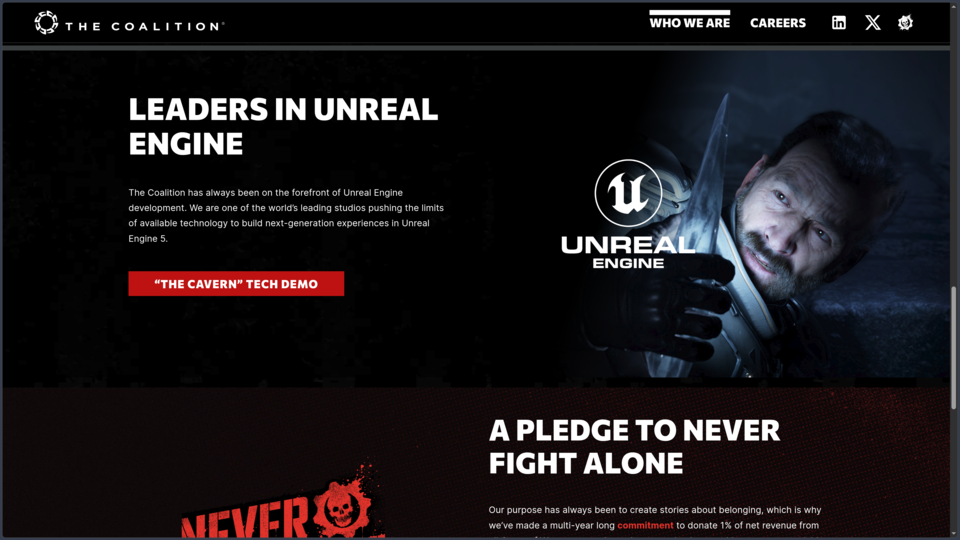
Gears of War has historically had a very close relationship with Unreal Engine, since the franchise was born at Epic Games. The Coalition continues this tradition and gradually became one of the Xbox studios most specialized in the engine.
After several productions using Unreal Engine 4, the team moved to Unreal Engine 5 and took part in exploring its new technologies. The studio notably presented technical demonstrations designed to test geometry, lighting, characters and next-generation environments.
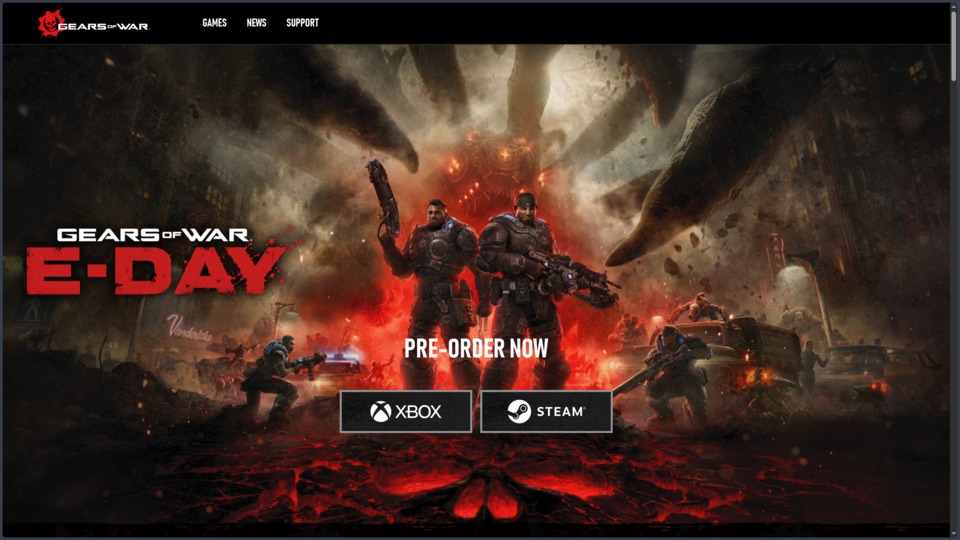
This expertise feeds directly into Gears of War: E-Day.
Revealed in 2024, the game does not immediately continue the story after Gears 5. The Coalition instead chooses to return to Emergence Day, when the Locust first appear on the surface of Sera.
The story takes place fourteen years before the first Gears of War and follows Marcus Fenix and Dominic Santiago at the beginning of their fight against this new threat.
This return to the past allows the studio to revisit the foundations of the series without simply remaking the first installment. The team places the brutality of combat, the horror of the Locust emergence, the bond between Marcus and Dom and a more vulnerable portrayal of characters who are not yet the veterans of the original trilogy back at the center.
E-Day also represents a major technical break.
Unlike previous Coalition productions, which could still reuse various elements inherited from earlier games, the project is rebuilt for Unreal Engine 5 with new environments, models, animations and technical systems.
The game takes place mainly in the fictional city of Kalona, designed with inspiration from Vancouver and its urban, industrial and maritime environment.
In October 2026, Gears of War: E-Day therefore represents both a return to the origins of the franchise and a new technological foundation for its future.
The Coalition remains a highly specialized studio today. Unlike other Xbox teams that work across several franchises, its public identity remains almost entirely tied to Gears of War.
That specialization is precisely what makes it distinctive: the studio does not simply operate a property acquired by Microsoft. For more than a decade, it has become the creative and technical steward of a universe originally created by Epic Games.
History
2010-2012 — From Zipline Studios to Microsoft Game Studios Vancouver
The studio was founded in Vancouver in 2010 under the name Zipline Studios.
Its early activities had nothing to do with Gears of War. The team notably worked on the social game Relic Rescue before being renamed Microsoft Game Studios Vancouver.
It later developed Microsoft Flight, a new interpretation of Microsoft’s long-running flight simulation series.
This first period remained unstable.
In 2012, several projects were discontinued and Microsoft significantly reorganized its Vancouver team.
By the end of the same year, a new identity appeared: Black Tusk Studios.
The ambition changed as well. Microsoft wanted to build a major action production around the studio to strengthen its internal game catalogue.
2014-2015 — Microsoft entrusts Gears of War to Black Tusk
The real turning point came on January 27, 2014.
Microsoft announced that it had acquired the rights to the Gears of War franchise from Epic Games, including the existing games, future projects and various uses of the property.
Black Tusk was given responsibility for developing future installments.
The choice represented a considerable challenge: the studio had to take over a series already strongly associated with another developer and several iconic characters.
To support this transition, Microsoft hired Rod Fergusson, former Gears production lead at Epic Games.
Before creating a new installment, the team worked on Gears of War: Ultimate Edition.
This reconstruction of the first game allowed the developers to study the foundations of the franchise: weapon feel, cover system, camera, combat pacing, character animation and multiplayer.
In June 2015, Black Tusk finally became The Coalition.
The new name definitively established the studio’s new mission.
2016-2019 — Building a new generation of Gears
Gears of War 4 was released in October 2016.
For its first original installment, The Coalition chose not to erase Epic Games’ trilogy. The studio moved the timeline forward and introduced new characters while maintaining a direct connection to Marcus Fenix and the consequences of the war against the Locust.
The game had to find a delicate balance: familiar enough to remain Gears, but different enough to justify a new generation.
With Gears 5 in 2019, the team took greater liberties.
Kait Diaz became the central character for much of the campaign, and her personal story allowed the game to explore the origins of the Locust and the Swarm in greater depth.
The game also introduced larger spaces traveled with the Skiff.
These areas do not make Gears an open-world game, but they alter its pacing by alternating exploration, main missions, secondary objectives and more traditional combat.
The Coalition therefore demonstrated that it could evolve the structure of the series without abandoning its identity as a third-person shooter.
2019-2021 — Expanding Gears and preparing a technical transition
Around Gears 5, the universe expanded in several directions.
Gears Pop! briefly adapted the characters into a mobile game developed with Mediatonic.
Gears Tactics, developed mainly by Splash Damage with participation from The Coalition, transformed the franchise into a turn-based tactics game.
The Hivebusters expansion, meanwhile, returned to a more focused narrative action experience built around a new squad.
At the same time, The Coalition began preparing for a major technological transition.
The studio announced that its future developments would move to Unreal Engine 5.
This decision required rebuilding a significant part of its tools and production methods rather than immediately moving on to another main installment.
2022-2026 — Unreal Engine 5 and a return to Emergence Day
The transition to Unreal Engine 5 became an essential period for the studio.
The Coalition experimented with Nanite, Lumen, new animation systems and the possibilities offered by Xbox Series hardware and contemporary PCs.
The studio developed an internal and external reputation as an Unreal Engine expert, to the point of presenting several technology demonstrations dedicated to the engine.
This phase prepared a project whose direction was finally revealed during the Xbox Games Showcase 2024.
Rather than Gears 6, The Coalition announced Gears of War: E-Day.
The story returns to the moment when the Locust first emerge and follows Marcus Fenix and Dominic Santiago well before the events of the original game.
The choice is not simply an exercise in nostalgia.
The team wants to return to a time when the Locust are still unknown, terrifying and difficult to fight, while showing how the relationship between Marcus and Dom develops during the first days of the catastrophe.
For E-Day, the studio also starts from a much newer technical foundation.
Characters, animations, environments and systems are reworked around Unreal Engine 5, while Kalona provides a dense urban setting designed to support the three days covered by the story.
In 2026, Mike Crump leads The Coalition. The studio remains based in downtown Vancouver and still belongs to Xbox Game Studios.
Gears of War: E-Day enters early access on October 1, 2026, ahead of its worldwide release on October 6 for Xbox Series X|S and PC.
More than ten years after receiving responsibility for the franchise, The Coalition therefore opens a new cycle by returning precisely to its narrative beginning.
What sets it apart
Becoming the steward of a series created by another studio
The Coalition did not create Gears of War.
The foundations of the series come from Epic Games, which developed the original trilogy and built its characters, cover system and visual identity.
The Coalition therefore has a particular task: preserve an existing identity while gradually earning the right to evolve it.
Gears 4 remains relatively close to those foundations, Gears 5 takes greater liberties and E-Day returns to the origins with completely renewed technology.
This progression summarizes a large part of the studio’s history.
Combining creative identity with technological specialization
The Coalition is not only responsible for the content of Gears.
The studio has also developed particularly advanced expertise around Unreal Engine.
This naturally fits the history of the franchise, which was born at Epic Games as a spectacular showcase for the capabilities of its engine.
Today, The Coalition continues that tradition within Xbox using Unreal Engine 5.
Technology is therefore not separate from creation: lighting, animation, destruction, environmental density and character quality directly contribute to the atmosphere of Gears.
Evolving Gears without turning it into another series
The studio regularly experiments, but within deliberate limits.
Gears 5 opens up its environments without becoming an open-world game.
Hivebusters explores another squad without replacing the main heroes.
Gears Tactics changes genre completely while preserving the visual and tactical language of the universe.
E-Day goes back in time without simply remaking Gears of War.
This approach allows The Coalition to expand the franchise while preserving several highly recognizable pillars: brutal combat, cover, cooperation, military camaraderie and cinematic spectacle.
Building its entire identity around Gears
The 2015 name change is particularly revealing.
The Coalition directly references the COG from the Gears of War universe.
The studio therefore does not try to hide its specialization behind a generic brand.
Its public identity, technical expertise and a large part of its internal culture have been built around this franchise.
This is comparable to some other specialized Xbox studios: the developer’s strength comes precisely from an extremely deep understanding of a universe it has supported for many years.
Good to know
- The studio was founded in Vancouver in 2010 under the name Zipline Studios before becoming Microsoft Game Studios Vancouver and then Black Tusk Studios.
- In January 2014, Microsoft acquired Gears of War from Epic Games and entrusted future development to Black Tusk.
- Rod Fergusson, a historic figure in the series at Epic Games, then joined Microsoft to support the transition of the franchise.
- Black Tusk was renamed The Coalition in June 2015, in reference to the Coalition of Ordered Governments in the Gears universe.
- The studio’s first Gears project was Gears of War: Ultimate Edition in 2015, followed by Gears of War 4 in 2016 and Gears 5 in 2019.
- The Coalition also collaborated on spin-off projects such as Gears Tactics and developed the narrative expansion Gears 5: Hivebusters.
- The studio is recognized within Xbox for its Unreal Engine expertise and uses Unreal Engine 5 for its new generation of productions.
- In October 2026, The Coalition is led by Mike Crump and is preparing the worldwide release of Gears of War: E-Day on October 6, following the start of early access on October 1.