

Overview
Founded in 1991 by Tim Sweeney, Epic Games is an American company based in Cary, North Carolina. Its history spans several very different periods of video games: PC shareware, the first 3D engines, AAA console productions, games as a service, digital distribution and, more recently, platforms where players can also become creators.
This evolution makes Epic difficult to reduce to a single activity. The company develops its own games, publishes certain productions, creates Unreal Engine, operates the Epic Games Store, provides technical services to developers and builds around Fortnite an environment intended for both players and creators.
For PANACHES CULTURE, Epic Games is treated here as a video game publisher. This choice corresponds to one of its major functions without implying that every game available on the Epic Games Store is published by Epic or that every game using Unreal Engine belongs to the company.
The distinction is essential.
Epic Games refers to the company.
Epic Games Publishing corresponds to its publishing activity, notably intended to support external studios.
The Epic Games Store is a distribution platform on which many other publishers release their own games.
Unreal Engine is a creation technology used by Epic but also licensed to thousands of external developers.
Finally, studios owned by Epic can develop their own productions without this automatically making every game associated with their history a work developed directly by Epic Games’ historic team.
This multiplicity of roles is not recent. As early as the 1990s, the company developed its own games while distributing titles created by other teams. With Unreal, it gradually added another dimension: the technology built to create its games became a product used by other developers.
This relationship between games, technology and distribution became one of the recurring threads of its history.
Unreal serves to demonstrate Unreal Engine.
Gears of War accompanies the evolution of AAA productions using later generations of the engine.
Fortnite becomes at once a game, a permanent service and an experimentation ground for Epic’s creation tools.
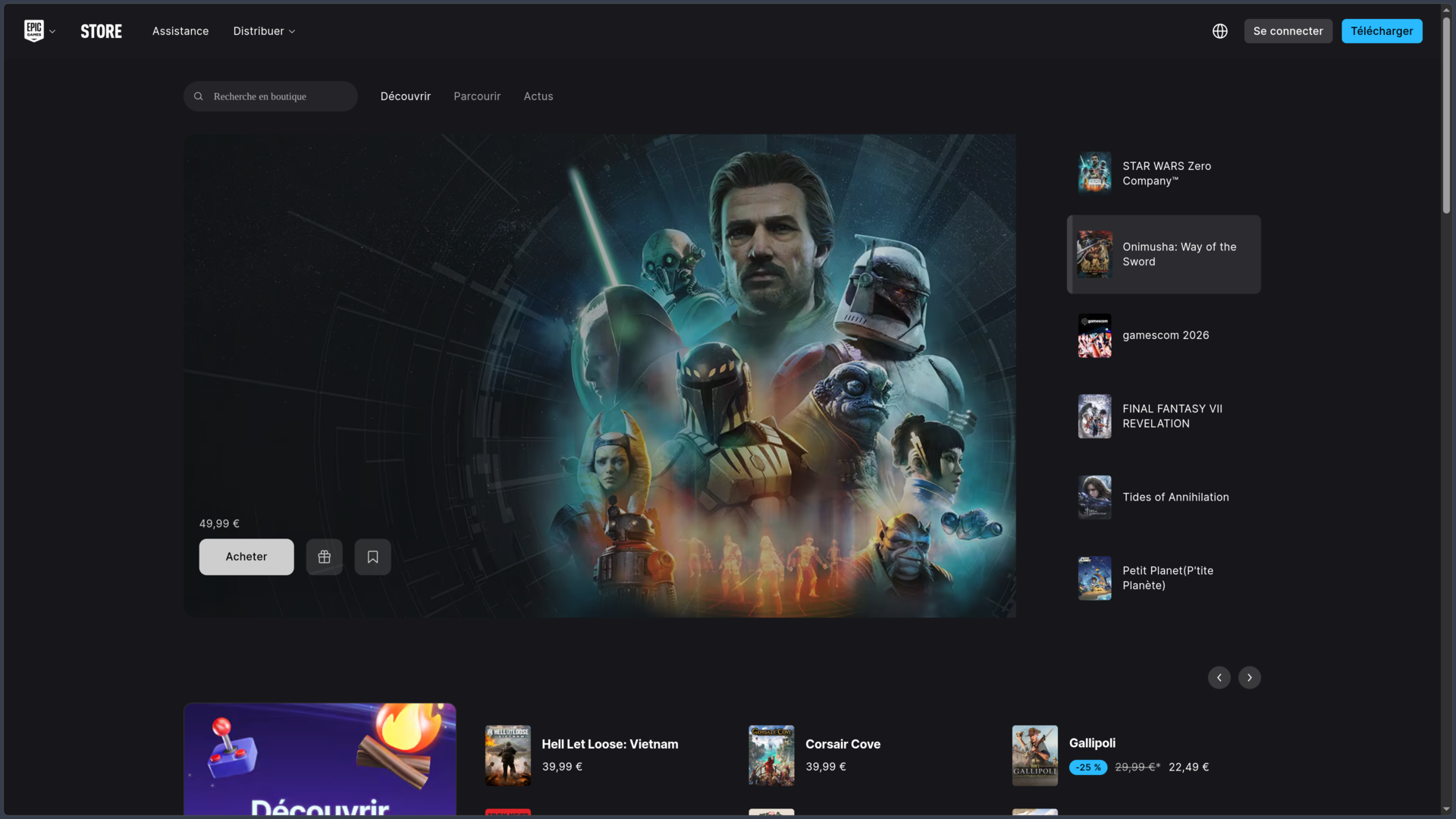
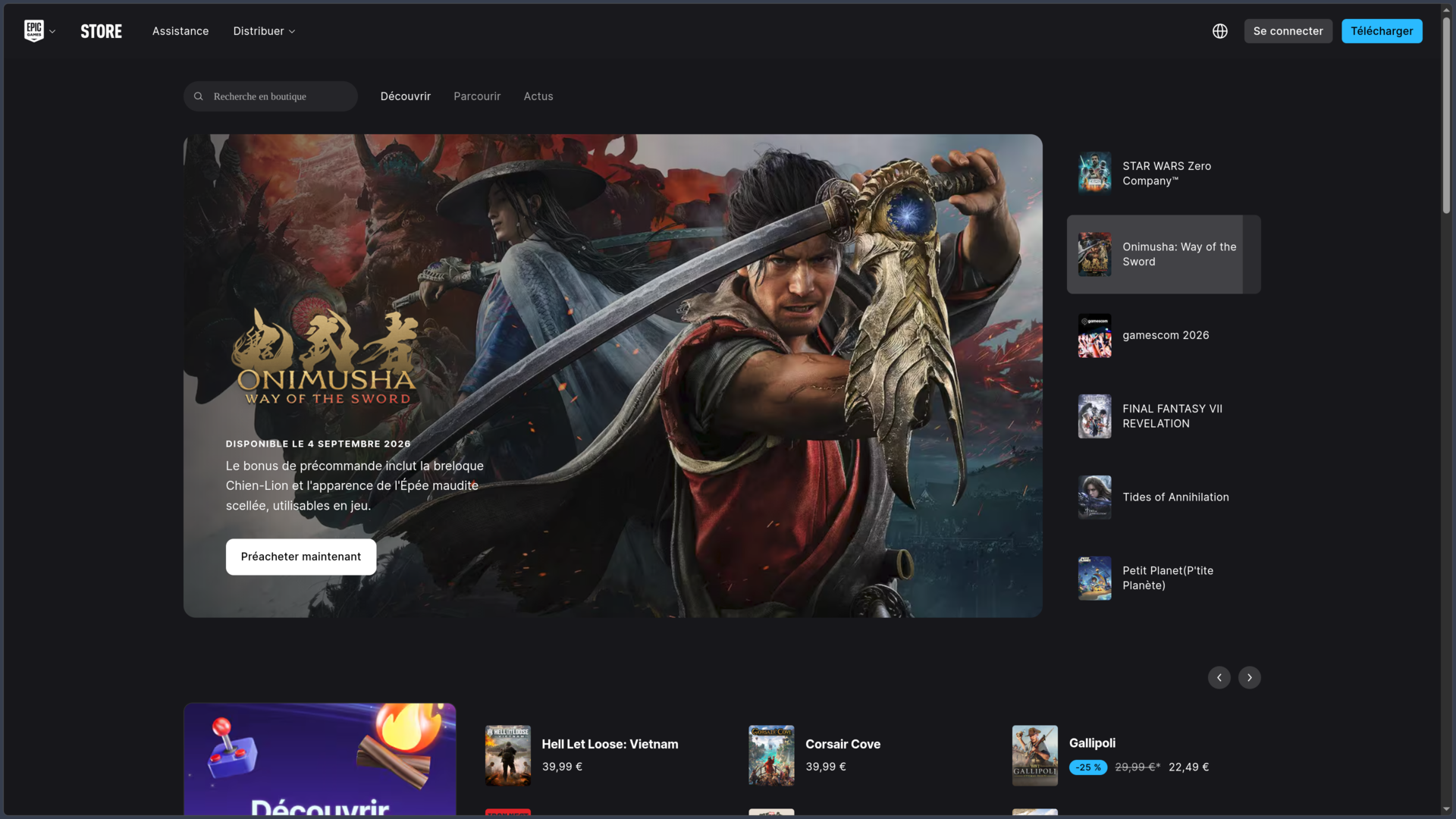
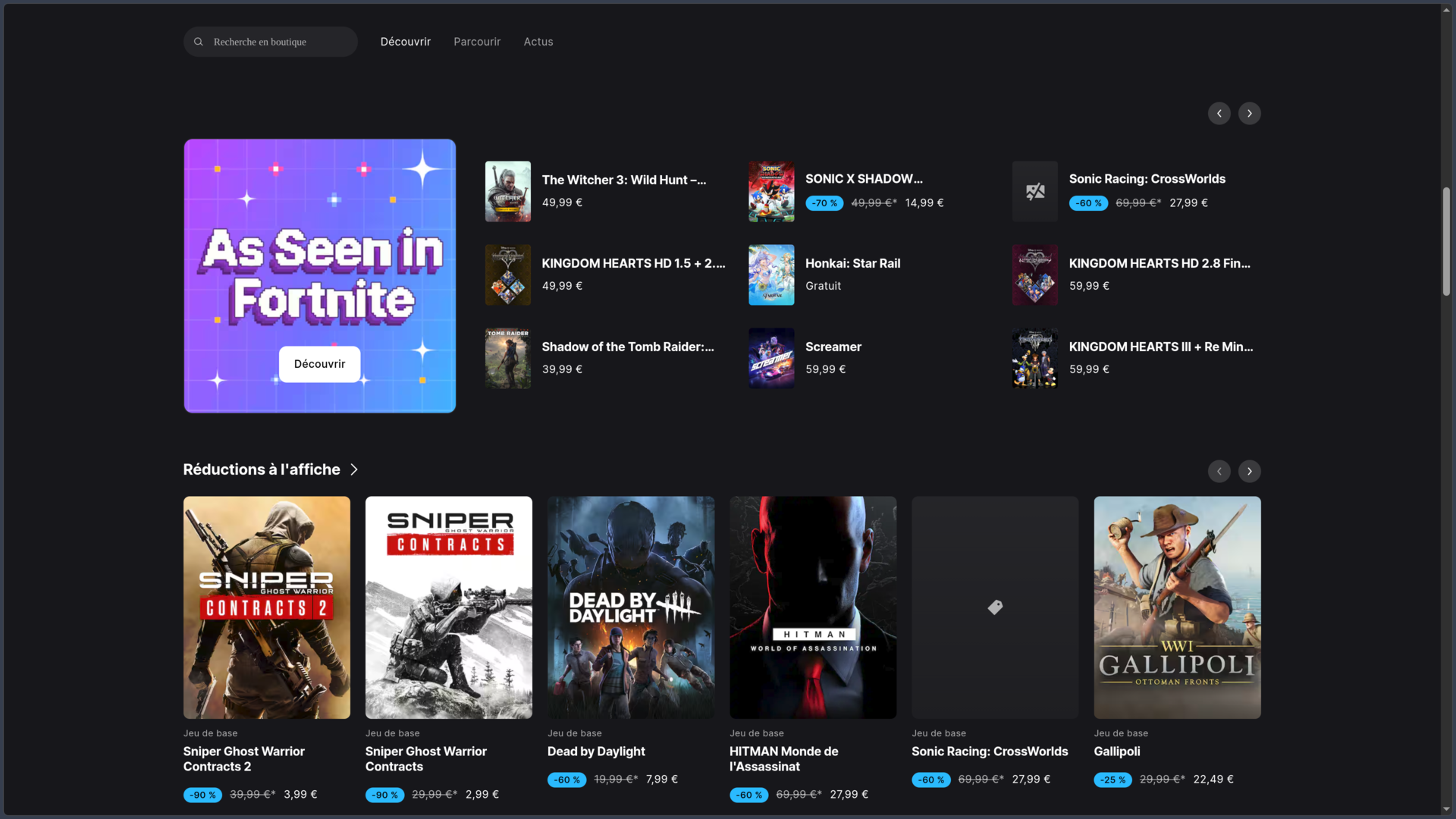
The Epic Games Store gives the company its own distribution infrastructure.
Epic Games Publishing simultaneously allows it to finance and publish productions developed by external studios.
In 2026, Epic itself presents its activity as an ecosystem connecting notably Fortnite, Unreal Engine, Epic Games Store and Epic Online Services. The company therefore remains a publisher, but its contemporary identity goes far beyond the traditional role of simply financing, producing and marketing games.
History
1991-1997: from shareware to Epic MegaGames
The story begins in 1991, when Tim Sweeney founded a small company called Potomac Computer Systems in Maryland.
Its first commercial game, ZZT, was released that same year.
Its operation then reflected the PC culture of the period. Games could circulate as shareware and be distributed directly to users without depending entirely on traditional physical publishing channels.
ZZT also included a system allowing players to create their own content, an idea that, long before Unreal Editor or Fortnite Creative, already placed user creation within the environment of Sweeney’s productions.
In 1992, the company adopted the name Epic MegaGames.
It developed and distributed several PC games during the decade.
Jill of the Jungle, Epic Pinball and especially Jazz Jackrabbit helped build its reputation.
Epic was already operating as more than just a developer. Within this shareware environment, the company also distributed some productions created by other developers.
This first period therefore established three dimensions that would later reappear on a much larger scale: internal development, publishing and tools that allowed content to be created.
But the decisive transformation came with 3D.
Unreal: turning a game into technology
In 1998, Epic MegaGames and Digital Extremes released Unreal.
The first-person shooter was important to the company on two levels.
It was first a major production in a market where FPS games had become one of the driving forces behind technical evolution on PC.
But the name Unreal also became that of the technology developed to build the game: Unreal Engine.
Epic began licensing this technology to other developers.
This decision profoundly changed the nature of the company.
A game normally has a limited commercial lifespan. An engine, by contrast, can be used to build many games made by several companies, then evolve from one generation to the next.
Epic therefore found itself in an unusual position: its own productions served both as standalone games and as demonstrations of the capabilities of technology that could be used by its partners or competitors.
Unreal Tournament, launched in 1999, further increased the visibility of this combination.
That same year, Epic MegaGames officially became Epic Games and established its headquarters in North Carolina.
Its current identity then began to take shape: a game developer capable of transforming the tools it builds for itself into infrastructure for a much broader part of the industry.
The Unreal years and the rise of multiplayer
Between the late 1990s and the mid-2000s, Epic remained strongly associated with the Unreal franchise.
The various Unreal Tournament games emphasized fast multiplayer combat while simultaneously serving as showcases for new generations of Unreal Engine.
This relationship between technology and internal production became structural.
When the engine progressed, Epic’s games could demonstrate its new capabilities.
When the needs of a game required new functions, those functions could enrich the engine.
Epic therefore developed a loop in which creative activity and technological activity reinforced one another.
The company also worked with other studios, including Digital Extremes, and its engine began to be adopted by an increasing number of external productions.
Epic’s role in the industry therefore gradually stopped depending solely on the number of games carrying its name directly.
A growing part of its influence came through games made by other companies using its technology.
Gears of War: becoming a major AAA console player
In 2006, Epic Games released Gears of War on Xbox 360, published by Microsoft Game Studios.
The production marked a new period.
Epic temporarily moved away from its almost exclusive association with PC FPS games to develop a third-person shooter strongly designed around consoles.
The cover system, short- and medium-range combat, spectacular staging and art direction helped give the series an immediately recognizable identity.
Gears of War also played an important role in demonstrating Unreal Engine 3.
The technology became one of the major engines of the Xbox 360 and PlayStation 3 generation, used far beyond games produced directly by Epic.
Several Gears of War installments were then developed with the participation of Epic and partner studios.
But Epic gradually decided to redirect its activities.
In 2014, Microsoft purchased the Gears of War intellectual property from Epic Games, including the rights to existing and future games in the franchise.
Epic therefore left the role of owner of one of its most important series in order to focus its efforts on new projects and its technological evolution.
This sale illustrates an important aspect of its history: properties associated with Epic do not necessarily all remain in its catalogue.
Gears of War is now a Microsoft property.
New models before Fortnite
At the beginning of the 2010s, Epic explored several directions.
The company developed or supported notably Infinity Blade, Shadow Complex and later Paragon.
This period also corresponded to a broader transformation of the market.
Continuous updates, digital stores, free-to-play games financed by in-game purchases and communities capable of remaining around the same title for several years became increasingly important.
Epic began moving away from the model in which an AAA production is developed for several years, sold once and then quickly replaced by the next one.
This transformation reached a completely different scale with Fortnite.
2017: Fortnite transforms the company
Fortnite launched in July 2017 with the experience that would later become Fortnite: Save the World.
A few months later, Fortnite Battle Royale profoundly transformed the trajectory of both the project and the company.
The free-to-play model, seasons, frequent updates and constant evolution of the map created a relationship with players very different from that of Epic’s previous productions.
A game was no longer necessarily a finished product quickly followed by another title.
It could become a service that constantly changes.
Fortnite gradually developed concerts, interactive events, collaborations with other cultural properties and new game modes.
The environment then expanded with experiences created by users.
Epic eventually began presenting Fortnite as a social entertainment ecosystem, in which experiences developed directly by the company coexist with creations produced by the community.
This evolution reconnects, on a vastly larger scale, with an idea present very early in its history: providing players with tools capable of transforming the experience itself.
2018: creating its own distribution platform
On December 7, 2018, Epic officially opened the Epic Games Store.
The store is not used solely to distribute the company’s own productions.
From launch, it hosted games from other developers, including Hades by Supergiant Games, Ashen by A44 and Hello Neighbor: Hide and Seek.
Epic then sought to intervene directly in the economics of digital distribution.
The original model notably relied on an 88/12 revenue split, with the publisher or developer retaining 88% of revenue while Epic received 12%.
The store also developed a regular program of free games financed by Epic in order to attract and retain users.
This creation further changed the scope of the company.
Epic was no longer merely capable of creating a game and the engine used to build it.
It also owned a platform capable of directly distributing its own productions and those of other publishers.
The Epic Games Store must nevertheless be distinguished from Epic’s publishing activity.
A game sold on the store is not automatically published by Epic Games.
On the contrary, the platform hosts thousands of products belonging to many different publishers.
In 2023, Epic broadly opened its self-publishing tools to allow developers and publishers meeting the store’s criteria to manage their own releases directly.
Distribution thus became another form of infrastructure accessible to other companies.
2020: relaunching a true publishing business with Epic Games Publishing
In March 2020, Epic announced Epic Games Publishing, a new multiplatform publishing initiative aimed at external studios.
The first announced partnerships involved Remedy Entertainment, Playdead and gen DESIGN.
Epic then presented a model built around several principles.
The developer retains ownership of its creation and creative control.
Epic can finance up to the full cost of development and marketing.
Once costs are recouped, profits are shared with the developer according to the announced model.
This approach represents an activity different from the Epic Games Store.
In the Store, Epic primarily provides a distribution platform.
With Epic Games Publishing, the company truly acts as the publisher of a project developed by another company.
The first set of partnerships also allowed Epic to reconnect with its own historic experience.
For several years, the company had worked with external publishers to finance or distribute its productions. It could now occupy this position itself for other studios.
Alan Wake 2: putting the Epic Games Publishing model into practice
One of the most visible examples of this strategy is Alan Wake 2, developed by Remedy Entertainment and published by Epic Games Publishing in 2023.
Epic finances the project while Remedy retains the Alan Wake intellectual property and creative responsibility for the game.
This relationship precisely illustrates the distinction between developer and publisher.
Alan Wake 2 is not a game developed by Epic Games simply because Epic finances and publishes it.
Remedy Entertainment remains the developer.
Epic handles the publishing function.
This ability to support external creations complements the company’s other roles: internal development with Fortnite, distribution with the Epic Games Store and technology with Unreal Engine.
In 2026: a publisher at the center of a broader ecosystem
In 2026, Epic Games no longer operates like the relatively traditional PC publisher of its early years.
The company connects several layers of the industry.
Fortnite constitutes its main game and creation environment.
Unreal Engine provides technology used both by Epic and by external developers.
The Epic Games Store distributes games and applications on PC and mobile.
Epic Online Services provides infrastructure that can be integrated into games.
Epic Games Publishing finances and publishes certain productions developed by external partners.
This organization allows Epic to intervene at almost every stage between the creation of a game and its encounter with players.
The company can provide the engine, development tools, online services, a distribution platform and, in some cases, financing and publishing.
It is this combination that defines Epic Games today more than any one of its franchises taken in isolation.
What sets it apart
Connecting creation, technology, publishing and distribution
Epic Games’ main particularity comes from the proximity between several activities that are usually separate.
A publisher can finance games without developing an engine.
An engine developer can provide technology without operating a store.
A distribution platform can sell games without owning major productions of its own.
Epic brings these functions together.
This integration allows it to build tools from problems encountered in its own productions and then make them available to other creators.
It can then distribute the resulting games through its own infrastructure.
The company therefore builds less a chain of independent products than a set of services capable of complementing one another.
Using its own games as technological laboratories
Since Unreal, Epic’s productions have regularly played a dual role.
They must function as games, but they also serve to push the company’s technologies forward.
The first Unreal games helped build and demonstrate Unreal Engine.
Gears of War accompanied the rise of Unreal Engine 3.
Fortnite now serves as a permanent experimentation ground for Unreal Engine and tools intended for creators.
This relationship gives Epic a particular advantage.
The technologies are not developed solely from assumptions about studios’ needs.
The company itself operates productions capable of testing these tools at very large scale.
Moving from published games to a permanent ecosystem
Fortnite represents a major transformation in the way Epic conceives a product.
The company’s early productions were relatively self-contained games.
Even the Unreal or Gears of War series progressed mainly through successive installments.
Fortnite works differently.
The same environment continuously evolves through seasons, modes, events, collaborations and user creations.
The catalogue is no longer made up only of a succession of games.
A single product can become a platform hosting many experiences.
This logic now strongly influences the company’s identity and brings its development, tools and service activities closer together.
Offering developers several levels of publishing relationships
Epic does not have a single model of relationship with external creators.
A developer can use Unreal Engine while publishing their game elsewhere.
They can self-publish their game on the Epic Games Store.
They can use Epic Online Services independently of the engine they choose.
In some cases, they can also enter into a partnership with Epic Games Publishing, where Epic participates directly in financing and publishing the project.
These levels must be distinguished.
Using Epic technology does not mean being published by Epic.
Being available on the Epic Games Store does not mean being published by Epic.
Publishing activity exists when the company genuinely intervenes in financing, marketing and publishing the work.
This open architecture is one of the most distinctive elements of its contemporary model.
Building a publishing business from its experience as a developer
Epic Games Publishing also rests on an unusual historic position.
Epic itself spent a large part of its history working with other publishers.
Unreal, Gears of War and various productions were published with external partners.
When the company relaunched a major publishing business in 2020, it said it wanted to offer developers the terms it would itself have wanted when working with publishers.
The announced model therefore strongly emphasizes the partner studio retaining intellectual property ownership and creative control.
Publishing becomes less a way of absorbing properties created by other teams than a way of financing productions while maintaining a clear separation between publisher and creator.
Good to know
- Epic Games was founded in 1991 by Tim Sweeney in the United States and its current headquarters are in Cary, North Carolina.
- The company began under the name Potomac Computer Systems, used notably to publish ZZT, before becoming Epic MegaGames and then Epic Games in 1999.
- Unreal, released in 1998, gave rise to the franchise of the same name and accompanied the development of Unreal Engine, which became a major part of the company’s business.
- Gears of War, created by Epic and published by Microsoft in 2006, became one of its main AAA franchises before Microsoft purchased the intellectual property in 2014.
- Fortnite launched in 2017 and gradually became a game as a service and then an ecosystem combining experiences developed by Epic with user-created content.
- The Epic Games Store officially opened in December 2018 to distribute Epic’s games as well as those of many external developers and publishers.
- Epic launched Epic Games Publishing in March 2020 with a multiplatform model notably emphasizing that partner developers retain intellectual property ownership and creative control.
- Remedy Entertainment, Playdead and gen DESIGN were among the first studios announced as Epic Games Publishing partners.
- Alan Wake 2, developed by Remedy Entertainment and published by Epic Games Publishing, was released in 2023 and represents one of the major examples of this publishing activity.
- The Epic Games Store opened its self-publishing tools in 2023, allowing eligible developers and publishers to manage their releases directly.
- In 2026, the current standard Epic Games Store terms allow publishers to retain 100% of the first one million dollars in net revenue per product per year, followed by an 88/12 split above that threshold.
- Epic now clearly distinguishes its main activities: Fortnite, Unreal Engine, Epic Games Store, Epic Online Services and Epic Games Publishing, which together form an ecosystem of creation, publishing and distribution.