



Overview
Founded in Stockholm in 2003 by Christofer Sundberg and Linus Blomberg, Avalanche Studios was built around an idea that would remain central to its work: creating vast worlds where game systems allow players to experiment rather than constantly follow a predetermined way of acting. This approach took its first major form with Just Cause, released in 2006, and then became a guiding principle across much of the studio’s production.
Avalanche Studios is not defined solely by the size of its maps. Its identity lies more in the way movement, vehicles, physics, environment and player tools can interact. In Just Cause, this philosophy leads to stunts, vehicle hijacking and destruction capable of producing sometimes unpredictable situations. Mad Max transfers part of this logic into a post-apocalyptic world centered on travel and vehicle combat, while Rage 2, developed with id Software, combines Avalanche’s open-world experience with the American studio’s expertise in shooters.
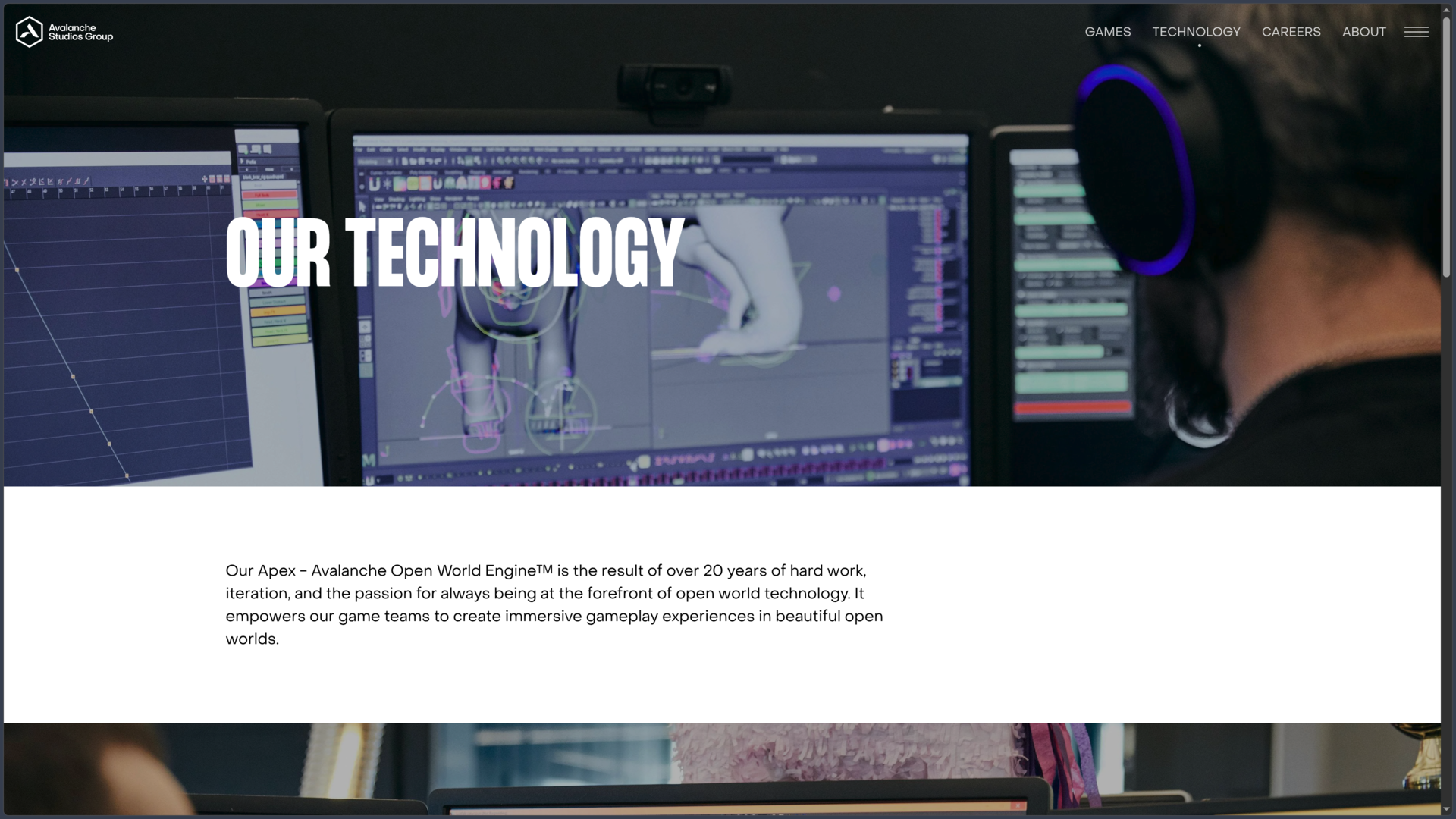
This continuity is closely linked to another component of its history: its proprietary technology. The engine developed from the earliest Just Cause games gradually evolved into Apex – Avalanche Open World Engine. Designed around the needs of the group’s productions, it allows teams to build large dynamic environments while developing tools suited to their own mechanics.
The Avalanche entity has nevertheless changed scale over the course of its existence. Other activities gradually developed around the historic studio, including Expansive Worlds and later Systemic Reaction. The organization is now structured under the name Avalanche Studios Group, while Avalanche Studios remains one of its creative divisions, specifically associated with large-scale open-world action productions.
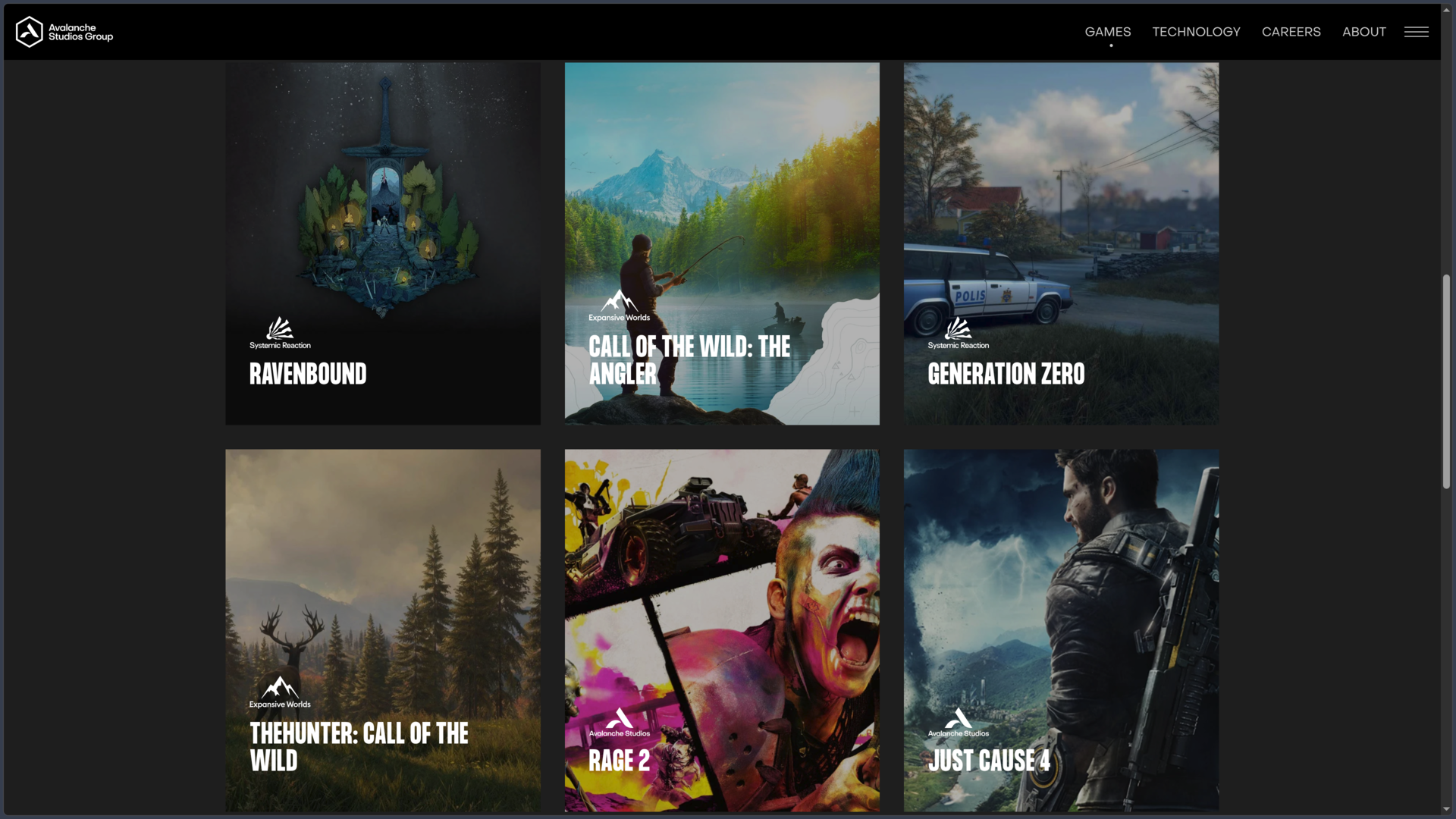
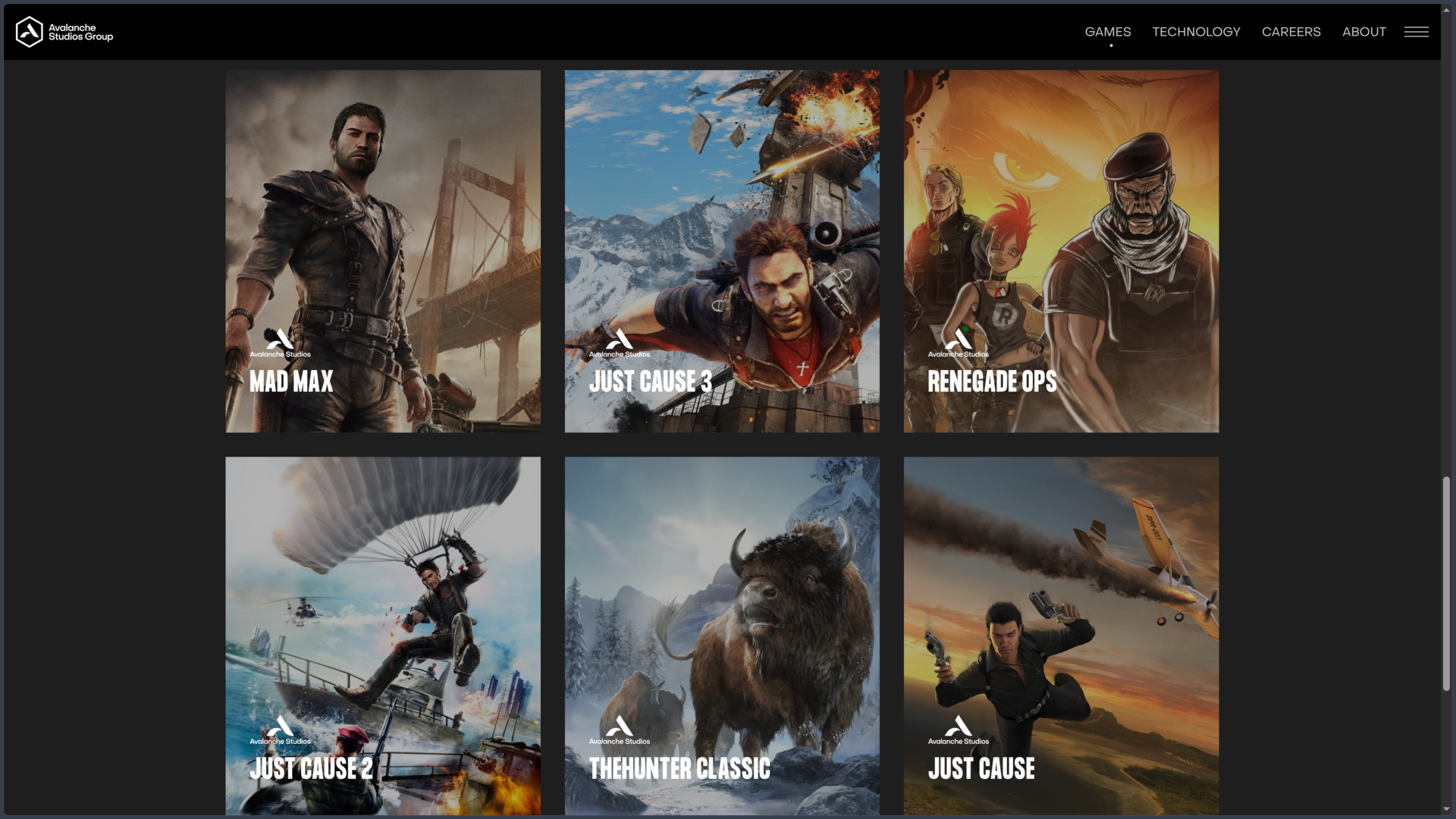
This distinction is essential. theHunter, Generation Zero and Ravenbound belong to the broader history of the group and its other divisions, but they should not be used to artificially turn Avalanche Studios into the direct creator of every production carrying the Avalanche name. The history of the studio itself therefore focuses on its own trajectory: Just Cause, Renegade Ops, Mad Max, Just Cause 3, Just Cause 4 and Rage 2, along with the design methods connecting these projects.
History
2003: building a studio around the open world
Avalanche Studios was founded in 2003 in Stockholm by Christofer Sundberg and Linus Blomberg. From its earliest years, the team worked on what would become Just Cause, a project whose ambition relied less on a traditional sequence of levels than on allowing players to move freely across a large territory.
One of the starting points described by the studio summarizes this philosophy well: allowing the player to perform spectacular actions such as moving onto a vehicle while it is in motion. This seemingly simple idea actually requires numerous systems capable of working together: characters, vehicles, physics, environment, animation and navigation all need to accommodate situations that the player can create relatively freely.
To support this ambition, Avalanche also developed its own technology. The engine used for Just Cause was designed with open worlds as a priority rather than adapted afterward to this kind of structure.
The first Just Cause was released in 2006. Its particularly large territory for the time, numerous means of transportation and freedom given to the player established the foundations of the series. The game did not simply seek to fill a map with missions: it gave movement and improvisation value in their own right.
This first major production established Avalanche Studios as a specialist in a particular form of sandbox where spectacle comes as much from the combination of systems as from sequences written in advance.
Just Cause 2: establishing a gameplay philosophy
With Just Cause 2, released in 2010, Avalanche deepened the ideas of the first game and gave the series several of the mechanics that would become its most immediately recognizable features.
The grappling hook in particular gained a much larger role in movement and interaction. Combined with the parachute, vehicles and the geography of the world, it transformed traversal into a gameplay system in its own right. The player no longer simply used the map to reach a mission: moving through the world could generate situations of its own.
This approach to sandbox design gradually became a signature of the studio. Systems were not meant to function only under conditions anticipated by designers; they needed to combine freely enough to allow events to emerge that nobody had necessarily written as a specific scene.
At the same time, Avalanche explored a more compact project with Renegade Ops, released in 2011. Its perspective and structure differed significantly from Just Cause, but its emphasis on immediate action, vehicles and explosions retained part of the studio’s sensibility.
That same year, Avalanche opened a location in New York. This expansion allowed the company to work on several major productions simultaneously and marked its transition into an international organization.
Mad Max and Just Cause 3: two different readings of the open world
The year 2015 was particularly important with the release of two major productions: Mad Max and Just Cause 3.
With Mad Max, Avalanche worked with an external license and had to adapt its principles to a universe whose codes already existed. The open world remained central, but freedom was expressed differently than in Just Cause. Vehicles became an essential part of survival and combat, while the desert environment directly contributed to the feeling of vulnerability.
The vehicle combat system particularly illustrates this adaptation. Encounters between vehicles rely on physics, collisions, weapons and the configuration of the player’s car. Avalanche therefore uses its experience with large spaces and driving without simply reproducing Rico Rodriguez’s stunts in another setting.
A few months later, Just Cause 3 pushed the studio’s historical formula toward even more spectacular freedom. The grappling hook could now connect different environmental elements to one another, while the wingsuit complemented the parachute and radically changed movement through the world.
These two games show how Avalanche can start from the same fundamental skills and produce different experiences. In one, the vehicle is an essential resource for surviving in a hostile environment; in the other, vehicles, grappling hook, wingsuit and explosives become pieces of an enormous playground.
A new structure and the evolution of Apex
Avalanche’s growth did not concern only its main productions. Other specialized teams gradually appeared around the studio.
Expansive Worlds developed its own identity around theHunter and outdoor experiences, while Systemic Reaction later focused on other forms of sandbox design. These divisions share resources and common technology, but should not be confused with Avalanche Studios itself.
This evolution gradually led to the current organization under the name Avalanche Studios Group, bringing together Avalanche Studios, Expansive Worlds and Systemic Reaction.
The internal engine followed the same transformation. Now called Apex – Avalanche Open World Engine, it became a shared technological foundation. However, it was not designed as a generic engine intended to satisfy every possible use case. Avalanche instead explains that Apex is developed directly around the needs of its own games.
This proximity between engine programmers and production teams makes it possible to design highly specific solutions. The same foundations can therefore support the explosions and weather phenomena of Just Cause 4, the calmer landscapes of theHunter: Call of the Wild or the environments of Generation Zero, even though these games belong to different divisions of the group.
The technology therefore becomes less a simple infrastructure than an accumulated memory of two decades of open-world design.
Just Cause 4 and Rage 2: pushing systems in new directions
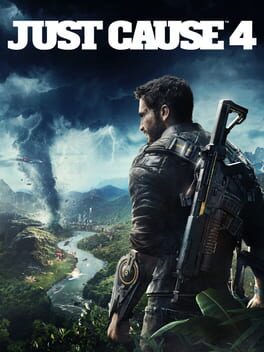
Just Cause 4, released in 2018, continued experimentation around physics and interactions. Extreme weather phenomena, particularly tornadoes, were integrated into the functioning of the world and could interact with objects, vehicles and the player’s tools.
The grappling hook itself became more configurable, offering access to several effects that could be combined. The game therefore pushed the philosophy of the series toward an almost experimental form: the world became a space where the player could deliberately trigger chain reactions.
The same period also transformed the studio’s industrial situation. After acquiring a minority stake in 2017, Nordisk Film acquired all of Avalanche Studios in 2018. The studio retained its identity and creative direction while joining a group with greater financial resources.
In 2019, Avalanche Studios developed Rage 2 in collaboration with id Software. The partnership was based precisely on the complementarity between two areas of expertise. id contributed its experience in first-person shooters, while Avalanche built the open world and the systems connecting encounters across a vast environment.
The result was not a new proprietary Avalanche franchise, but it demonstrated the studio’s ability to apply its sandbox expertise to an external property and development culture.
From a single studio to a division of Avalanche Studios Group
Over the following years, Avalanche’s public identity evolved in order to distinguish its different activities more clearly.
Avalanche Studios became clearly positioned as the division focused on AAA action productions and large open worlds, while Expansive Worlds and Systemic Reaction maintained their own teams and catalogues. This organization makes it possible to preserve a shared heritage without attributing every production to the same studio.
In 2021, Avalanche Studios announced Contraband, developed with Xbox Game Studios Publishing. The project was intended to apply its open-world experience to a cooperative adventure centered on smuggling. Active development was nevertheless stopped in August 2025 while the two partners evaluated the project’s future.
This interruption accompanied a more difficult period for the group. After several phases of international expansion, Avalanche Studios Group closed its New York and Montréal locations in 2024. A further restructuring later led to the closure of Liverpool and workforce reductions in Sweden.
In 2026, the group states that it is now based in Stockholm and Malmö. This contraction changes its organization without erasing the continuity of the historic studio: Avalanche Studios remains presented as one of the group’s three creative divisions and retains its focus on open-world action games.
What sets it apart
The open world as a system rather than simply a map
At Avalanche Studios, the open world is not defined solely by the amount of territory available.
The essential difference lies in how that space can be used. In Just Cause, buildings, terrain, vehicles, grappling hook, parachute and physical objects form a set of systems capable of interacting. The map serves less as scenery connecting missions than as a foundation for the player’s actions.
This philosophy encourages a form of emergent gameplay. A chase can change because a vehicle enters the scene, an explosion moves an object or the player uses the grappling hook in a way different from what was initially anticipated.
Avalanche does not seek to control every second of these situations. Part of their appeal comes precisely from the fact that the systems retain enough freedom to produce their own consequences.
Making traversal a central mechanic
The studio’s productions also place unusual importance on the way players move through their worlds.
In Just Cause, traversal gradually evolves from vehicle hijacking toward much freer combinations of grappling hook, parachute and wingsuit. The player can continuously move between the ground, the air and vehicles without every transition requiring a prescribed sequence.
This fluidity changes the perception of the world’s scale. A large environment only becomes truly interesting if moving through it can itself become a source of play.
Mad Max uses a very different approach but retains this emphasis on movement. The car is not simply a means of reaching an objective: it forms part of progression, combat and the player’s relationship with the territory.
Transportation therefore regularly becomes an extension of the character’s abilities rather than a simple shortcut between activities.
Using physics to create situations
Physics is another recurring component of Avalanche Studios’ work.
It does not serve only to make collisions believable. It allows situations to evolve according to the way systems come into contact with one another.
The stunts and explosions of Just Cause, vehicle combat in Mad Max, grappling-hook attachments in Just Cause 3 and weather phenomena in Just Cause 4 all use this logic to different degrees.
The player receives relatively simple tools whose combinations can produce complex results. Attaching two objects, hijacking a vehicle or using an environmental force can become more interesting than the action originally planned around those elements.
This approach directly contributes to the spectacular nature of the studio’s games without requiring every spectacle to be fully scripted.
An engine built alongside the games
Apex is finally one of the most persistent elements of Avalanche’s identity.
The engine has been developed since the studio’s beginnings and evolves directly alongside its productions. This relationship allows teams to request features corresponding to highly specific needs rather than relying exclusively on the decisions of an external provider.
Avalanche notably presents this proximity as a way of enabling relatively compact teams to produce large open worlds. Programmers working on tools and the engine remain in direct contact with designers, artists and animators.
This organization creates a particular loop: the games push the engine to evolve, while new technical capabilities allow later projects to experiment with other forms of open world.
Apex therefore provides technical continuity across very different productions and remains one of the main elements connecting Avalanche Studios with the other divisions of Avalanche Studios Group today.
Good to know
- Avalanche Studios was founded in Stockholm in 2003 by Christofer Sundberg and Linus Blomberg.
- Just Cause, released in 2006, was the studio’s first major production and established the foundations of its approach to open worlds.
- Just Cause 2, released in 2010, strengthened the importance of the grappling hook, vehicles and free traversal within the identity of the series.
- Avalanche opened a location in New York in 2011, which later contributed notably to Just Cause 3 and Just Cause 4.
- Mad Max and Just Cause 3 were both released in 2015 and demonstrated two very different applications of the studio’s open-world expertise.
- Nordisk Film became the owner of Avalanche Studios in 2018, after acquiring a minority stake the previous year.
- Rage 2, released in 2019, was developed in collaboration with id Software, combining the studio’s open-world expertise with id’s experience in shooters.
- The group’s proprietary engine is now called Apex – Avalanche Open World Engine and continues to be developed directly around the needs of its productions.
- Avalanche Studios is currently one of the three creative divisions of Avalanche Studios Group, alongside Expansive Worlds and Systemic Reaction.
- After several phases of expansion and restructuring, Avalanche Studios Group states that it is based in Stockholm and Malmö in 2026.