Herbie Hancock is an American pianist, keyboardist and composer, and a major figure in modern jazz and fusion. Rising to prominence with Miles Davis during the 1960s, he developed a career shaped by improvisation and electronic experimentation. Albums including Maiden Voyage, Head Hunters and Future Shock reflect his evolution from acoustic jazz toward jazz-funk and electronic music. With Watermelon Man, Chameleon and Rockit, he helped connect jazz, funk and popular music.
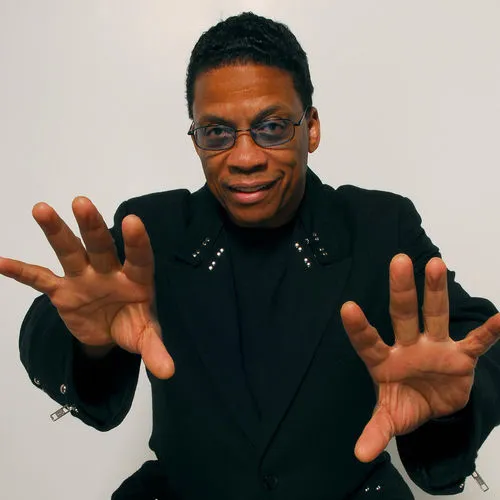
Herbie Hancock
From acoustic piano to synthesizers, jazz in constant motion.
Details
- Type
- Music
- Countries
- 🇺🇸 United States
- Genres
- Funk, Jazz, Jazz fusion, Jazz-funk
- Albums
- 15
Synopsis
Herbie Hancock
Glossary terms: Acoustics, Album, Blues, Classical music, Composer, Composition, Funk, Harmony, Hip-hop, Jazz, Master (recording), Piano, Rhythm, Synthesizer
Trailer
Watch the trailer
Overview
Presentation
Herbie Hancock is an American pianist and composer born in Chicago in 1940. Classically trained, he turned to jazz and began his professional career with trumpeter Donald Byrd. His debut album, Takin' Off (1962), featured Watermelon Man. In 1963, he joined Miles Davis's quintet, alongside musicians including Wayne Shorter, Ron Carter and Tony Williams. Meanwhile, his albums Empyrean Isles (1964) and Maiden Voyage (1965) established his reputation as a composer.
During the 1970s, Hancock explored electric piano, synthesizers and funk rhythms. With Head Hunters (1973), featuring Chameleon and a new version of Watermelon Man, he helped popularize jazz-funk. Thrust (1974) continued this direction. In 1983, Future Shock and its single Rockit incorporated techniques associated with hip-hop, particularly scratching.
Hancock subsequently continued his collaborations and acoustic projects. He composed the score for 'Round Midnight, winning an Academy Award in 1987. His album River: The Joni Letters (2007), a tribute to Joni Mitchell, won the Grammy Award for Album of the Year in 2008.
Key Takeaways
Herbie Hancock is distinguished by his modern harmonies, improvisational freedom and use of electronic instruments. His playing retains a recognizable jazz identity even when drawing on funk, rhythm and blues or hip-hop.
His career connects several transformations of contemporary jazz, from the acoustic explorations of Miles Davis's quintet to the electronic experiments of the 1980s.
Conclusion
Herbie Hancock holds an essential place in the history of jazz and fusion. His work reflects a continuous dialogue between improvisation, technological innovation and popular music.
Did You Know?
- Origins: Chicago, Illinois, United States; born in 1940.
- Instruments: piano, electric piano and synthesizers.
- Major collaborators: Miles Davis, Wayne Shorter, Ron Carter and Tony Williams.
- Landmark albums: Maiden Voyage, Head Hunters, Thrust, Future Shock and River: The Joni Letters.
- Notable compositions: Watermelon Man, Cantaloupe Island, Maiden Voyage, Chameleon and Rockit.
- Cinema: Academy Award for Best Original Score in 1987 for 'Round Midnight.
- Recognition: NEA Jazz Master in 2004 and 14 Grammy Awards, including Album of the Year in 2008.
Link graph
Open in the full graphLoading the graph…
Only the strongest links are shown.
View the list ({count})
Discography
Discography (15)


