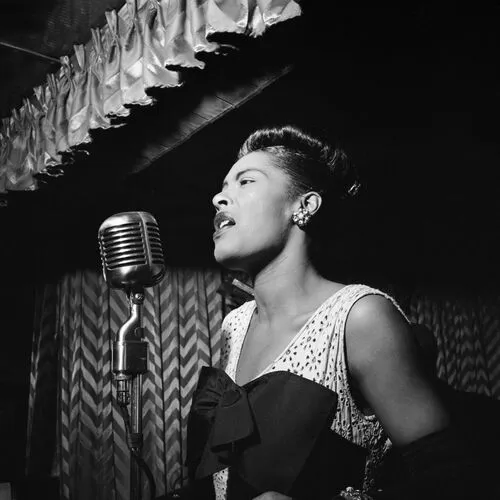
Billie Holiday, nicknamed Lady Day, was an American singer who became one of the most important voices in twentieth-century vocal jazz. Her performances were defined by highly personal phrasing, deep emotional expression and a unique way of shaping rhythm and melody, giving jazz standards and ballads an unmistakable intensity. With songs such as Strange Fruit, God Bless the Child and Lover Man, Billie Holiday profoundly influenced jazz, soul and generations of singers.
Details
- Type
- Music
- Countries
- 🇺🇸 United States
- Genres
- Jazz, Swing
- Albums
- 13
Synopsis
Billie Holiday
Glossary terms: Album, Arrangement, Ballade, Blues, Fundamental, Identity, Interpretation, Interpretation, Interpretation, Jazz, Low register / bass, Melody, Phrasing, Rhythm, Rock, Row / record, Song, Soul, Staff / stave, Story, Swing
Trailer
Watch the trailer
Overview
Presentation
Billie Holiday, born Eleanora Fagan on April 7, 1915, in Philadelphia, was an American jazz and swing singer known as "Lady Day". After spending much of her childhood in Baltimore, she moved to New York and began performing in Harlem nightclubs. Influenced by Louis Armstrong and Bessie Smith, she developed a distinctive approach to singing, using rhythm, pauses and subtle vocal inflections to reshape melodies. Discovered by producer John Hammond, she made her first recordings in 1933 with Benny Goodman before beginning a series of sessions with pianist Teddy Wilson.
During the 1930s, Holiday worked closely with saxophonist Lester Young, who gave her the nickname Lady Day. She also performed with Count Basie's orchestra in 1937 and Artie Shaw's in 1938. In 1939, she performed and recorded Strange Fruit, written by Abel Meeropol as a condemnation of racist lynchings in the United States. The song became one of her defining recordings and a powerful statement against racial violence. Her repertoire continued to grow with God Bless the Child (1941), co-written with Arthur Herzog Jr., Lover Man (1944) and Don't Explain.
Despite racial discrimination, personal hardships and struggles with addiction, Holiday continued recording and performing. During the 1950s, she worked with producer Norman Granz and released albums including Lady Sings the Blues (1956) and Songs for Distingué Lovers (1957). Her later interpretations became increasingly intimate and reflective, particularly on Lady in Satin (1958), recorded with orchestral arrangements by Ray Ellis. She died on July 17, 1959, in New York City, aged 44.
Key Takeaways
Billie Holiday transformed jazz singing through her phrasing, rhythmic placement and ability to reshape melodies without losing their identity. Rather than relying on vocal power, she emphasised nuance, silence and emotional expression. Her singing maintained a close dialogue with instrumental improvisation, particularly the saxophone playing of Lester Young.
Her repertoire combined jazz standards, romantic ballads, blues and socially conscious songs. Through Strange Fruit, she brought a powerful political dimension to her performances during an era of racial segregation in America. Her influence extended beyond jazz into soul, blues and generations of vocal performers.
Conclusion
Billie Holiday holds a fundamental place in the history of vocal jazz. Her rhythmic approach, expressiveness and interpretations transformed popular singing, while her repertoire remains closely connected to the cultural and social history of the United States.
Did You Know?
- Identity: Eleanora Fagan, born April 7, 1915, in Philadelphia and died July 17, 1959, in New York City, United States.
- Nickname: "Lady Day", given to her by saxophonist Lester Young.
- Major collaborations: Benny Goodman, Teddy Wilson, Lester Young, Count Basie and Artie Shaw.
- Signature recordings: What a Little Moonlight Can Do, Strange Fruit, God Bless the Child, Lover Man, Don't Explain, Fine and Mellow and I'll Be Seeing You.
- Notable albums: Music for Torching (1955), Lady Sings the Blues (1956), Songs for Distingué Lovers (1957) and Lady in Satin (1958).
- Protest song: Strange Fruit (1939), a condemnation of racist lynchings, recorded for Commodore Records.
- Autobiography: Lady Sings the Blues (1956), written with William Dufty.
- Distinctive appearance: the white gardenia flowers she frequently wore in her hair.
- Recognition: posthumous Grammy Lifetime Achievement Award in 1987 and induction into the Rock & Roll Hall of Fame in 2000.
Link graph
Open in the full graphLoading the graph…
Only the strongest links are shown.
View the list ({count})
Discography
Discography (13)


