What constitutes true joy, and how can we achieve a life in harmony with the world? In Supreme Joy and Other Texts, a selection of passages from the Zhuangzi, the philosopher explores the relationships between happiness, nature, and the transformations of life. Through philosophical stories, dialogues, and paradoxical situations, he challenges conventional ideas about pleasure, success, and suffering. The Daoist thinker shows that the relentless pursuit of external satisfactions can distance human beings from a deeper joy, grounded in spontaneity and harmony with the Dao. His reflections on non-action, the limitations of judgment, and the acceptance of death invite readers to regard existence as a continuous process of transformation in which everyone participates. This collection thus presents a conception of wisdom in which inner freedom emerges from a more flexible relationship with events and the changing world.
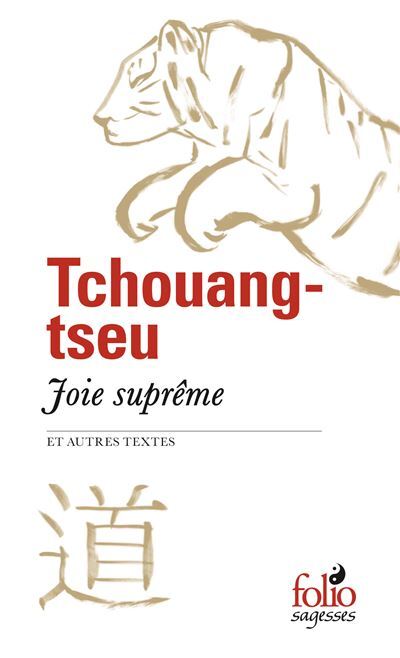
Zhuangzi: Supreme Joy and Other Texts
- Gallimard Publisher
- Tchouang Tseu Author
What if true joy began when we stopped trying to control everything?
Details
- Type
- Book
- Original language
- Chinese
- Genres
- Philosophy
- ISBN
- 9782072794629
- Information verified on
- October 14, 2026
Synopsis
Zhuangzi: Supreme Joy and Other Texts
Glossary terms: Accumulation, Certainty, Chapter, Character, Desire, Dialogue, Existence, Exterior / EXT., Folio, Harmony, Human preference, Humor, Movement, Narrative, Page, Parable, Paradox, Philosophy, Publisher, Reflection, Selection, Self-evidence, Social recognition, Story, Text, Title, Transformation, Treatise, Work, Wu wei
Overview
Overview
In Supreme Joy and Other Texts, Zhuangzi, also known as Chuang Tzu, explores the nature of happiness and the conditions for living in harmony with the world. Published by Gallimard in the Folio Sagesses collection, this volume brings together selected passages from the Zhuangzi, one of the major texts of Chinese Daoist philosophy. Its title is taken from a chapter devoted to the pursuit of true joy. Through stories, dialogues, and paradoxical observations, Zhuangzi's thought challenges the idea that happiness depends on accumulating pleasures, achieving social success, or constantly satisfying one's desires.
The question of supreme joy leads to a criticism of the values commonly pursued by human beings. Wealth, reputation, honors, and comfort may provide satisfaction, but they also make individuals dependent on unstable circumstances. Zhuangzi emphasizes that people often pursue what those around them consider desirable without examining whether these goals truly correspond to their nature. He contrasts this restless pursuit with a form of joy that no longer depends on multiplying pleasurable experiences. This conception finds expression in the paradox of a joy that transcends ordinary forms of pleasure: it lies in a way of living freed from unnecessary expectations and constraints.
At the heart of this reflection lies the Dao, or the Way, a fundamental principle of the natural order and the transformations of the universe. In Zhuangzi's philosophy, all beings belong to a changing world whose movements do not necessarily conform to human preferences. Attempting to impose one's own categories or desires on everything means resisting the natural course of events unnecessarily. Wisdom, by contrast, requires attentiveness to circumstances, adaptability, and trust in natural processes. This attitude is closely related to the principle of wu wei, generally translated as "non-action," which refers to action without artificial constraint rather than a refusal to take any initiative.
The collection also explores the relationships between life, death, and transformation. In a story associated with the chapter Supreme Joy, Zhuangzi reflects on the death of his wife and surprises another character with a response that appears contrary to conventional mourning practices. His reflection does not seek to deny loss, but to place death within a succession of transformations comparable to the changing seasons. Other stories question conventional ideas of happiness and misfortune, showing how deeply they depend on the perspectives adopted. These situations challenge familiar judgments and encourage readers to consider existence within a larger whole that extends beyond individual concerns.
Finally, the texts demonstrate the philosophical power of parables and paradoxes. Characters, animals, and unusual situations serve to question moral conventions and the human tendency to define what is appropriate for everyone. The story of a bird treated according to a ruler's preferences rather than its own needs illustrates the danger of projecting one's desires onto other beings. Humor and reversals of perspective are therefore more than literary embellishments: they require readers to reconsider what seems self-evident. Through this variety of narratives, Supreme Joy and Other Texts presents a philosophy of inner freedom grounded in accepting change and seeking a more harmonious relationship with nature.
Key Takeaways
True joy should not be confused with the pursuit of pleasure. Zhuangzi questions the satisfactions associated with wealth, honors, and social recognition. These advantages remain dependent on circumstances, whereas deeper joy requires greater independence from expectations and desires.
Living in harmony with the Dao means accepting the world's transformations. Existence is shaped by changes that human beings cannot entirely control. Wisdom consists in recognizing this movement and acting according to the nature of circumstances rather than systematically attempting to impose one's will.
Non-action does not mean passivity. The principle of wu wei describes a spontaneous way of acting without excessive effort or artificial interference. It involves developing conduct flexible enough to respond to circumstances without creating unnecessary resistance or disorder.
Life and death belong to the same process of transformation. Zhuangzi invites readers to move beyond overly rigid oppositions between different states of existence. His stories do not deny the reality of suffering, but propose understanding death and change within the broader framework of natural transformations.
Parables reveal the limitations of human judgment. Through humor, unexpected situations, and shifts in perspective, the philosopher questions conventional ideas of happiness, usefulness, and wisdom. What appears beneficial to one individual may not suit another, and human categories cannot always capture the diversity of reality.
Conclusion
With Supreme Joy and Other Texts, Zhuangzi's philosophy approaches the question of happiness through reflections on nature, change, and the illusions that govern human desires. By contrasting inner joy with the relentless pursuit of external satisfactions, the texts show how detachment and spontaneity can transform our relationship with existence.
The collection also highlights an essential feature of Daoist philosophy: its ability to encourage reflection through storytelling rather than systematic argumentation. The paradoxes concerning joy, death, and human conduct invite readers to recognize the limitations of their certainties and to understand wisdom as a way of living in harmony with the transformations of the world.
Good to Know
- Zhuangzi, also known as Chuang Tzu or Zhuang Zhou, was a Chinese thinker traditionally placed in the fourth century BCE. He is one of the leading figures of early philosophical Daoism.
- Supreme Joy and Other Texts is a selection of passages from the Zhuangzi, not a complete translation of the work. The texts are drawn from the French edition of the Complete Works, also published by Gallimard.
- The Gallimard edition, in the Folio Sagesses collection, was released on October 18, 2018, and contains 112 pages, according to the publisher's catalog. An earlier edition under the same title appeared in 2013.
- The translation and annotations are primarily attributed to Liou Kia-hway. Gallimard's bibliographic information also mentions Paul Demiéville among the translators associated with the volume.
- Identifiable passages in the collection include "Heaven and Earth," "The Way of Heaven," and "Supreme Joy." They address the natural order, non-action, the pursuit of happiness, and the transformations of existence.
- The chapter "Supreme Joy" contains stories about death, differences between living beings, and the limitations of conventional ideas of happiness. The anecdote of a bird welcomed by a ruler notably illustrates the mistake of treating another being according to one's own preferences.
- The Zhuangzi is a composite work transmitted over many centuries. Not all its constituent texts can be confidently attributed to the historical Zhuangzi alone. This tradition is distinct from that of the Tao Te Ching, associated with Laozi, although both works are among the major references of Daoism.
Link graph
Open in the full graphLoading the graph…
Only the strongest links are shown.