How can we preserve our inner freedom when confronted with injustice, humiliation, and insults? In On the Constancy of the Wise, Seneca addresses his friend Serenus to defend one of the fundamental principles of Stoicism: a truly wise person cannot be deprived of virtue by external attacks. Drawing on historical examples, particularly that of Cato the Younger, he distinguishes material harm from moral injury and argues that insults, contempt, and reversals of fortune cannot destroy the worth of someone whose conduct remains governed by reason. The philosopher thus examines the difference between suffering an injustice and allowing it to disturb one's judgment. This reflection on steadfastness presents wisdom as an inner strength grounded in virtue, clarity of mind, and independence from external circumstances.
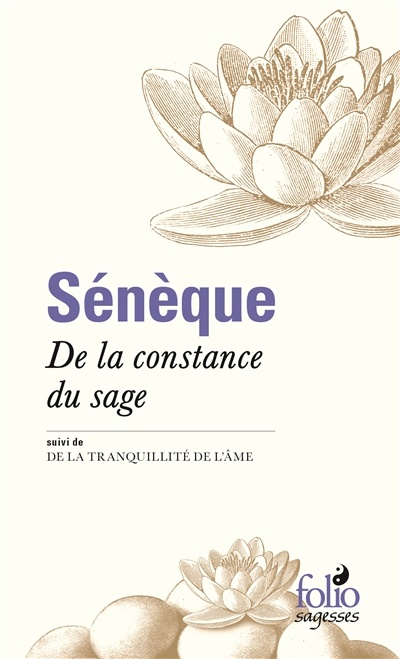
Seneca: On the Constancy of the Wise
- Gallimard Publisher
- Flammarion Publisher
- Sénèque Author
Can we endure injustice without surrendering our dignity or inner freedom?
Details
- Type
- Book
- Original language
- LA
- Genres
- Philosophy
- ISBN
- 9782070302505
- Information verified on
- October 14, 2026
Synopsis
Seneca: On the Constancy of the Wise
Glossary terms: Dialogue, Difficulty, Editorial summary, Event, Example, Existence, Exterior / EXT., Folio, Laisse, Objection, Part, Person, Politics, Proof (printing), Reflection, Ressentiment, Sample, Stoicism, Text, Thesis, Title, Treatise, Work
Overview
Overview
In On the Constancy of the Wise, Seneca explores the human capacity to preserve moral integrity in the face of injustice and personal attacks. Addressed to his friend Serenus, this treatise belongs to the tradition of Roman Stoicism, which regards virtue as the only good truly indispensable to happiness. Seneca defends a deliberately paradoxical proposition: the wise person can suffer neither injury nor insult. This does not mean that such a person is physically invulnerable or protected from misfortune, but rather that external events cannot deprive them of what constitutes their essential worth. Constancy therefore refers to an inner stability that circumstances cannot overthrow.
To illustrate this idea, Seneca draws particularly on the example of Cato the Younger, a Roman statesman presented as a model of moral steadfastness. Despite the public humiliations, violence, and setbacks he faced, Cato is portrayed as having remained faithful to his convictions. Seneca uses this example to answer the objections of Serenus, who finds it difficult to imagine that a person could experience injustice without suffering genuine harm. The philosopher therefore distinguishes material losses, bodily injuries, and political reversals from the destruction of virtue. An individual may be deprived of possessions or external freedom without abandoning the integrity of their judgment.
The treatise develops this argument by distinguishing injury from insult. Injury, or iniuria, refers to a more serious wrong that may cause genuine harm in the ordinary circumstances of life. Insult, or contumelia, concerns mockery, contempt, and humiliation. Seneca observes that human beings are particularly sensitive to expressions of disdain, sometimes suffering more from an offensive remark than from material damage. This sensitivity reveals, in his view, the excessive dependence we place on the opinions of others. The wise person, aware of their own moral worth, does not allow external judgments to determine their self-respect.
This independence rests on the Stoic conception of virtue as an inner good. Seneca maintains that fortune may grant or take away wealth, power, reputation, and even certain conditions of existence, but that it has no authority over the moral integrity of someone who is genuinely wise. He does not deny the reality of pain or physical suffering. Rather, he argues that these experiences do not, in themselves, diminish the moral worth of the person enduring them. Through this distinction, constancy emerges as a strength acquired through the exercise of reason, not as mere insensitivity or passive resignation.
Finally, Seneca extends his reflection to everyday behavior and human relationships. Mockery, contempt, provocation, and injustice may provoke anger and resentment in those who attach excessive importance to how others perceive them. The philosopher contrasts these reactions with mastery of judgment, patience, and the steadfastness of a mind that refuses to be governed by external attacks. By also referring to Socrates and other figures associated with wisdom, he shows that moral greatness reveals itself not through the absence of adversity, but through the way one responds to it. Constancy thus becomes an expression of inner freedom grounded in reason, virtue, and independence from fortune.
Key Takeaways
The wise person cannot be deprived of moral worth by external injustice. Seneca distinguishes harm affecting possessions, the body, or social standing from anything that could compromise virtue. The wise person remains exposed to events but retains the ability to judge and act according to moral principles.
Injury and insult are not identical. Injury refers to a more serious wrong, while insult primarily concerns humiliation, offensive remarks, and expressions of contempt. Seneca shows that such offenses become particularly painful when individuals allow their self-esteem to depend entirely on the opinions of others.
Constancy rests on virtue rather than the absence of suffering. The Stoicism defended by Seneca does not claim to eliminate physical pain or the difficulties of existence. It distinguishes between what happens to a person and what genuinely damages their moral character. The steadfastness of the wise consists in refusing to abandon principles under the pressure of circumstances.
Mastery of judgment protects inner freedom. Unjust behavior, criticism, and provocation should not automatically determine our reactions. By examining the true significance of events and refusing to respond systematically with anger or resentment, individuals preserve their moral autonomy.
Wisdom reveals itself through adversity. The examples of Cato and Socrates allow Seneca to present constancy as a quality tested by hardship. Moral strength does not consist in living without difficulties, but in retaining justice, moderation, and dignity when circumstances become unfavorable.
Conclusion
With On the Constancy of the Wise, Seneca defends a demanding conception of inner freedom. By distinguishing external harm from a person's moral worth, he maintains that injustice and humiliation cannot destroy the virtue of someone who remains faithful to reason. The treatise thus presents constancy as an intellectual and moral strength rather than merely an ability to endure suffering.
This reflection occupies a distinctive place within Seneca's Stoic philosophy. It examines the relationship between the individual, fortune, and the opinions of others while defining wisdom through independence of judgment. The steadfastness of the wise does not consist in controlling events, but in preserving moral integrity when those events lie beyond their power.
Good to Know
- The work's Latin title is De constantia sapientis. The treatise is also associated with the formulation That the Wise Person Receives Neither Injury nor Insult, which directly expresses its central thesis.
- Serenus, the treatise's addressee, also appears in On Tranquility of Mind and On Leisure. These three works explore different aspects of philosophical life but do not address exactly the same questions.
- Cato the Younger plays an important role in the argument. Seneca presents him as an example of fidelity to moral convictions despite the humiliations and violence he endured in Roman political life.
- The treatise distinguishes two Latin concepts: iniuria, referring to injustice or injury, and contumelia, referring particularly to an affront, insult, or expression of contempt. This distinction structures much of the argument.
- The work belongs to Seneca's collection of Dialogues, although it consists primarily of a philosophical exposition incorporating objections and replies rather than a dramatic conversation.
- The Gallimard edition published in the Folio Sagesses collection brings together On the Constancy of the Wise and On Tranquility of Mind, in a French translation by Émile Bréhier. The editorial synopsis associated with this edition describes both treatises together, explaining its references to boredom and tranquility of mind.
- Flammarion also publishes the text in a collection containing On Providence, On Tranquility of Mind, and On Leisure. These works help place the constancy of the wise within Seneca's broader reflections on virtue and the trials of existence.
Link graph
Open in the full graphLoading the graph…
Only the strongest links are shown.