How much of our existence depends on our will, and how much lies beyond our control? In On Destiny and Other Texts, Liezi explores the relationships between human freedom, necessity, and the natural course of events. Through anecdotes, dialogues, and parables drawn from the True Classic of the Perfect Void, he contrasts individual ambitions with the unpredictable circumstances that determine their success or failure. Human activities are guided by intentions, but their outcomes also depend on conditions that no one can entirely control. This reflection is accompanied by an examination of social conventions, the limitations of judgment, and the search for a way of living in harmony with nature. Featuring sages, ordinary people, and figures from Chinese tradition, the collection presents a Daoist conception of existence in which wisdom requires recognizing the limits of human will and accepting the transformations of the world.
Details
- Type
- Book
- Original language
- Chinese
- Genres
- Philosophy
- ISBN
- 9782070785810
- Information verified on
- October 14, 2026
Synopsis
Liezi: On Destiny
Glossary terms: Absolute, Accumulation, Attention, Book, Character, Classical music, Complete edition, Convention (manga convention), Dialogue, Discourse, Event, Existence, Exterior / EXT., Folio, Intention, Knowledge, Narrative, Necessity, New edition, Parable, Part, Possibility, Reflection, Rejet, Story, Text, Title, Transformation, Typesetting, Work
Overview
Overview
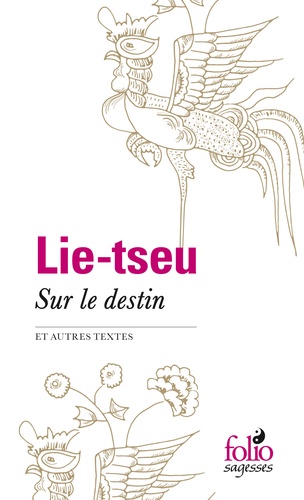
In On Destiny, Liezi, also known as Lieh Tzu, examines the place of human will in a world subject to constant transformation. Published by Gallimard under the complete French title Sur le destin et autres textes (On Destiny and Other Texts), this collection brings together passages from the True Classic of the Perfect Void, one of the major works of Chinese Daoist tradition. It includes three sections devoted to Confucius, destiny, and human conventions, translated by Benedykt Grynpas. Through dialogues, anecdotes, and short philosophical stories, the work explores the relationships between individual intentions, external circumstances, and the possibility of living in harmony with the natural order.
The central question concerns destiny and the limitations of human action. Liezi observes that everyone pursues objectives corresponding to their needs, activities, or ambitions. Yet success never depends exclusively on the efforts undertaken. Farmers cultivate the land but remain subject to weather conditions; merchants seek profit without being able to guarantee the outcome of their transactions; craftsmen apply their skills but are not immune to failure. These examples distinguish the intentions that guide behavior from the circumstances that determine its results. Destiny thus appears as a dimension of existence that human will can neither fully predict nor control.
This reflection leads to an examination of the relationships between necessity, freedom, and acceptance of events. The text questions the idea that every success necessarily results from personal merit or every failure from individual fault. Human situations depend on multiple factors, some of which escape individual understanding and initiative. Wisdom therefore consists in recognizing these limitations rather than pursuing an illusory domination over the course of events. This conception reflects an essential orientation of Daoism: acting in accordance with circumstances without attempting to impose rigid intentions or excessive expectations on everything.
The passages devoted to Confucius and philosophical learning extend this inquiry by addressing the limitations of knowledge and conventional judgments. A sage is not simply someone who accumulates knowledge or formulates rules of conduct. Wisdom also requires learning to abandon the categories that prevent individuals from perceiving situations in their diversity. The dialogues and stories consequently emphasize a gradual transformation of perspective, in which spontaneity and attentiveness take precedence over artificial reasoning. Knowledge becomes less a claim to explain everything than an ability to recognize the natural order and find one's place within it.
The collection also questions the conventions that organize human relationships. Social rules, moral judgments, and distinctions between success and failure are not always treated as absolute truths. Their application can become problematic when they no longer account for particular circumstances and the nature of individual beings. Daoist narratives therefore encourage distinguishing the necessities of collective life from artificial constraints that distance individuals from spontaneous conduct. This criticism does not amount to a systematic rejection of all social relationships, but rather to an examination of the limitations of norms when they claim to govern existence entirely.
Through these different perspectives, On Destiny presents a philosophy of moderation and detachment. Human beings act, choose, and pursue objectives, but they must recognize that the consequences of their efforts are never entirely theirs to determine. The collection does not propose a method for predicting the future or eliminating uncertainty. Instead, it examines how understanding the limits of human will can transform our relationship with success, adversity, and life's changes. Daoist wisdom thus emerges as a search for harmony between human initiatives and the natural conditions of existence.
Key Takeaways
Destiny refers to what lies beyond individual control. Human intentions and efforts are insufficient to determine the outcome of events. Success or failure also depends on external circumstances, sometimes unpredictable. Liezi therefore encourages distinguishing what we undertake from what actually happens.
Human will has limitations. Individuals can guide their actions, but they control neither all the conditions in which those actions unfold nor all their consequences. Recognizing this limitation challenges the assumption that we can completely master our own existence.
Wisdom rests on a more flexible relationship with circumstances. Rather than systematically resisting events, the sage seeks to understand their nature and adapt accordingly. This attitude reflects the Daoist principle of non-action, which favors acting without excessive constraint or artificial interference.
Human conventions and judgments must be questioned. Social distinctions, rules of conduct, and ideas of success can become sources of illusion when considered universally valid. The stories encourage examining their relevance in light of concrete situations.
Knowledge requires recognizing its own limitations. Philosophical dialogues demonstrate that accumulating knowledge does not guarantee a sound understanding of the world. Learning may also involve abandoning certainties and developing a more open attentiveness to the transformations of reality.
Accepting destiny does not necessarily mean remaining inactive. Liezi's reflection distinguishes human initiatives from their outcomes. It does not eliminate the possibility of action, but questions the belief that every action can produce precisely the consequences intended.
Conclusion
With On Destiny, Liezi's philosophy examines a fundamental question of the human condition: how can we act and pursue our objectives when events remain partly beyond our control? By contrasting individual intentions with external circumstances, the texts challenge conceptions that attribute success or failure exclusively to personal qualities.
Through its reflections on destiny, knowledge, and social conventions, the collection presents a Daoist conception of wisdom grounded in discernment, spontaneity, and acceptance of transformation. It distinguishes the exercise of human will from control over outcomes and encourages understanding human freedom in relation to the natural order rather than as absolute power over the world.
Good to Know
- Liezi, also transcribed as Lieh Tzu or Lie Yukou, is a Chinese sage traditionally placed between the fifth and fourth centuries BCE. His historical existence remains uncertain, and the stories attributed to him belong to a complex philosophical and legendary tradition.
- The complete French title of Gallimard's edition is Sur le destin et autres textes (On Destiny and Other Texts). It is a selection from the True Classic of the Perfect Void, not a complete translation of the Liezi.
- The collection contains three of the eight books of the traditional work: Book IV, "Confucius," Book VI, "On Destiny," and Book VIII, "Discourse on Conventions and Destiny."
- The texts were translated from Chinese by Benedykt Grynpas (1904–1979), a scholar specializing in Chinese philosophical traditions. His complete translation of the True Classic of the Perfect Void was also published by Gallimard.
- Gallimard published Sur le destin et autres textes in 2009 in the Folio collection. A new edition appeared on March 17, 2016, in the Folio Sagesses collection, under number 6109.
- The reflection on destiny notably draws on the distinction between the tendencies of human will and external circumstances. Examples involving farmers, merchants, craftsmen, and officials illustrate the different ways in which human activities remain subject to conditions independent of individual intentions.
- Confucius appears as a philosophical character in several narratives of the Liezi. Dialogues featuring him serve to explore questions of knowledge and conduct; they should not automatically be interpreted as accounts of historical encounters.
- The Liezi is a composite text, whose formation and dating remain subjects of debate. The surviving version is traditionally associated with the commentary of Zhang Zhan, in the fourth century CE. This textual history requires distinguishing the ancient attribution to Liezi from the actual composition of the work.
Link graph
Open in the full graphLoading the graph…
Only the strongest links are shown.