Can we attain certain knowledge, or are our judgments always open to question? In Academica, Cicero examines the foundations of knowledge and the limits of human certainty. Through a confrontation of Greek philosophical doctrines, he presents the arguments of the Academic skeptics against Stoic theories of truth. He questions the reliability of sensory perception, the possibility of distinguishing a true impression from a deceptive one, and the conditions required to form a judgment. His investigation also addresses the suspension of assent and the role of probability in human decision-making. By defending an approach based on the critical examination of arguments, Cicero explores the relationships between doubt, reason, and the pursuit of truth.
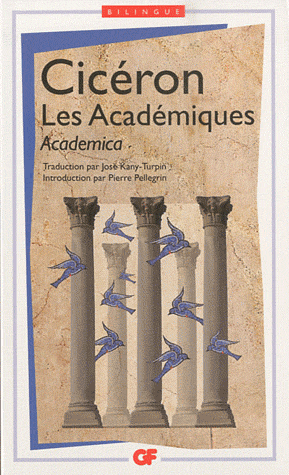
Cicero: Academica
- Flammarion Publisher
- Les Belles Lettres Publisher
- Cicéron Author
How can we recognize the truth when our senses and reasoning may deceive us?
Details
- Type
- Book
- Original language
- LA
- Genres
- Philosophy
- ISBN
- 9782081224025
- Information verified on
- 14 octobre 2026
Synopsis
Cicero: Academica
Overview
Overview
In Academica, Cicero develops an investigation into the possibilities and limits of human knowledge. The work examines a fundamental question: how can we distinguish what we genuinely know from what we merely believe we know? To answer it, the philosopher confronts the doctrines of the Academy, the school founded by Plato, with the theories of knowledge defended by the Stoics. The treatise belongs to a tradition of philosophical debate in which the critical examination of arguments plays an essential role.
At the center of this confrontation stands Academic skepticism, developed particularly by Arcesilaus and Carneades. Unlike philosophers who claim that unquestionable certainty is attainable, representatives of this tradition challenge the existence of a criterion that would allow truth to be recognized infallibly. Their approach does not necessarily consist in denying every possibility of knowledge, but rather in questioning the claims of those who believe they possess certain knowledge.
Cicero particularly examines the Stoic theory of cognitive impressions, associated with Zeno of Citium and his successors. According to this conception, certain impressions produced by objects possess characteristics that make it possible to recognize them as true. They could therefore provide a reliable foundation for knowledge. The Academic skeptics, however, challenge this guarantee: dreams, illusions, and similarities between certain perceptions suggest that a deceptive impression may appear just as convincing as a genuine one.
This criticism leads to an investigation into the suspension of assent. If no impression can absolutely guarantee truth, should the wise person refrain from making definitive judgments? The Stoics accuse the skeptics of thereby making knowledge and action impossible. The Academic skeptics respond that it remains possible to navigate life by examining available impressions without treating them as unquestionable certainties.
The concept of the probable or plausible consequently becomes important. In the tradition of Carneades, certain impressions may appear more convincing than others and serve as practical guides, even when they do not guarantee certain knowledge. Cicero thus explores the possibility of forming provisional judgments based on comparing arguments and evaluating their credibility. Philosophical doubt does not necessarily lead to inaction: it can become a method of discernment.
The work also highlights the internal transformations of the Academy. The skeptical positions of Arcesilaus and Carneades are confronted with the views of Antiochus of Ascalon, who seeks to restore a positive doctrine of knowledge by bringing together elements of the Platonic, Aristotelian, and Stoic traditions. Through these debates, Cicero traces part of the intellectual history of Greek philosophy while clarifying his own approach to seeking truth without claiming to possess absolute certainty.
Key Takeaways
One of the fundamental questions of Academica concerns the possibility of certain knowledge. The Stoics maintain that some impressions allow reality to be apprehended reliably. The skeptical philosophers of the Academy challenge this claim by emphasizing the difficulty of distinguishing true perceptions from deceptive ones with absolute certainty.
The concept of the cognitive impression, also known as the kataleptic impression, occupies a central place in this debate. For the Stoics, it constitutes a criterion of truth. The Academic skeptics question this principle by arguing that false impressions may exhibit the same apparent characteristics as true ones.
The suspension of assent represents another essential dimension of Academic skepticism. It consists in avoiding the assertion of certainty when a proposition cannot be decisively established. This attitude does not necessarily mean abandoning reflection or decision-making, but rather exercising caution toward insufficiently supported judgments.
Probability and plausibility then offer criteria for guiding human conduct. It remains possible to compare arguments, assess their strength, and favor the most convincing impressions without claiming to possess definitive truth. This approach distinguishes cautious acceptance of a proposition from dogmatic certainty.
Finally, the treatise illustrates Cicero's philosophical method, based on the confrontation of doctrines and the critical examination of opposing arguments. The pursuit of truth does not rest on the immediate acceptance of intellectual authority, but on a process of inquiry that recognizes the difficulties and limitations of human knowledge.
Conclusion
With Academica, Cicero develops an investigation into the foundations of knowledge, the reliability of perception, and the conditions of judgment. By confronting the skeptical doctrines of the Academy with Stoic theories of knowledge, he highlights the difficulties involved in establishing absolute certainty.
The treatise occupies an important place in the history of ancient philosophy, particularly because it preserves numerous arguments from debates between Greek philosophical schools. It also contributes to the transmission of Academic skepticism and the development of an understanding of philosophical inquiry grounded in critical doubt, discussion, and the reasoned assessment of probability.
Good to Know
- Academica, also known in English as The Academics or On Academic Skepticism, underwent several revisions by Cicero. An initial version consisted of two books, while a revised version contained four.
- The surviving text is incomplete. It includes the Lucullus, the second book of the first version, as well as part of the first book of the revised version, generally associated with Varro. Additional fragments provide evidence of certain lost passages.
- The Academy was the philosophical school founded by Plato. It underwent several changes of direction throughout its history, including a skeptical period associated with Arcesilaus and Carneades.
- Zeno of Citium, the founder of Stoicism, and Chrysippus are among the major figures in the debate concerning cognitive impressions and the criteria by which truth may be recognized.
- Philo of Larissa, under whom Cicero studied, and Antiochus of Ascalon played important roles in the debates of the Academy's later period. Their positions illustrate disagreements concerning the possibility of attaining certain knowledge.
- Academic skepticism should not be entirely confused with Pyrrhonian skepticism. Although both traditions question claims to knowledge, they differ in their approaches to judgment, appearances, and practical conduct.
- The work belongs to Cicero's major philosophical writings devoted to the transmission and discussion of Greek doctrines. It complements the ethical investigations developed in On the Ends of Good and Evil and the Tusculan Disputations.