How can we distinguish truth from error and construct rigorous reasoning? In On the Geometrical Spirit, Blaise Pascal examines the principles that make it possible to demonstrate a proposition with clarity and certainty. Taking geometry as his model, he explores the role of definitions, axioms, and the logical progression of proofs. He shows, however, that not everything can be defined or demonstrated, since all knowledge necessarily rests on fundamental notions that the mind recognizes without prior reasoning. His investigation also addresses space, time, motion, and infinity, revealing both the power and the limitations of human reason. Through this study, Pascal seeks to establish the conditions of a systematic approach to thought capable of recognizing truth and avoiding errors in reasoning.
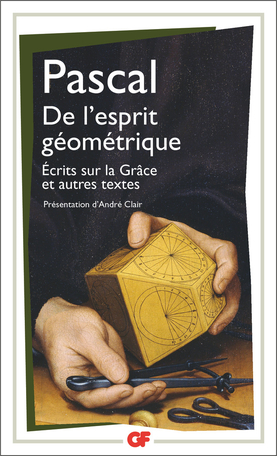
Blaise Pascal: On the Geometrical Spirit
De l'esprit géométrique
- Flammarion Publisher
- Hachette Livre Publisher
- F. Alcan Publisher
- Blaise Pascal Author
Can reason prove everything, or must certain truths necessarily remain beyond demonstration?
Details
- Type
- Book
- Release
- 1728
- Original title
- De l'esprit géométrique
- Genres
- Philosophy
- ISBN
- 9782080704368
Synopsis
Blaise Pascal: On the Geometrical Spirit
Overview
Overview
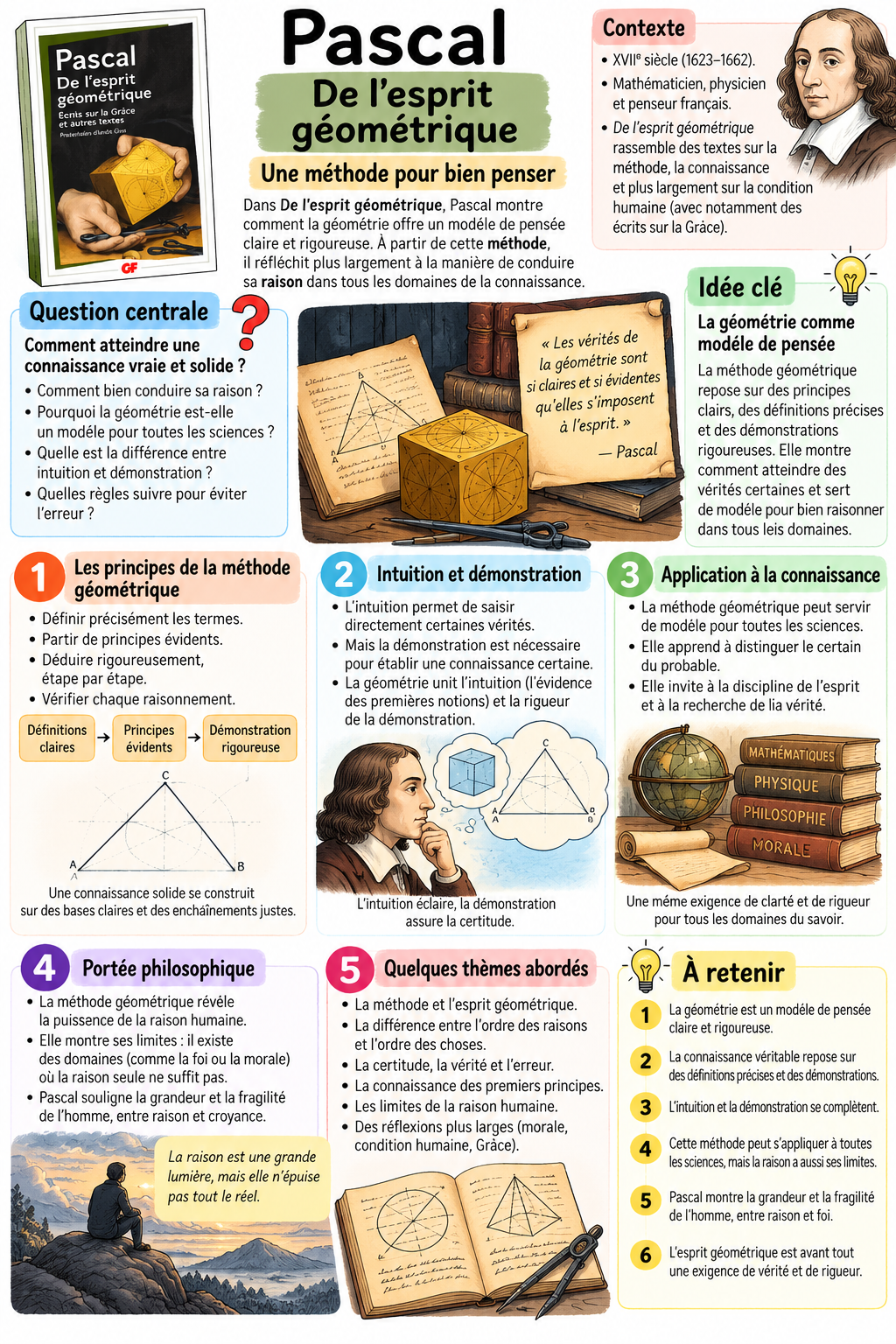
In On the Geometrical Spirit, Blaise Pascal develops an investigation into the methods that enable the human mind to reason rigorously and attain certain knowledge. As both a mathematician and a philosopher, he takes geometry as a model of orderly thinking, capable of distinguishing established truths from insufficiently justified claims. His purpose, however, extends beyond mathematics alone: he seeks to identify the principles of a method applicable to reasoning more generally.
Pascal distinguishes three activities involved in the pursuit of truth: discovering what is unknown, demonstrating what is known, and recognizing the difference between truth and falsehood. His investigation focuses primarily on the art of demonstration. A rigorous proof requires clearly defined terms, accepted principles, and the establishment of each proposition through truths already acknowledged. The strength of an argument therefore depends both on its foundations and on the order in which its different steps are presented.
This demand for rigor leads Pascal to examine the limits of demonstration. An absolutely perfect method would require every word to be defined and every proposition to be proved. Yet such an undertaking is impossible: each definition would require further terms to be explained, while every proof would presuppose earlier truths. To avoid this infinite regress, thought must necessarily rely on fundamental notions and principles whose evident character makes further demonstration unnecessary.
Pascal therefore distinguishes nominal definitions from propositions concerning the nature of things. Defining a term means specifying the meaning assigned to it, not proving a truth about the object it designates. Confusing these two operations can produce misleading arguments, particularly when a debatable assertion is presented as a mere definition. The philosopher thus emphasizes the importance of precise language in preserving clarity of thought.
The work also explores space, time, motion, and infinity. Pascal examines the possibility of conceiving quantities that are indefinitely greater or smaller, together with the endless divisibility of extension. These reflections show that certain truths can be established with certainty even when the imagination cannot fully represent their implications. Geometry thus becomes a means of exploring the capacities of reason as well as the limits of human understanding.
Key Takeaways
One of the fundamental ideas of On the Geometrical Spirit is that rigorous reasoning depends on clear definitions and sound demonstrations. Ambiguous terms must be explained, the principles employed must be acknowledged, and conclusions must follow logically from preceding propositions. This method helps prevent ambiguities and errors arising from imprecise language.
Pascal also demonstrates that not everything can be proved. Certain first principles are immediately recognized by the mind and provide the foundations for subsequent reasoning. Their lack of demonstration does not necessarily constitute a weakness: their evident character makes it possible to establish the proofs that follow from them.
The distinction between definition and demonstration occupies an essential place in the work. Giving something a name is not equivalent to establishing its nature, and changing the meaning of a term is not sufficient to prove a proposition. This requirement for precision helps explain why some apparently convincing arguments actually rest on conceptual confusion.
Finally, the study of infinity and divisibility reveals a difference between rationally understanding a truth and being able to imagine it. Pascal emphasizes that difficulties of mental representation are not sufficient to invalidate a demonstrated proposition. This reflection leads to a recognition of both the reach of reason and the limitations of the human mind.
Conclusion
With On the Geometrical Spirit, Blaise Pascal offers an analysis of the conditions necessary for rational demonstration. By examining definitions, first principles, and the organization of proofs, he shows how geometry can serve as a model for systematic thought grounded in clarity and coherence.
The work occupies an important place in philosophical reflection on knowledge and methods of reasoning. It highlights a fundamental tension in Pascal's thought: reason possesses a remarkable capacity for demonstration, yet it depends on foundations that it cannot itself fully demonstrate.
Good to Know
- On the Geometrical Spirit, originally titled De l'esprit géométrique, is a short philosophical work by Blaise Pascal devoted to the principles of demonstration and methods of reasoning.
- The text is frequently published alongside On the Art of Persuasion (De l'art de persuader), a related work that extends the investigation into proofs by examining the mechanisms of assent and persuasion.
- Pascal distinguishes nominal definitions, which specify the meaning assigned to a term, from propositions that make claims about the nature of reality and must therefore be justified.
- The concepts of space, time, motion, and number serve particularly to illustrate immediately intelligible principles and the questions raised by infinity.
- The investigation into the limits of reasoning is connected to the Pensées, but this treatise should not be confused with the fragments discussing the distinction between the geometrical spirit and the spirit of finesse.