What makes a story compelling, and how can a work of art evoke emotions? In Poetics, Aristotle examines the principles of poetic creation and the different ways of representing human actions. Focusing particularly on tragedy and epic poetry, he analyzes plot construction, the role of characters, the sequence of events, and the effects produced on an audience. His investigation distinguishes a mere succession of incidents from the unity and coherence that give a story its meaning. Through the concepts of imitation, probability, and catharsis, Aristotle establishes the foundations of a theory of dramatic composition and artistic representation.
Book
Writing
Essay
Philosophy
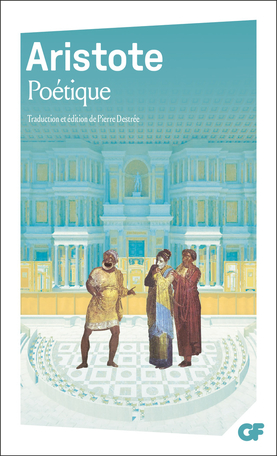
Aristotle: Poetics
Poetics
- Flammarion Publisher
- Mille et une nuits Publisher
- Hachette Livre Publisher
- Les Belles Lettres Publisher
- Gallimard Publisher
- Aristote Author
How can a story achieve coherence, give meaning to human action, and evoke powerful emotions?
Details
- Type
- Book
- Original title
- Poetics
- Genres
- Writing, Essay, Philosophy
- ISBN
- 9782755509137
- Information verified on
- 1 octobre 2026
Synopsis
Aristotle: Poetics
Overview
Overview
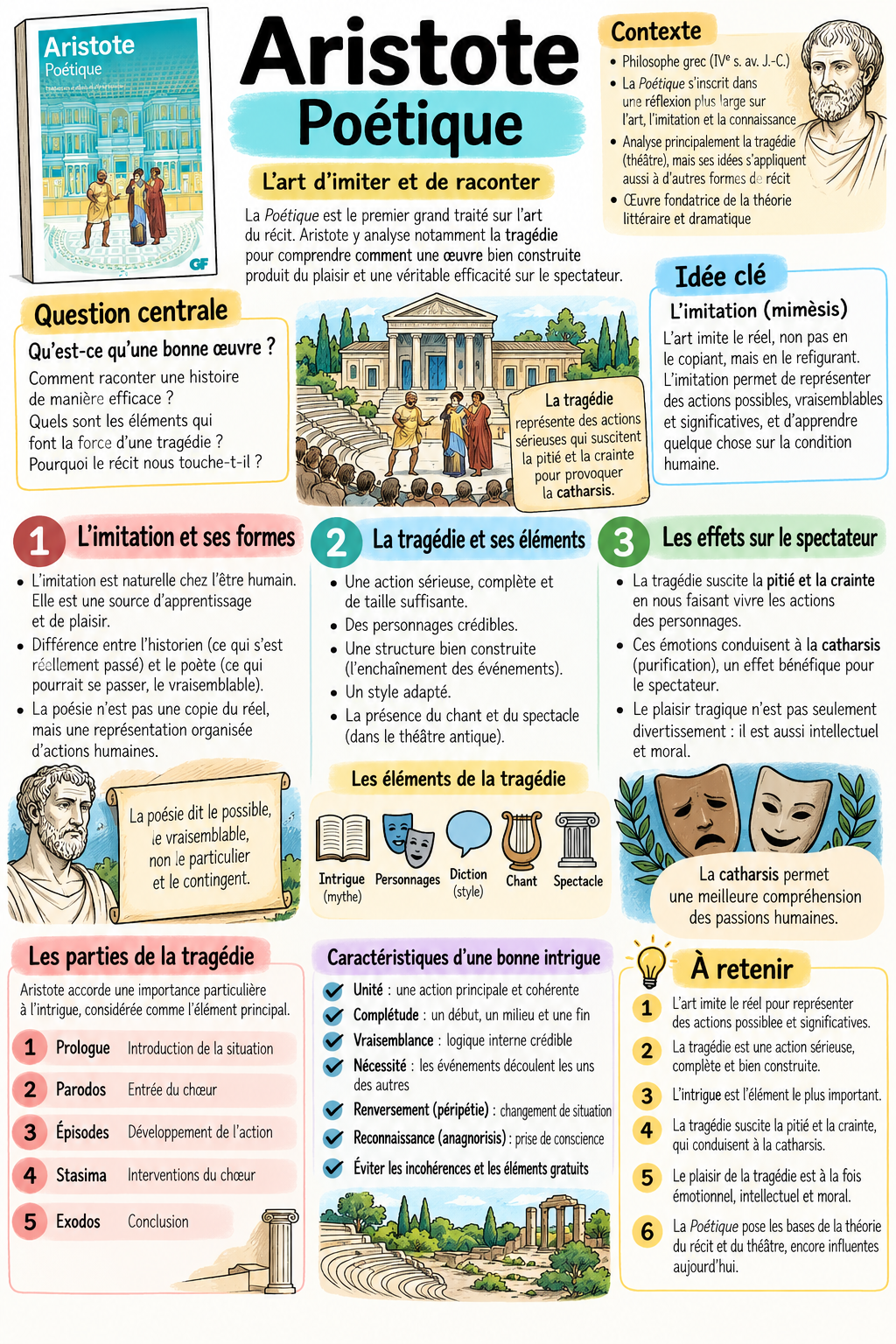
In Poetics, Aristotle develops an investigation into the nature of literary creation and the principles underlying narrative and dramatic works. Rather than limiting poetry to writing in verse, his study encompasses different forms of artistic representation, particularly tragedy and epic poetry. He seeks to understand how a work is constructed, what gives it coherence, and how it produces its effects on an audience.
At the heart of the treatise lies the concept of mimesis, generally translated as "imitation" or "representation." For Aristotle, poetic creation does not simply reproduce reality as it appears. Instead, it represents human actions by giving them an intelligible structure. The poet therefore differs from the historian: whereas the historian recounts what actually happened, the poet represents what could happen according to probability or necessity.
Aristotle places particular emphasis on plot construction, which he regards as the most important element of tragedy. A story should form a coherent whole, with a beginning, middle, and end, whose different parts are connected by necessary or probable relationships. The unity of action therefore does not depend merely on the presence of a central character, but on the organization of events into a meaningful progression.
The philosopher also examines the mechanisms that give dramatic action its power. He distinguishes reversal of fortune (peripeteia) and recognition (anagnorisis), two devices capable of transforming the understanding of events and the circumstances of the characters. These elements contribute to the production of pity and fear, emotions associated with tragedy and the concept of catharsis.
Finally, Aristotle analyzes the different components of dramatic representation: plot, character, thought, diction, song, and spectacle. He thus distinguishes the underlying structure of a work from the means used to present it, giving priority to the organization of action rather than relying solely on visual effects or the qualities of language.
Key Takeaways
One of the essential contributions of Poetics is the importance it assigns to action and narrative structure. For Aristotle, the power of tragedy depends above all on how events are organized. Characters, dialogue, and theatrical effects acquire their meaning within a coherent plot in which every part contributes to the whole.
The distinction between history and poetry is another fundamental idea. A poetic work does not merely report actual events: it explores human possibilities and more general situations. Probability and necessity therefore make it possible to construct a narrative whose events follow an intelligible logic.
Catharsis occupies an important place in Aristotle's analysis of tragedy. He associates tragedy with pity and fear, whose representation produces a particular effect on the audience. The precise meaning of catharsis remains debated, with interpretations emphasizing purification, clarification, or the regulation of emotions.
Finally, the treatise distinguishes different forms of poetic creation according to their means, objects, and modes of representation. This approach allows works to be studied through their own artistic principles rather than being judged exclusively by their moral value or their fidelity to historical facts.
Conclusion
With Poetics, Aristotle develops one of the earliest systematic analyses of literary and dramatic composition. By placing action, plot coherence, and the effects of representation at the center of his investigation, he establishes concepts that profoundly influenced the history of literary theory and theater.
The treatise's influence extends to dramaturgy, literary criticism, and modern reflections on storytelling. Its analyses of probability, dramatic structure, and the relationships between events continue to inform studies of narrative construction, theater, and screenwriting.
Good to Know
- Poetics, also known by its Greek title Peri poiētikēs, is a treatise devoted to the principles of poetic creation, particularly tragedy and epic poetry.
- The surviving text deals primarily with tragedy. Comedy is mentioned, but a detailed analysis of it is absent from the portion of the work that has survived.
- The famous three unities of classical drama — action, time, and place — were not formulated by Aristotle as a complete set of three mandatory rules. This doctrine largely emerged through later interpretations.
- Aristotle considers plot more important than character: tragedy is primarily a representation of action, with characters forming one of its components.
- The work is also published in French in the Mille et une nuits collection, associated with Fayard.