What is nature, and how can movement and change be explained? In Physics, Aristotle seeks to understand the principles governing transformations in the natural world. He examines different forms of motion, the relationships between matter and form, and the causes that explain natural phenomena. His investigation also addresses time, place, continuity, and infinity, while exploring the fundamental conditions that make change possible. By considering motion an essential characteristic of nature, Aristotle develops a philosophical understanding of the physical world and the principles governing its processes.
Book
Philosophy
Aristotle: Physics
Physics
- Flammarion Publisher
- Primento Publisher
- Les Belles Lettres Publisher
- Nathan Publisher
- Librairie philosophique J. Vrin Publisher
- Aristote, Author
Why do things change, and what fundamental principles govern motion in the natural world?
Details
- Type
- Book
- Original title
- Physics
- Genres
- Philosophy
- ISBN
- 9782335016772
Synopsis
Aristotle: Physics
Overview
Overview
In Physics, Aristotle undertakes a fundamental investigation into nature and the principles that explain its transformations. Unlike modern physics, which relies on mathematical formulations of natural laws and experimental verification, his approach belongs to natural philosophy. It seeks to understand what change means, why beings undergo transformation, and which causes account for observable phenomena.
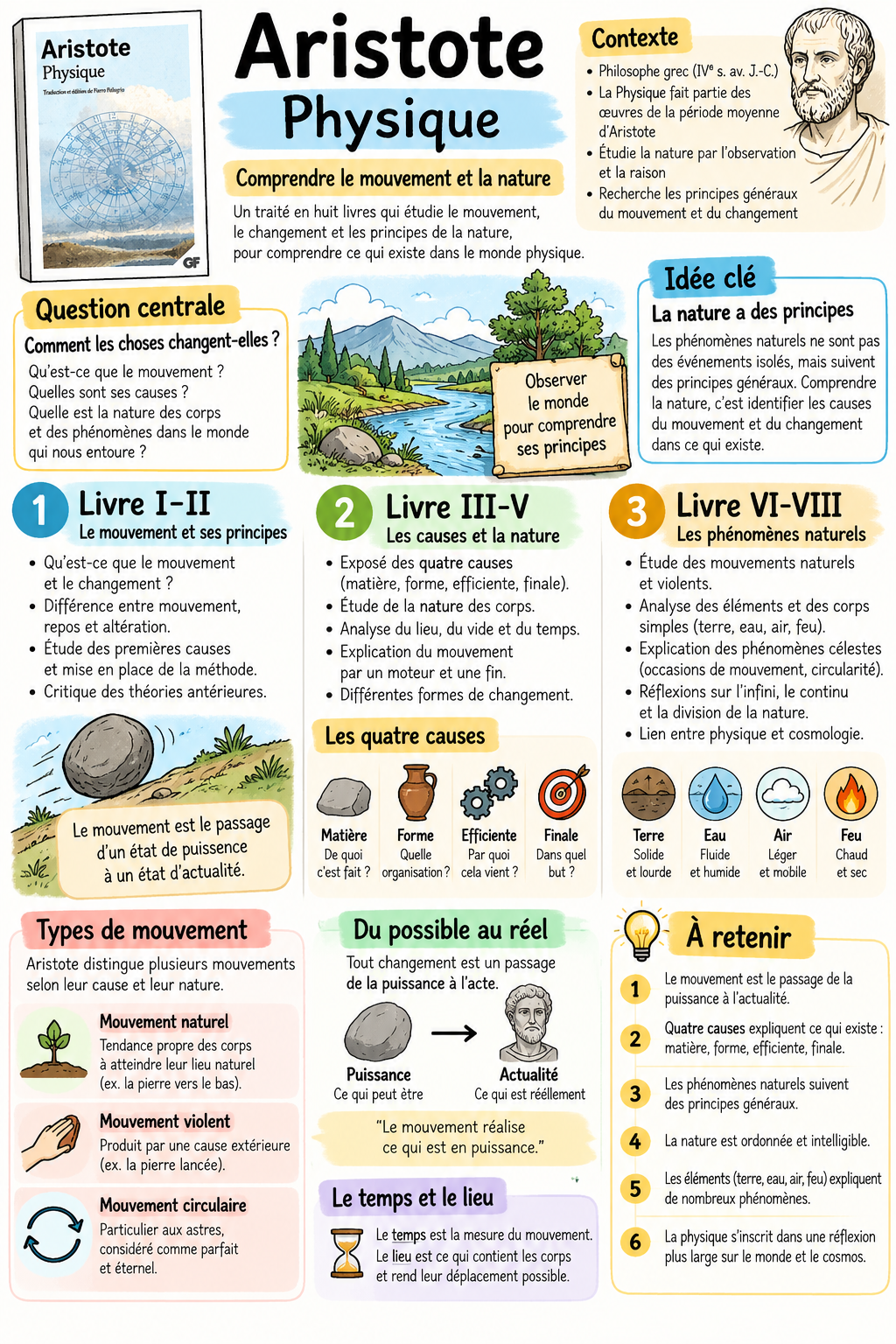
At the heart of the treatise lies the concept of motion, understood in a broader sense than simple movement through space. Aristotle also examines changes in quality, growth and diminution, as well as processes of generation and destruction. To explain these transformations, he draws particularly on the concepts of matter and form, potentiality and actuality. Change thus becomes intelligible as the ongoing realization of a possibility inherent in a being.
The work also develops the celebrated theory of the four causes. Aristotle distinguishes the material cause, referring to what something is made of; the formal cause, determining what it is; the efficient cause, responsible for initiating change; and the final cause, identifying the end toward which a process is directed. This framework makes it possible to investigate natural phenomena through several complementary dimensions without reducing their explanation to a simple sequence of events.
Composed of eight books, the treatise progressively examines the principles of nature, different forms of causation, and the concepts of motion, infinity, place, void, and time. Aristotle pays particular attention to the continuity and divisibility of motion, confronting difficulties raised by earlier philosophers. His investigation culminates in a reflection on the necessity of an unmoved mover, a principle intended to explain the eternity of motion.
Key Takeaways
One of the essential ideas of Physics is the definition of nature as an internal principle of motion and rest. Unlike artificial objects, whose transformations depend on factors external to their own constitution, natural beings possess within themselves the principles of certain changes. This distinction allows Aristotle to define the subject matter of natural philosophy.
The relationship between potentiality and actuality forms another foundation of the treatise. Motion is understood as the actualization of what exists potentially, insofar as that potentiality is being realized. This conception explains the transition from one state to another without treating change as the inexplicable emergence of new properties.
Aristotle also develops an analysis of time, which he defines in relation to motion according to before and after. Time is not identical to motion itself but provides a way of determining its order and measure. His reflections on place, void, and infinity complement this investigation by examining the conditions under which natural transformations can occur.
Finally, the theory of the four causes introduces an explanatory framework combining constitution, organization, the source of change, and purpose. This approach occupies a central position in Aristotelian philosophy and reappears in his studies of living beings, metaphysics, and the knowledge of nature.
Conclusion
With Physics, Aristotle establishes a philosophical framework for understanding nature through motion, change, and causation. By connecting the concepts of matter, form, potentiality, and actuality, he offers a systematic analysis of the transformations affecting natural beings.
The treatise profoundly influenced the history of philosophy and natural science, particularly throughout Antiquity and the Middle Ages. Although its physical explanations were extensively challenged by the development of modern science, its analyses of change, causality, and time retain an important place in the history of philosophical thought.
Good to Know
- Physics, also known by its Greek title Physikê akroasis, consists of eight books devoted to the general principles of nature and motion.
- For Aristotle, motion does not refer exclusively to spatial movement: it also encompasses different forms of change, including alteration and changes in quantity.
- The treatise is closely connected to Metaphysics, particularly through the concepts of causation, potentiality, actuality, and the unmoved mover.
- Aristotle's reflections on motion and continuity engage critically with the paradoxes of Zeno of Elea.
- Aristotelian Physics belongs to the tradition of natural philosophy and should not be confused with contemporary experimental physics.