How do we perceive the world, why do we retain memories, and what happens when we sleep? In Short Treatises on Natural History, Aristotle brings together several investigations into functions shared by the soul and body. He examines the mechanisms of sensation, memory, sleep, and dreams, while also exploring respiration, aging, and the conditions of life and death. By studying these phenomena in living beings, he seeks to understand how mental activities depend on bodily organization. Extending the inquiries developed in On the Soul, these treatises establish connections between natural philosophy, the study of living organisms, and the investigation of human faculties.
Book
Philosophy
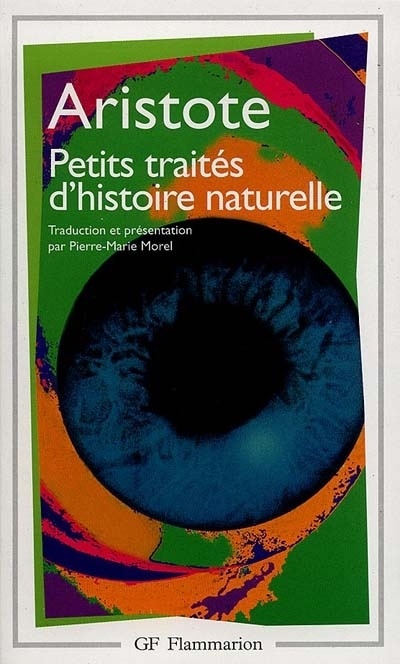
Aristotle: Short Treatises on Natural History
- Flammarion Publisher
- Les Belles Lettres Publisher
- Aristote Author
Why do we dream, how are memories formed, and what processes sustain life?
Details
- Type
- Book
- Original language
- Greek
- Genres
- Philosophy
- Information verified on
- 14 octobre 2026
Synopsis
Aristotle: Short Treatises on Natural History
Overview
Overview
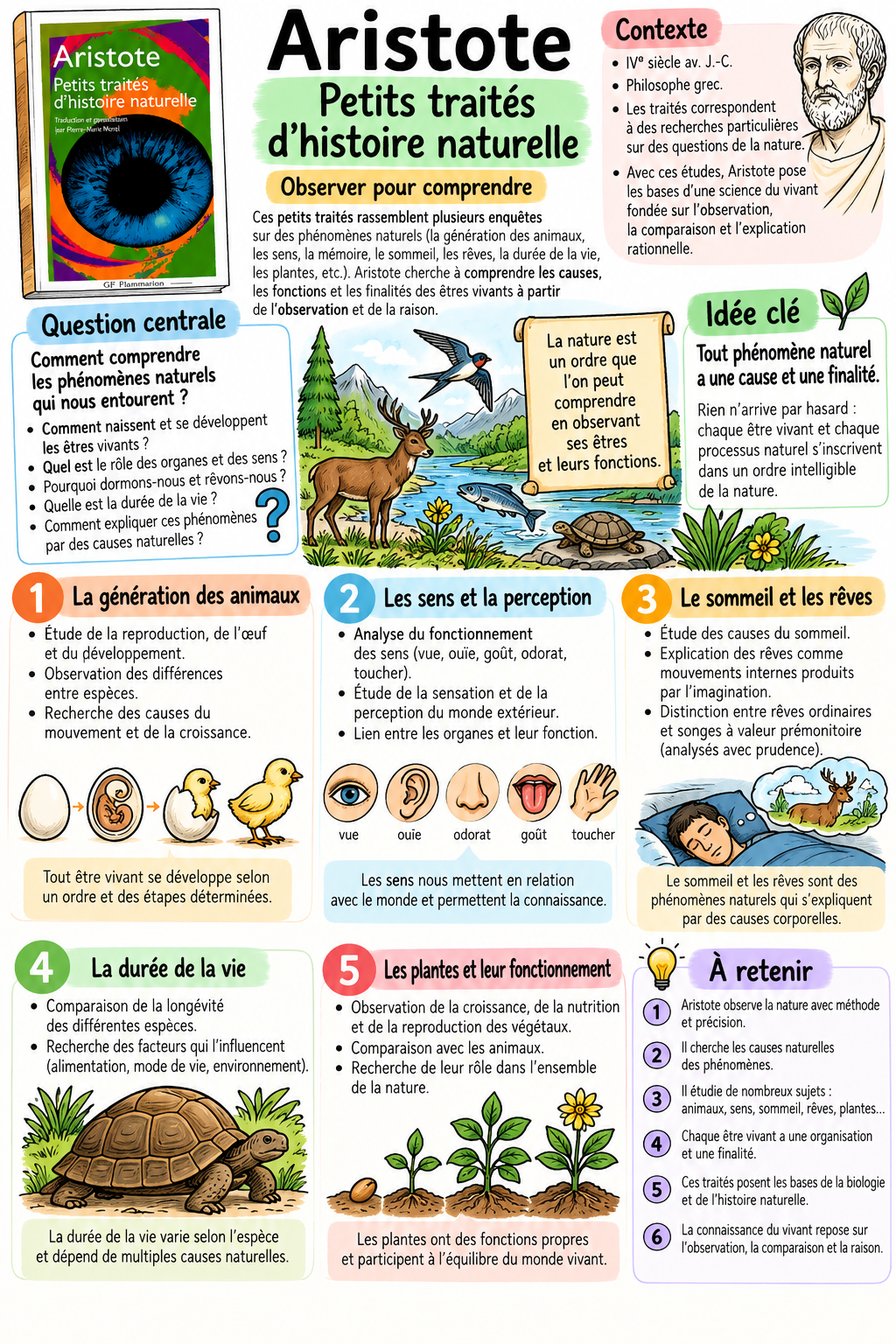
In Short Treatises on Natural History, Aristotle continues his investigation into living beings by examining phenomena that connect the activities of the soul with bodily functions. Traditionally grouped under the Latin title Parva naturalia, these short treatises extend the reflections developed in On the Soul. Whereas the latter seeks to define the fundamental faculties of living beings, the Short Treatises examine more precisely the processes through which these faculties are expressed.
The first major area of investigation concerns sensation and memory. Aristotle studies the relationships between sensory organs and perceived qualities, particularly colors, sounds, and smells. He seeks to understand how sensation becomes possible and how it contributes to our knowledge of the world. His analysis of memory distinguishes the preservation of impressions derived from experience from recollection, the process through which the mind actively searches for a memory. This distinction introduces an examination of the relationships between perception, imagination, and the representation of the past.
The treatises devoted to sleep and dreams extend this inquiry. Aristotle investigates the natural causes of the alternation between waking and sleeping, as well as the conditions under which dream images arise. He regards dreams as phenomena connected to sensory activity and to impressions that persist when the senses are no longer stimulated in the same way. He also questions the supposed ability of dreams to predict the future, seeking natural explanations rather than systematically attributing such phenomena to divine intervention.
The collection also addresses vital functions and transformations in living beings. Aristotle studies differences in longevity among living organisms, the processes of aging, respiration, and the conditions of life and death. These investigations belong to his understanding of physiology, in which bodily functions are examined through the relationships between organs, vital heat, and the natural principles governing their activity.
Underlying this diversity of subjects is a common question: how can we explain phenomena that connect the material organization of the body with the distinctive capacities of living beings? Aristotle thus develops an approach combining natural observation, the analysis of biological functions, and philosophical reflection on knowledge.
Key Takeaways
One of the fundamental contributions of Short Treatises on Natural History lies in its examination of functions shared by the soul and body. Aristotle does not regard sensation, memory, or sleep as activities entirely independent of the organism. Instead, he seeks to understand how these phenomena depend on bodily processes and contribute to the lives of sentient beings.
The distinction between memory and recollection constitutes another essential point. Memory preserves a representation of something previously perceived or experienced, whereas recollection involves an active search to recover a memory. Aristotle thus emphasizes the role of mental images and associations in how human beings relate to the past.
The study of sleep and dreams also reveals his intention to provide natural explanations for phenomena long associated with the supernatural. Dreams are examined through sensory impressions and their persistence, while sleep is investigated as a condition characteristic of beings possessing sensation.
Finally, the reflections on respiration, longevity, and aging extend the analysis to the material conditions of existence. Aristotle seeks to explain why living beings have different lifespans and which processes accompany their development and eventual death. These hypotheses belong to ancient physiology and differ from modern biological knowledge.
Conclusion
With Short Treatises on Natural History, Aristotle deepens his understanding of living beings by connecting psychological phenomena with bodily functions. Sensation, memory, dreams, and vital processes become subjects of an investigation intended to uncover the natural mechanisms of life.
These writings occupy an important place in the history of psychology, physiology, and the philosophy of knowledge. Although their biological explanations have been extensively revised by modern science, they illustrate an approach that seeks to understand human and animal experiences through their natural causes.
Good to Know
- Short Treatises on Natural History are traditionally known by the Latin title Parva naturalia. They form a collection of shorter writings rather than a single unified treatise.
- The collection includes works devoted to sensation, memory and recollection, sleep and waking, dreams, divination during sleep, longevity, aging, and respiration. Their arrangement and presentation may vary between editions.
- These writings directly extend the investigations of On the Soul, focusing more specifically on phenomena that connect psychological faculties with bodily functions.
- Aristotle distinguishes memory, which preserves representations of the past, from recollection, which involves deliberately searching for and retrieving a memory.
- The analyses of sleep, dreams, and vital functions contributed to the history of psychology and natural science, although their physiological foundations no longer correspond to contemporary scientific knowledge.