Why do human beings live in communities, and what makes a government just? In Politics, Aristotle examines the origins of the city-state, the role of citizens, and the different ways political power can be organized. Through his study of constitutions, he distinguishes governments directed toward the common good from those serving the private interests of their rulers. His investigation also addresses justice, the distribution of wealth, social conflict, and the conditions required for institutional stability. By connecting political organization with education and the pursuit of a fulfilling life, Aristotle develops an analysis of the relationships between individuals, communities, and political authority.
Book
Philosophy
Aristotle: Politics
Politics
- Flammarion Publisher
- Hachette Livre Publisher
- Aristote Author
What makes a just political community, and how should power be organized to serve the common good?
Details
- Type
- Book
- Original title
- Politics
- Genres
- Philosophy
- ISBN
- 9782329268286
Synopsis
Aristotle: Politics
Overview
Overview
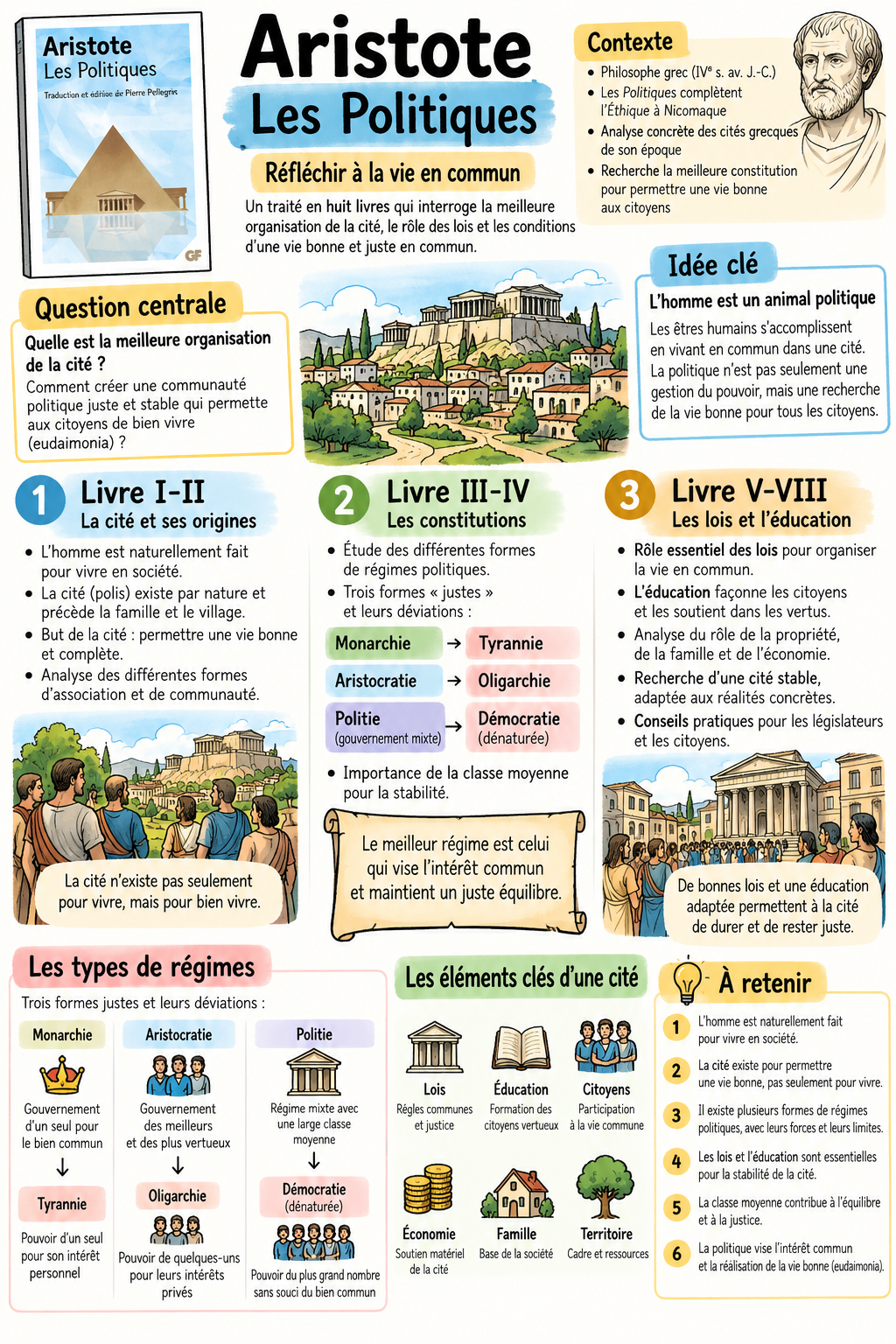
In Politics, Aristotle investigates the foundations of collective life and the different ways a political community can be organized. He describes human beings as naturally political animals: the city-state, or polis, is not merely an association established for survival, but a community in which individuals can pursue a good and fulfilling life. This understanding establishes a close relationship between politics, ethics, and the ultimate purposes of human existence.
The treatise draws on the observation of institutions and the comparison of political systems in the ancient Greek world. Aristotle examines the development of the city-state from smaller communities, particularly the household and village, before considering the definition of citizenship, the distribution of political authority, and the principles underlying political justice. He also evaluates the ideas of earlier thinkers, especially Plato.
A central part of the work is devoted to the classification of constitutions. Aristotle identifies three forms of government directed toward the common good: kingship, aristocracy, and constitutional government, or politeia. Each has a corresponding deviant form when political power serves particular interests: tyranny, oligarchy, and democracy, understood here according to Aristotle's ancient classification. He also examines variations within these systems, the ways governments change, and the causes of political instability.
The work extends beyond the description of political institutions. Aristotle considers tensions between rich and poor, the role of the middle class, the conditions necessary to preserve constitutions, and the importance of education. His aim is therefore not only to determine what the best possible government might be, but also to understand which political arrangements are suitable for the particular circumstances of different communities.
Key Takeaways
One of the treatise's fundamental ideas is that the political community exists for the sake of living well, rather than simply enabling people to live together. Politics therefore has an ethical dimension: institutions must be evaluated according to the purposes they serve and their contribution to the common good.
Aristotle also places considerable importance on citizenship. A citizen is primarily defined by participation in the deliberative and judicial functions of the city-state. However, this definition varies according to the constitution and belongs to the restrictive political framework of ancient Greek societies, in which large sections of the population were excluded from political participation.
The question of institutional stability provides another essential theme. Aristotle examines conflicts arising from inequality, competing conceptions of justice, and the concentration of political power. He particularly emphasizes the stabilizing role of a sufficiently large middle class and considers the advantages of constitutions that combine different social and political elements.
Finally, the work reveals a tension between the theoretical search for the best constitution and the practical study of existing governments. This dual approach allows Aristotle to examine political institutions both in terms of their underlying principles and their actual conditions of operation.
Conclusion
With Politics, Aristotle develops a major philosophical investigation into the nature of political communities, forms of government, and the conditions necessary for lasting collective organization. His analysis combines the pursuit of the common good with a detailed examination of institutions, social relationships, and the conflicts that shape political life.
The treatise occupies a foundational place in the history of political philosophy. Its distinctions between constitutions, its conception of citizenship, and its analysis of political stability have profoundly influenced subsequent political thought, while also attracting critical examination of Aristotle's views on slavery, social hierarchies, and political exclusion.
Good to Know
- Politics, known in Greek as Politika, consists of eight books whose arrangement and reading order remain subjects of scholarly discussion.
- The treatise develops themes explored in the Nicomachean Ethics, particularly the good life, virtue, and the role of political communities in human flourishing.
- The democracy examined by Aristotle refers to forms of government in ancient Greece and should not be confused with contemporary representative democracies.
- A heritage edition published by Hachette Livre in partnership with the Bibliothèque nationale de France reproduces, among other volumes, the third volume of a French translation by Charles Millon, originally published in 1803. This publishing initiative aims to preserve and provide access to historical works.