Intent on settling the arid region of Durotar, Thrall's new Horde expands its ranks by welcoming the Forsaken alongside Orcs, Tauren and Trolls. At the same time, Dwarves, Gnomes and the ancient Night Elves pledge their allegiance to a renewed Alliance led by the human kingdom of Stormwind. After King Varian Wrynn mysteriously disappears, Highlord Bolvar Fordragon serves as Regent, but his rule is weakened by the manipulation and mind control of the black dragon Onyxia, who hides behind the appearance of a human noblewoman. As heroes investigate her schemes, ancient enemies resurface across the world and threaten both the Horde and the Alliance.
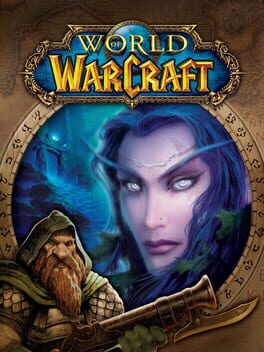
Video game
2004
Action
Adventure
Fantasy
RPG
Open world
World of Warcraft
- Blizzard Entertainment Developer
- Blizzard Entertainment Publisher
Azeroth becomes a world to explore, inhabit and share with thousands of other adventurers.
Details
- Type
- Video game
- Release
- 2004-11-23
- Genres
- Action, Adventure, Fantasy, RPG, Open world
- Platforms
- PC, Mac
- Game modes
- Multiplayer, Massively Multiplayer Online (MMO)
Synopsis
World of Warcraft
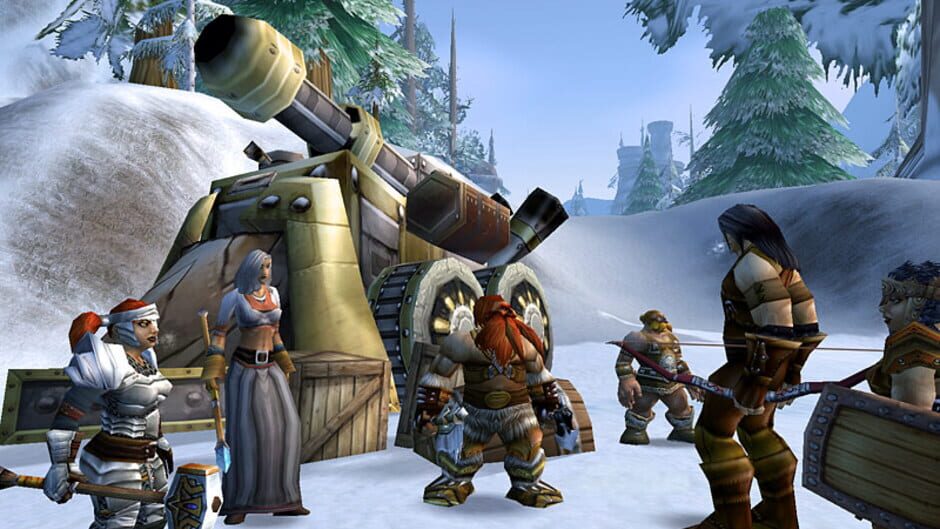

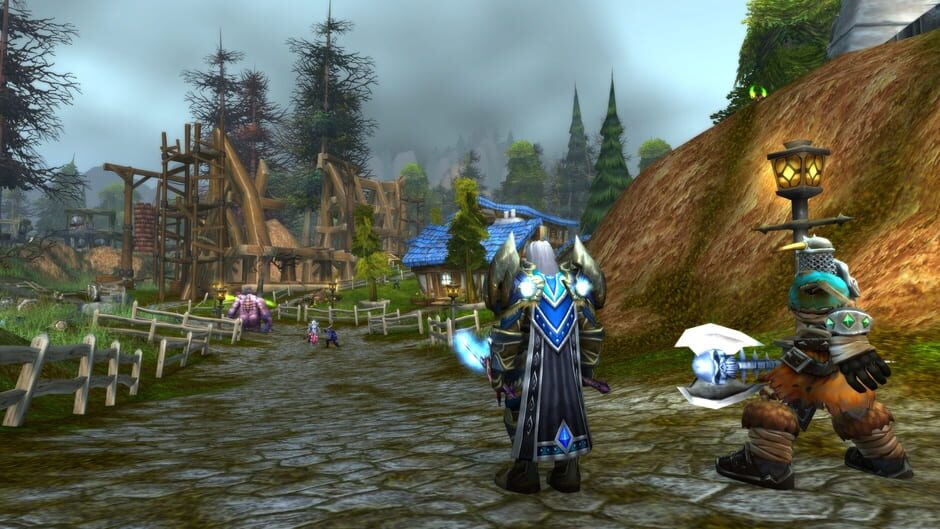
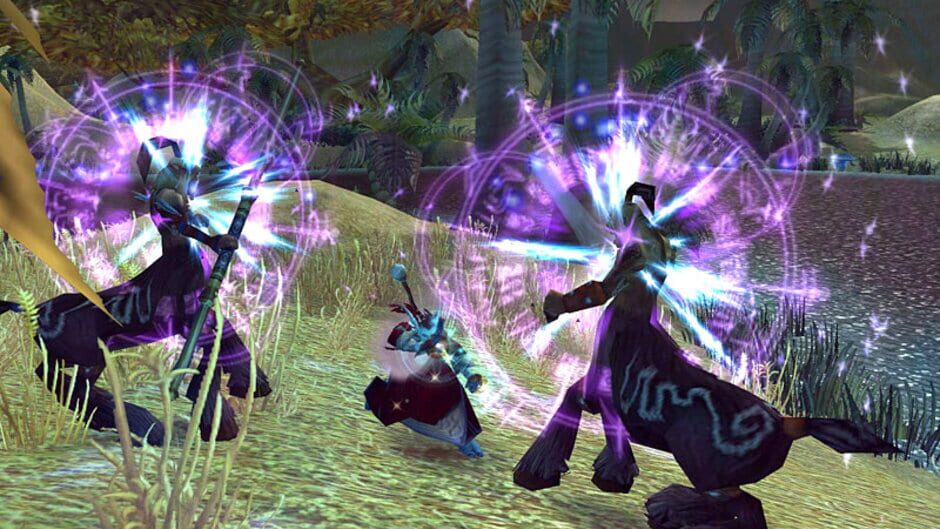
Trailer
Watch the trailer
Overview
Presentation
With World of Warcraft, Blizzard transforms a universe previously explored through strategy games into a vast persistent world that players can enter directly. Azeroth is no longer simply the setting for armies commanded from above: each player creates a character, chooses a faction, race and class, then begins a journey built around exploration, combat and questing.
The original experience is organized around two major factions, the Alliance and the Horde, each bringing together several peoples. At launch, eight playable races are divided between the two sides: Humans, Dwarves, Gnomes and Night Elves for the Alliance; Orcs, Tauren, Trolls and Undead for the Horde. Race and, above all, class determine much of the character's available abilities, usable equipment and potential role when joining a group.
Progression forms the backbone of the adventure. Characters gain experience by completing quests and fighting the many creatures encountered throughout the world, improve their attributes, learn new abilities and gradually obtain more effective equipment. Talents also allow players to further shape their playstyle and specialize their character as they gain levels.
Quests play an essential role in this progression. Mainly given by characters found in towns, villages and adventure zones, they can require players to defeat enemies, recover items, explore locations or deliver information. They also gradually introduce the different regions and their stories: rather than following a single linear campaign, the narrative is built through numerous situations and quest chains spread across Azeroth.
The world is designed to be crossed over long distances. Kalimdor and the Eastern Kingdoms contain regions with different environments, populations and levels of danger, connected by roads, boats and various forms of transport. Discovering new territories naturally accompanies the character's growth, while cities serve as important hubs for learning skills, practicing professions, trading and meeting other players.
This individual progression is joined by a strong cooperative dimension. Much of the adventure can be experienced alone, but players can form groups to face more dangerous enemies or enter instanced dungeons. Each group receives its own version of the area, with its enemies, objectives and rewards. Different classes then take on complementary roles centered around dealing damage, protection and healing, making cooperation particularly important.
Players can also learn gathering and crafting professions. Mining, skinning creatures or gathering herbs provides raw materials that can later be used to create various items and pieces of equipment. These activities develop an economy alongside combat progression and encourage trade between players.
This social dimension extends beyond temporary groups. Players can gather in guilds, trade, communicate and progress alongside many other characters sharing the same realm. Conflicts between members of the Horde and the Alliance also add a player-versus-player element to a world in which the two factions remain politically and territorially opposed.
Key points
- World of Warcraft brings the Warcraft universe into a persistent massively multiplayer world explored directly through the player's own character.
- The original experience revolves around two major factions: the Alliance and the Horde.
- At launch, the game features eight playable races divided between the two factions and several classes with different abilities and roles.
- Progression is built around levels, skills, talents and equipment.
- Quests structure exploration, character progression and a large part of the storytelling.
- Kalimdor and the Eastern Kingdoms form the main explorable regions of the original game.
- Players can learn gathering and crafting professions and participate in the world's economy.
- Instanced dungeons encourage group formation and class cooperation.
- Guilds, trading, cooperation and player-versus-player conflict give the world a strong social dimension.
Conclusion
World of Warcraft marks a major change in the way the Warcraft universe is explored. Where previous entries placed the player in command of a faction and its armies, this game allows them to embody a single individual moving directly through Azeroth, meeting its inhabitants and gradually building their own path.
The formula therefore combines character-based role-playing progression with a world permanently shared with other players. Exploration, quests, equipment, professions, dungeons and social interaction come together to create an adventure that no longer depends on a sequence of closed campaigns, but on the character's continued presence within a persistent universe.
Good to know
World of Warcraft was developed and published by Blizzard Entertainment and released in 2004 on PC and Mac.
Unlike the first three Warcraft games, which focused on real-time strategy, it takes the form of a massively multiplayer online role-playing game.
The original experience allows characters to progress up to level 60 and primarily takes place across Kalimdor and the Eastern Kingdoms.
The game is commonly known by the abbreviation WoW.
Over the years, World of Warcraft has received numerous updates and expansions that have substantially expanded and transformed its content. This entry covers the base game released in 2004, before those expansions.