Overview
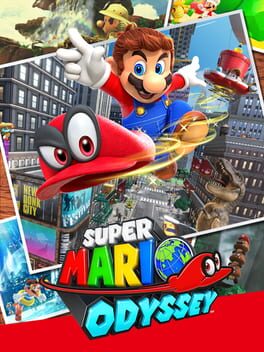
Developed by Nintendo EPD Production Group No. 8 and published by Nintendo, Super Mario Odyssey is a video game released on October 27, 2017. The platforms listed in this entry are Nintendo Switch and Nintendo Switch 2. The associated genres are action, adventure, fantasy, platforming, open world and sandbox, with single-player and cooperative modes.
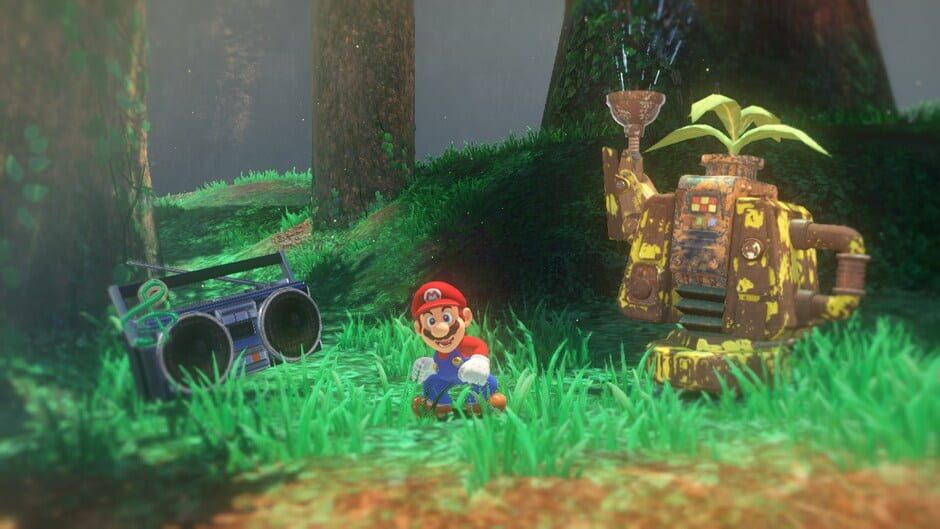
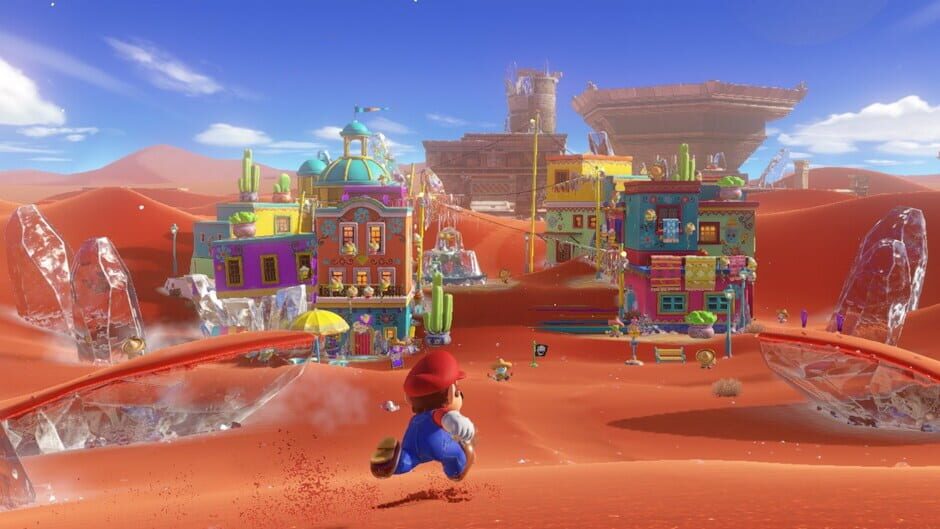
The adventure is built around a succession of three-dimensional kingdoms offering large areas to explore. Rather than following only a linear route, Mario can leave the main path, search for hidden passages, complete different activities and pursue multiple objectives spread throughout the same environment.
Progression is structured around Power Moons. Hidden throughout the environments or obtained by completing platforming, exploration or observation challenges, they provide the energy needed for the Odyssey to reach new destinations.
Each kingdom can contain numerous Moons accessible in different ways. Some are found directly along the route, while others require exploring higher areas, using a specific ability, solving a small puzzle or taking part in a particular activity.
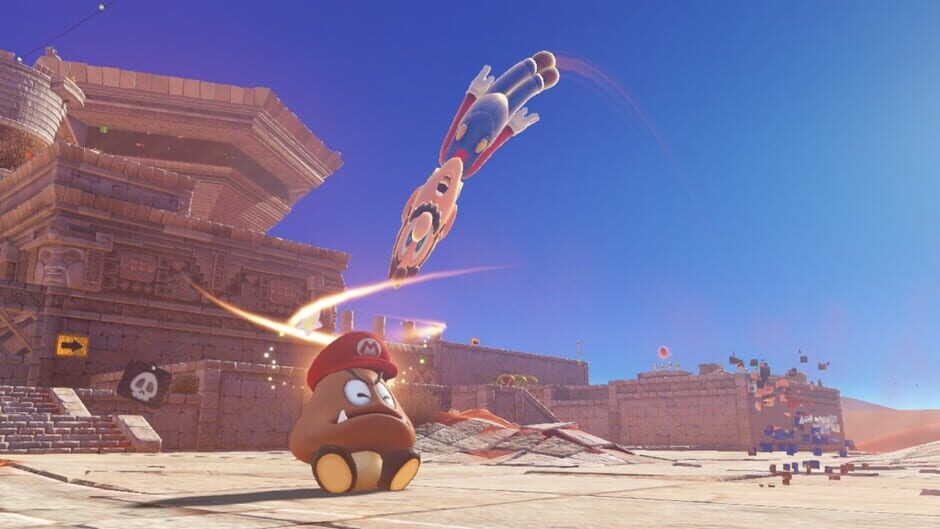
Cappy directly expands Mario’s movement and interaction options. The Cap Throw can hit enemies, activate mechanisms or break certain elements of the environment.
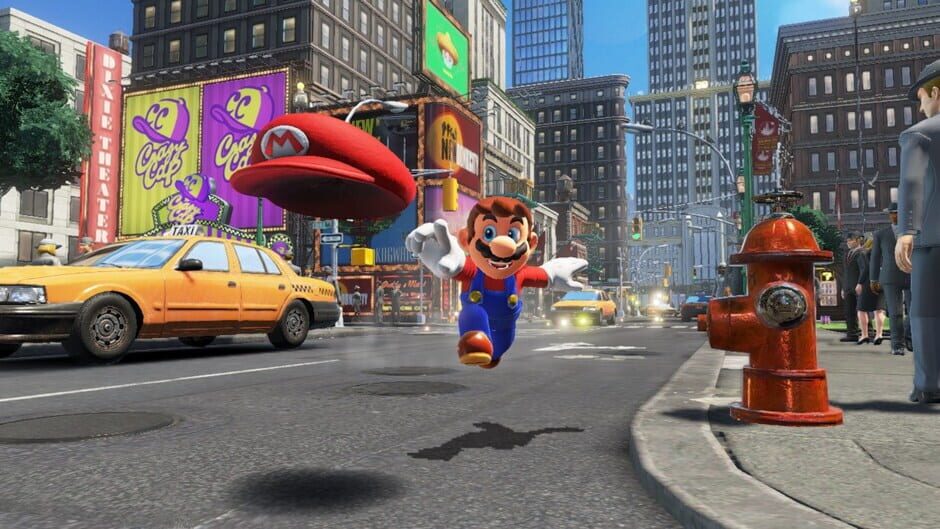
Mario can also throw Cappy in front of him and bounce off him with the Cap Jump, extending his movement range and allowing him to reach platforms beyond the distance of a standard jump.
The central mechanic, however, remains Capture. By throwing Cappy onto certain enemies, animals or objects, Mario can take control of them and use their abilities.
This mechanic regularly changes how environments are approached. A Bullet Bill, for example, allows Mario to cross certain distances quickly, a Cheep Cheep makes underwater exploration easier, while other Captures can be used to climb, fight, move objects or reach specific areas.
Mario can also take control of much larger creatures, including a T-Rex, temporarily gaining access to abilities very different from his usual movements.
Outside Captures, Mario retains many of his traditional 3D platforming moves: wall jumps, triple jumps, ground pounds, somersaults and various combinations with Cappy can all be used to navigate the environments.
Each kingdom also has its own regional coins. Unlike standard coins, they can only be spent in the region where they were collected.
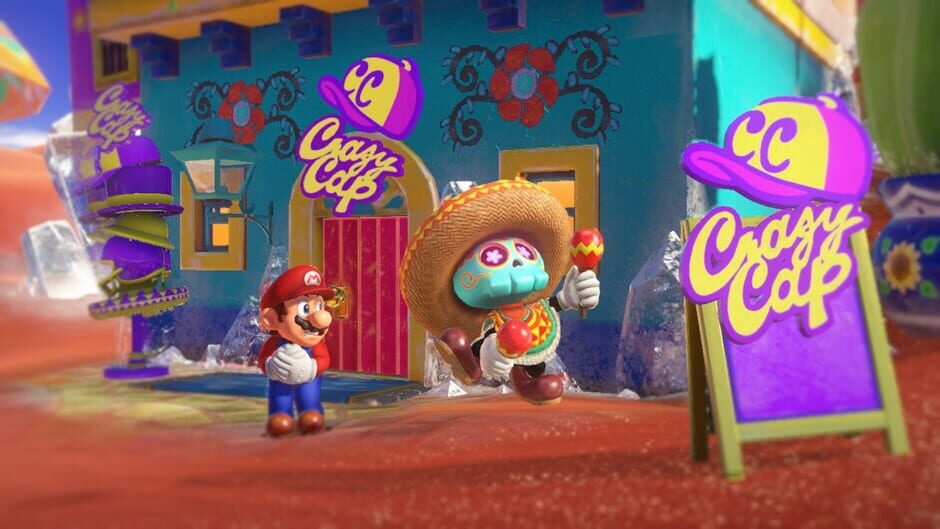
Shops allow players to buy different outfits for Mario as well as souvenirs used to decorate the Odyssey. Some outfits also provide access to specific situations or areas.
The kingdoms also contain various side activities and minigames tied to their environments. Some feature timed objectives or score-based challenges whose results can be compared through online leaderboards.
An Assist Mode can be enabled or disabled at any time. It increases Mario’s durability, makes recovery from certain falls easier, restores health while standing still and displays guidance toward the next objective.
Super Mario Odyssey also offers local two-player cooperation. The first player controls Mario while the second controls Cappy, who can move independently, attack certain enemies and take part in interactions with the environment.
The overall structure therefore combines exploration of large spaces, the search for Power Moons and experimentation with the abilities obtained through Cappy. The same area can be approached in several ways depending on the movements mastered, the available Captures and the objectives being pursued.
Super Mario Odyssey therefore builds its 3D platforming around a less compartmentalized progression structure, in which movement, collection and transformation are directly connected. Power Moons fuel travel between kingdoms, while Cappy continually expands the interaction possibilities within each one.
Key takeaways
- The different kingdoms offer large 3D spaces containing numerous objectives, hidden passages and activities.
- Power Moons are used to power the Odyssey and allow the journey to continue toward new destinations.
- Capture allows Mario to control certain enemies, animals and objects in order to use their abilities.
- Cappy also provides new movement options, particularly the Cap Throw and Cap Jump.
- Regional coins can be used to purchase outfits and souvenirs specific to the different kingdoms.
- Cooperative mode allows a second player to control Cappy alongside the player controlling Mario.
Conclusion
Super Mario Odyssey structures its progression around large environments where Power Moons can be obtained through exploration, platforming and various activities distributed throughout each kingdom.
Cappy complements Mario’s traditional movements with new traversal possibilities and, above all, Capture, which turns certain enemies, creatures and objects into directly usable abilities.
Regional coins, shops, outfits, minigames and numerous secondary objectives extend exploration beyond the path required to power the Odyssey and continue the journey.
Super Mario Odyssey therefore combines 3D platforming, open exploration, collection and transformation in environments where Mario and Cappy’s abilities determine many of the accessible routes and interactions.
Good to know
- Super Mario Odyssey was released on October 27, 2017.
- The game was developed by Nintendo EPD Production Group No. 8 and published by Nintendo.
- The platforms listed in this entry are Nintendo Switch and Nintendo Switch 2.
- The associated genres are action, adventure, fantasy, platforming, open world and sandbox.
- It features Single player and Co-operative modes.
- Power Moons fuel the Odyssey and are one of the main elements of progression.
- In local cooperative play, the first player controls Mario and the second controls Cappy.