Presentation
Developed and published by Capcom, Resident Evil 4 was originally released for Nintendo GameCube in 2005 under the direction of Shinji Mikami, with Hiroyuki Kobayashi serving as producer. After three main installments built around pre-rendered backgrounds, fixed cameras and exploration-focused progression, the fourth entry dramatically changes how the series plays without abandoning the biological threats and conspiracies that define its universe.
The story takes place in autumn 2004, approximately six years after the destruction of Raccoon City. Leon S. Kennedy is no longer the inexperienced police officer from Resident Evil 2: he has become a trained government agent sent to Europe to locate Ashley Graham. This change in status directly accompanies the game's evolution, placing its protagonist in situations where combat plays a considerably larger role.
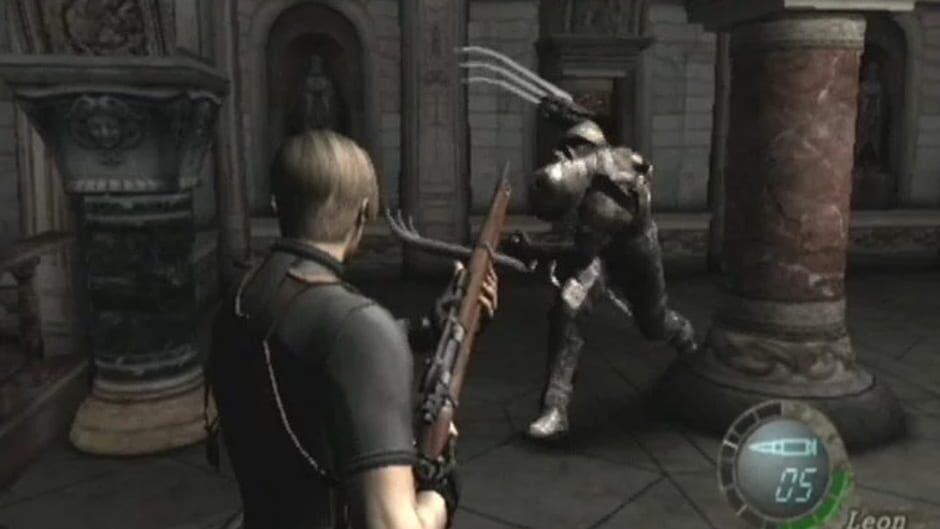
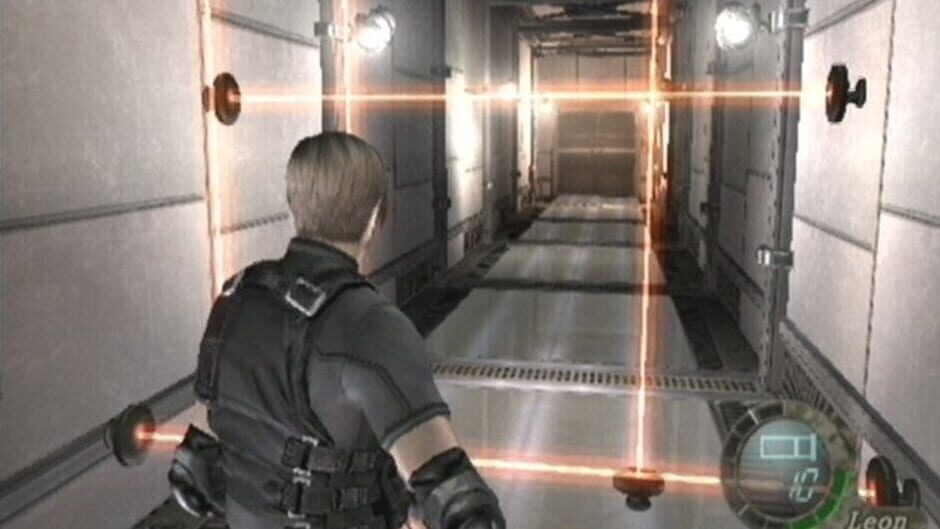
The most visible change is the camera. Resident Evil 4 abandons the traditional fixed perspectives in favor of a view positioned behind Leon and close to his shoulder. When aiming, the camera moves closer and allows different parts of an enemy's body to be targeted. Shooting a leg can stagger an opponent, while a well-placed attack can create an opportunity for a close-range physical move.
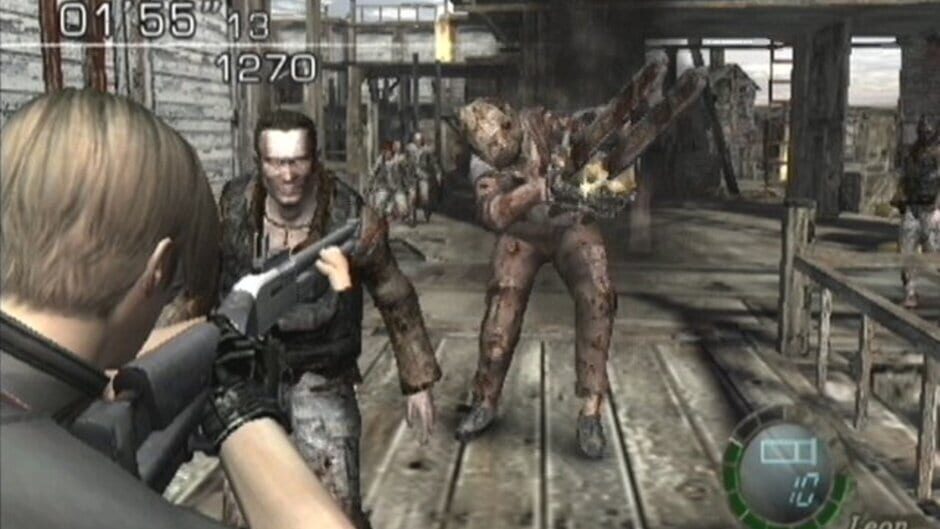
This precision transforms combat. The main enemies are no longer slow-moving zombies: the Ganados can run, use weapons, throw projectiles, move around Leon and attack in groups. Their behavior forces players to constantly monitor their surroundings, create distance and quickly decide which threats should be neutralized first.
Resident Evil 4 therefore adopts a more action-oriented pace while retaining meaningful resource management. Ammunition and healing supplies still require attention, while the inventory takes the form of an attaché case in which weapons, healing items and certain resources physically occupy space. Efficiently organizing equipment becomes a mechanic in its own right.
The merchant is another major addition. Appearing at different points throughout the journey, he allows players to purchase weapons, improve their power, firing speed or capacity, expand the attaché case and sell treasures found during exploration. This economy provides greater freedom to gradually shape Leon's arsenal according to individual preferences.
Exploration remains part of the experience, although it is integrated into environments that are generally more linear than the mansion or Raccoon City Police Department. The village, castle and various facilities contain secondary areas, treasures, puzzles and locations that can be revisited, but the overall progression more closely follows Leon's continuous movement toward his objective.
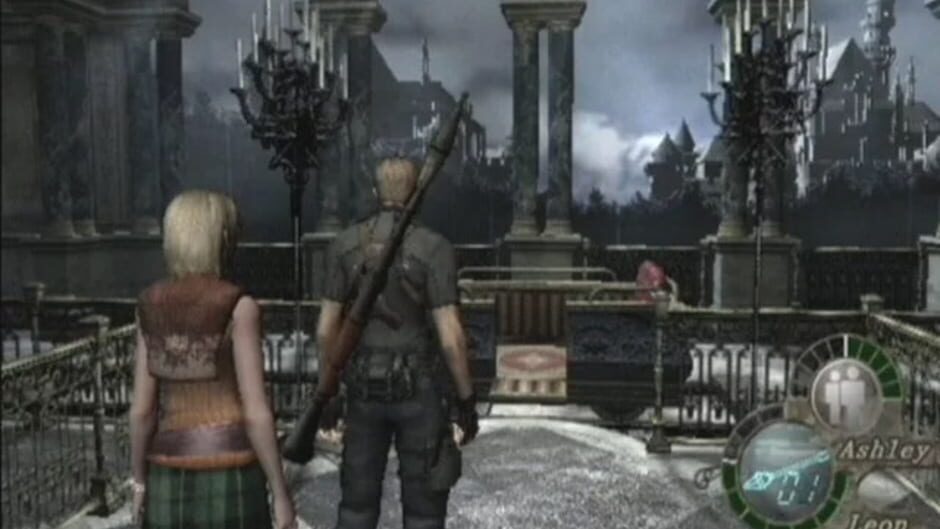
The presence of Ashley Graham also influences certain sequences. Once found, she regularly accompanies Leon and must be protected, repositioned or placed somewhere safe during combat. Players must therefore manage both surrounding enemies and the location of a character who does not possess Leon's combat abilities.
Narratively, Resident Evil 4 opens a new period for the series. Umbrella and the direct consequences of Raccoon City are no longer the immediate center of the story. The threat now revolves around Las Plagas, a parasite used by Los Illuminados to control its hosts, allowing the game to introduce enemy behavior and mutations different from those produced by the viruses of previous entries.
Ultimately, this transformation affects the entire formula. Camera, aiming, enemies, progression, economy and pacing are all rebuilt around a more dynamic game. Resident Evil 4 retains certain survival horror principles, particularly resource management and uncertainty when confronting creatures, but establishes a new direction whose influence would extend far beyond the series itself.
What to remember
- The return of Leon S. Kennedy, now a government agent six years after the Raccoon City events and tasked with finding Ashley Graham.
- A camera positioned behind the character and an aiming system that allows different body parts to be targeted, fundamentally changing combat.
- The Ganados, enemies capable of communicating, using weapons and attacking collectively, replacing traditional zombies as the main threat.
- An attaché-case inventory combined with a weapon purchasing and upgrading system through the merchant encountered during the adventure.
- Las Plagas and Los Illuminados as the new source of the biological threat, moving the story away from the setting directly tied to Umbrella and the T-virus.
- An installment that moves the series strongly toward action while retaining resource management, exploration, puzzles and several mechanics inherited from survival horror.
Conclusion
Resident Evil 4 represents one of the most significant transformations in the series. Capcom does not simply move the story to a new location or change protagonists: the way players aim, navigate environments and confront enemies is completely reorganized around a camera positioned much closer to the character.
This evolution naturally changes the nature of fear. Tension depends less on what fixed cameras prevent players from seeing and more on the pressure created by groups of enemies capable of moving quickly, surrounding Leon and reacting to his actions. Players are given more ways to fight, but the enemies themselves become more active.
Resource management nevertheless remains important enough to keep combat from becoming entirely mechanical. Organizing the attaché case, upgrading weapons, preserving ammunition and selecting equipment still require players to prepare for what lies ahead. Resident Evil 4 therefore combines much more direct action with decisions inherited from the previous games.
The change in biological threat also helps renew the universe. Las Plagas moves the series away from repeatedly relying on traditional zombies while preserving the central theme of biological manipulation. Leon provides a connection to earlier events, but his new role allows the series to explore a context no longer directly dependent on the Raccoon City disaster.
By combining its new camera, precise aiming, more organized enemies and increasingly action-oriented progression, Resident Evil 4 establishes a new formula for the franchise. Its importance comes as much from its break with the earliest installments as from the coherence with which Capcom rebuilds almost its entire gameplay system around this new direction.
Good to know
- Resident Evil 4 was developed and published by Capcom, with Shinji Mikami as director and Hiroyuki Kobayashi as producer.
- The game was originally released in 2005 for Nintendo GameCube and is titled Biohazard 4 in Japan.
- The story takes place in autumn 2004, approximately six years after the events of Raccoon City.
- Leon S. Kennedy is now a government agent assigned to locate Ashley Graham, the daughter of the President of the United States.
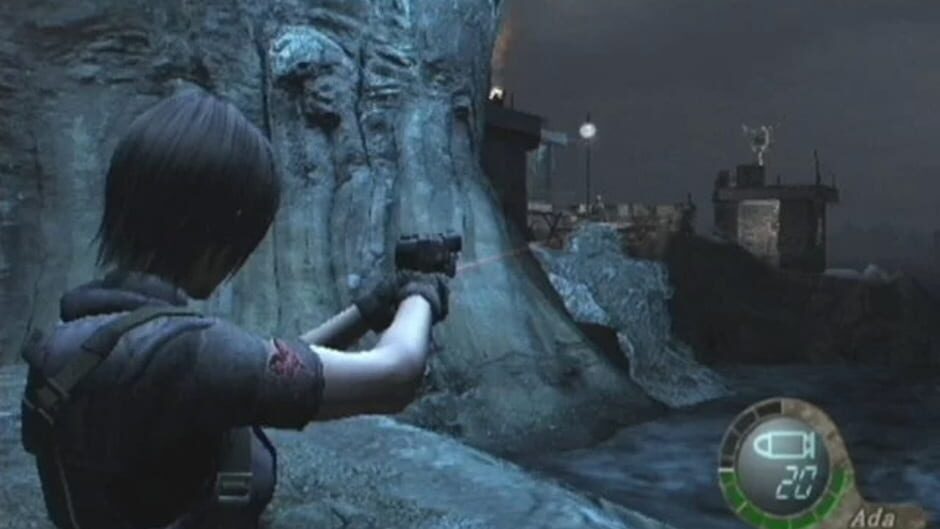
- A PlayStation 2 version was also released in 2005 and notably introduced the additional Separate Ways campaign centered on Ada Wong.
- Resident Evil 4 was later ported and re-released across numerous platforms, including Windows, Wii, PlayStation 3, Xbox 360, PlayStation 4, Xbox One and Nintendo Switch.
- The 2005 original should not be confused with Resident Evil 4 released in 2023, a remake that retains the same broad narrative foundation while extensively rebuilding the environments, combat system, progression and several story elements.
```