

Synopsis
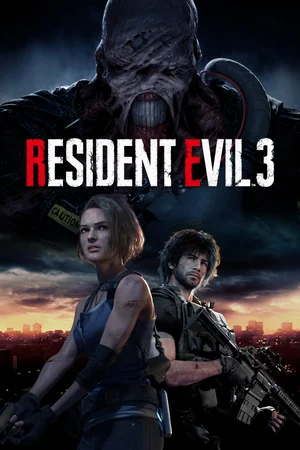
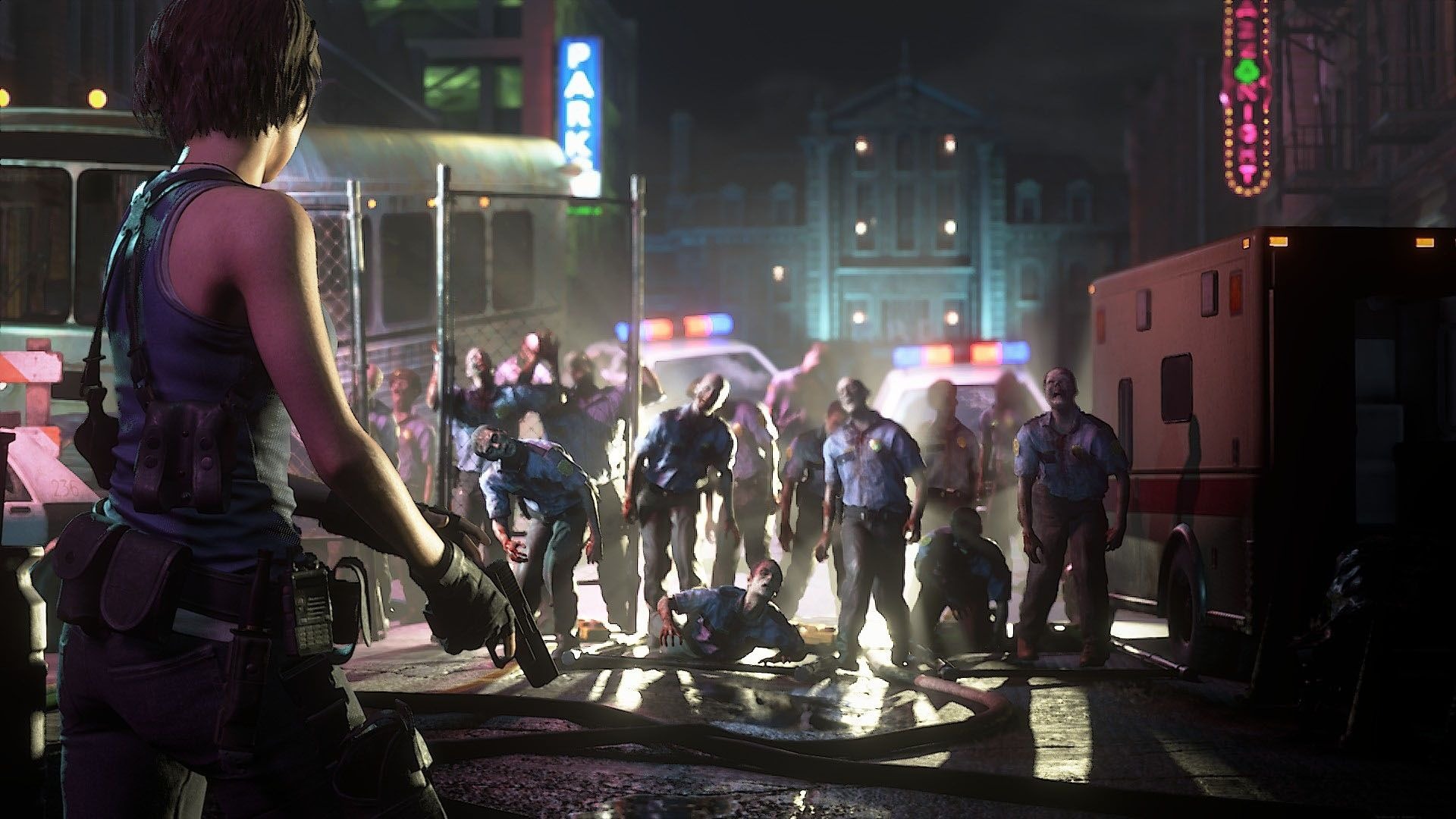
A few weeks after the Spencer Mansion incident, Raccoon City begins to collapse as well. The T-virus has spread through the population, and streets that were once ordinary are now overrun by the dead and by creatures produced through Umbrella’s research.
Jill Valentine, a survivor of the first Resident Evil and a member of S.T.A.R.S., is preparing to leave the city when a new bio-organic weapon crashes into her apartment. Its purpose does not appear to be infection or feeding, but specifically hunting the S.T.A.R.S. members capable of exposing Umbrella’s activities.
That creature is Nemesis.
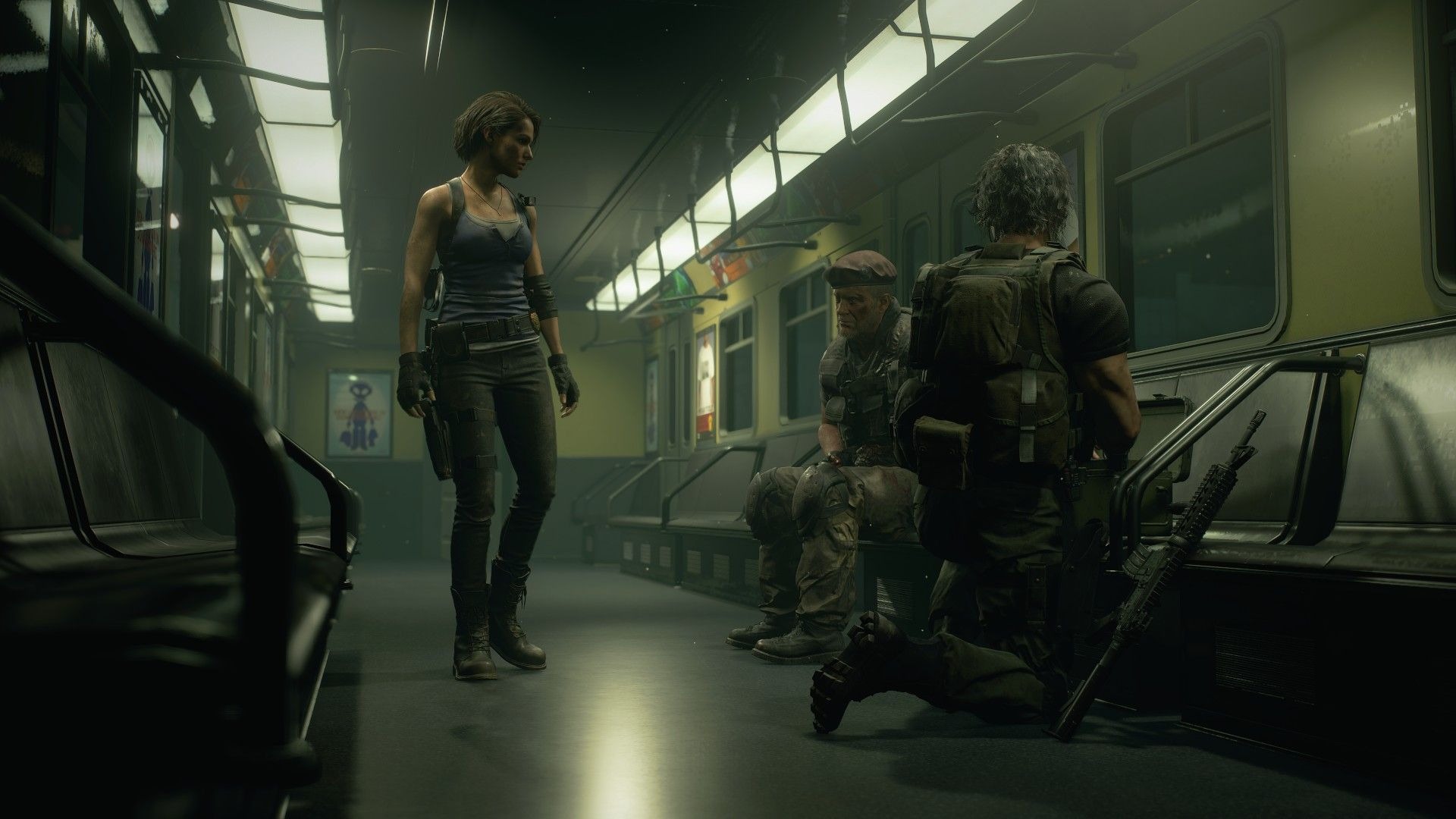
Jill soon joins Carlos Oliveira, a U.B.C.S. mercenary sent with other soldiers to help evacuate civilians. Despite their initial distrust, both are drawn into the same desperate attempt: restore the subway, find whatever survivors can still be reached and escape Raccoon City before the situation becomes irreversible.
But Nemesis continues to pursue Jill across the city. Its weapons, behavior and even its physical form change as the confrontation escalates.
The story partly unfolds alongside the events of Resident Evil 2: it begins before Leon and Claire arrive and follows the final days of Raccoon City through to their conclusion.
Resident Evil 3 is therefore less about exploring a cursed place than escaping a city that has almost run out of time to be saved.
Overview
An escape rather than an investigation
Resident Evil 2 largely confined the player inside locations that had to be understood gradually. Resident Evil 3 follows a different logic.
Jill already knows Umbrella. She understands that the monsters are not an incomprehensible accident and does not need to slowly uncover the nature of the catastrophe. Her objective is much more immediate: get out of Raccoon City alive.
That difference shapes the entire structure of the remake. The streets, buildings, underground areas and facilities crossed along the way form less of a gigantic space to decipher than a succession of areas caught inside an evacuation that is gradually falling apart.
There are still puzzles, items to collect, side paths and doors that require returning later, but the overall movement constantly pushes forward.
Jill Valentine against Nemesis
Nemesis is, of course, the defining image of the game.
Umbrella sends it to eliminate the remaining S.T.A.R.S. members who know the truth about its activities. Capcom presents it as a bio-organic weapon capable not only of pursuing Jill, but also of using different heavy weapons and infecting certain creatures with parasites.
Its role nevertheless differs from that of the Tyrant in Resident Evil 2.
Mr. X could turn relatively calm exploration into a problem simply because his footsteps were getting closer in a corridor. Nemesis is more closely tied to large pursuit sequences, direct confrontations and spectacular escalation.
This approach sometimes makes it less unpredictable, but far more aggressive. When it appears, the pace of the game can change within seconds.
Dodging at the heart of combat
The remake brings back and develops one of Resident Evil 3: Nemesis’s signature mechanics: dodging.
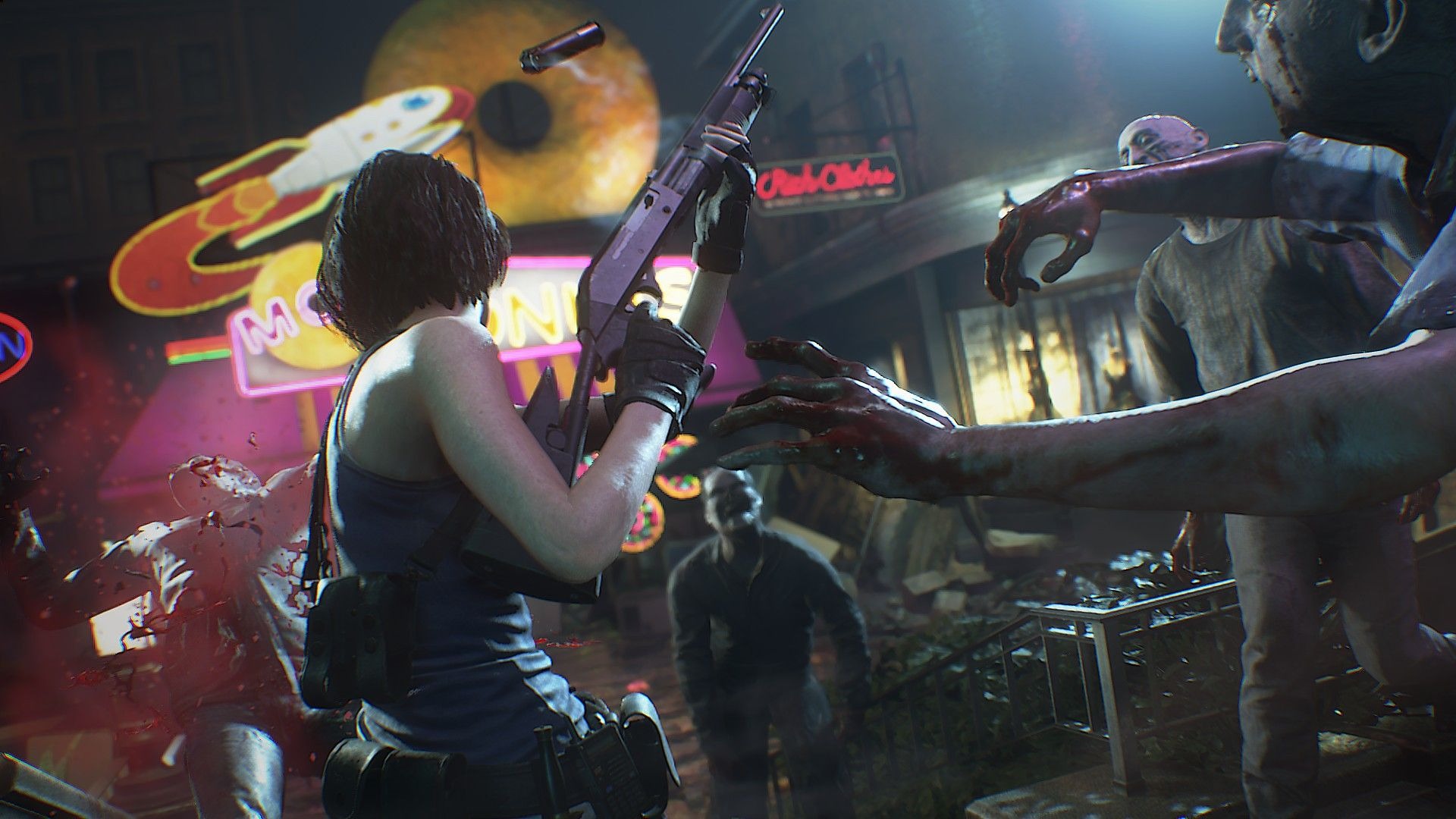
A move performed at the right moment allows Jill to avoid an attack and quickly regain the advantage. A perfect dodge can create a brief opening that is especially favorable for counterattacking.
Capcom had already made this mechanic a distinctive feature of the original game and completely rebuilt it for the remake.
This makes Jill much more mobile than Leon or Claire in Resident Evil 2. Zombies remain dangerous and ammunition still matters, but the player gains an additional response when space begins to close around them.
Resident Evil 3 therefore becomes a more physical survival horror experience: it still demands careful resource management, but also asks the player to know when to stand still, when to shoot and when to take the risk of slipping right past an enemy.
Carlos is more than a supporting character
Part of the campaign places the player in control of Carlos Oliveira.
A member of the U.B.C.S., he arrives in Raccoon City believing that his unit is taking part in a rescue operation. The reality of Umbrella’s activities and the motivations of certain members of his group gradually complicate that belief.
Carlos has a more combat-oriented playstyle. His equipment and some of his abilities make him particularly well suited to fighting multiple enemies at once.
His sections are not disconnected from the main story, however. They allow the player to explore locations and events Jill does not directly witness, while also giving more space to the relationship between the two characters.
One already knows Umbrella is lying. The other must gradually discover how far that lie goes.
A larger-looking Raccoon City with a tighter route
RE ENGINE allows the remake to give Raccoon City a very different presence from the 1999 game.
Shattered storefronts, fire-lit streets, abandoned apartments, subway stations and industrial facilities create the impression of a real city collapsing in real time.
The paradox comes from the structure itself: the city appears larger and more believable visually, while the campaign remains highly directed.
Some areas allow relatively free exploration, but Resident Evil 3 clearly favors narrative progression and action. Several locations, mechanics and branching paths from the 1999 game were also removed or significantly transformed.
That choice explains part of the remake’s identity — and part of the debate around it: Capcom rebuilt Resident Evil 3 as a faster adventure rather than as an exhaustive recreation of Resident Evil 3: Nemesis.
A remake that naturally accompanies Resident Evil 2
Resident Evil 3 uses the same generation of technology and part of the same visual language as the Resident Evil 2 remake.
The connection goes beyond appearance. Both stories unfold around the same days in September 1998, and certain locations or characters create direct links between the two games.
The official Resident Evil portal states that Resident Evil 3 begins one day before Resident Evil 2: Remake and then continues through the final days of Raccoon City.
Playing both remakes therefore makes it possible to observe the catastrophe from several perspectives: Leon and Claire arrive in a city that is already lost, while Jill watches it fall.
Key takeaways
- Resident Evil 3 is a remake of Resident Evil 3: Nemesis, originally released in 1999.
- Jill Valentine is the main protagonist and attempts to escape Raccoon City during the T-virus outbreak.
- Nemesis hunts members of S.T.A.R.S., and Jill in particular, to prevent them from exposing Umbrella’s activities.
- Carlos Oliveira is also playable during several parts of the campaign.
- The gameplay combines third-person shooting, survival horror, exploration, resource management and action.
- Dodging is one of Jill’s main defensive mechanics and brings back an idea already present in the 1999 game.
- Nemesis uses different weapons and evolves over the course of the adventure.
- The remake uses RE ENGINE, Capcom’s proprietary engine.
- The story takes place partly before and alongside Resident Evil 2.
- Resident Evil 3’s campaign is entirely single-player.
- Resident Evil Resistance is a separate asymmetric multiplayer game originally included with Resident Evil 3.
- Resident Evil 3 is now available on PS5, PS4, Xbox Series X|S, Xbox One, Nintendo Switch via cloud, PC and compatible Apple devices.
PANACHES review
A Resident Evil that prefers to run
Resident Evil 3 almost has the opposite problem of many modern games: it never tries to keep the player around artificially.
The campaign moves quickly, changes scenery regularly and greatly reduces the amount of time spent circling the same space.
That concentration creates a very efficient adventure. It also removes some of what makes survival horror fascinating: the time needed to become familiar with a place, memorize its shortcuts and eventually recognize every door before opening it.
The remake clearly chooses its side. It favors urgency over settling in.
Nemesis impresses more than it haunts
Nemesis has everything required to become the perfect threat: power, speed, mobility and a silhouette that is difficult to forget.
The paradox is that Resident Evil 3 often uses the creature as the engine of heavily staged sequences. Nemesis therefore produces spectacular moments, but sometimes leaves less room for that strange fear created by an enemy whose location is simply unknown.
That choice is not necessarily worse. It mainly matches the overall pace of the remake.
Nemesis is not always a presence that inhabits Raccoon City. It is the thing that prevents Jill from ever stopping there.
An excellent companion piece, a more debatable remake
Taken as an extension of Resident Evil 2, Resident Evil 3 works remarkably well.
It shows Raccoon City from another angle, places a much more experienced protagonist at the center and presents the catastrophe while it is still actively unfolding.
The comparison with the 1999 game is more complicated. Some locations and systems were heavily transformed or removed, making this new version less exhaustive than the reconstruction seen in Resident Evil 2.
That does not make Resident Evil 3 a bad remake. It makes it a remake that interprets more freely.
Capcom is not trying to rebuild every fragment of the past here: the studio mainly recovers the essential idea — Jill, a doomed city and something enormous that refuses to let her leave — and then accelerates everything else.
Good to know
Original release of the remake
- Resident Evil 3 was released on April 3, 2020 for PlayStation 4, Xbox One and PC.
- The game was developed and published by Capcom.
- It reimagines Resident Evil 3: Nemesis, originally released in 1999.
- Capcom uses its proprietary RE ENGINE for this new version.
PS5 and Xbox Series versions
- The PlayStation 5 and Xbox Series X|S versions were released on June 14, 2022.
- These are officially released versions for those platforms and are therefore represented in the
plateformesfield. - On PS5, Capcom notably lists support for 4K HDR, ray tracing depending on the selected mode, adaptive triggers, haptic feedback and 3D audio.
Nintendo Switch Cloud
- Resident Evil 3 Cloud was released on Nintendo Switch on November 18, 2022.
- This version runs through cloud gaming and therefore requires a stable Internet connection.
- Capcom states that its core content is essentially identical to the other versions, despite certain differences related to how the service operates.
- The entry therefore uses
nintendo-switchin the platforms while clarifying here the particular nature of this edition.
iPhone, iPad and Mac versions
- Resident Evil 3 was released on iPhone, iPad and Mac on March 18, 2025 for compatible devices.
- These editions justify the use of the
mobileandmacvalues in the entry. - They continue Capcom’s strategy of bringing several recent Resident Evil titles to compatible Apple devices.
Resident Evil Resistance
- The original release of Resident Evil 3 also included Resident Evil Resistance.
- Resistance is an online asymmetric multiplayer game in which several survivors face a player controlling traps, enemies and other threats within an experiment.
- It is nevertheless a separate experience from the Resident Evil 3 campaign.
- The entry therefore keeps
modes_de_jeu: 'solo'to describe the main work.
Resident Evil 3 and Resident Evil 2
- Resident Evil 3 begins one day before Resident Evil 2: Remake and continues through the final days of Raccoon City.
- The two remakes share several locations, events and supporting characters.
- Resident Evil 3 nevertheless remains an independent adventure centered on Jill Valentine and Carlos Oliveira.
Sales
- Resident Evil 3 surpassed 2 million copies five days after release.
- The game then passed 5 million copies in early 2022.
- It had exceeded 10 million copies by 2025.
- As of March 31, 2026, Capcom’s official data reports 14.5 million copies sold.
- The campaign is a completed work; the entry therefore uses
statut_parution: completed.