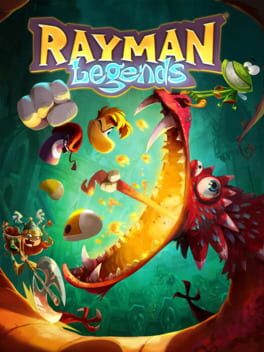
After sleeping for more than a century, Rayman, Globox and their companions discover that the Nightmares have multiplied throughout the Glade of Dreams and created new worlds filled with dangerous creatures. Many Teensies have been captured and chaos has spread. Awakened by Murfy, the heroes set out once again through a series of magical paintings that lead to these worlds, where they must free the prisoners and push back the forces threatening the Glade of Dreams.
Video game
2013
Action
Adventure
Comedy
Fantasy
Platformer
Rayman Legends
- Nintendo Publisher
- Ubisoft Montpellier Developer
Rayman turns every level into a playground of movement, timing and sometimes even music.
Details
- Type
- Video game
- Release
- 2013-08-29
- Genres
- Action, Adventure, Comedy, Fantasy, Platformer
- Platforms
- Nintendo Wii U, PS Vita
- Engine
- UbiArt Framework
- Game modes
- Single player, Multiplayer
Synopsis
Rayman Legends
Trailer
Watch the trailer
Overview
Presentation
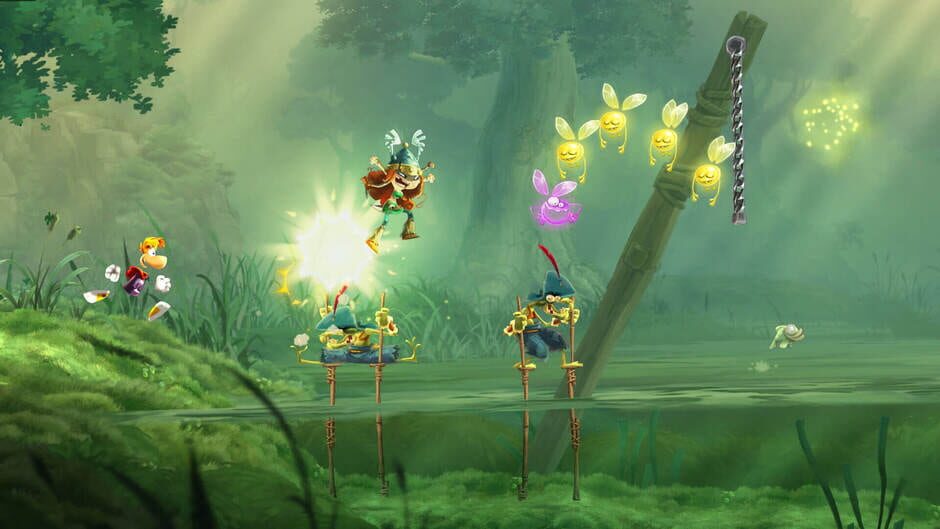
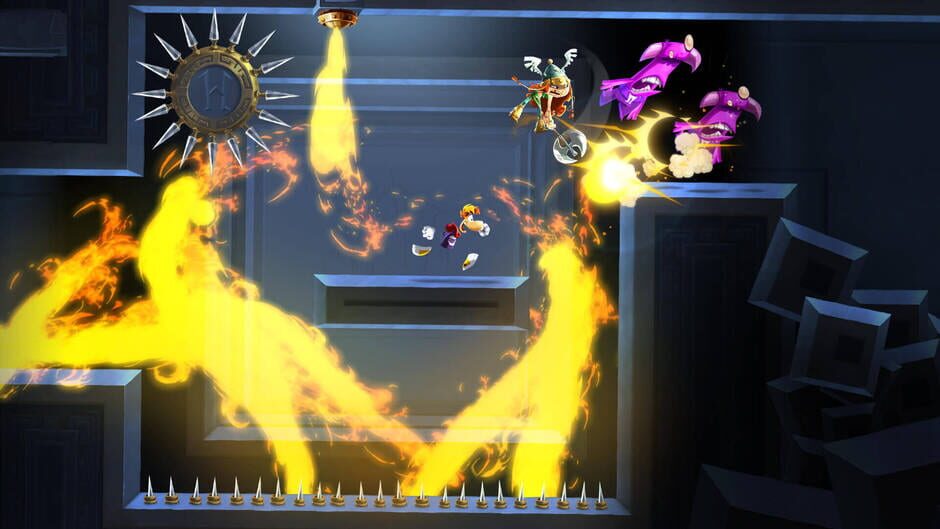
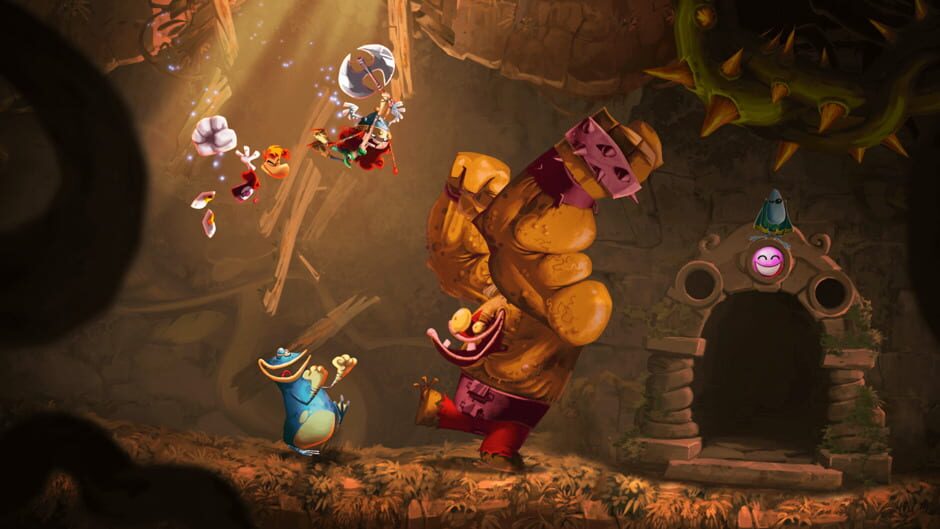
Rayman Legends continues the formula established by Rayman Origins, retaining its two-dimensional platforming, emphasis on movement and illustrated universe while greatly increasing the variety of situations. Rayman, Globox and their companions now travel through different worlds accessed from a gallery of magical paintings, each introducing its own environments, obstacles and mechanics.
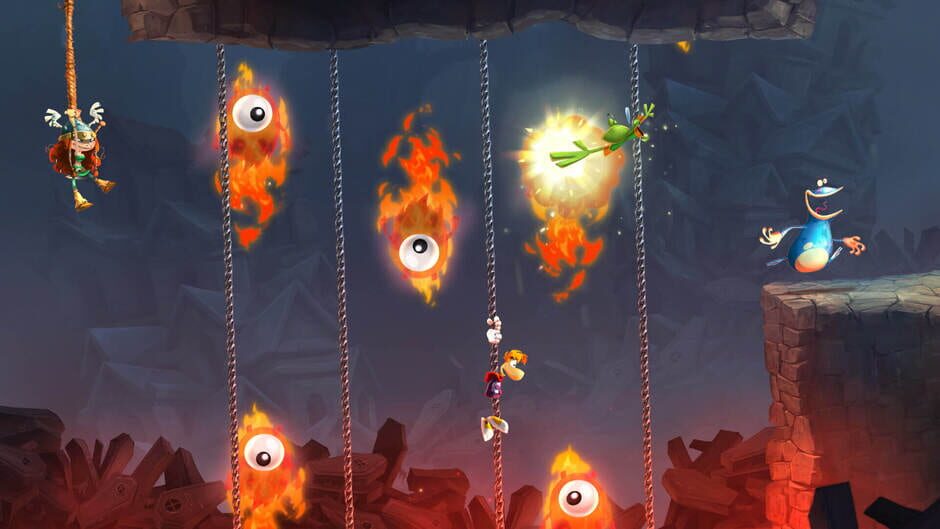
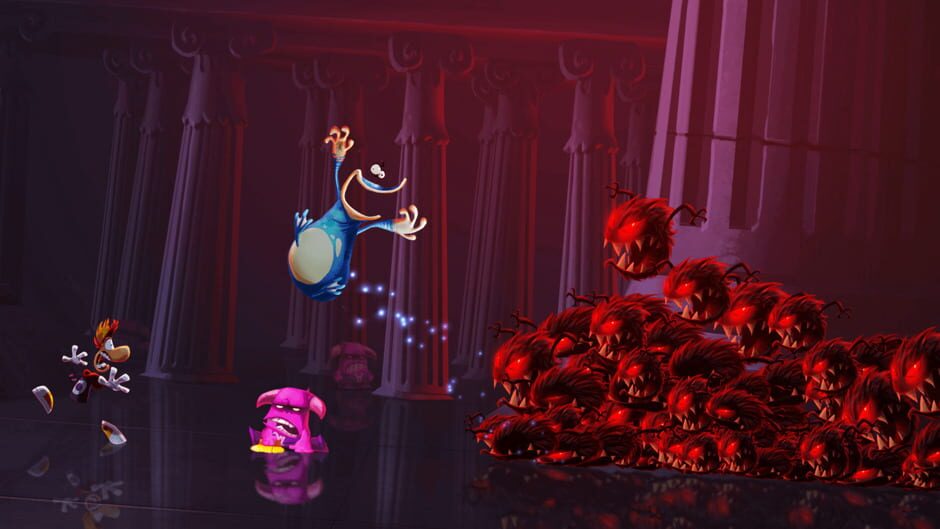
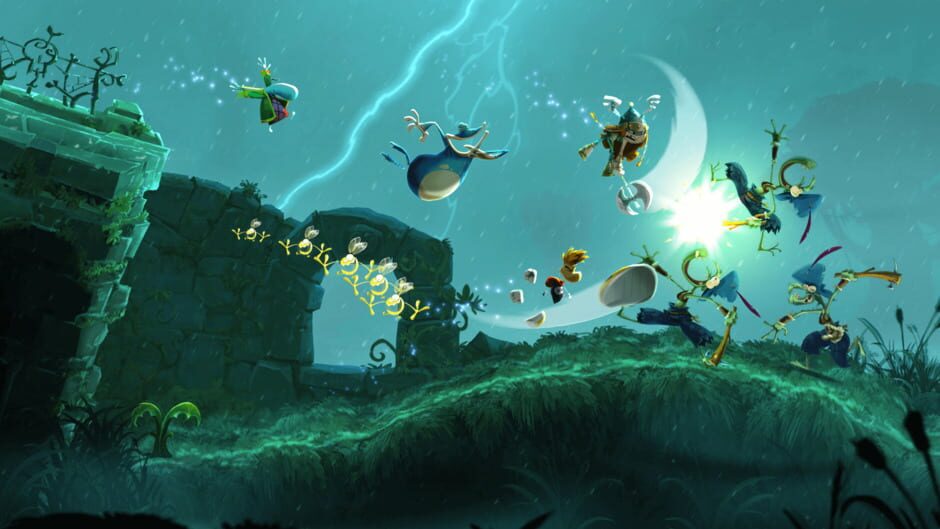
Movement remains at the heart of the experience. Characters run, jump, attack, glide, swim and chain actions together through levels that gradually demand greater precision and timing. Some courses emphasize exploration, others focus on chases or faster sequences, while several levels play with scenery, depth and moving elements to regularly change the way players progress.
The Teensies replace the Electoons as the main characters to rescue. They are scattered throughout the levels, sometimes placed directly along the player's path and sometimes hidden in secondary areas or behind more demanding challenges. Rescuing them helps unlock new worlds and encourages players to explore beyond simply reaching the end of a level.
The Lums also remain central to collecting. Their placement often rewards smooth movement and successful action chains. Some appear according to precise sequences, turning their collection into a small exercise in timing and trajectory rather than a simple search for scattered objects.
Murfy takes part in several levels by directly manipulating elements of the environment. He can activate mechanisms, move platforms, cut ropes or temporarily neutralize obstacles and enemies. His role varies depending on the platform: versions using a touchscreen allow more direct interaction, while other versions require players to trigger his actions while continuing to control their character.
The musical levels are one of the game's most distinctive features. Obstacles, enemies, jumps and actions are arranged according to the rhythm of a song, turning each course into a sequence where platforming and music move together. The player therefore does not simply hear music in the background: the structure of the level itself is synchronized with it.
The adventure can be played alone or in local co-op with up to four players. As in Origins, participants share the same space and can progress together while also creating more chaotic situations through their interactions. The game therefore remains clear enough to work effectively in solo play while allowing for a far more unpredictable multiplayer experience.
Alongside its main content, the game includes Back to Origins, which brings back forty levels from Rayman Origins. These courses are not simply reproduced unchanged: they are adapted to the systems and presentation of Legends, allowing a substantial part of the previous game to be revisited within this new structure.
The art direction once again relies on the UbiArt Framework. Characters and environments retain an appearance close to animated illustration, while the scenery makes greater use of depth effects, shifts in atmosphere and animation. Each world can therefore develop a very different visual identity without breaking the overall coherence of the Glade of Dreams.
Key points
- A 2D platformer that directly expands on the foundations of Rayman Origins.
- Levels built around movement, exploration, chases and rhythm.
- Rescuing Teensies structures part of the progression and encourages exploration.
- Lums reward precise routes and smooth action chains.
- Murfy directly interacts with certain level elements and introduces new gameplay situations.
- Musical levels synchronize player actions with the rhythm of the soundtrack.
- The adventure can be played solo or in local co-op with up to four players.
- Back to Origins includes 40 adapted levels from Rayman Origins.
- The visual direction once again relies on the UbiArt Framework.
Conclusion
Rayman Legends retains the fluidity and visual direction of Rayman Origins while expanding the formula through a wider variety of situations. Murfy's interventions, musical levels, chase sequences and frequent mechanical changes give each world its own identity without abandoning the fundamentals of platforming.
The game remains built above all around the pleasure of movement: understanding the rhythm of a course, chaining actions together and exploring thoroughly enough to find hidden Teensies. The inclusion of many levels from Origins completes this structure and brings together a substantial part of this 2D era of Rayman within a single experience.
Good to know
Rayman Legends was developed by Ubisoft Montpellier and published by Ubisoft. It was originally released in 2013.
The game uses the UbiArt Framework, previously used for Rayman Origins.
It was released on several platforms, including PC, Wii U, PlayStation 3, PlayStation Vita and Xbox 360, before later appearing on PlayStation 4, Xbox One and Nintendo Switch.
The Back to Origins content includes 40 levels from Rayman Origins, adapted for integration into Rayman Legends.
An edition titled Rayman Legends: Definitive Edition was also released on Nintendo Switch.
This entry covers Rayman Legends and its own content without confusing it with Rayman Origins, despite the inclusion of levels from that game.