Overview
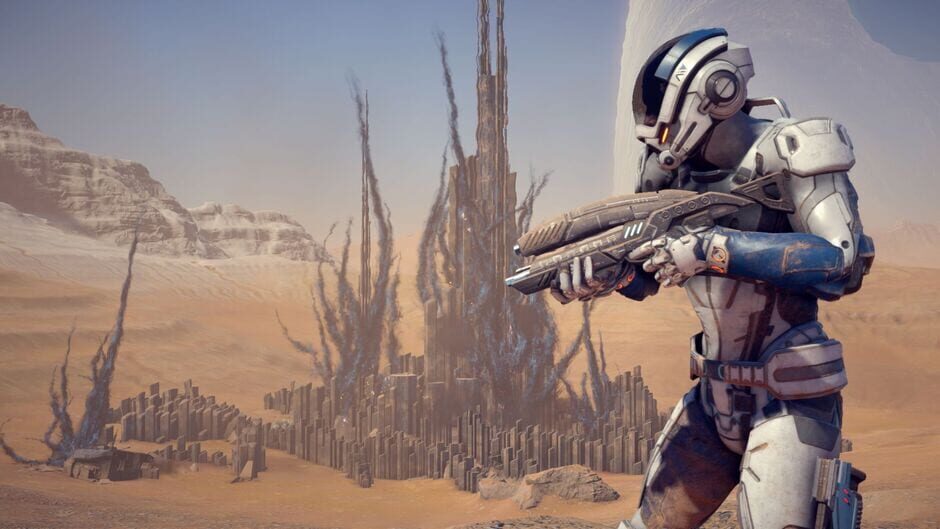
Mass Effect: Andromeda moves the series far from the Milky Way and places exploration at the center of its structure. The player takes on the role of the Pathfinder, responsible for a team of explorers tasked with traveling across the Heleus Cluster, studying its planets and helping establish the Andromeda Initiative in a galaxy that remains largely unknown.
Developed by BioWare Montréal and published by Electronic Arts, the game was released on March 21, 2017. The platforms listed in this entry are PlayStation 4, Xbox One and PC. The associated genres are action, adventure, science fiction, RPG and FPS. The specified game modes are Single player, Multiplayer and Co-operative, and the engine listed is Frostbite 3.
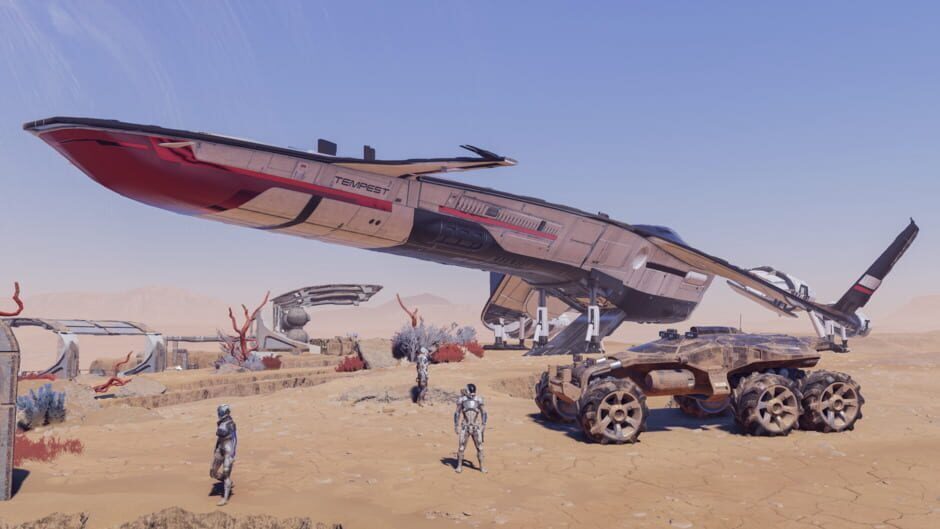
The Tempest serves as the main ship for navigating the Heleus Cluster. Its galaxy map allows players to travel through different systems and observe planets, moons, space phenomena and spacecraft before reaching worlds that can be explored on foot.
On planetary surfaces, exploration relies heavily on the Nomad, an all-terrain vehicle designed to cross vast landscapes. It can receive several upgrades affecting areas such as acceleration, jumping and handling, helping the player reach regions that are more difficult to access.
Forward Stations also structure this traversal. Once deployed, they serve as fast-travel points, allow loadouts to be changed, recall the Nomad and replenish supplies. They also play a role in hazardous environments, where the Pathfinder’s and vehicle’s life-support systems can be challenged by extreme temperatures or other hostile conditions.
Exploration directly contributes to planet viability. Resolving local problems, eliminating threats, completing missions and building relationships with encountered populations can improve viability until establishing an outpost becomes possible.
This progression also generates Andromeda Viability Points, which are used in the development of the Nexus. Reaching certain thresholds notably allows new colonists to be awakened from cryostasis, and the groups selected can provide different advantages related to research, commerce or military capabilities.
The worlds of Andromeda also contain Vaults, ancient installations whose exploration combines traversal, environmental observation, puzzle-like mechanisms and combat. Activating them forms part of the Pathfinder’s broader work to understand explored territories and make them habitable.
The combat system abandons rigid classes in favor of much more flexible progression. Skills are divided between Combat, Biotics and Tech, while Profiles provide bonuses according to the areas in which the player invests skill points.
Up to seven types of Profiles can be unlocked. They allow the player either to specialize or to combine several skill families. Favorite configurations then pair a Profile with three powers and make it possible to switch quickly from one combat approach to another.
Mobility also evolves through the jump-jet. The character can jump, dodge and briefly hover during combat, adding greater verticality. The cover system becomes dynamic at the same time: the character automatically uses many elements of the environment as protection.
The squad remains an important part of combat. Companions have active and passive skills whose progression can be directed, while their powers can be combined with those of the Pathfinder to trigger Power Combos.
Equipment also relies on a Research and Development system. Scanning wildlife, technologies and various encountered elements provides research data used to unlock blueprints. Resources collected or extracted can then be used to craft weapons and armor, with augmentations added to modify certain properties.
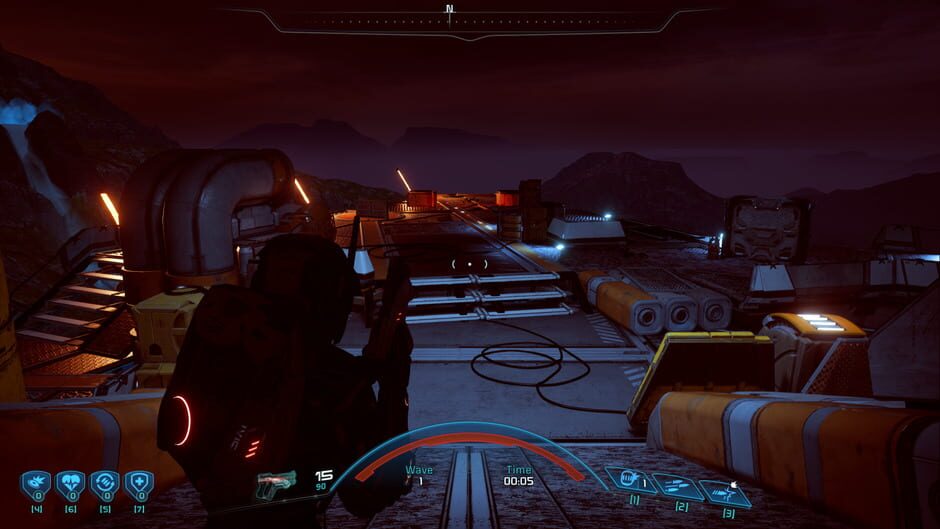
Multiplayer adapts the campaign’s combat into a cooperative format for up to four players. Teams must survive waves of enemies, complete different objectives and then evacuate the area. Playable characters have their own abilities and progress separately through experience earned during missions.
These operations are connected to the single-player universe through APEX missions. From the campaign, the player can send strike teams to complete certain operations or choose to participate directly in one of them through multiplayer.
Mass Effect: Andromeda therefore builds its identity less around an already familiar territory than around its gradual discovery. Space navigation, the Nomad, viability, outposts, crafting and Profiles give the Pathfinder a concrete function: explore, understand and then prepare the Initiative’s settlement of the Heleus Cluster.
Key takeaways
- The Andromeda Initiative undertakes a 600-year journey in search of new places to settle in the Andromeda galaxy.
- The player takes on the role of the Pathfinder, responsible for exploring the worlds of the Heleus Cluster and assessing their potential.
- The Nomad allows players to cross vast planetary surfaces and can receive several upgrades.
- World progression notably depends on viability, outposts and Andromeda Viability Points.
- Forward Stations provide fast travel, resupply, loadout changes and Nomad recall.
- Combat combines Combat, Biotics and Tech skills with a Profile system that can be changed according to the situation.
- Research and Development allows weapons and armor to be crafted and modified using data and resources obtained during exploration.
- Multiplayer offers cooperative missions for up to four players connected to APEX operations.
Conclusion
Andromeda reframes the central role of Mass Effect around the exploration of a new galaxy. The Pathfinder does not act only as a combatant: planetary traversal, viability, outposts and Nexus development make colonization a system directly integrated into progression.
This direction also appears in combat. The jump-jet increases mobility, Profiles replace permanently locked specialization and favorites allow powers and bonuses to be reorganized quickly according to the situation.
The Nomad, crafting and APEX missions complete this structure by connecting exploration, equipment development and cooperation. Mass Effect: Andromeda therefore builds its adventure around a single principle: gradually transforming unknown territory into a space that can be traveled, understood and settled.
Good to know
- Mass Effect: Andromeda was released on March 21, 2017.
- The game was developed by BioWare Montréal and published by Electronic Arts.
- The platforms listed are PlayStation 4, Xbox One and PC.
- The associated genres are action, adventure, science fiction, RPG and FPS.
- The specified game modes are Single player, Multiplayer and Co-operative.
- The engine listed is Frostbite 3.
- The Heleus Cluster is the main area of exploration.
- Multiplayer allows up to four players to take part in cooperative missions together.