Presentation
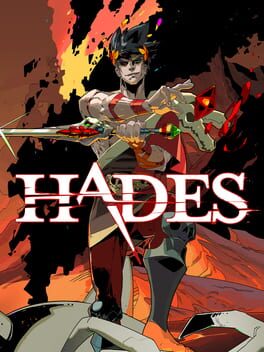
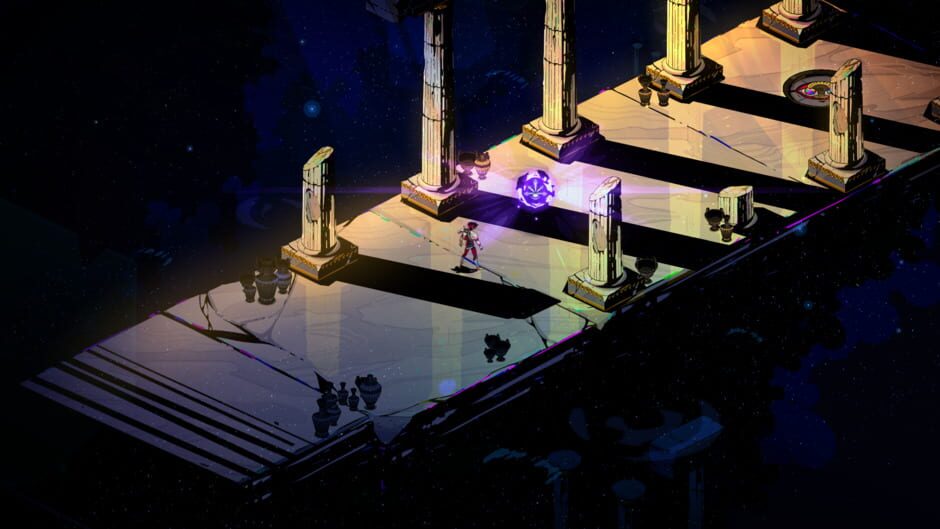
Hades builds its entire adventure around repeated escape attempts. A run begins in the House of Hades, crosses several regions of the Underworld and ends when Zagreus dies or reaches the end of the route. Rooms, rewards and encounters vary from one attempt to another, forcing the player to gradually build a setup around what the game provides.
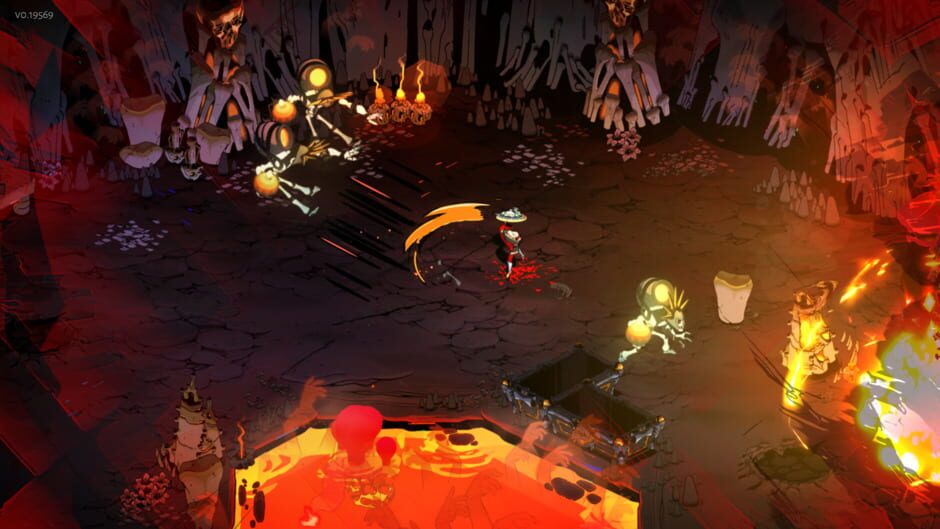
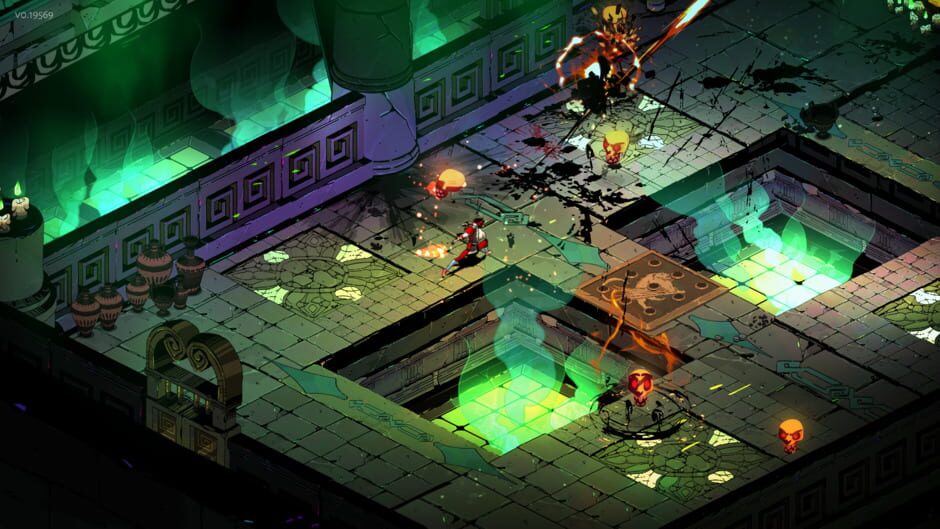
Combat takes place in real time with a main attack, special attack, dash and Cast. Their behavior depends heavily on the Infernal Arm chosen before departure. The Stygian Blade favors close combat, the Heart-Seeking Bow emphasizes range, while the Eternal Spear, Shield of Chaos, Twin Fists of Malphon and Adamant Rail each establish their own rhythm.
These weapons also have several Aspects that modify particular characteristics or mechanics. Changing Aspect can transform a weapon enough to encourage a different approach without changing the fundamental controls. The game therefore offers a limited number of weapons while multiplying the ways they can be built.
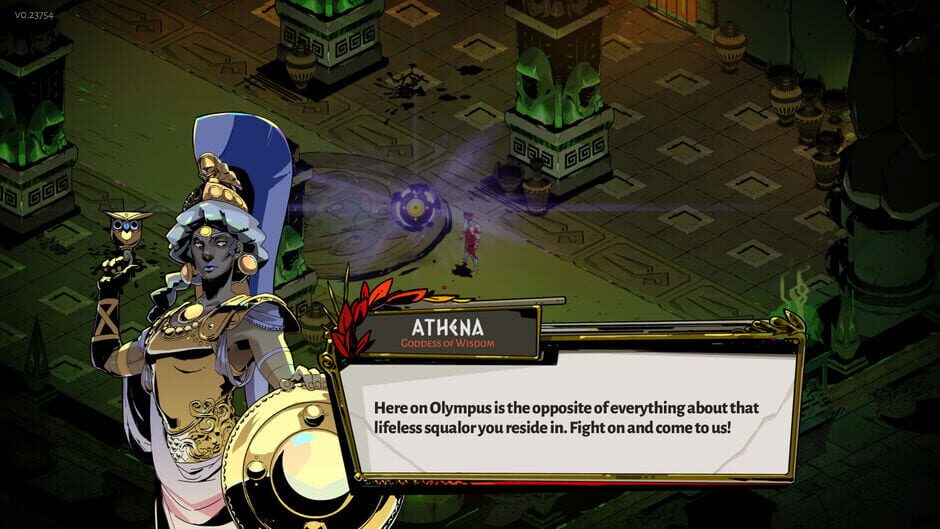
The gods’ boons provide the main variation within each attempt. Zeus can attach lightning to certain attacks, Poseidon can add knockback, Athena can grant deflection, Artemis can emphasize critical hits and Dionysus can apply persistent effects. The player does not freely select the entire build at the beginning and instead has to work with the gods and upgrades encountered along the way.
Some synergies go further through Duo Boons and Legendary Boons. Having specific powers can unlock access to a new boon that combines the influence of two deities. A run can therefore begin with a relatively simple direction and gradually evolve into a far more specialized build.
Most of this build disappears on death, but Hades also preserves permanent progression. Darkness improves Zagreus through the Mirror of Night, Chthonic Keys unlock new weapons or Mirror options, while Gemstones, Diamonds, Nectar and Ambrosia are used to develop the House or relationships with its inhabitants.
The Mirror of Night can improve Zagreus’s survival chances and adjust several progression rules. Health, Death Defiance, the power of certain attacks and control over rewards can all be upgraded. Alternate talents later allow many of these choices to be changed without starting over with a new character.
Keepsakes obtained by offering Nectar provide another form of preparation. Each one grants a particular advantage and can support a playstyle, improve survivability or increase the chance of receiving a boon from a specific god. Social relationships therefore have a concrete effect on future escape attempts.
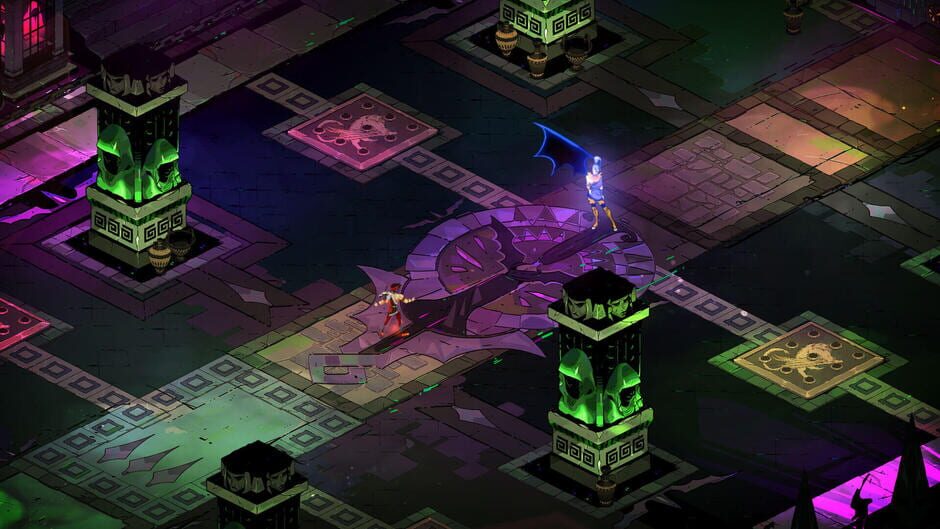
The four major stages of the escape each have their own identity. Tartarus introduces the first encounters and chambers of the infernal administration, Asphodel imposes stretches of lava, Elysium brings tougher warriors, while the Temple of Styx changes the structure with several short and dangerous passages before the exit.
Bosses act as landmarks within this progression and sometimes evolve across repeated attempts. Megaera and the Furies, the Bone Hydra and the champions of Elysium become recurring encounters whose attacks must gradually be learned. Repetition does not automatically make them secondary: the Pact of Punishment can later alter their behavior or strengthen the general difficulty.
The Pact becomes especially important after the first victories. The player can add different modifiers to increase the Heat of a run: tougher enemies, time limits, more dangerous traps or strengthened versions of certain encounters. These conditions allow specific rewards to remain available while the player gradually constructs a preferred difficulty level.
By contrast, God Mode offers an option for players who are more interested in the story or who encounter persistent difficulty. It gradually increases Zagreus’s damage resistance after defeats without removing the structure of the game. Failure therefore remains part of the experience but is less likely to block narrative progress for long.
The main achievement of Hades, however, lies in the way repetition is integrated into the writing. Characters remember previous attempts, comment on particular events, react to a victory, defeat or encounter and continue their own stories. Dying therefore does not simply cause a mechanical reset.
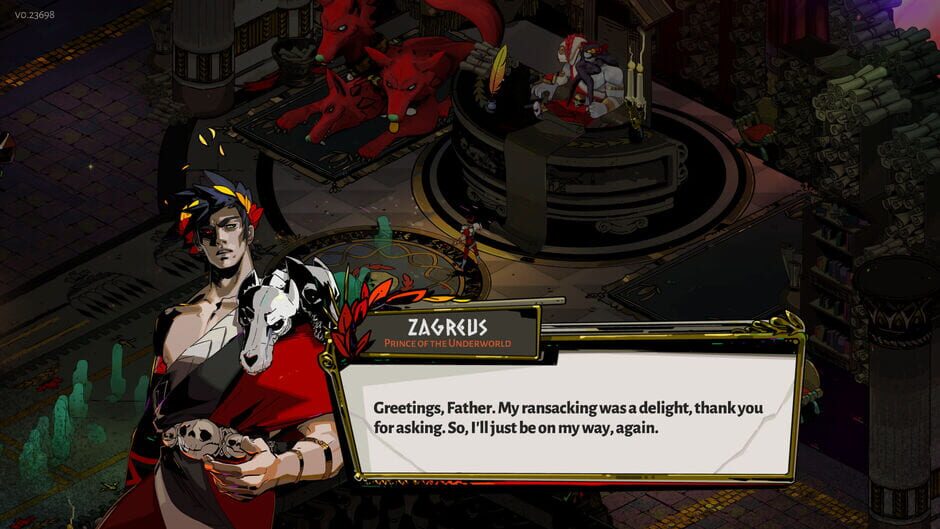
The House of Hades gradually becomes as important as the combat zones. Zagreus can speak with its inhabitants, give gifts, order renovations from the House Contractor, consult Achilles or follow different relationships. The large amount of dialogue allows characters to develop over a period far longer than what is required to complete a first successful escape.
Greek mythology provides the foundation of the setting without imposing a literal adaptation of ancient stories. Supergiant reinterprets Hades, Persephone, Nyx, Achilles, Patroclus, Orpheus, Eurydice, Sisyphus and the Olympians as members of a network of family, friendship and romantic relationships. Cosmic conflict remains present, but it is often expressed through highly personal problems.
The art direction supports this approach with strongly stylized characters and environments that immediately distinguish each region. Darren Korb’s music combines guitars, percussion and Mediterranean influences, while songs performed with Ashley Barrett play a particular role in several stories involving the inhabitants of the Underworld.
What to remember
- An action roguelike centered on Zagreus, son of Hades, who tries to leave the Underworld and uncover the truth about his family.
- Each attempt crosses Tartarus, Asphodel, Elysium and the Temple of Styx with changing rooms and rewards.
- Six Infernal Arms offer different combat styles and can be further modified through their Aspects.
- Boons from the Olympian gods temporarily transform attacks, abilities and the dash while enabling numerous synergies.
- Death removes most upgrades gained during a run but preserves several resources, relationships and forms of permanent progression.
- The Mirror of Night, Keepsakes and weapon upgrades gradually allow new escape attempts to be prepared more effectively.
- The story continues after defeat: inhabitants of the House of Hades react to events and develop their own stories across Zagreus’s returns.
- The Pact of Punishment allows difficulty to be increased and customized after the first victories, while God Mode offers a more accessible progression.
Conclusion
Hades solves one of the common narrative problems of the roguelike with particular efficiency: repetition does not interrupt the story, it provides its structure. Zagreus has to die and return because he belongs to the Underworld, and each return allows the characters to react to what has just happened. A defeat can therefore advance a relationship or reveal new information even when it ends the run.
The combat system supports this repetition through its ability to produce very different builds. The six weapons have enough individuality to alter the rhythm, but the Olympian boons are primarily responsible for the variation from one run to the next. The player learns not only to master a weapon but also to recognize useful combinations among the powers being offered.
Permanent progression also prevents failures from becoming completely fruitless. An interrupted attempt may still provide Darkness, Nectar, resources for the House or simply new conversations. This accumulation gives continuity to runs that mechanically restart from the same place again and again.
The family story gives Greek mythology a different scale. Zagreus literally crosses the Underworld and receives help from the gods of Olympus, but his essential problem concerns his parents, the lies that created their separation and the relationships he is trying to repair. Major mythological figures therefore become people with whom he shares everyday life rather than prestigious references alone.
This coherence between combat, repetition and storytelling largely explains what makes Hades distinctive. The first successful escape is an important milestone, but it does not mark the end of either the game or its story. Supergiant uses that continuity to make every new attempt something more than a restart: a new combination of powers, a new challenge and another opportunity to understand this immortal family.
Good to know
- Hades was developed and published by Supergiant Games, the studio behind Bastion, Transistor and Pyre.
- The game first entered Early Access on the Epic Games Store on December 6, 2018.
- Version 1.0 was released on September 17, 2020, for PC, Mac and Nintendo Switch.
- PlayStation 4, PlayStation 5, Xbox One and Xbox Series X|S versions were released on August 13, 2021.
- Zagreus is voiced in English by Darren Korb, who also composed the game’s soundtrack.
- The campaign and character relationships continue to evolve after the first successful escape; several escapes are required to reach the main narrative conclusions.
- The Pact of Punishment allows difficulty to be adjusted through the Heat system, while God Mode gradually increases Zagreus’s resistance to make progression more accessible.
- An iOS version distributed through Netflix Games launched in March 2024 before being removed from the service in July 2025.