Presentation
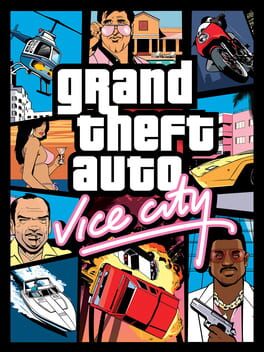
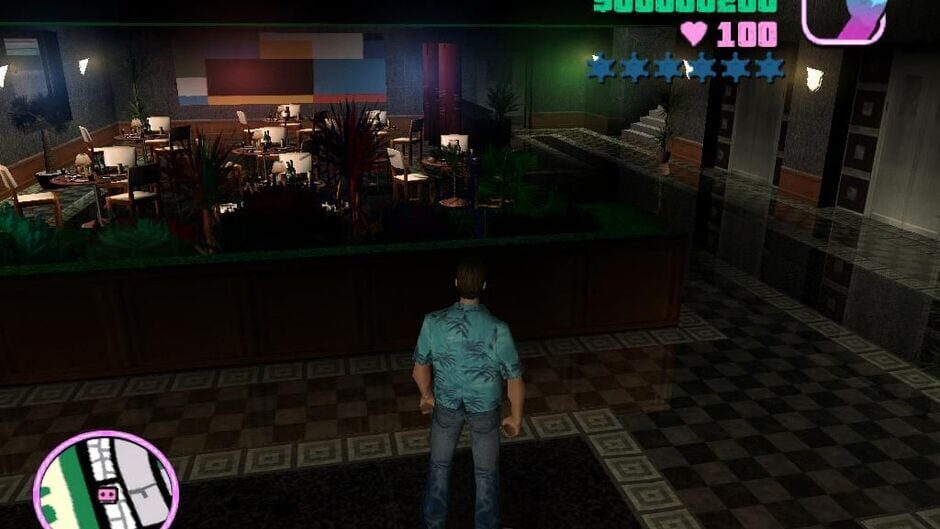
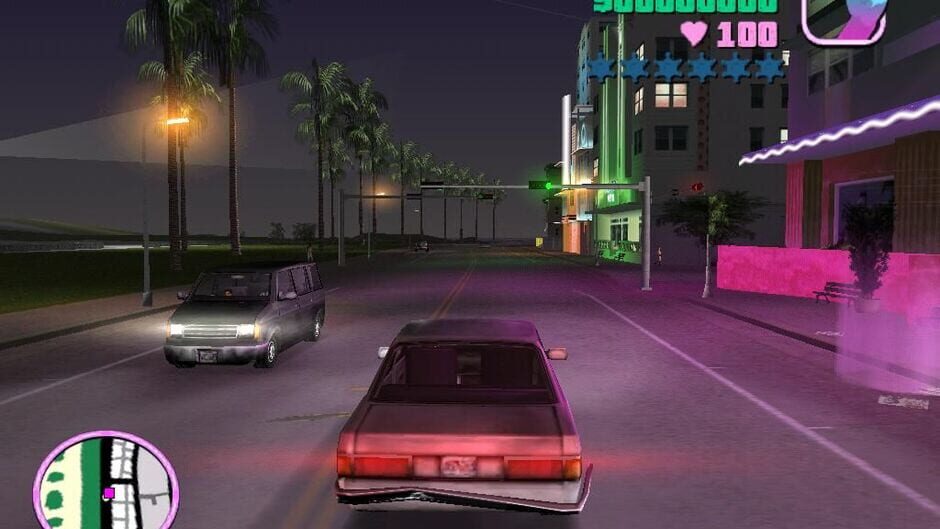
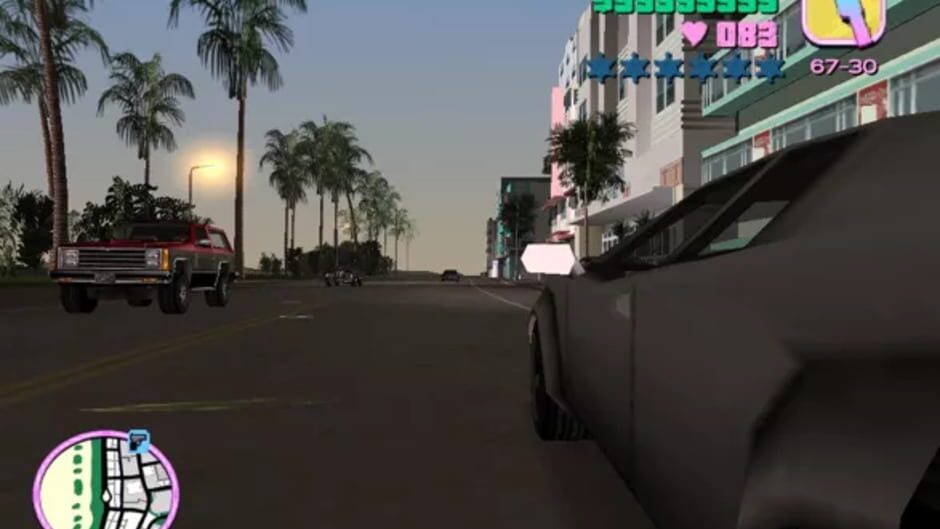
Grand Theft Auto: Vice City retains the open structure of Grand Theft Auto III but gives it an immediately different identity. The gray austerity of Liberty City gives way to a tropical metropolis in 1986 dominated by neon lights, beachfront hotels, villas, palm trees, clubs and neighborhoods with strongly defined personalities. Rockstar North uses the period as a genuine foundation for the game rather than simple decoration.
Vice City is spread across several islands that gradually become accessible during the campaign. The beaches and hotels of Ocean Beach sit alongside the towers of Downtown, the neighborhoods of Little Havana and Little Haiti, the luxurious properties of Starfish Island and the port and industrial districts. The map remains more compact than San Andreas, but its neighborhoods are distinct enough for travel to remain easy to read.
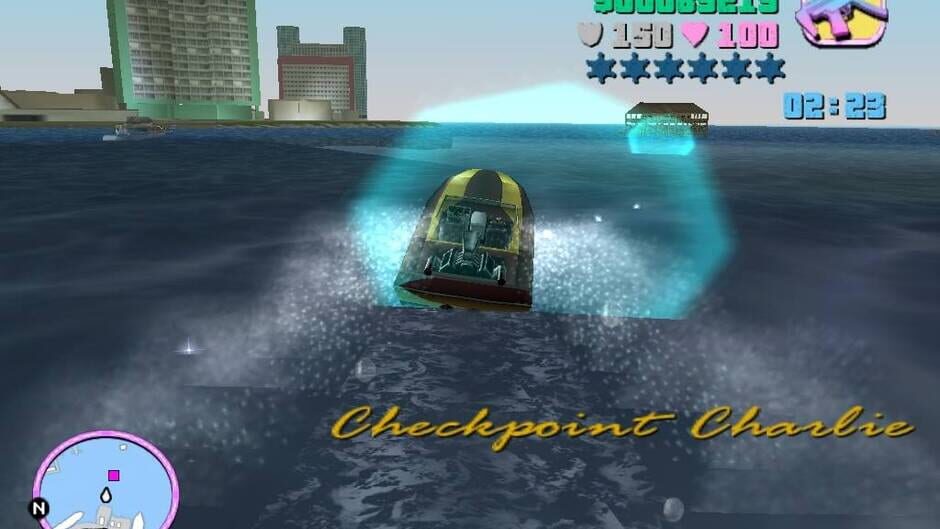
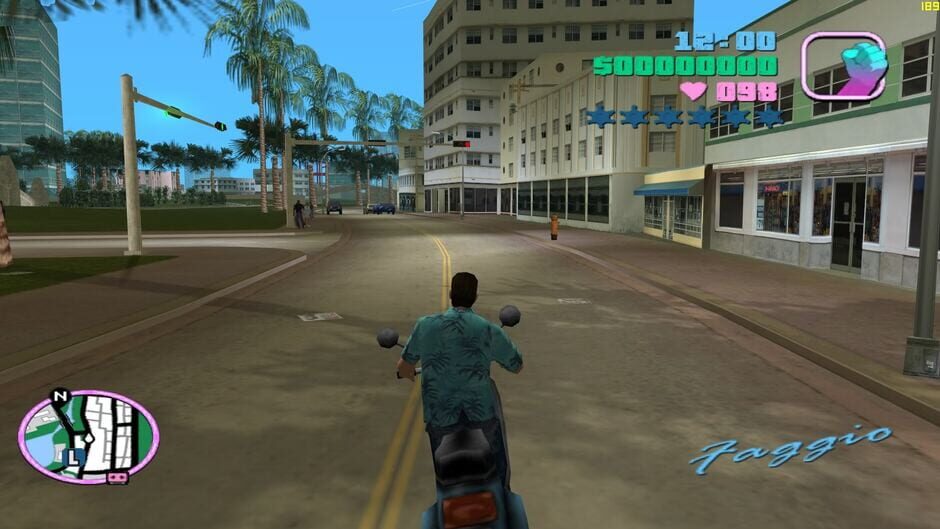
Vehicles naturally play a central role. Cars retain the arcade handling of GTA III, but the arrival of motorcycles introduces a new and much more agile form of mobility through the streets. Boats and several aircraft also expand movement options, particularly once helicopters become available later in the game.
The missions make more confident use of this variety. Gunfights, chases, races, assassinations, deliveries, vehicle thefts and aerial operations regularly alternate. Some sequences remain highly restrictive and the controls clearly show their age, but the campaign constantly tries to change the type of situation rather than repeat the same mission structure.
Tommy himself represents an important evolution from the silent protagonist of Grand Theft Auto III. He has a clearly defined personality, past and ambitions. His exchanges with Ken Rosenberg, Lance Vance, Ricardo Diaz and Sonny Forelli give the story stronger continuity and make his progression through the criminal world one of the main engines of the adventure.
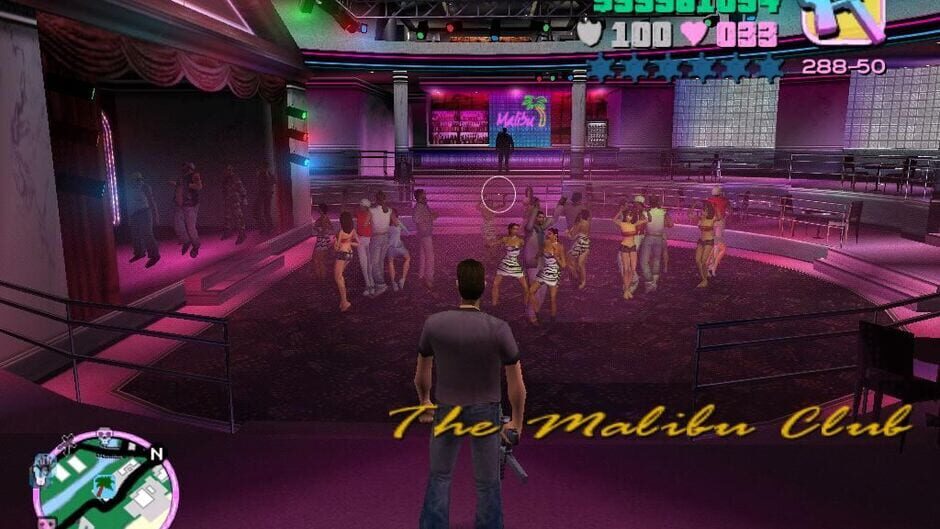
That progression eventually changes the structure of the game itself. Tommy can purchase several properties and businesses across the city, then complete specific missions that develop their activities. The Malibu Club, Kaufman Cabs, Print Works, the film studio and Sunshine Autos are therefore not simply buildings purchased to generate money: several come with their own mission chains.
This system gives Tommy’s rise a concrete mechanical form. At the beginning of the story, he works for others in order to recover what he lost. Later, he owns establishments, runs different operations and earns income from his own activities. The open world therefore directly supports his transformation from hired muscle into a criminal boss.
Progression remains much simpler than what San Andreas would later introduce. Tommy has no complex physical statistics or true skill-development system. Freedom instead comes from access to weapons, vehicles, properties and the activities available across the city.
Combat also remains close to the foundations of GTA III. Pistols, rifles, submachine guns, heavy weapons and melee equipment support the many confrontations, while certain weapons offer more precise aiming. The system can feel rigid today, particularly in enclosed spaces, but it accompanies a campaign where variety of situations matters more than tactical depth.
Music plays a much larger role than simple accompaniment. Radio stations cover pop, rock, new wave, metal, funk, soul and several other genres associated with the 1980s, while hosts, advertisements and talk shows extend the satire of the city. Entering a vehicle therefore becomes another way of building the period and atmosphere of Vice City.
This recreation is deliberately excessive. Money, drugs, real estate, fashion, media and the constant pursuit of success are caricatured through the characters and the city itself. Tommy moves through an environment where almost everything can become a commodity or an opportunity to gain power, which directly reflects his own trajectory.
The result gives Vice City a particularly cohesive personality. The period, music, architecture, cars, clothing and criminal-rise narrative all belong to the same world. This consistency allows the game to stand apart clearly from GTA III despite still being technically close to it, while preparing the much broader ambition Rockstar would pursue two years later with San Andreas.
What to remember
- An adventure set in Vice City in 1986, in a tropical metropolis strongly associated with the culture and aesthetics of the 1980s.
- Tommy Vercetti, a former prisoner sent by the Forelli family to supervise a drug deal that turns into an ambush.
- A story built around his gradual transformation from criminal enforcer into a major local power.
- Properties and businesses that can be purchased and then developed through their own mission chains.
- The introduction of motorcycles and wider access to boats and aircraft, expanding movement compared with GTA III.
- A particularly varied campaign mixing gunfights, chases, races, assassinations and activities linked to Tommy’s different businesses.
- Radio stations and a highly prominent soundtrack that are essential to the game’s satirical representation of the 1980s.
- An entry that greatly develops storytelling, protagonist identity and the idea of gradually building a criminal empire.
Conclusion
Grand Theft Auto: Vice City does not yet aim for the systemic scale of San Andreas. Its main achievement lies instead in the consistency with which Rockstar North turns a city, a period and a protagonist into a single identity. Vice City exists as much through its streets as through its radio stations, cars, clubs and the characters trying to profit from its criminal economy.
Tommy Vercetti is essential to that evolution. Where GTA III relied on an almost completely silent protagonist, Tommy comments on situations, develops relationships and gradually pursues ambitions of his own. His rise gives the open world a clear direction without preventing the player from regularly stepping away from the main campaign.
Buying businesses is probably the clearest mechanical expression of this progression. Controlling a taxi company, nightclub or print shop does not offer the depth of a true management game, but these activities make the player feel that Tommy’s place in the city is genuinely changing. Properties gradually stop being simple map markers and become visible signs of his power.
The game retains several limitations inherited from its era. Combat can be rigid, some missions become frustrating because of controls or checkpoint structure, and the city offers fewer systemic possibilities than later entries. Its strength, however, does not come from the sheer quantity of mechanics.
Vice City remains remarkable above all for the unity of its world. Tommy’s journey, the satire of the 1980s and the gradual takeover of the city work together with a clarity rarely matched within the 3D trilogy. Between the structural revolution of GTA III and the enormous playground of San Andreas, this entry gives Grand Theft Auto a much stronger narrative and cultural personality.
Good to know
- Grand Theft Auto: Vice City was developed by Rockstar North and published by Rockstar Games.
- The original game was released in October 2002 for PlayStation 2 before being adapted for PC and Xbox.
- The story takes place in 1986 and follows Tommy Vercetti’s criminal rise after a drug deal turns into an ambush.
- Vice City is a fictional tropical metropolis strongly inspired by Miami and Florida.
- Several businesses can be purchased, including the Malibu Club, Kaufman Cabs, Print Works, InterGlobal Films and Sunshine Autos.
- The game notably introduces motorcycles to the 3D era of the series and greatly expands the use of aircraft.
- Grand Theft Auto: Vice City – The Definitive Edition is included in Grand Theft Auto: The Trilogy – The Definitive Edition, released on November 11, 2021, alongside Grand Theft Auto III and Grand Theft Auto: San Andreas.