Presentation
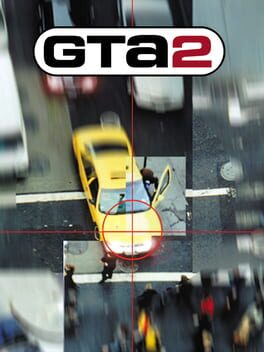
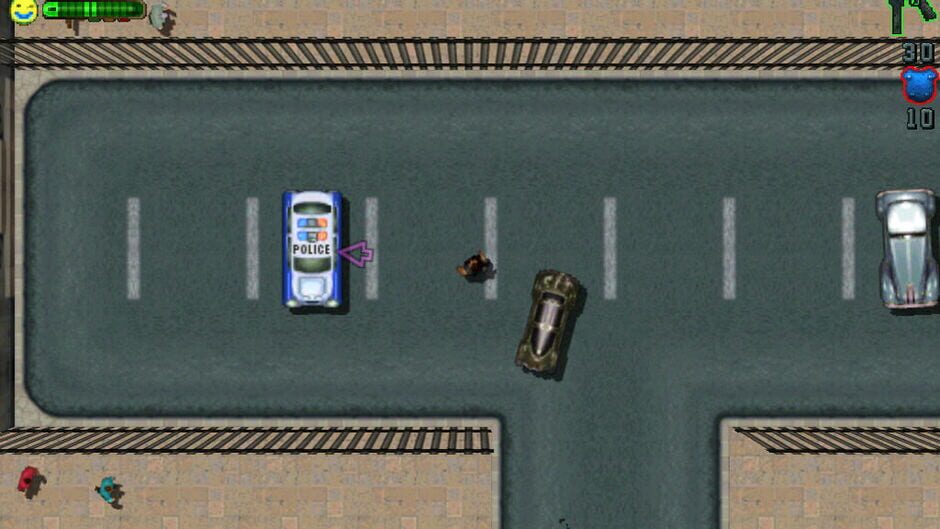
Developed by DMA Design and published by Rockstar Games, Grand Theft Auto 2 was released in 1999 for Windows and PlayStation before later appearing on Dreamcast and Game Boy Color. It retains the top-down perspective, free-form driving and criminal missions of the first Grand Theft Auto while giving greater depth to the relationships between the player, gangs and law enforcement.
The game takes place in Anywhere City, a fictional metropolis whose visual identity mixes contemporary urban environments, industrial landscapes and retrofuturistic elements. Unlike the first game, which featured Liberty City, San Andreas and Vice City, GTA 2 concentrates its campaign within a single city divided into three major areas: Downtown, Residential and Industrial.
Each district has its own structure and dominant criminal groups. The game features seven gangs: the Zaibatsu Corporation, Loonies, Yakuza, SRS Scientists, Rednecks, Russian Mafia and Hare Krishna. Not every faction appears in every district, giving each section of Anywhere City its own balance of power.
The main new mechanic is the respect system. Completing jobs for an organization increases the trust it places in the player and gradually unlocks more important contracts. Several gangs are rivals, however, meaning that helping one faction can reduce the player's reputation with its enemies.
This system turns progression into a balancing act. A hostile faction may attack the player when they enter its territory, while a gang with sufficiently high respect provides access to new missions. Choosing which contracts to accept therefore directly affects how certain parts of the city respond to the player's presence.
Missions are still obtained through telephones and retain the variety of the original game. Car thefts, deliveries, attacks against rival groups, destruction, escorts and target eliminations appear throughout the campaign, but players remain largely free to determine their route and choose which vehicles or streets best suit the objective.
Driving remains central to the experience. Numerous vehicles can be stolen directly from traffic and differ in speed, durability and handling. GTA 2 also expands the possibilities surrounding vehicles through various equipment and modifications available around the city.
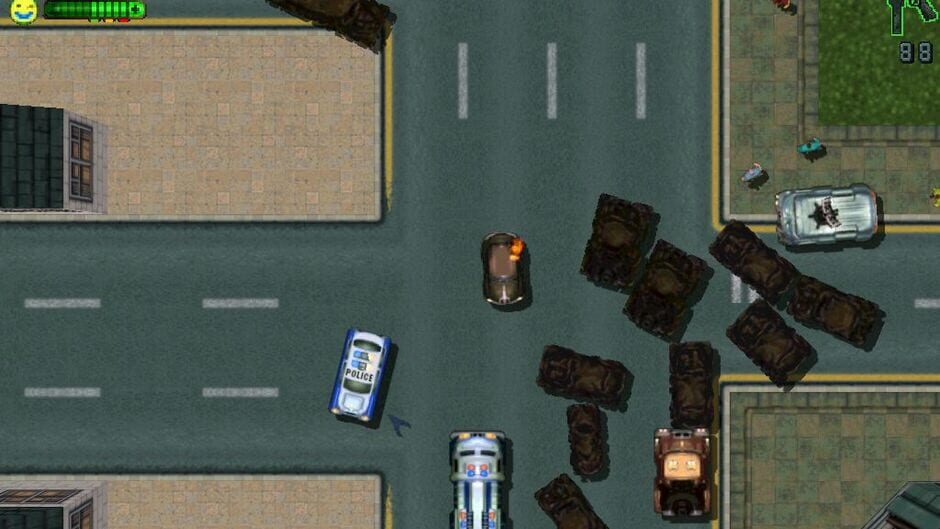
Law enforcement is more developed as well. Police respond as the wanted level increases, but the most serious situations can attract significantly stronger forces. SWAT teams, federal agents and the military progressively join the response when criminal activity reaches sufficiently extreme levels.
This escalation gives greater importance to pursuits. A relatively simple activity can quickly become difficult to control when several wanted levels have accumulated. Changing vehicles, using side streets and understanding the layout of each district can therefore become as important as raw speed.
Progress also retains a structure based around money and points. Players must reach a financial target before they can leave one district and move into the next. More demanding missions are therefore valuable not only because of the respect they provide but also because of their direct contribution to campaign progression.
Grand Theft Auto 2 further develops the audio identity and satire already present in the first installment. Vehicles provide access to different radio stations, gangs possess deliberately exaggerated personalities and Anywhere City adopts a tone mixing crime, parody advertising and dark humor. The series therefore begins giving greater personality to the open world itself before its transition to 3D with Grand Theft Auto III.
What to remember
- A sequel that retains the top-down perspective and freedom of movement of the first Grand Theft Auto while concentrating the action in Anywhere City.
- Seven gangs distributed across the different districts, each with its own identity, missions and rivalries.
- A respect system in which working for one faction improves relations with it while potentially making its enemies more hostile.
- A city divided into Downtown, Residential and Industrial, with a financial target that must be reached before progressing to the next area.
- More extensive and aggressive law enforcement capable of escalating from ordinary police to SWAT teams, federal agents and the military.
- A formula still based around vehicles, criminal missions and improvisation but with a world more capable of reacting to the player's choices.
Conclusion
Grand Theft Auto 2 remains visually close to its predecessor, but it substantially develops the systems surrounding player freedom. Anywhere City is no longer simply a map where different employers distribute missions: gangs now maintain relationships that directly affect how players can move and work throughout the city.
The respect system is the most important evolution. Accepting a contract no longer simply increases money or score. It also influences the character's reputation and can turn another faction hostile, giving criminal activity a continuity that was less developed in the original game.
The escalation of law enforcement reinforces the same principle. The more players exploit the freedom offered by the city, the greater the world's response becomes. Pursuits are therefore not simply a punishment: they contribute to an improvisational system capable of turning a mission or ordinary journey into an unexpected situation.
Anywhere City also gives the overall experience a more coherent identity. Its three districts, gangs and retrofuturistic atmosphere create a single distinctive world rather than a succession of independent cities, while radio and humor further develop the franchise's emerging satirical personality.
Grand Theft Auto 2 therefore represents an important transitional step. It still belongs completely to the top-down period of the series, but its reactive gangs, reputation system and more structured criminal world already demonstrate DMA Design and Rockstar's growing ambition to create cities that operate as genuine systems.
Good to know
- Grand Theft Auto 2 was developed by DMA Design and published by Rockstar Games.
- The game was released in 1999 for PlayStation and Windows; Dreamcast and Game Boy Color versions followed in 2000.
- Keith Hamilton is credited as Lead Programmer and Ian McQue as Lead Artist, with Stephen Banks, William Mills and Billy Thomson among the designers.
- The credits list Sam Houser and David Jones as Executive Producers.
- Anywhere City is divided into three main sectors: Downtown, Residential and Industrial, with different gangs operating across each area.
- GTA 2 also features a multiplayer mode on PC, allowing several players to compete within the game's environments.
- It is the last main Grand Theft Auto installment built entirely around the top-down perspective before the series moved into a fully 3D open world with Grand Theft Auto III in 2001.
```