Presentation
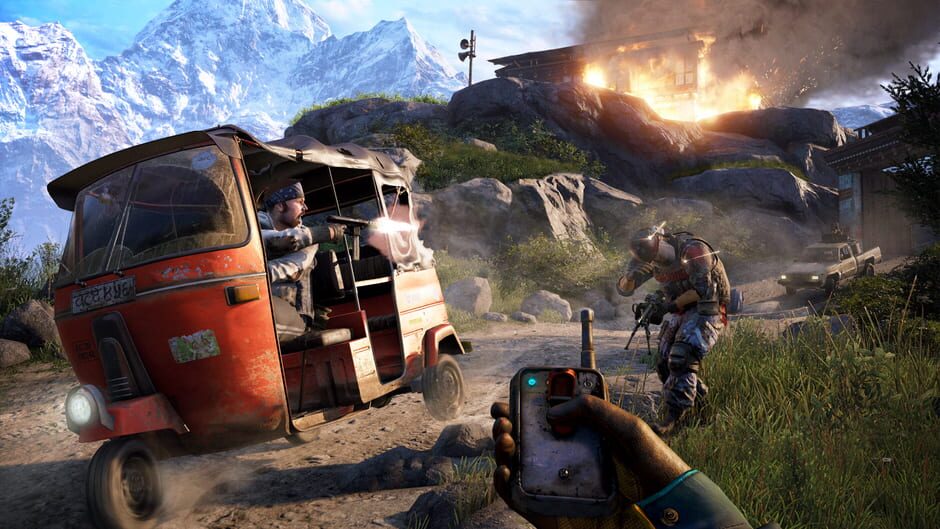
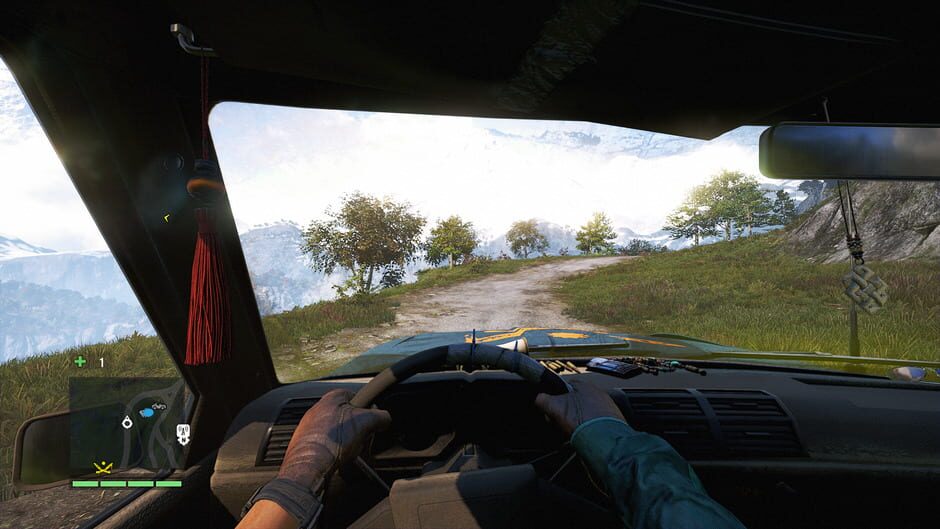
Kyrat immediately gives Far Cry 4 an identity distinct from the tropical island of its predecessor. Green valleys, villages, cliffs, temples and snow-covered peaks create a strongly vertical territory where terrain directly shapes exploration. A destination only a few hundred meters away may require circling a mountain, using a grappling hook, finding a vehicle or simply throwing yourself into the void with a wingsuit.
This verticality supports a formula built around freedom of approach. Outposts occupied by Pagan’s army can be assaulted head-on, infiltrated quietly or observed from a distance before the attack begins. Tagging enemies, disabling alarms and choosing an advantageous position make it possible to prepare a methodical operation. Conversely, explosives, heavy weapons or vehicles can turn the same situation into chaos almost instantly.
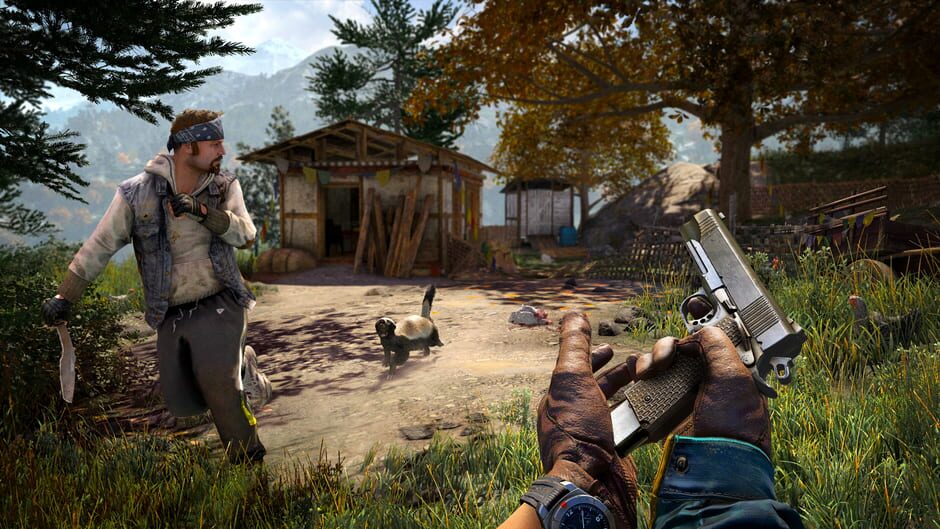
Animals play a full role in this unpredictability. Predators and large herbivores are not merely decorative elements: they can attack Ajay, turn against soldiers or completely ruin a carefully prepared plan. Some animals can even be used to the player’s advantage, including charging an enemy position from the back of an elephant. The open world therefore regularly produces situations that feel less scripted than triggered by several interacting systems.
Hunting also retains a role in progression. Resources obtained from animals are used to improve different pieces of equipment and carrying capacity. At the same time, experience allows Ajay to develop through several skills focused on combat, mobility or stealth takedowns. Character growth quickly translates into additional options rather than simply increased power.
The arsenal follows the same logic. Assault rifles, bows, sniper rifles, sidearms, explosives and heavy weapons make it easy to move from a silent approach to a much more direct attack. The bow remains particularly suited to hunting and infiltration, while automatic and explosive weapons provide the means to regain control once stealth collapses.
Traversal is important enough to become a source of enjoyment in itself. Cars, ATVs, boats and gyrocopters allow certain regions to be crossed quickly, while the grappling hook and wingsuit make greater use of the terrain. The gyrocopter in particular changes the way the landscape is read by providing access to high ground and allowing roads, buildings and enemy positions to be observed from above.
As in Far Cry 3, certain structures are used to gradually reclaim territory. Liberating outposts reduces the local enemy presence and creates new footholds, while exploration progressively opens access to more activities. The map is therefore not simply a surface covered with objectives: it also reflects the advance of a guerrilla movement attempting to weaken Pagan Min’s authority.
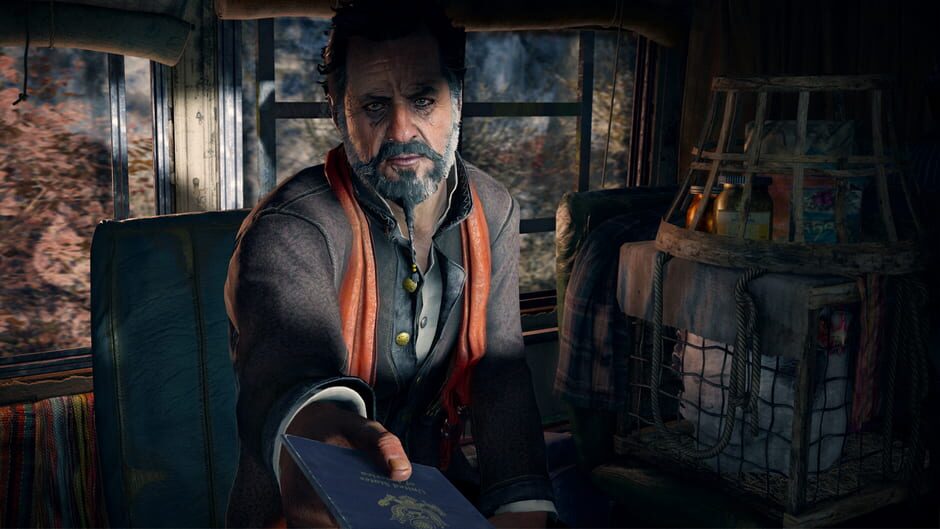
The campaign, however, adds further ambiguity to this idea of liberation. Ajay fights a clearly violent regime, but the leaders of the Golden Path repeatedly ask him to take sides in their own disagreements. Sabal and Amita do not simply propose two methods for reaching the same goal: they defend different visions of Kyrat, its traditions and its future.
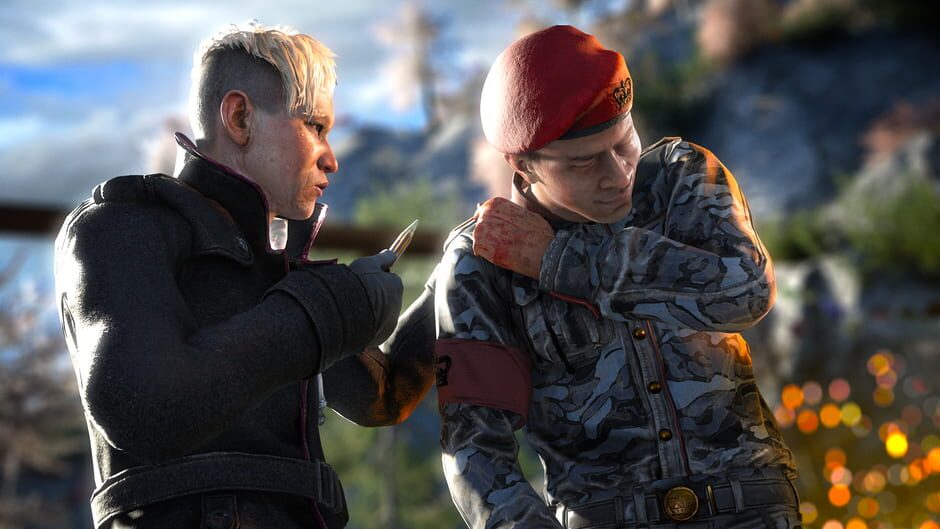
Pagan Min remains a singular presence throughout. He is not constantly standing in Ajay’s path, but his interventions repeatedly suggest that he knows far more about the protagonist’s family history than he initially reveals. His mixture of politeness, humor and brutality creates an antagonist less predictable than a simple military tyrant and reinforces one of the game’s most interesting themes: the distance between how each side presents itself and what it is actually willing to do.
The open world can also be explored cooperatively with a second player across many activities. This possibility further strengthens the improvised nature of encounters, as two players can combine stealth, vehicles, weapons and wildlife with results that are rarely very disciplined.
What to remember
- An open-world action-adventure FPS set in Kyrat, a fictional country inspired by Himalayan regions.
- Ajay Ghale returns to his homeland to honor his mother’s final wish before being drawn into a civil war against Pagan Min.
- Considerable freedom to attack outposts through infiltration, long-range shooting, direct assault or use of the environment.
- A strongly vertical territory crossed using vehicles, the grappling hook, wingsuit and gyrocopter.
- Wildlife that can intervene directly in encounters and create unpredictable situations.
- A rebellion divided between Amita and Sabal, whose choices confront Ajay with competing visions of Kyrat’s future.
Conclusion
Far Cry 4 does not try to overturn the formula established by its predecessor. Instead, it gives that formula more space, more verticality and more tools, then allows its systems to collide.
This is particularly visible in the outposts. The player can spend several minutes observing a base, tagging every guard and preparing a perfect infiltration before an animal, a vehicle or one badly placed arrow turns the entire operation into a firefight. The appeal then comes not only from carrying out the plan successfully, but from having to invent another one immediately.
Kyrat is an especially effective setting for this freedom. Its terrain constantly encourages players to look upward, search for shortcuts and use traversal tools that give the open world a genuinely vertical dimension. This richness can sometimes come with a familiar accumulation of activities and objectives, but the pleasure of crossing the landscape and improvising remains strong enough to keep the map from becoming a simple checklist.
The civil war adds an interesting ambiguity of its own. Bringing down Pagan Min is not enough to determine what Kyrat will become afterward, and the Golden Path does not provide a perfectly united or reassuring alternative. Ajay arrives in his homeland with an extremely simple personal mission and gradually discovers that he has become one of the arbiters of a conflict in which no side offers him an entirely comfortable answer.
That mixture gives Far Cry 4 its personality: the almost playful freedom to create chaos in a spectacular open world, set against a story that repeatedly reminds the player that overthrowing a tyrant is much easier than deciding what should replace him.
Good to know
- Far Cry 4 was primarily developed by Ubisoft Montreal, with contributions from several other Ubisoft studios.
- The game was released on November 18, 2014.
- Ajay Ghale was born in Kyrat and returns there to fulfill his mother’s final wish.
- Pagan Min rules Kyrat while the Golden Path leads a rebellion against his regime.
- The Himalayan terrain plays an important role in exploration, particularly through the grappling hook, wingsuit and gyrocopter.
- The open world can be explored cooperatively with a second player across many activities.
- Wildlife includes several species directly integrated into hunting and combat systems, and some elephants can be ridden by the player.