Presentation
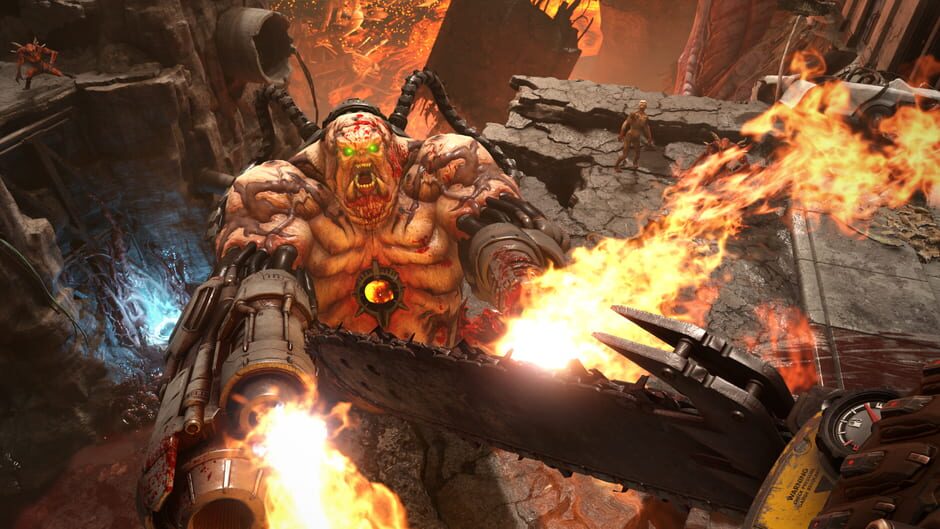
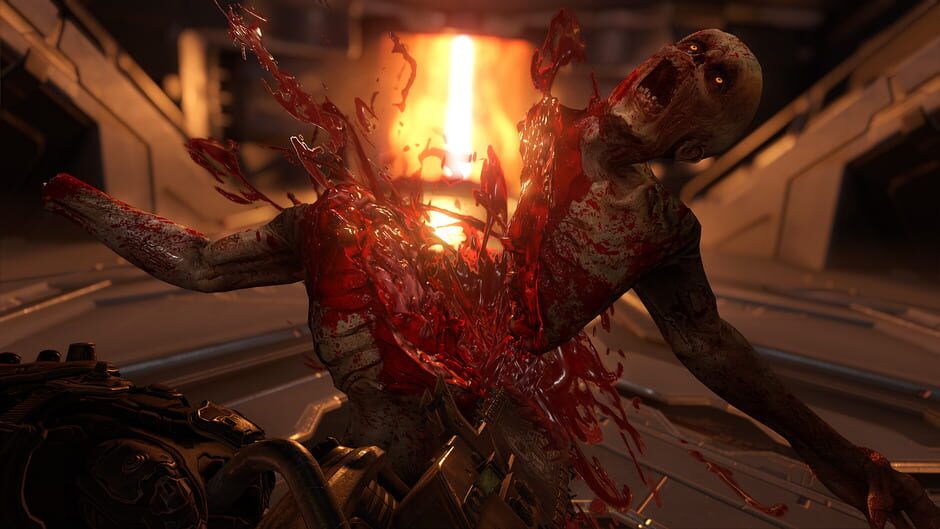
DOOM Eternal takes the aggressive combat of its predecessor but refuses to simply make it faster. id Software transforms the system into a genuine resource economy where every tool has a precise purpose. Glory Kills restore health, the Flame Belch generates armor and the chainsaw provides ammunition. Enemies are therefore no longer only obstacles to destroy: they also become the resources required to keep fighting.
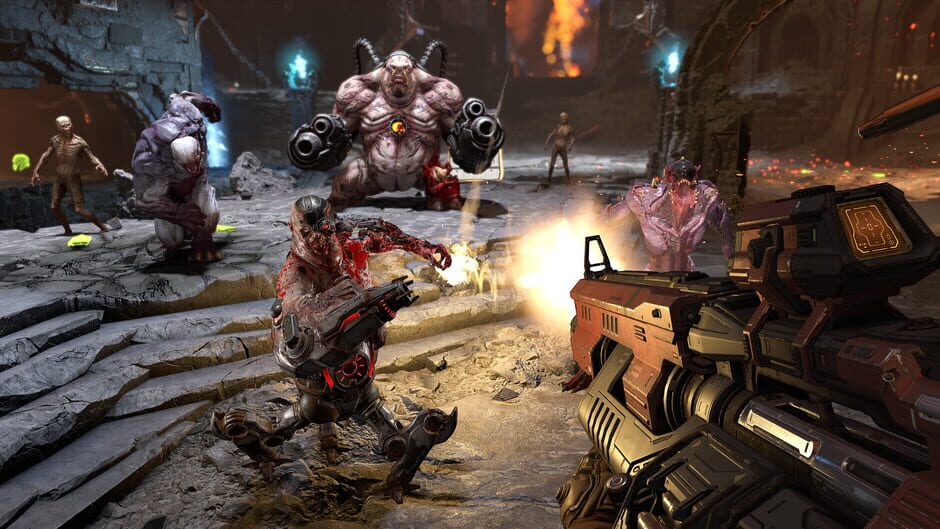
This logic profoundly changes the rhythm. Staying at a distance and constantly using the same weapon rarely works for long. The player must move through the arena, identify priority threats, switch weapons and quickly decide what resource is currently needed. A weakened demon can become a source of health, another an opportunity to recover ammunition, while a burning group can provide the armor required to survive the next few seconds.
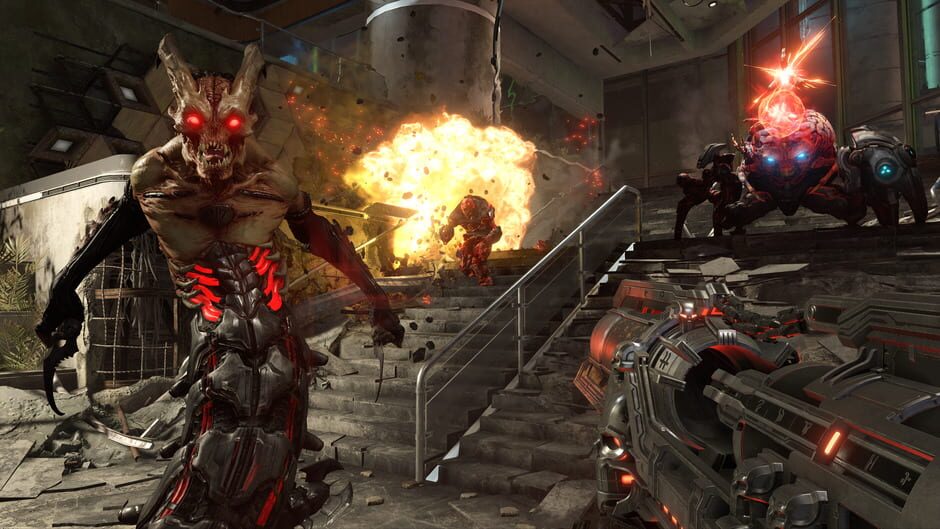
The enemies themselves reinforce this need for adaptation. Several have destructible weak points capable of disabling some of their attacks. A weapon particularly effective against one creature may be less useful against the next. The arsenal therefore works less like a progression system where the latest weapon replaces the previous ones and more like a toolbox whose every part must be understood and used.
Mobility becomes equally important. Double jump, dash, swing bars and the Super Shotgun equipped with its Meat Hook give the Slayer a freedom of movement that turns arenas into three-dimensional spaces. Survival rarely means holding a position: it requires constantly creating a new trajectory between enemies, platforms and resources.
This philosophy extends to exploration. Between battles, Eternal introduces more platforming sequences, climbable walls, aerial passages and hidden secrets. These sections change the pace of the campaign while forcing the player to use outside combat some of the mobility skills that must later be mastered inside the arenas.
The difficulty comes precisely from this accumulation of systems. DOOM Eternal asks the player to monitor several pieces of information almost simultaneously: remaining ammunition, health, armor, enemy positions, available abilities and the next possible movement route. The opening hours can make the game feel as though it is imposing a specific method, but this constraint gradually reveals an extremely coherent logic. Once all the mechanics begin to work together, combat becomes less a succession of shots than a continuous chain of decisions.
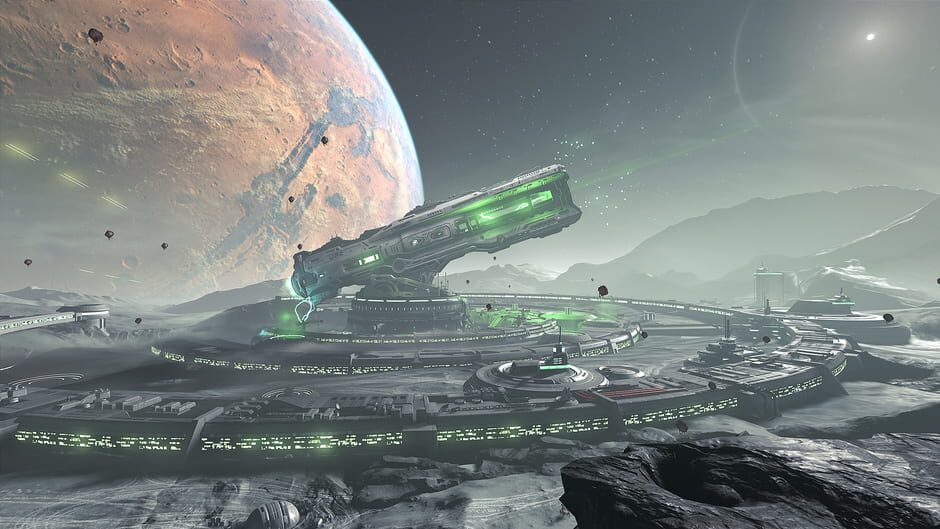
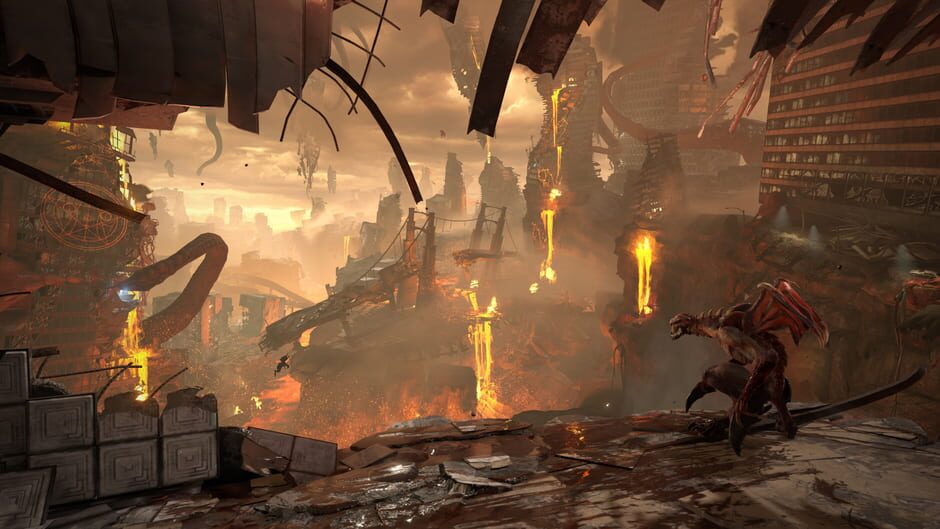
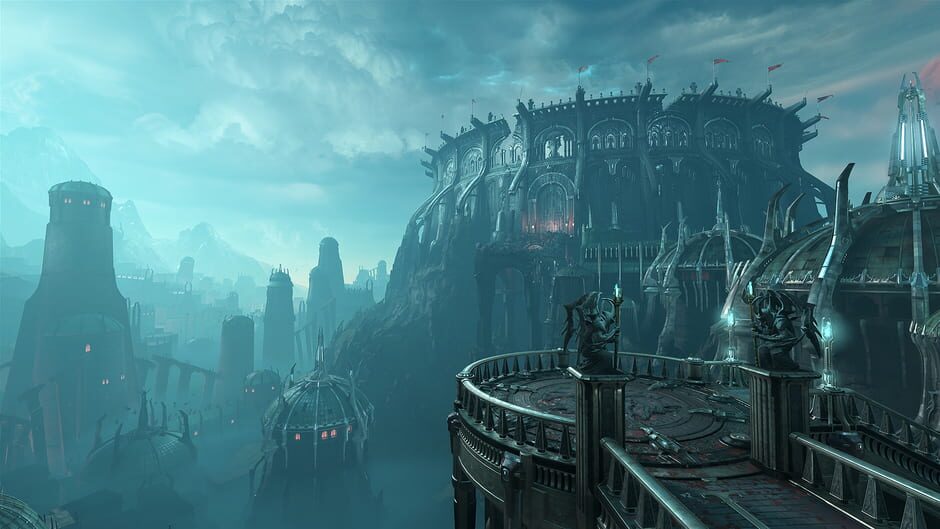
The staging supports this evolution by embracing the exaggeration of DOOM even more openly. Gigantic citadels, infernal dimensions, impossible technologies and enormous creatures move the game away from the tighter industrial setting of 2016. Eternal turns the Slayer’s crusade into a true infernal science-fiction epic without losing the fundamental simplicity of its objective: move forward and destroy everything Hell places in the way.
What to remember
- An extremely fast FPS built around constant movement and complementary use of the entire arsenal.
- Active resource management: Glory Kills for health, Flame Belch for armor and the chainsaw for ammunition.
- Demons with specific behaviors and weak points that encourage frequent changes of weapon and strategy.
- Greatly expanded mobility through dash, double jump and several tools designed to exploit verticality.
- A campaign that significantly develops the Slayer’s mythology and extends the conflict far beyond the invasion of Earth.
- Combat designed as a system to master, where positioning, priorities and ability management matter as much as accuracy.
Conclusion
DOOM Eternal starts from an already extremely effective formula and chooses to make it more demanding rather than merely more spectacular. Where DOOM (2016) encouraged aggression, its sequel organizes that aggression: killing in the right way, with the right tool and at the right moment becomes as important as shooting accurately.
This approach can feel more restrictive. Limited ammunition regularly pushes the player toward the chainsaw, certain enemies strongly encourage specific solutions and the large number of abilities demands constant attention. Players looking only for the immediate freedom of a classic shooter may experience this structure as an additional set of rules to manage.
But once these rules are understood, they produce something much rarer. An arena filled with demons gradually stops looking like chaos: the player begins to see resources, routes, priorities and opportunities. One action prepares the next, and every decision helps preserve momentum.
This is where DOOM Eternal truly finds its identity. The Slayer appears invincible not because the game removes danger, but because it gives the player the tools required to transform an impossible situation into a perfectly controlled system. Violence becomes almost a grammar: learning to speak it fluently is the real objective.
Good to know
- DOOM Eternal was developed by id Software and published by Bethesda Softworks.
- The game was released on March 20, 2020.
- It is the direct sequel to DOOM, released in 2016.
- The game uses idTech 7, an engine developed by id Software.
- The original soundtrack was primarily composed by Mick Gordon.
- BATTLEMODE is an asymmetrical mode in which one player controls the DOOM Slayer against two players controlling demons.