Presentation
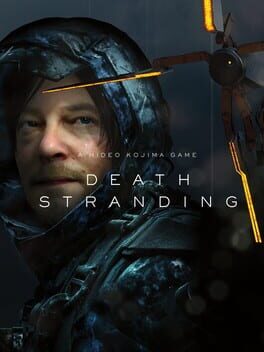
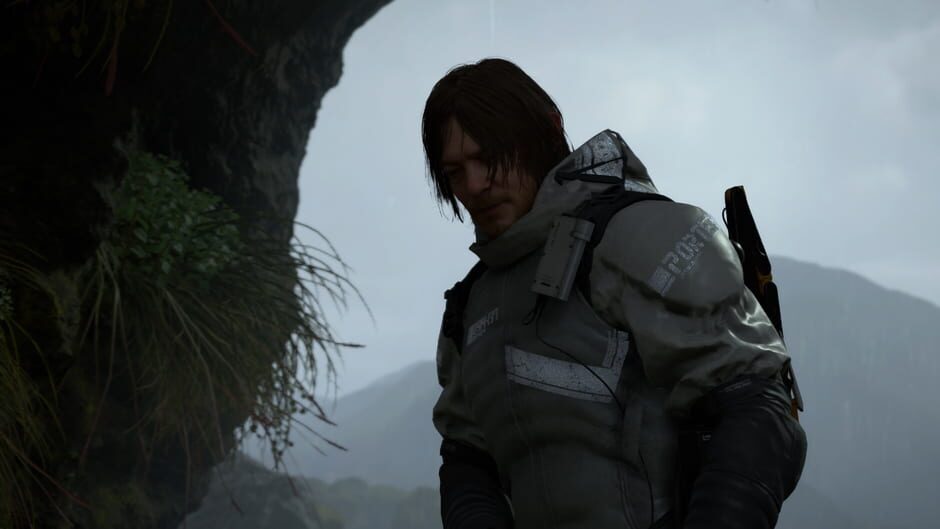
Death Stranding organizes almost its entire experience around an activity usually reduced to a transition in adventure games: carrying something from one place to another. Sam accepts orders, prepares his equipment, distributes his cargo and must then physically cross the terrain to reach his destination. The journey therefore matters as much as whatever awaits the player at the end of it.
Cargo directly affects movement. Every package has weight and volume, and a poorly arranged load shifts Sam’s center of gravity. On uneven terrain, the player must control his balance, choose where to place his feet and avoid falls that could damage the cargo. Carrying more allows additional deliveries to be completed, but also makes movement more difficult.
Terrain therefore becomes a genuine gameplay system. A river that is too deep can sweep Sam or his cargo away, a steep slope increases the risk of falling, and an apparently longer detour may ultimately be the safest route. The Odradek can scan the terrain to identify different depths and levels of difficulty before a path is chosen.
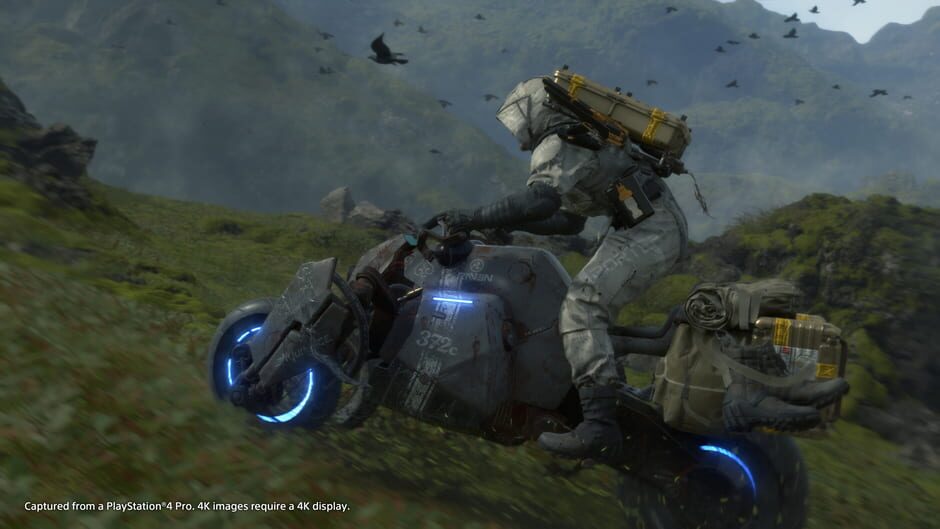
New equipment gradually expands the possibilities. Ladders and climbing anchors help with early crossings, before different exoskeletons improve carrying capacity, stability or speed. Trikes and trucks become effective on suitable surfaces, while zip-lines later allow players to build real networks capable of crossing entire mountain ranges quickly.
PCCs allow the player to install generators, bridges, shelters, postboxes and other structures. Roads and larger infrastructure require more resources but can permanently transform movement through a region. A route that is initially long and dangerous can therefore become much easier once the territory has gradually been developed.
This is where the Social Strand System comes into play. Once a region is connected to the Chiral Network, certain structures, signs, vehicles or cargo belonging to other players can appear in the world without those players being physically present. Their constructions can be used, given Likes or improved by contributing materials.
This system does not create traditional co-op where several players travel together. Instead, it creates an accumulation of traces and indirect assistance. A ladder left in the right place, a generator installed before a long climb or a bridge built over a river can solve a problem for someone the original player will never meet.
Timefall nevertheless prevents the world from becoming permanently domesticated. This rain accelerates the deterioration of exposed equipment, cargo containers and structures. Infrastructure must be maintained and cargo protected, preserving a certain fragility even when transport networks become more efficient.
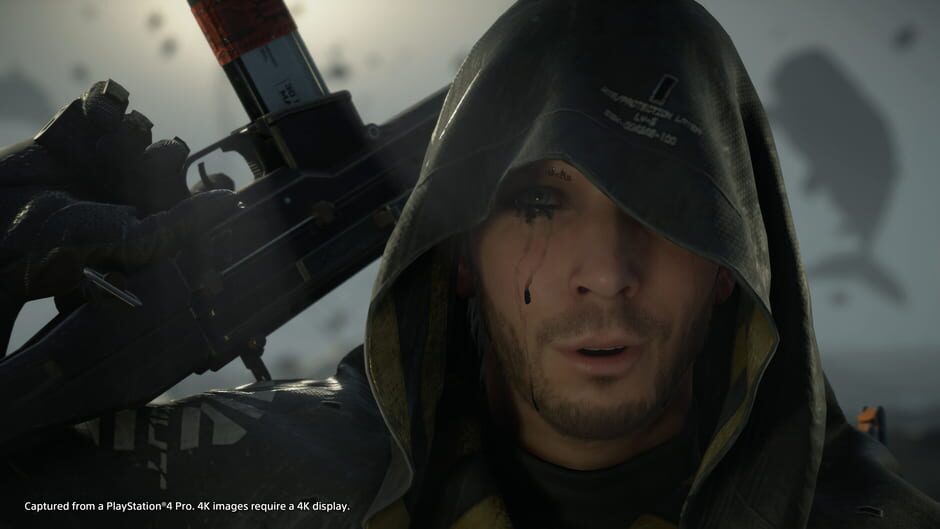
BTs impose a different kind of tension. In areas they occupy, BB and the Odradek allow Sam to detect their approximate presence. He must slow down, watch their positions and sometimes hold his breath to pass without being detected. If caught, the situation can escalate into a confrontation with a much larger creature.
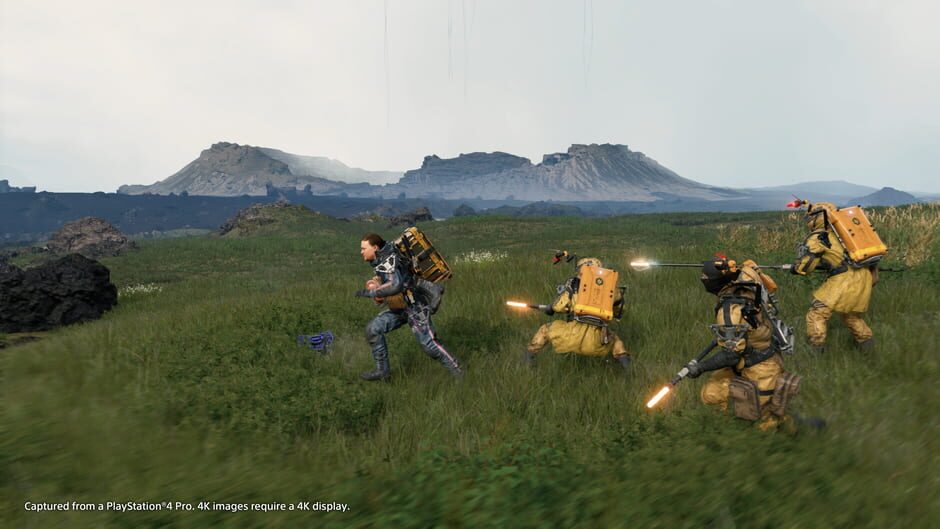
The arsenal gradually expands to deal with these threats, particularly through grenades and weapons that use Sam’s blood against BTs. MULEs and terrorists introduce human confrontations, but lethality has unusual consequences in this world: a corpse left behind can create further problems if it is not properly handled.
Progression depends less on traditional stat increases than on mastering the terrain and gaining access to new tools. Each connection to the network can unlock blueprints, equipment or upgrades, while reputation with distribution centers and Preppers increases by completing their orders. Evaluations take into account the condition of cargo, the amount delivered and sometimes the speed of the journey.
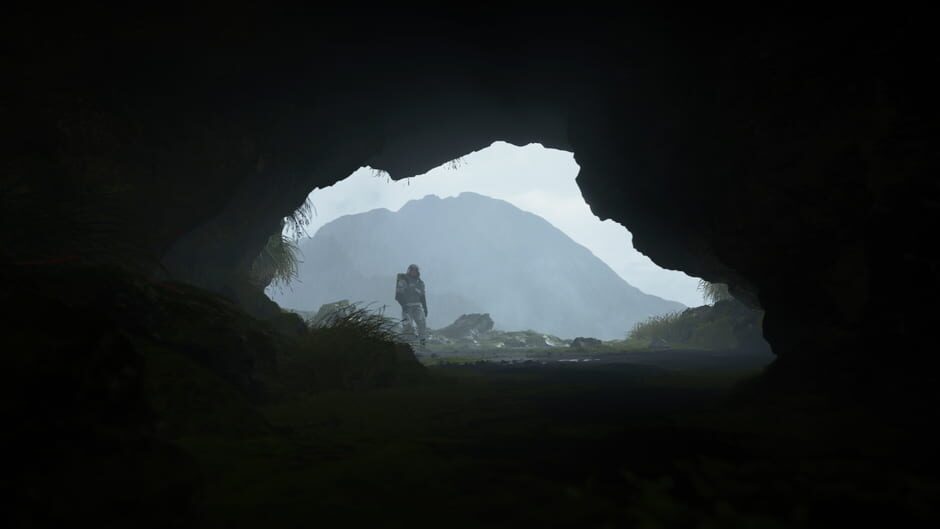
This structure gives landscapes an unusual importance. Rocky plains, snow-covered mountains, rivers and empty expanses are not simply there to separate two missions: their shape directly determines the preparation required. Travel gradually becomes faster, but this efficiency comes largely from what Sam and other players have built.
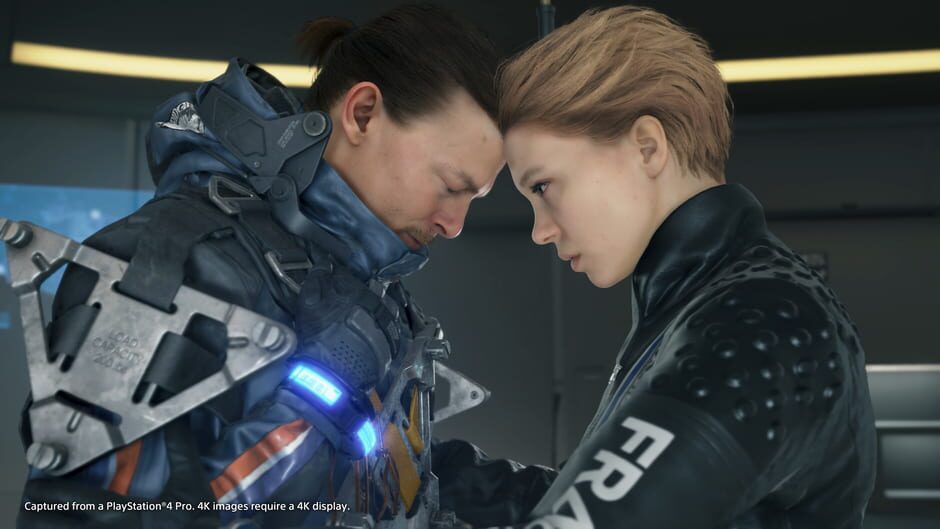
The story accompanies these systems with a large amount of dialogue, messages, archives and cutscenes. The members of Bridges each develop a particular relationship with death, their Beach and the Death Stranding, while Sam’s personal history is gradually reconstructed around BB, Cliff, Bridget and Amelie.
Music plays a major role in the journey as well. Several tracks, particularly songs by Low Roar, appear during selected stretches of travel. Their timing often accompanies the arrival in a new area or the end of a difficult route and gives periods of solitude a contemplative quality.
This connection between system and theme is the game’s main singularity. Sam fictionally reconnects isolated communities, while the player concretely benefits from actions performed by strangers. Asynchronous cooperation therefore turns the idea of connection into a mechanic rather than leaving it as a simple subject of the story.
What to remember
- A post-apocalyptic adventure in which Sam Porter Bridges crosses a fragmented America to reconnect its communities to the Chiral Network.
- Delivery is the core of the gameplay, with management of weight, balance, cargo condition, terrain and route planning.
- Ladders, climbing anchors, exoskeletons, vehicles, roads and zip-lines progressively change how the territory can be crossed.
- The Social Strand System makes structures and contributions from other players appear without offering traditional direct co-op.
- Timefall gradually damages equipment and infrastructure and reinforces the fragility of the world.
- BB-28 and the Odradek allow Sam to detect BTs, creatures connected to the world of the dead.
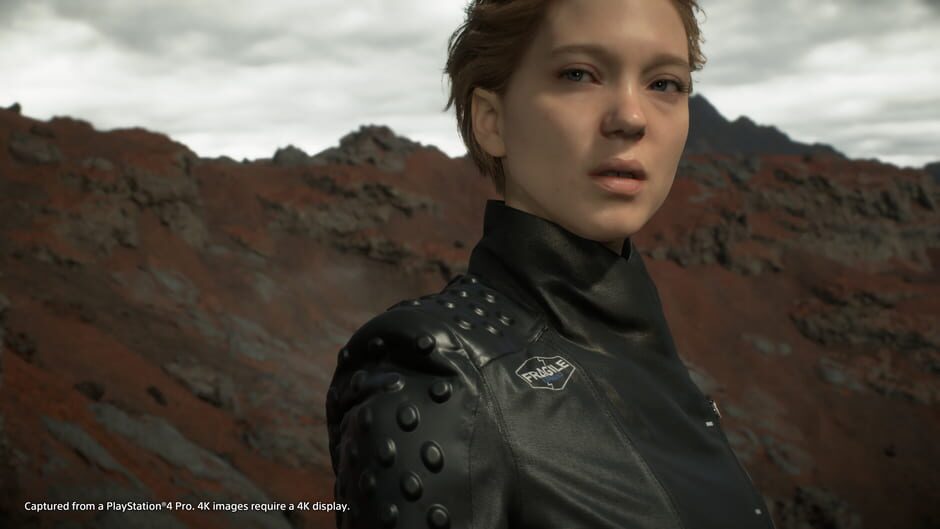
- Fragile, Deadman, Heartman, Mama, Cliff, Bridget and Amelie play major roles in a story about death, isolation and human connection.
- A game where mastery of routes and the construction of a transport network become forms of progression as important as character equipment.
Conclusion
Death Stranding builds its identity by giving real weight to movement. A mountain is not simply scenery between two objectives: it forces the player to consider cargo weight, stamina, available tools and the consequences of taking a detour. Early crossings can feel slow, but that constraint later makes the benefits of organizing the territory tangible.
Progress becomes especially clear when an old difficult route is revisited. A ladder, bridge or road can remove an obstacle, then a network of zip-lines can transform several kilometers of difficult terrain into a journey lasting only a few minutes. The sense of improvement comes as much from knowledge and infrastructure as from Sam’s own abilities.
The online system gives another dimension to this evolution. Structures left by strangers do not remove the difficulty of the terrain, but they create a form of assistance without direct contact. This fits closely with the story of a character who tries to live in isolation while nevertheless rebuilding connections between separated people.
In return, the game asks the player to accept a very particular rhythm. Cargo preparation, long walks, repeated orders and extensive narrative developments occupy a large amount of space. Combat exists, but it is not the main driving force of the experience and remains less developed than traversal itself.
This decision explains the deeply singular nature of Death Stranding. Kojima Productions does not merely use a post-apocalyptic world to tell a story about reconnection: topography, deliveries, shared structures and traces left by other players give that idea a concrete form. The game can be deliberately laborious, strange and sometimes excessive in its storytelling, but its systems and themes work together strongly enough to create an experience that is difficult to confuse with anything else.
Good to know
- Death Stranding was developed by Kojima Productions and is the first game created by the studio after it was established as an independent company.
- The original version was released for PlayStation 4 on November 8, 2019, published by Sony Interactive Entertainment.
- Norman Reedus plays Sam Porter Bridges; the main cast also includes Mads Mikkelsen, Léa Seydoux, Lindsay Wagner, Margaret Qualley, Tommie Earl Jenkins and Troy Baker.
- The game uses Guerrilla’s Decima engine.
- The original PC version, published by 505 Games, was released on July 14, 2020.
- Death Stranding Director’s Cut was released for PlayStation 5 on September 24, 2021, with new missions, equipment, activities and several improvements.
- The Director’s Cut was later released on PC and, since November 2024, is also available on Xbox Series X|S.
- Death Stranding 2: On the Beach continues this universe and Sam’s story in a separate sequel.