Overview
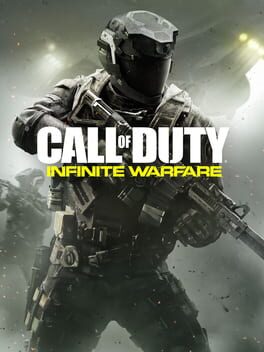
With Call of Duty: Infinite Warfare, the battlefield largely leaves Earth’s surface to extend across the planets, moons, stations and spacecraft of the Solar System. The game retains the series’ first-person combat, but connects it with space battles, zero-gravity sequences and a campaign organized around a genuine ship-based hub.
Developed by Infinity Ward and published by Activision, the game was released on November 4, 2016. The platforms listed in this entry are PlayStation 4, Xbox One and PC. The associated genres are action, adventure, science fiction and FPS. The specified game modes are Single player, Multiplayer, Co-operative and Split screen, and the engine listed is the IW Engine.
In the campaign, Nick Reyes takes command of the Retribution, which serves both as a warship and as a persistent hub between operations. The player can move around aboard it, prepare missions and depart for different destinations without progression being limited to a succession of completely isolated levels.
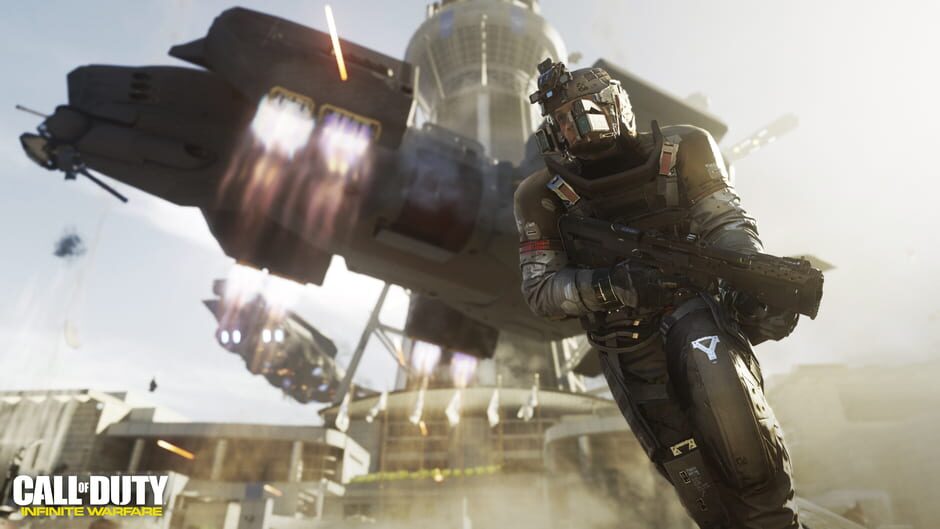
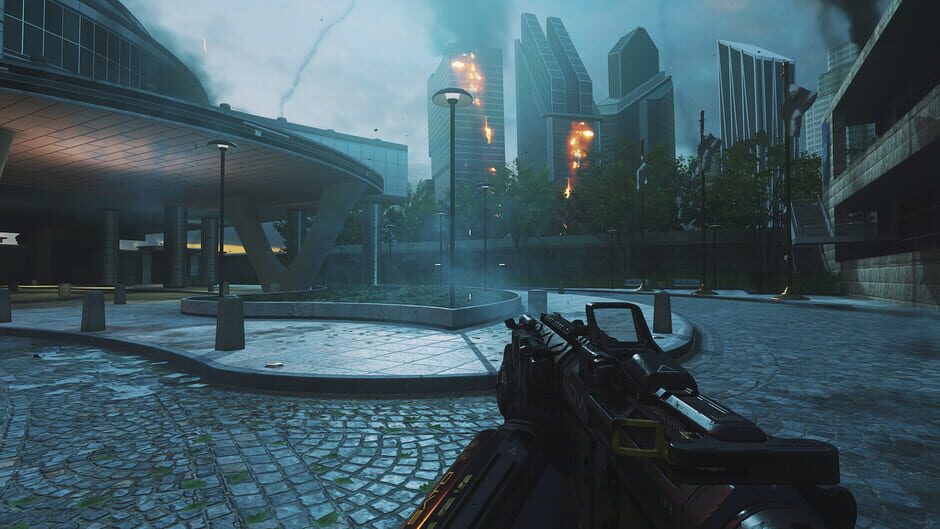
From the Retribution, the campaign allows players to move between main missions and different operations against enemy forces. Some take the form of assaults on spacecraft, while others alternate between ground combat, movement through space and fighting in reduced gravity.
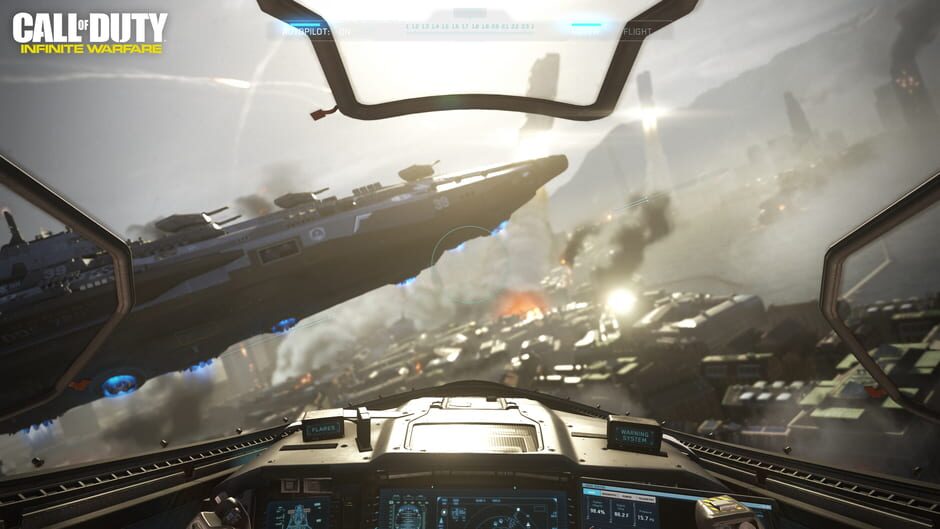
The Jackal occupies a particular place within this structure. This space fighter can be directly piloted during the campaign and is used in aerial combat both in atmosphere and in space. It can be customized and upgraded as progression continues.
Transitions between ground combat and piloting are designed to maintain continuity between these different scales. An operation can therefore take the player from an interior environment into the vacuum of space, then into the Jackal cockpit before returning aboard the Retribution.
The arsenal accompanies this shift in era with a mixture of ballistic weapons, energy weapons and futuristic equipment. Some weapons also include functions that allow their behavior to be changed during use while retaining Call of Duty’s immediate shooting principles.
Multiplayer continues the dynamic movement system introduced in previous futuristic installments, but structures playstyles more clearly around Combat Rigs. These tactical suits each have their own abilities and characteristics, directing the player toward different approaches to combat.
Progression also involves Mission Teams. The player can join one of these units and complete the objectives assigned to them in order to advance through its ranks and unlock associated content, including weapons, camos, emblems and calling cards.
Alongside the campaign and multiplayer, Zombies in Spaceland shifts into an entirely different register. The cooperative mode takes players to an amusement park inspired by the 1980s, with attractions, arcades and different areas overrun by the undead.
This version retains several long-standing principles of Zombies mode — wave-based progression, bonuses, distinctive weapons and secrets — while introducing its own mechanics. The After Life Arcade comes into play after a character dies and allows participation in arcade games in an attempt to return to the match.
Fate and Fortune Cards complement this progression by providing different effects that can be used during a session. Zombies in Spaceland therefore builds a cooperative component whose setting, mechanics and tone are deliberately separated from the space war developed in the campaign.
Infinite Warfare therefore organizes its three major components around distinct identities: a campaign connecting a ship-based hub, ground operations and space battles; multiplayer structured around Combat Rigs and Mission Teams; and a Zombies mode that turns a 1980s-inspired amusement park into a cooperative battleground.
Key takeaways
- The campaign follows Nick Reyes, a pilot who becomes captain of the warship Retribution.
- The Retribution functions as a persistent hub from which different operations can be launched.
- The Jackal allows players to take part directly in space combat and can be upgraded throughout the campaign.
- Certain sequences combine ground combat, zero gravity, ship assaults and spaceflight.
- Multiplayer notably relies on Combat Rigs, designed for different playstyles.
- Mission Teams provide objectives and progression associated with specific rewards.
- The arsenal combines ballistic weapons, energy weapons and futuristic technologies.
- Zombies in Spaceland places the cooperative mode in a 1980s-inspired amusement park, with the After Life Arcade and Fate and Fortune Cards.
Conclusion
Infinite Warfare does more than move Call of Duty’s aesthetic into science fiction. Its campaign uses the Solar System as an operational space and makes the Retribution the connecting point between missions, travel and space combat.
The Jackal directly extends the player’s role beyond infantry combat, while zero-gravity sequences and ship assaults make it possible to move from one scale of confrontation to another without abandoning the series’ FPS structure.
Multiplayer and Zombies each follow their own direction: Combat Rigs and Mission Teams structure competitive customization, while Zombies in Spaceland develops a standalone cooperative experience. Infinite Warfare therefore divides its futuristic universe across three clearly differentiated forms of play.
Good to know
- Call of Duty: Infinite Warfare was released on November 4, 2016.
- The game was developed by Infinity Ward and published by Activision.
- The platforms listed are PlayStation 4, Xbox One and PC.
- The associated genres are action, adventure, science fiction and FPS.
- The specified game modes are Single player, Multiplayer, Co-operative and Split screen.
- The engine listed is the IW Engine.
- The Retribution serves as the main ship and a persistent hub throughout the campaign.
- The Jackal is a pilotable and customizable space fighter integrated into the missions.