Presentation
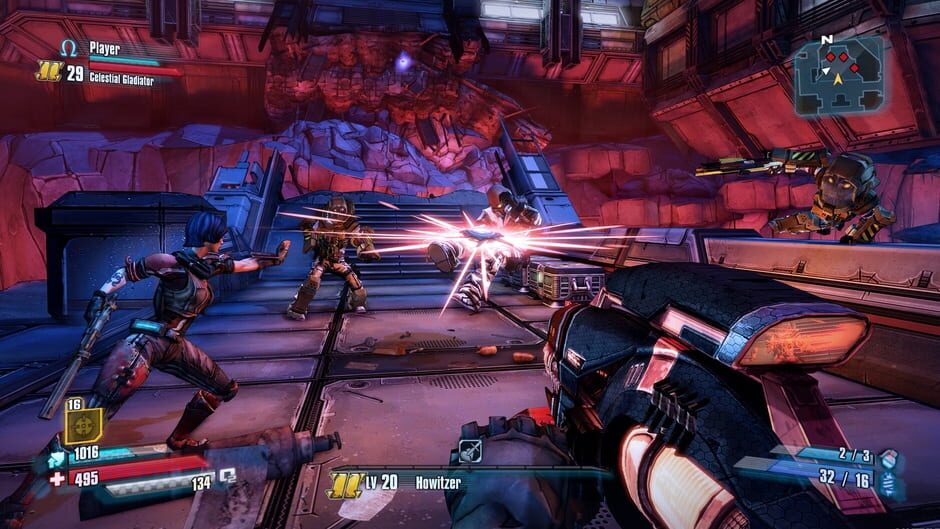
Borderlands: The Pre-Sequel directly reuses the systems established by Borderlands 2, but moves most of the adventure to Elpis. This change of setting gives the game a distinct identity while deliberately keeping its structure, combat and progression close to its predecessor.
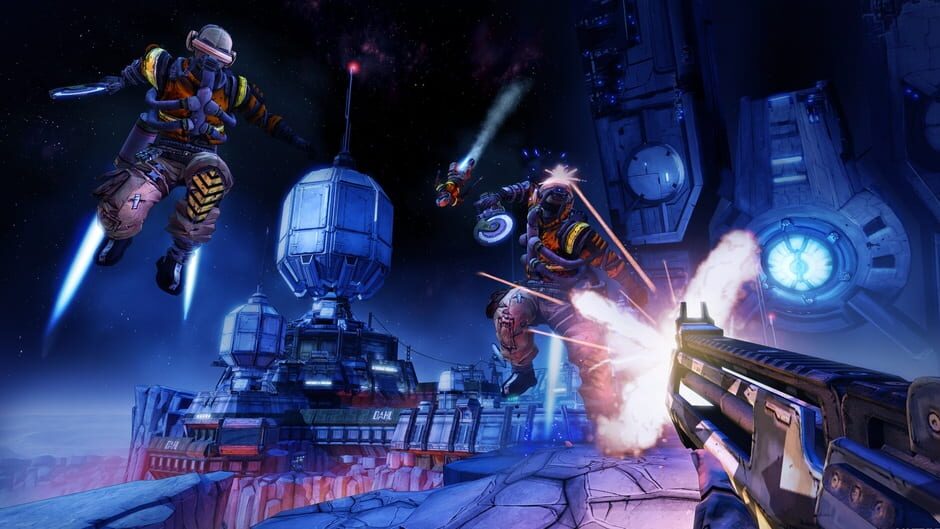
Low gravity is the most immediately noticeable change. Characters can jump much higher and remain airborne for longer periods, which affects both exploration and combat. Environments make greater use of verticality and regularly allow players to attack from above or reach distant platforms.
Oz Kits complement this movement system. They provide the oxygen needed in areas without atmosphere and can also be used to extend certain movements or perform a ground slam. Oxygen therefore becomes an additional resource to monitor, although the air stations and oxygen pockets scattered throughout the environments usually prevent it from becoming a constant restriction.
This mechanic also differentiates the various areas of Elpis. Pressurized bases allow normal combat, while outdoor sections require more attention to the environment and can alter certain elemental interactions. Claptrap is an exception because, as a robot, he does not need to breathe.
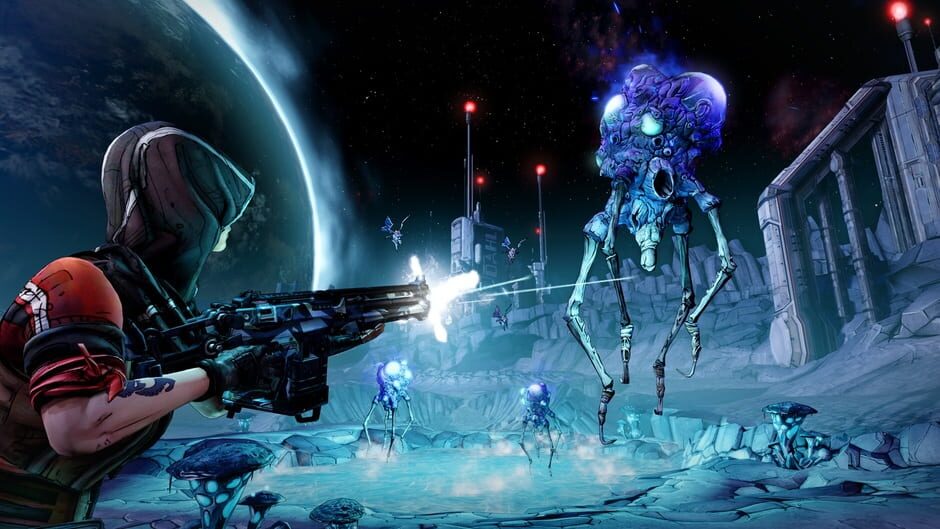
The weapon system remains very close to Borderlands 2, with a huge number of variants generated from different manufacturers and characteristics. Two additions play an especially important role. Laser weapons introduce several firing styles, ranging from continuous beams to shots closer to conventional firearms, while cryogenic damage can slow and eventually freeze certain enemies.
Cryogenic effects work particularly well with the mobility created by low gravity. Frozen enemies become more vulnerable to physical damage and can be shattered, creating new combinations with melee attacks and ground slams. These additions expand combat without fundamentally changing the foundations of the series.
The four playable characters also strongly define the episode because they are not complete newcomers to the universe. Athena previously appeared in The Secret Armory of General Knoxx, while Wilhelm and Nisha are already known as future allies of Handsome Jack. Claptrap becomes directly playable.
Athena uses her kinetic shield, the Aspis, to absorb damage before throwing it at enemies. Her skill trees can strengthen this ability, develop elemental attacks or support a more aggressive melee-focused style. Wilhelm relies on two drones, Wolf and Saint, one focused on offense and the other on support, while his upgrades gradually transform him through cybernetic implants.
Nisha focuses heavily on firearms, with an Action Skill that greatly improves her ability to target and eliminate multiple enemies. Claptrap offers a deliberately more unpredictable approach: VaultHunter.EXE analyzes the situation before activating one of several temporary programs, some of which also affect his co-op partners.
These characters support very different playstyles while strengthening the game’s connection to the wider chronology of the series. Their dialogue is also more integrated into missions, with specific reactions depending on the selected Vault Hunter. This personalization remains limited compared with more narrative-focused role-playing games, but it gives the protagonists more presence throughout the campaign.
Co-op retains its central role in the Borderlands formula. Up to four players can combine their abilities, which becomes particularly interesting with certain skill trees designed to support or directly influence the group. Progression still revolves around experience, skill trees and, above all, the constant search for more effective equipment.
The main narrative difference comes from the perspective on Jack. The game does not immediately present the tyrant seen in Borderlands 2. Instead, it shows a character who is already ambitious, egotistical and capable of violence, but still different enough for his transformation to unfold over the course of the story. His relationships with the Vault Hunters and the events on Elpis provide additional context for several elements that later become important.
This position between two games also explains the title. The Pre-Sequel takes place chronologically between the first two main entries while using systems developed for Borderlands 2. It therefore works less as a complete reinvention than as an extension of that formula built around a new setting and a different perspective on the series’ history.
What to remember
- An entry set chronologically between Borderlands and Borderlands 2, centered on events that contribute to Jack’s rise.
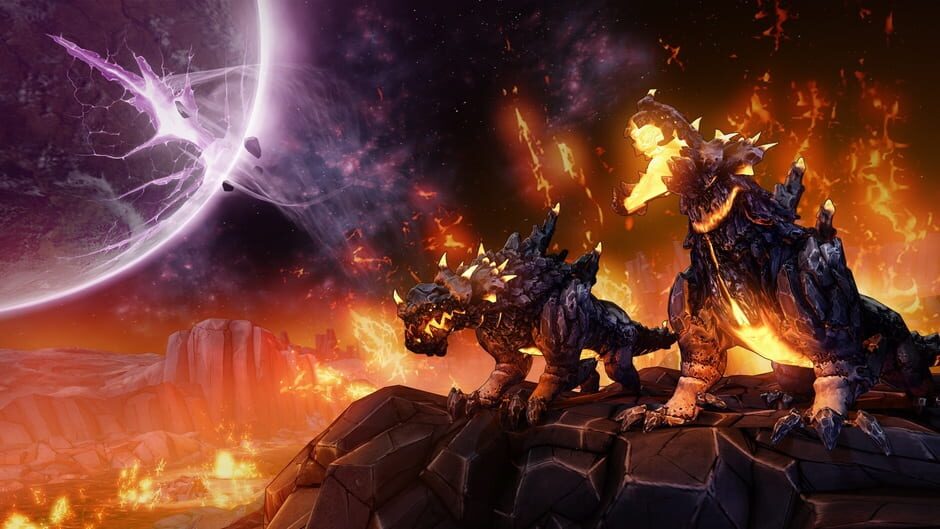
- An adventure set mainly on Elpis, Pandora’s moon, with low-gravity environments and areas without atmosphere.
- Four playable Vault Hunters: Athena, Wilhelm, Nisha and Claptrap, all already connected to the wider series.
- Oz Kits used to manage oxygen, extend certain movements and perform ground-slam attacks.
- The introduction of laser weapons and cryogenic damage, which can slow and freeze enemies.
- A loot, skill-tree progression and four-player co-op formula that remains very close to Borderlands 2.
- A story that adds context to Jack, Hyperion and several characters who later become important to the series.
Conclusion
Borderlands: The Pre-Sequel relies heavily on the foundations of Borderlands 2 and does not attempt to radically transform the formula. Gunplay, loot and progression remain immediately familiar, while the overall mission structure follows the established habits of the series.
Elpis nevertheless introduces several changes that give the game its own identity. Low gravity makes traversal more vertical, Oz Kits add new possibilities and cryogenic weapons fit particularly well with the lunar environments. Laser weapons also expand the arsenal without disrupting the systems already in place.
The four playable characters are another major strength. Their abilities support sufficiently distinct approaches, but their place in the chronology adds an extra dimension to the campaign. Playing Athena, Wilhelm, Nisha or Claptrap means following characters whose future or relationships are already partly known from other entries.
Its closeness to Borderlands 2 can make the game feel like an intermediate chapter, while the variety of lunar environments is more limited than in an adventure spanning many different regions of Pandora. Its appeal therefore comes less from mechanical reinvention than from the combination of its lunar features and its narrative role.
By following Jack before his establishment as the main antagonist of Borderlands 2, The Pre-Sequel fills in an important part of the series’ history. It does not try to excuse his evolution, but shows more clearly the circumstances, decisions and breaks that accompany his transformation.
Good to know
- Borderlands: The Pre-Sequel was originally released on October 14, 2014.
- The game takes place mainly on Elpis, Pandora’s moon, and is set chronologically between Borderlands and Borderlands 2.
- The four playable characters in the base game are Athena, Wilhelm, Nisha and Claptrap.
- Low gravity, Oz Kits, laser weapons and cryogenic damage are among the main additions introduced by this entry.
- The game retains four-player co-op and the series’ progression based on skill trees and equipment.
- Development was led primarily by 2K Australia in collaboration with Gearbox Software.
- Borderlands: The Pre-Sequel was later included alongside Borderlands 2 in Borderlands: The Handsome Collection.