Presentation
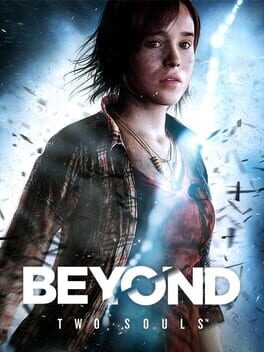
Beyond: Two Souls is defined first by the scale of its story. Quantic Dream does not focus on a few days or a single crisis, but follows Jodie Holmes across roughly fifteen years. The player sees her as a child, a teenager and a young adult in situations sometimes separated by several years and belonging to very different parts of her life.
The original release presents these episodes out of chronological order. The story can show an adult Jodie in an extreme situation before returning to her childhood, or reveal the consequences of an event long before explaining its origin. This structure asks the player to gradually reconstruct her journey and gives particular weight to the way Jodie changes between different stages of her life.
Aiden naturally stands at the center of the experience. The player can switch between Jodie and the entity in many situations, but they interact with the world in very different ways. Jodie remains bound by physical constraints, while Aiden can pass through certain obstacles, observe inaccessible spaces and affect objects or people whenever the game allows it.
This alternation supports both exploration and action. Aiden can discover what lies beyond a closed door, create a distraction, move certain objects or protect Jodie. In more dangerous situations, his powers can also become much more aggressive. The system is strongly contextual, but it regularly provides another perspective on the same scene.
The bond between Jodie and Aiden goes beyond a simple gameplay mechanic. Aiden has a degree of independence and can sometimes act in ways Jodie dislikes. Their connection can be protective, frustrating, dependent or isolating depending on the situation. Since childhood, Jodie has had to live with a presence that gives her extraordinary abilities while making an ordinary life extremely difficult.
Nathan Dawkins plays a major role during these formative years. A researcher specializing in paranormal phenomena, he gradually becomes one of the most important people in Jodie’s life. Their relationship grows beyond scientific observation and becomes more personal, complicating the line between his affection for her and his fascination with what she represents.
The game also tries to give its paranormal world a scientific framework. Aiden and other supernatural phenomena are not treated only as unexplained mysteries; they are studied through experiments, measurement devices and research into an unseen dimension. This places Beyond somewhere between paranormal fantasy and science fiction.
The tone changes regularly throughout the story. Some sequences resemble family drama, others move into espionage thriller or horror, while several parts slow down almost completely to follow Jodie through much more ordinary situations. This variety can make the experience feel uneven, but it also reflects the game’s ambition to portray different stages of a life rather than one continuous adventure in a single setting.
When the government begins using Jodie’s abilities, the tone shifts again. The child once observed in a laboratory becomes a young woman trained to survive, fight and carry out missions. Her bond with Aiden stops being only something to understand and becomes a capability that institutions attempt to exploit.
Action remains consistent with Quantic Dream’s cinematic approach. Jodie’s movement and combat are largely contextual, asking the player to follow the direction of her body or respond to specific situations. The system prioritizes visual continuity and staging rather than deep mechanical mastery.
Choices work in a similar way. Some conversations offer multiple responses, some actions can be accepted or refused, and Aiden may sometimes intervene differently. Success or failure in certain sequences can also alter what happens next.
The overall structure is considerably more directed than a game such as Detroit: Become Human. Jodie must pass through major stages required by the coherence of the story. Choices more often affect relationships, individual scenes, the fate of certain characters and possibilities near the ending than the entire narrative trajectory.
This can create a gap between the frequent presence of choices and the actual scale of the branching. At the same time, it allows Quantic Dream to maintain tight control over staging and dramatic construction. The experience is less interested in producing radically different stories than in giving different shades to Jodie’s journey.
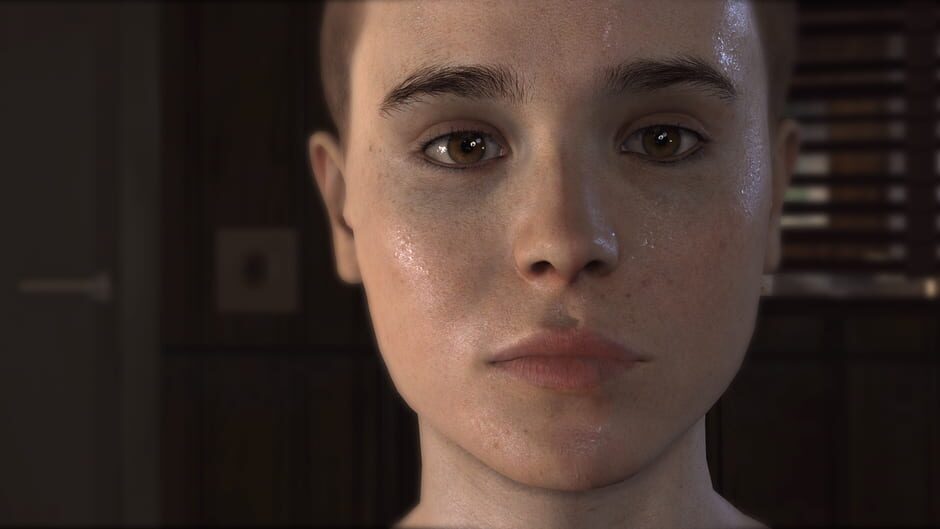
Performance is another major part of the game’s identity. Elliot Page portrays adult Jodie and Willem Dafoe plays Nathan Dawkins through extensive performance capture of voice, movement and facial expression. The technology supports the larger dramatic sequences, but it is especially effective in quieter moments built around hesitation, conversation or small changes in expression.
Those scenes reinforce one of the game’s recurring themes: despite Aiden’s permanent presence and the extraordinary abilities that come with him, Jodie is often deeply alone. Much of her journey is therefore about searching for relationships, stability and independence within a life that others have repeatedly tried to study, control or exploit.
What to remember
- A narrative adventure following roughly fifteen years of Jodie Holmes’s life from childhood to adulthood.
- A protagonist linked since birth to Aiden, an invisible entity the player can also control in many situations.
- An originally non-chronological structure that presents Jodie’s life as a series of fragments.
- Mainly contextual gameplay combining exploration, dialogue, action and the use of Aiden’s abilities.
- Nathan Dawkins, played by Willem Dafoe, as a major scientific and personal figure in Jodie’s life.
- A story blending intimate drama, paranormal fiction, science fiction, espionage and horror.
- Choices that can alter relationships, scenes, character outcomes and ending variations without completely changing the main storyline.
Conclusion
Beyond: Two Souls is most distinctive when it connects its supernatural premise to a story centered firmly on Jodie herself. Aiden allows her to do impossible things, but his existence also shapes her childhood, her relationships and the way other people perceive her. The game is therefore as interested in the cost of the bond as it is in the abilities it provides.
The long time span strengthens this idea. Seeing Jodie at different ages makes it possible to follow the evolution of her relationship with Aiden, the researchers, the government and the people she meets. The non-chronological structure reinforces that approach by sometimes revealing consequences before causes, although it can also make parts of the story feel artificially fragmented.
The game also clearly reflects Quantic Dream’s highly directed design philosophy. Choices exist and can alter several important situations, but the main storyline retains many required events. This tension between interaction and staging is one of its main limitations, especially when some decisions seem to promise greater branching than they ultimately deliver.
Its strongest moments depend less on the number of narrative branches than on Jodie’s emotional continuity. Her relationship with Nathan, her conflicts with Aiden, periods of isolation and attempts to live a more ordinary life give the story a dimension beyond its paranormal premise. Beyond: Two Souls remains a highly scripted and occasionally uneven experience, but its ambition to follow one person across such a large part of her life gives it a distinctive place among Quantic Dream’s narrative games.
Good to know
- Beyond: Two Souls was developed by French studio Quantic Dream and originally released for PlayStation 3 in October 2013.
- The story follows roughly fifteen years of Jodie Holmes’s life from childhood to adulthood.
- Elliot Page portrays Jodie through performance capture, while Willem Dafoe plays Nathan Dawkins.
- The player can switch between Jodie and Aiden to explore certain spaces, solve situations and protect Jodie.
- The original version presents the chapters out of chronological order; later editions also allow the story to be played chronologically.
- Beyond: Two Souls was later released on PlayStation 4 and PC.
- The game appeared in the official selection of the Tribeca Film Festival in 2013.