
Overview
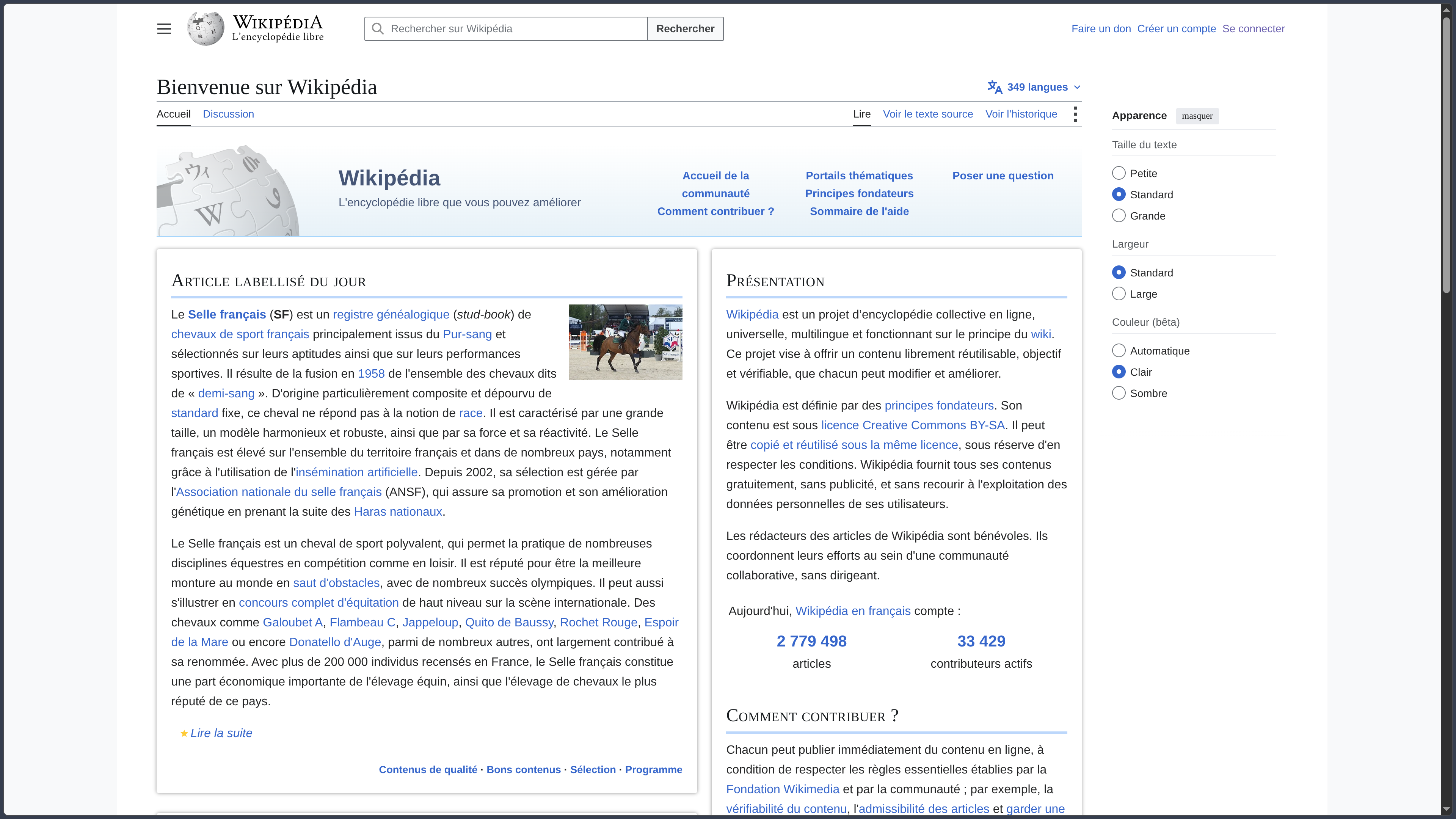
Wikipedia is a free, multilingual and collaborative online encyclopedia, created in 2001. It now contains more than 65 million articles across more than 300 languages and is one of the main projects hosted by the Wikimedia Foundation.
Its operation is based on a simple idea: articles are not written by a central editorial team, but built and maintained collectively by an international community of volunteer contributors.
The Wikimedia Foundation provides the technical infrastructure, hosting and support for Wikimedia projects, but does not act as a conventional editorial department responsible for writing or approving articles. Editorial rules, discussions, corrections and content decisions are mainly handled by contributor communities.
Wikipedia aims to produce encyclopedia articles based on published and verifiable sources. Contributors are notably expected to respect the neutral point of view principle, cite information that requires a reference and avoid turning the encyclopedia into a platform for promotion, personal opinion or original research.
Each article nevertheless remains open to change. Information can be added, corrected, rewritten or removed, while previous versions remain accessible through the page history. This makes the editorial process far more visible than in a traditional encyclopedia.
Wikipedia is available free of charge and without advertising or a paywall. Its funding relies mainly on donations made to the Wikimedia Foundation rather than advertising, subscriptions or selling personal data to finance the service.
The site runs on MediaWiki, free and open-source wiki software developed for Wikimedia projects and also used by many other organizations. Official Wikipedia applications are also available for Android, iPhone and iPad.
Features
Searching and exploring knowledge
Wikipedia allows users to search directly for a subject, person, work, place, scientific concept, historical event or many other kinds of knowledge.
Articles make extensive use of internal links.
A page dedicated to a topic can therefore lead to:
- related concepts;
- people;
- organizations;
- places;
- events;
- works;
- more specialized articles.
This structure turns consultation into encyclopedic exploration rather than a simple succession of search results.
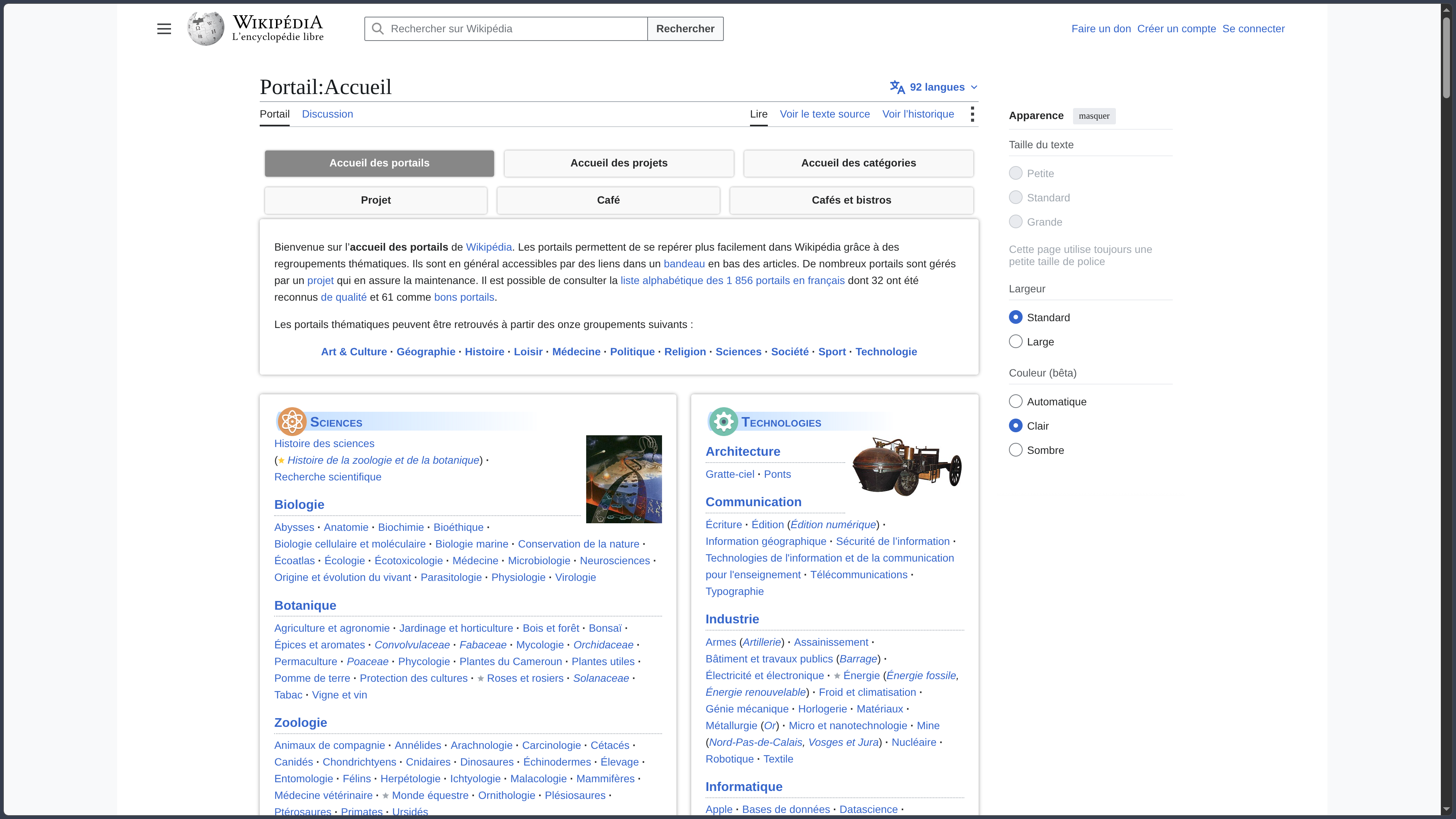
Categories, portals and thematic pages can also be used to explore a field in a more structured way.
Articles organized around sources and references
A Wikipedia article can include notes and references linked to information presented in the text.
These references may point to:
- books;
- scientific publications;
- media outlets;
- institutions;
- official documents;
- specialist websites;
- other published sources.
The goal is not for Wikipedia itself to become the original source of information, but to summarize knowledge that has already been published.
For deeper research or verification of an important claim, it is therefore often useful to consult the references listed in the article directly.
The quality of sourcing nevertheless varies from page to page: some articles contain extensive bibliographies, while others remain incomplete or insufficiently referenced.
Editing articles
Wikipedia is based on reader participation.
Many pages can be edited directly from the browser.
The platform notably provides a VisualEditor that allows users to work on content without knowing traditional wiki markup.
More experienced contributors can also edit the wikitext directly.
Depending on the page, its protection level and the contributor’s permissions, some edits may be restricted to protect articles that are particularly exposed to vandalism or editorial disputes.
The general principle nevertheless remains that of a collaborative encyclopedia in which readers can become contributors.
Contributing without a permanent account
Wikimedia projects also allow contributions without immediately creating a permanent account.
The historical system that publicly exposed the IP addresses of logged-out contributors has progressively been replaced by temporary accounts.
When a user contributes while logged out on a wiki where this system is enabled, a temporary identifier is created automatically.
Public edits are then attributed to this identifier rather than to the IP address.
The IP address is still stored for a limited period for security and abuse-prevention purposes, but access is restricted to authorized users who need it for moderation.
Creating a permanent account remains recommended for users who want a persistent identity, personal preferences and more complete community tools.
Complete edit history
Each page has a history showing its successive versions.
Users can see:
- the date of an edit;
- its author or temporary account;
- the edit summary;
- the size of the change;
- previous versions.
The comparison tool, often called a diff, highlights what was added, removed or changed between two revisions.
This traceability makes it possible to understand how an article evolved and identify the origin of a modification.
It also makes it possible to restore an older version when vandalism, an error or a problematic edit is detected.
Recent changes and community monitoring
Changes made to Wikipedia can be followed through the Recent changes pages.
Contributors, patrollers, administrators and automated tools monitor part of this activity in order to detect issues such as:
- vandalism;
- spam;
- promotional content;
- unjustified removals;
- problematic contributions.
This monitoring is mainly carried out after publication.
Wikipedia therefore does not work like a scientific journal or traditional encyclopedia where every change is systematically reviewed and approved by an expert committee before publication.
The speed of correction can vary considerably depending on the visibility of an article and the number of contributors monitoring it.
Personal watchlist
Logged-in users can add articles to a watchlist.
This list displays recent changes concerning only the pages being watched.
It becomes particularly useful for contributors who want to monitor:
- articles they have edited;
- their areas of interest;
- sensitive subjects;
- pages that change frequently.
The watchlist can be organized and filtered to make it easier to monitor many articles.
It remains personal and is not published as a public list of the user’s interests.
Talk pages
Articles generally have a talk page separate from the encyclopedia content.
This area is used to discuss how the article can be improved.
Contributors can discuss:
- a source;
- wording;
- a disagreement;
- the weight given to different pieces of information;
- the structure of the article;
- a proposed change.
Talk pages play an important role in Wikipedia’s collaborative operation.
When disagreement appears, the goal is normally not for one contributor to impose their version directly, but for the community to seek wording compatible with editorial rules and available sources.
Neutral point of view
The neutral point of view is one of Wikipedia’s core principles.
An article should not normally advocate a position personally.
When a subject involves several significant viewpoints, the article aims to present them according to their importance in the available reliable sources.
Neutrality therefore does not mean that every opinion must receive exactly the same amount of space.
A fringe theory does not necessarily need to be presented as equivalent to scientific or historical consensus simply because it exists.
The objective is instead to accurately represent the state of published knowledge and debate.
An encyclopedia divided into many language editions
Wikipedia is not a single database automatically translated into every language.
Each language edition has its own community, articles, local rules and editorial history.
The same subject can therefore differ significantly between its French, English, Spanish, German or Japanese versions.
Links make it easy to switch between languages when a corresponding article exists.
This organization can be particularly useful for comparing how a subject is documented by several linguistic communities.
It also means that an article that is highly developed in one language may be much shorter or completely absent in another.
Official applications for Android and iOS
The Wikimedia Foundation provides official Wikipedia applications for Android, iPhone and iPad.
They provide access to articles in more than 300 languages and remain free and ad-free.
Depending on the platform, they notably provide:
- saved articles;
- reading lists;
- offline reading;
- reading history;
- display customization;
- exploration of places and points of interest;
- multilingual navigation.
Offline reading is particularly useful for preparing a list of articles before a trip or keeping references available without an internet connection.
The mobile applications themselves are also developed as open-source software.
Content under free licenses
A large part of the textual content of Wikimedia projects is published under the Creative Commons Attribution-ShareAlike 4.0 International — CC BY-SA 4.0 license, as well as the GNU Free Documentation License for contributions covered by Wikimedia’s applicable terms.
These licenses notably allow text to be copied, redistributed and adapted, including for some commercial uses, provided that the applicable obligations are respected.
This notably includes preserving attribution and applying a compatible license when an adaptation is redistributed under ShareAlike conditions.
Images, audio and video do not necessarily use the same license as the text.
Each media file should therefore be checked individually on its description page before reuse.
MediaWiki and open-source infrastructure
Wikipedia mainly runs on MediaWiki, the open-source wiki software developed for Wikimedia projects.
MediaWiki is released under GPL-2.0-or-later.
Its source code is public and can be studied, modified or used to host other wikis.
This openness also applies to many technical components, extensions and applications developed around the Wikimedia ecosystem.
Wikipedia should not, however, be confused with MediaWiki: Wikipedia is the encyclopedia and its content community, while MediaWiki is the software on which it runs.
An ad-free model
Wikipedia does not rely on advertising to finance its operations.
The Wikimedia Foundation is a nonprofit organization funded mainly through donations.
There is therefore no Premium plan that unlocks more articles and no subscription required to remove advertising.
Donation campaigns may periodically appear on the site, but financial contributions remain optional for accessing the encyclopedia.
This model distinguishes Wikipedia from many major commercial Web platforms.
Use cases
Getting an initial overview of a subject
Wikipedia is particularly useful for quickly discovering a field that is still unfamiliar.
A well-developed article can provide an overview, introduce the main concepts, identify important people or events and provide a bibliography for further research.
This orientation function is often more useful than treating Wikipedia as the final step of a research process.
Finding sources for deeper research
The references in an article can serve as a starting point toward more specialized sources.
A reader studying a historical, scientific, cultural or technical subject can consult the notes and bibliography and then continue directly to the original publications.
Wikipedia therefore becomes a tool for quickly mapping a subject and its vocabulary before carrying out deeper documentary research.
Checking how information has evolved
The history makes it possible to see when information was added or modified.
Comparing several versions can be useful for following the development of a recent event, understanding an editorial dispute or finding an earlier wording.
A permanent link to a specific revision can also be used to cite the state of an article at a given moment rather than a page that may continue to change later.
Correcting or expanding an article
A reader who notices an error, imprecise wording or missing information can become a contributor.
For significant changes, adding a reliable source helps other participants verify the information.
Talk pages can be used to propose larger changes before directly modifying a sensitive section.
This participation turns Wikipedia into a collective project rather than simply a consultation website.
Comparing several language versions
For some international topics, consulting several language editions can reveal different bibliographies, angles or levels of detail.
A French personality may be documented much more extensively in the French-language edition, while an American or Japanese event may have a more complete article in another language.
This comparison does not automatically determine which version is correct, but it can open new research paths.
Preparing offline reading
The official mobile applications allow articles to be saved for later consultation.
This is useful for travel, public transport or situations with limited connectivity.
Lists can group several articles around the same subject in order to create a small personal documentary pathway.
Conclusion
Wikipedia occupies a distinctive place on the Web: it combines an encyclopedia, collaborative platform, editorial community and free-knowledge infrastructure.
Its main strength lies in the breadth of its content and the speed with which a reader can move from one subject to another through internal links, categories, references and different language editions.
Its open operation also provides unusual transparency. Page histories show how content was built, comparison tools show exact changes and talk pages expose part of the editorial discussion.
This openness also means that not all articles have the same level of quality.
A heavily monitored page may be extensively documented and regularly corrected, while a more obscure article can remain incomplete or contain an error for a long time.
Wikipedia is therefore not a peer-reviewed scientific source or a primary source. For important information, good practice is to consult the references, assess their quality and return to the original publications when necessary.
This precaution is particularly important for medical, legal, political, scientific or recent-event topics, where information can evolve quickly or have significant consequences.
The collaborative model nevertheless allows any reader to take part in improving the content, provided that editorial rules and licenses are respected.
Temporary accounts also changed participation in 2025 and 2026: it remains possible to contribute without creating a permanent account, but IP addresses are no longer intended to be publicly exposed on wikis using this system.
Its funding model is another major distinction. Wikipedia remains free, without subscription or advertising, while the Wikimedia Foundation relies mainly on donations to maintain its infrastructure and support Wikimedia projects.
Finally, its free licenses allow content to circulate far beyond the website itself. Text can be reused and adapted provided that the applicable attribution and ShareAlike requirements are respected, while media files need to be checked individually.
For discovering a subject, finding documentary leads, exploring connections between areas of knowledge, consulting several languages or contributing to a collective encyclopedia, Wikipedia remains one of the most important general-purpose resources on the Web.
Points to consider
-
Wikipedia is free, with no subscription and no advertising. Its operation is mainly funded through donations to the Wikimedia Foundation.
-
The Wikimedia Foundation hosts and protects the infrastructure, but is not Wikipedia’s central editorial department. Content is mainly created, corrected and organized by volunteer communities.
-
Article quality can vary considerably depending on the subject, available sources and the number of contributors monitoring the page.
-
Wikipedia is not a peer-reviewed scientific publication and should not replace an appropriate academic, medical, legal or professional source.
-
The references listed in an article are often more important than the article itself for in-depth research. Consulting the original sources is recommended.
-
Current or controversial topics can evolve quickly. The history and publication dates of sources should be checked before reusing information.
-
Edits are preserved in the page history, making it possible to compare versions and identify the origin of many changes.
-
It remains possible to contribute without a permanent account. Temporary accounts progressively replace public exposure of IP addresses for logged-out users.
-
IP addresses linked to temporary accounts may still be accessible to certain authorized users for abuse prevention, even though they are no longer displayed publicly.
-
Neutral point of view does not mean every opinion must receive equal weight. Representation should reflect its importance in reliable sources.
-
Creating or editing an article about yourself, your company, your product or an organization in which you have an interest can create a conflict of interest. Paid contributions are subject to transparency requirements.
-
Text is mainly reusable under CC BY-SA 4.0 and GFDL according to Wikimedia’s terms, but attribution and compatible ShareAlike licensing requirements must be respected.
-
Images, video and audio may use licenses different from the article text. Their individual description pages should be checked before reuse.
-
Wikipedia runs on MediaWiki, but the two are not synonymous: Wikipedia is the collaborative encyclopedia, while MediaWiki is the open-source software hosting it.
-
Official Android and iOS/iPadOS apps notably support offline reading, article lists and mobile-adapted navigation.
-
The different language editions of Wikipedia are not simply translations of one another. Their content, sources and level of development can differ.
-
For a durable citation, using a permanent link to a specific revision may be preferable, since the current page can continue to change.