
Presentation
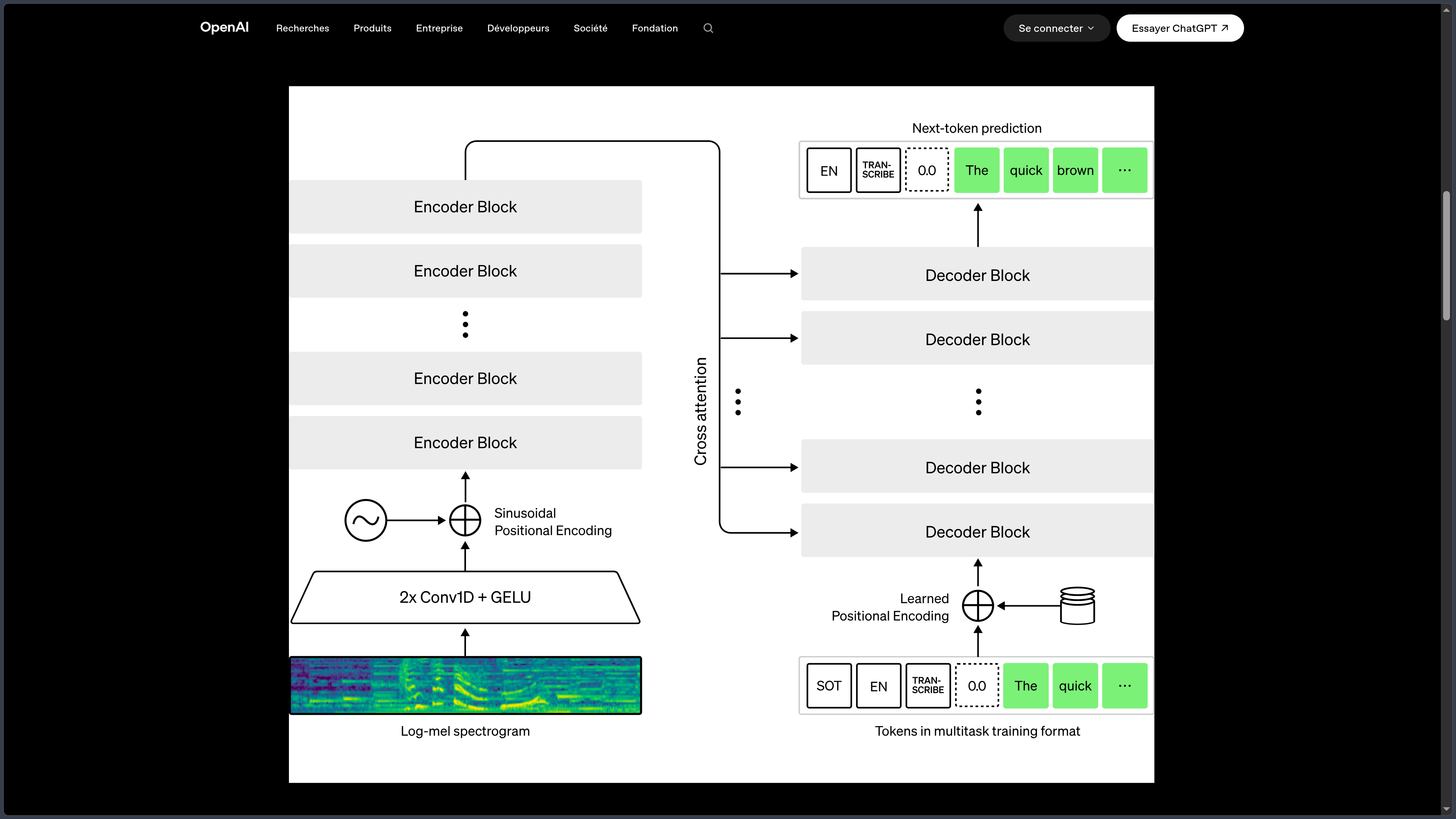
Whisper is an open-source automatic speech recognition model developed by OpenAI to turn audio recordings into text.
Introduced in 2022, it was trained on 680,000 hours of supervised audio data covering many languages and recording conditions. This diversity notably aims to improve robustness to accents, background noise and technical vocabulary.
Whisper is not limited to transcription. Its multilingual models can also identify the spoken language and translate recordings from another language into English.
The code and model weights are released under the MIT license, allowing Whisper to be installed on a user's own machine and applications to be built around its capabilities without necessarily depending on a cloud service.
OpenAI also provides the whisper-1 model through its Audio API. This approach avoids running the model locally but is billed according to the duration of the processed audio.
Features
Audio transcription
Whisper's main function is to convert files containing speech into text.
The model analyzes audio through successive windows and produces a transcription together with timing information.
It can be used for interviews, podcasts, meetings, conferences, videos, voice memos and other spoken content.
Accuracy nevertheless depends heavily on audio quality, language, the selected model and recording conditions.
Multilingual recognition
Whisper was trained on data covering many languages and can automatically identify the language used in a recording.
The multilingual models then transcribe speech in its original language.
Performance is not uniform, however. Languages that were strongly represented in the training data generally achieve better results than those with less available data.
Whisper can also encounter more difficulty with certain accents, dialects or very short and noisy recordings.
Translation into English
Whisper's multilingual models can perform direct speech translation into English.
A recording in French, Japanese or another supported language can therefore produce English text directly without first requiring a separate transcript and then a translation system.
This feature is not a universal translator between every language pair: Whisper's native translation task targets English.
The turbo model is also optimized for transcription and is not intended for this translation task. OpenAI recommends using a multilingual model such as medium or large when translation into English is required.
Several model sizes
Whisper provides several model sizes for balancing speed, memory consumption and accuracy.
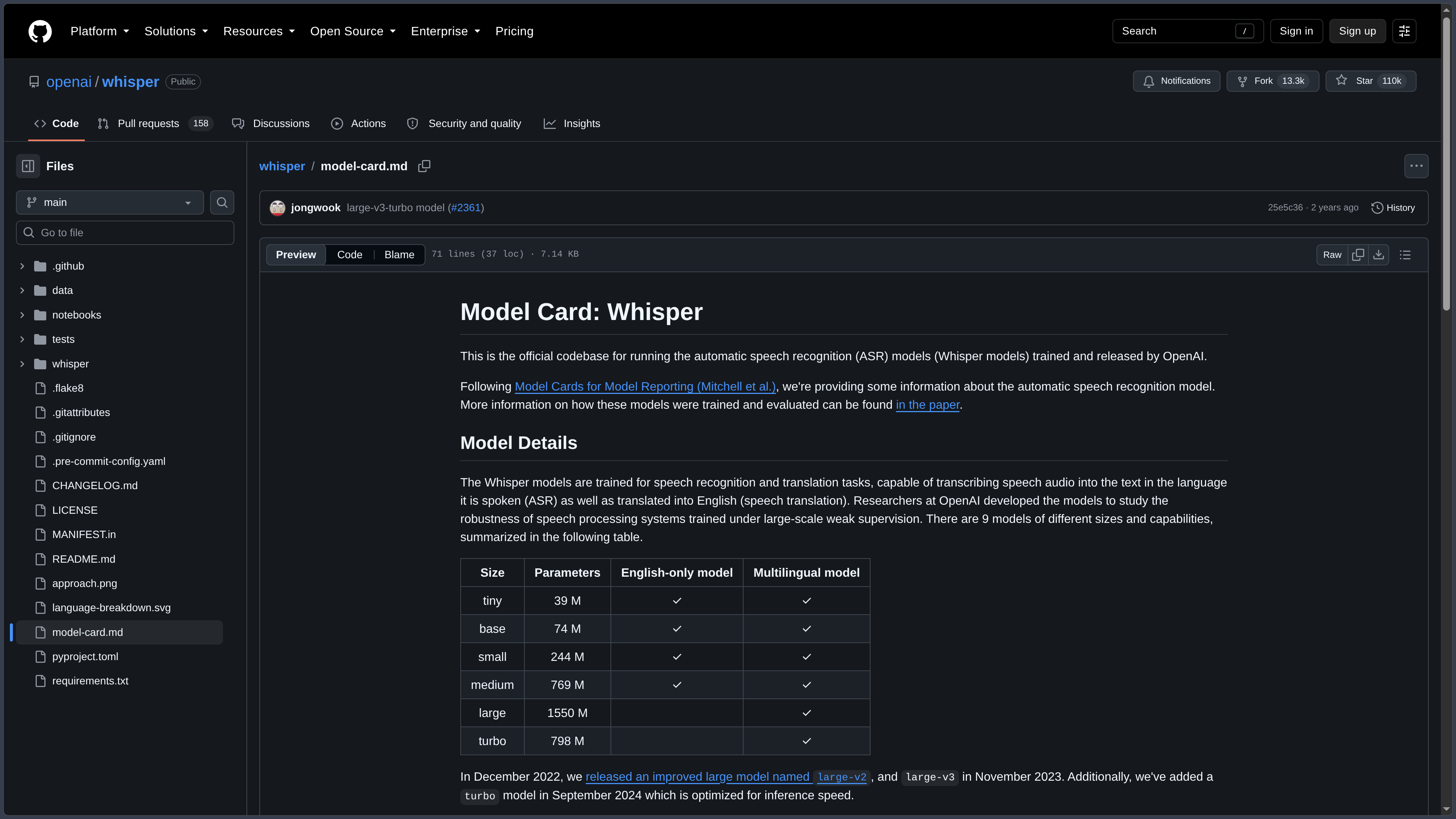
The main variants are tiny, base, small, medium, large and turbo. The first four also have .en variants specialized for English.
Approximate GPU memory requirements range from around 1 GB for tiny and base to around 10 GB for large.
turbo requires around 6 GB of VRAM and is an optimized version of large-v3, designed to greatly accelerate transcription while retaining accuracy close to the larger model.
This choice makes Whisper adaptable to both smaller computers and workstations equipped with more powerful GPUs.
Local execution
Whisper can run directly on a computer without sending the recording to a remote service.
The official installation relies on Python, PyTorch and FFmpeg, using the openai-whisper package.
This local approach can be useful for private data, automated processing or projects where the cost of transcribing many hours of audio needs to be controlled.
Performance nevertheless depends on the hardware. Whisper can run on a CPU, but a compatible GPU considerably speeds up the heavier models.
Windows, macOS and Linux can run Whisper as long as the Python environment and dependencies are installed correctly.
Command-line interface
Whisper provides a command-line interface for quickly running transcription without developing a complete application.
One or more audio files can be passed to the program along with the model, language or desired task.
This interface is suitable for occasional processing as well as shell scripts or automated workflows that process several files in sequence.
The usable formats notably depend on FFmpeg, which handles audio decoding before the model processes the content.
Python integration
Whisper can also be integrated directly into a Python application.
The library can load a model, transcribe a file, detect a language and provide access to lower-level decoding functions.
This integration makes it easier to create transcription tools, search engines for audio archives, subtitle generators or multimedia processing pipelines.
The MIT license also allows developers to build their own interfaces and services around the models.
Timestamps and subtitling
Whisper can produce timing information associated with the transcription.
This data can be used to synchronize text with an audio or video file and build subtitles.
The official library notably supports output formats suited to different transcription workflows and can provide word-level timestamps.
Human review remains preferable when subtitles need to follow timing, speaker changes or professional editorial rules precisely.
Turbo model
The turbo model, also known as large-v3-turbo, is an optimized version of large-v3.
It significantly reduces the decoding component in order to increase inference speed while keeping accuracy relatively close to the large model.
The official repository now selects it by default in common transcription examples.
It therefore provides an attractive compromise for processing large amounts of audio when speed matters as much as accuracy.
For translation from foreign languages into English, however, the standard multilingual models should be preferred over turbo.
OpenAI API
Whisper can also be used without local installation through the whisper-1 model available in the OpenAI API.
This approach runs the model on OpenAI infrastructure and currently charges US$0.006 per minute of transcription.
It can simplify integration into a Web service or application when users do not want to manage the models and hardware themselves.
The API and open-source version should nevertheless be considered two different usage modes: one runs on paid remote infrastructure, while the other runs on hardware controlled by the user.
Use cases
Transcribe an interview
An interview recording can be processed with Whisper to obtain a first written version.
The text can then be reviewed and corrected before publication, archiving or use in an article.
Generate subtitles
Whisper can turn a video's audio track into timestamped text.
This information can serve as the basis for subtitles intended for a video, training material or online content.
Index podcasts or audio archives
A collection of shows, conferences or recordings can be transcribed automatically.
The resulting text then becomes searchable, making it easier to find a subject, person or specific passage in large audio archives.
Transcribe private content locally
An organization or individual can run Whisper directly on their own machine so that audio files are not sent to a remote API.
This approach requires more configuration and computing power but provides greater control over data processing.
Translate a recording into English
Spoken content in another language can be turned directly into English text using a compatible multilingual model.
This feature can be used to prepare a translation, analyze foreign-language content or create a first version of English subtitles.
Conclusion
Whisper remains a particularly versatile open-source speech recognition model for developers and creators who want to turn audio into text.
Its main strength comes from combining multilingual transcription, language identification, translation into English and the ability to run the models entirely on the user's own hardware.
The different model sizes make it possible to balance accuracy and available resources, while turbo provides a particularly fast option for transcription.
The availability of the code and weights under the MIT license has also encouraged a large ecosystem of interfaces, integrations and variants built around Whisper.
The model nevertheless remains an automatic recognition system rather than an infallible transcription tool. Hallucinations, repetitions, errors involving proper names and differences in performance between languages require review whenever the resulting text needs to be reliable.
OpenAI now offers newer transcription models through its API, but Whisper retains particular value because of its local execution, openness and ecosystem.
For transcribing audio or video files, generating subtitles, automating spoken-content processing or integrating local speech recognition into an application, Whisper remains a solid and flexible foundation.
Points to consider
-
Whisper is open source under the MIT license. The code and model weights can be downloaded and run locally without API fees.
-
The latest official package release is v20250625 as of October 3, 2026. This version mainly brings fixes, compatibility changes and technical updates.
-
turbois optimized for transcription, not translation. To translate a foreign language into English, OpenAI recommends a multilingual model such asmediumorlarge. -
Whisper can hallucinate text. Under certain conditions, particularly with silence, noise or ambiguous signals, it may produce words that were not actually spoken.
-
Performance varies between languages, accents and dialects. Good accuracy in English or French does not guarantee equivalent results for every language.
-
Whisper does not natively provide a complete speaker diarization system. Automatically identifying who is speaking may require additional tools.
-
The model is not designed as a turnkey real-time transcription system. Third-party applications can build near-real-time workflows around Whisper, but this is not the model's native operating mode.
-
Local installation requires a technical environment. Python, PyTorch and FFmpeg are among the main dependencies, and a GPU becomes useful for the larger models.
-
The current repository declares Python 3.8 or later and references Python support up to 3.13. Actual compatibility also depends on the installed versions of PyTorch, FFmpeg and other dependencies.
-
The
largemodel requires around 10 GB of VRAM andturboaround 6 GB according to official estimates. Smaller models greatly reduce hardware requirements, generally at the cost of lower accuracy. -
The
whisper-1API is a paid service separate from local execution. It currently costs US$0.006 per minute of transcription and requires sending the file to OpenAI infrastructure. -
The legacy
whisper-1API limit is 25 MiB per request. Larger files need to be split or processed using an appropriate strategy. -
Automatic transcription should be reviewed for sensitive or professional uses. Errors involving numbers, names, technical terms or ambiguous phrases can change the meaning of the content.