Overview
SoundCloud is both a music streaming service and a publishing platform open to creators. This dual identity deeply distinguishes it from Spotify, Deezer or Apple Music. On those services, most of the catalog arrives through labels and distributors; on SoundCloud, an artist can create an account, upload a track directly and make it available to a community only moments later.
It is precisely this openness that shaped the history of the platform. Founded in Berlin in 2007 by Alexander Ljung and Eric Wahlforss, SoundCloud was initially conceived as a simple way for musicians to share their creations. It gradually became a space where finished tracks, demos, remixes, edits, DJ sets, podcasts, experiments and professional releases can coexist.
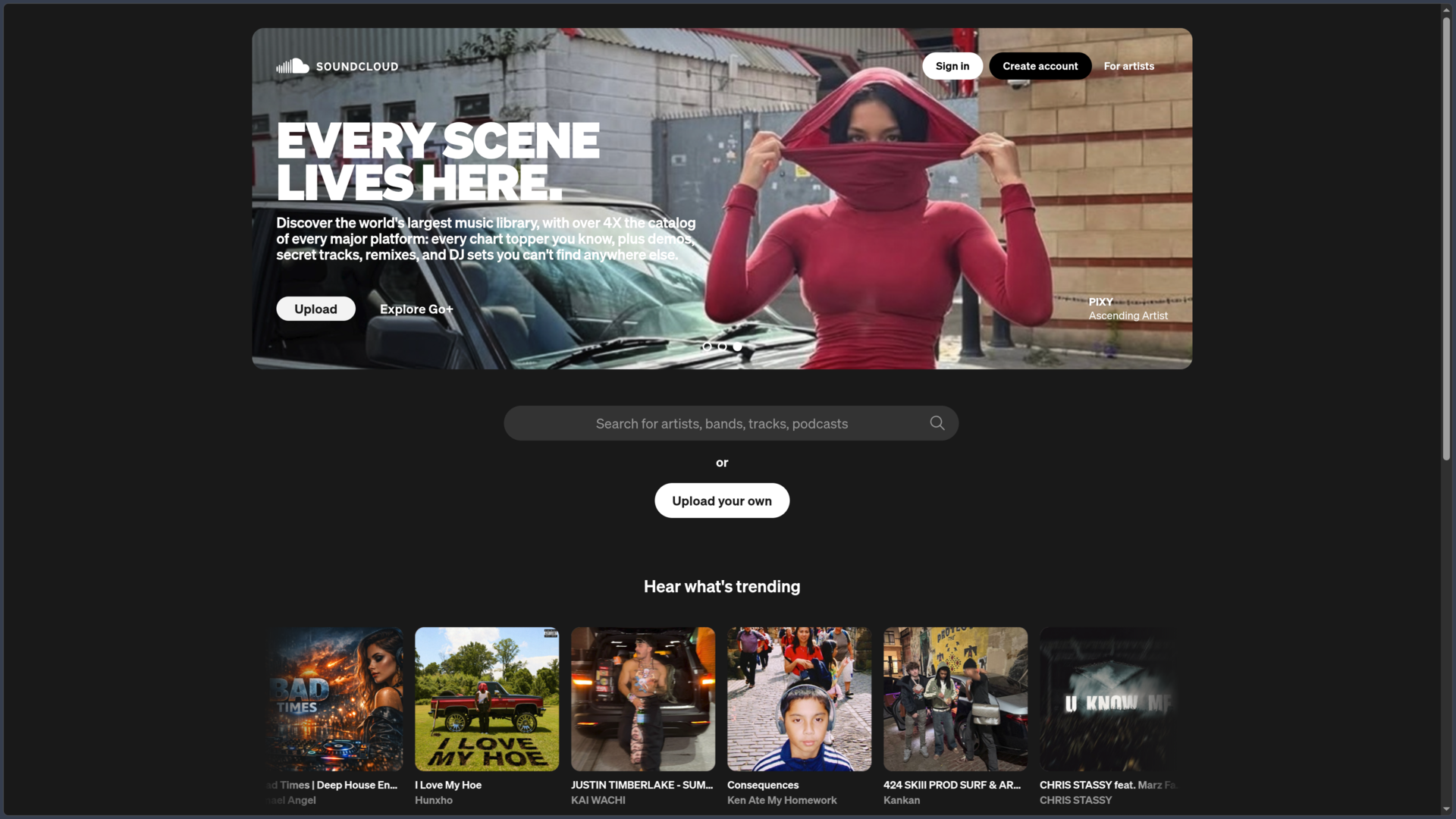
The scale it has reached is considerable. SoundCloud now announces more than 400 million tracks from more than 40 million artists across 193 countries. This volume should not be interpreted in the same way as the catalog of a traditional streaming service: a significant proportion comes directly from users and includes content that may not be available anywhere else.
This is one of SoundCloud’s major strengths. Searching for a well-known artist may lead to their official releases, but exploring the platform can also reveal a remix not distributed through conventional services, the first track from a still-unknown producer, a one-hour mix published by a DJ or an alternative version uploaded directly by its creator.
SoundCloud also maintains a genuine licensed catalog and offers subscriptions aimed at listeners. SoundCloud Go removes advertising and notably adds offline listening for part of the catalog. SoundCloud Go+ provides full access to the catalog available in the user’s territory and adds high-quality audio.
The platform also has a much more visible social dimension than most streaming services. A track is not merely accompanied by a play count: users can like it, comment at a precise point on the waveform, follow the artist, repost the track to their own followers or send a message. The boundary between listening to music and following someone who is actually creating it therefore becomes much thinner.
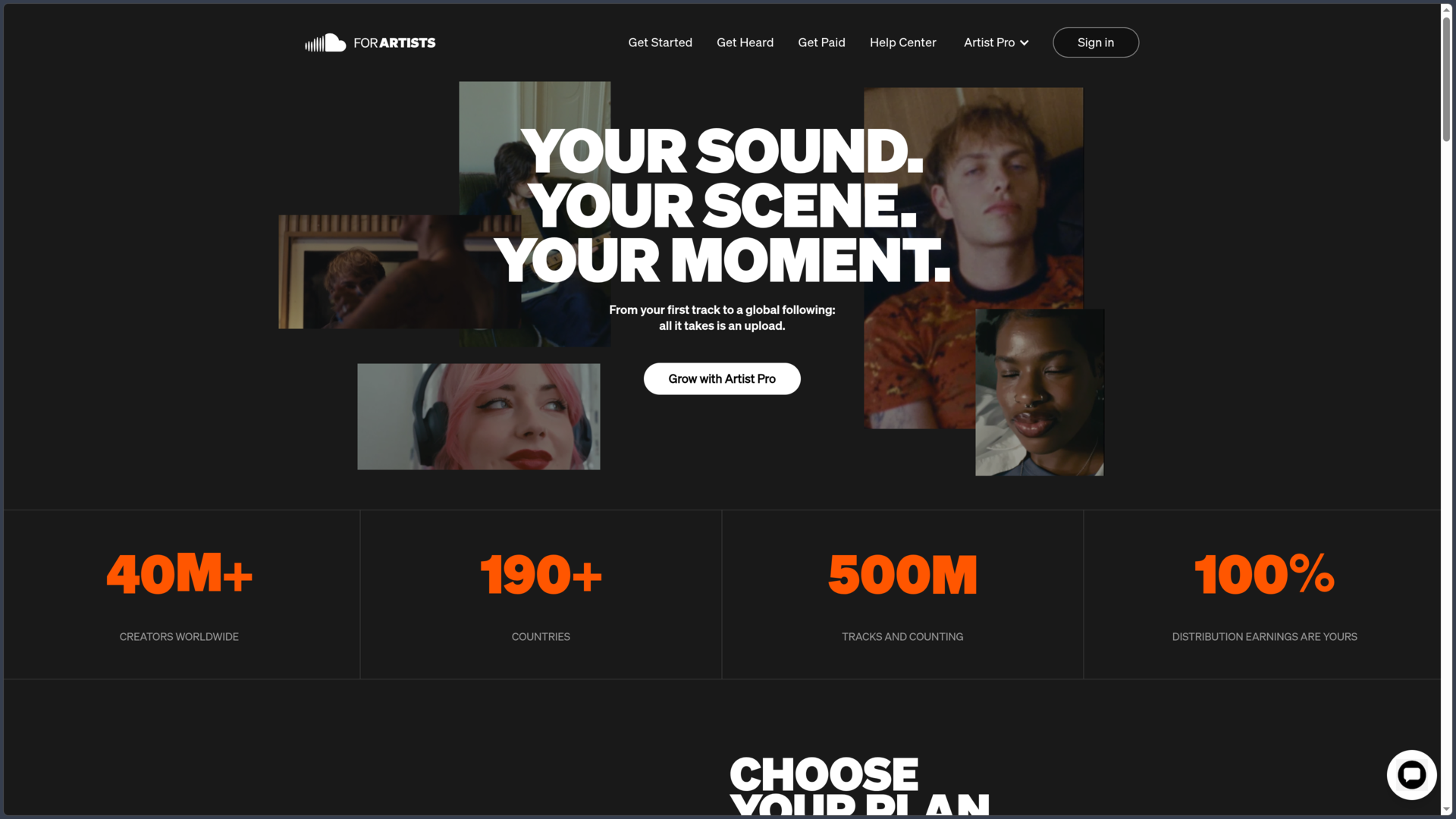
For artists, SoundCloud now extends far beyond hosting. Artist and Artist Pro combine publishing, analytics, promotion, mastering, monetization and distribution to other platforms. SoundCloud therefore aims to cover an increasing part of the journey from a first upload to a genuine music activity.
Features
A huge catalog unlike those of other platforms
SoundCloud announces more than 400 million tracks, a volume far greater than the music catalogs generally claimed by the major streaming platforms.
This difference comes from the way it works. SoundCloud hosts professionally distributed releases, but it also allows creators to upload their own audio directly. A track therefore does not necessarily need to pass through a label or digital distributor before appearing on the platform.
The result is especially visible in certain scenes. Electronic music, hip-hop, beatmaking, DJing, ambient, experimental music and remix cultures have long used SoundCloud as a space that operates alongside official releases.
The platform contains conventional singles and albums, but also demos, bootlegs, edits, mashups, remixes, DJ sets, extended versions, works in progress and tracks published only on SoundCloud.
This abundance naturally comes with a trade-off. The catalog is less homogeneous than on a platform where most content passes through standardized professional channels. Metadata, cover artwork, album organization and audio quality can vary considerably depending on the creator.
It is therefore less a perfectly organized library than a vast, living musical space. For people who enjoy digging and discovering what is circulating before or outside traditional channels, this characteristic is precisely part of its appeal.
Direct publishing for creators
SoundCloud retains a feature that has become relatively rare among major listening services: uploading is directly part of the product.
A creator can send an audio file, provide a title, image, description, genre, tags and various metadata, then decide whether to publish the track publicly or keep it private.
The free account already allows users to begin publishing, while the Artist and Artist Pro plans increase capacity and add professional features.
This model makes it possible to use the platform long before having a professional catalog. A musician can publish a first demo, a producer can test a beat, a DJ can share a set or a band can send a private work-in-progress version.
Private links are especially useful for sending a track before release without displaying it on the public profile or making it available in search.
Artist Pro also adds features such as scheduled releases. A track can therefore be prepared in advance and automatically become public on the selected date.
SoundCloud therefore remains a multi-stage workspace and distribution environment, not merely the final destination for music that has already been released elsewhere.
A waveform that becomes a space for conversation
The orange waveform is one of SoundCloud’s most recognizable visual elements, but it is not purely decorative.
Users can leave a comment at a precise moment in the track. The message then appears at the corresponding point on the waveform.
This idea is particularly relevant to music. A listener can react when a bass line arrives, a rhythm changes, a drop begins or a particular phrase occurs instead of leaving only a general comment beneath the track.
For an artist sharing a demo or work in progress, this system can also be used for feedback. Several people can indicate exactly where a section works or where something seems to need improvement.
Comments can receive replies and users can be mentioned directly.
This dimension explains part of SoundCloud’s social identity: listening and discussion directly use the track’s timeline as a shared space.
It can also become intrusive on certain highly popular tracks or attract spam. Comments therefore do not replace a genuine audio collaboration environment, but they create much more contextual interaction than comments placed beneath a conventional post.
Likes, follows and reposts as social circulation
SoundCloud does not build discovery solely through algorithmic recommendations.
When a user follows an artist or another account, their new uploads, playlists and certain reposts can appear in the Feed.
The repost plays an important role here. Someone who discovers a track can republish it on their own profile and make it appear in their followers’ feeds.
This works more like the circulation of a post on a social network than the silent addition of a track to a personal library.
Likes also have a public dimension. They allow users to save a track for later, but also signal to the creator and other users that someone appreciated it.
SoundCloud extends this approach with various tools designed to highlight active listeners and early supporters around a release.
This social layer makes discovery less exclusively dependent on a recommendation engine. Following DJs, producers, labels or enthusiasts who regularly repost music can gradually turn the Feed into a genuine stream of human curation.
Discovery between algorithms and community
SoundCloud also provides more conventional recommendation systems.
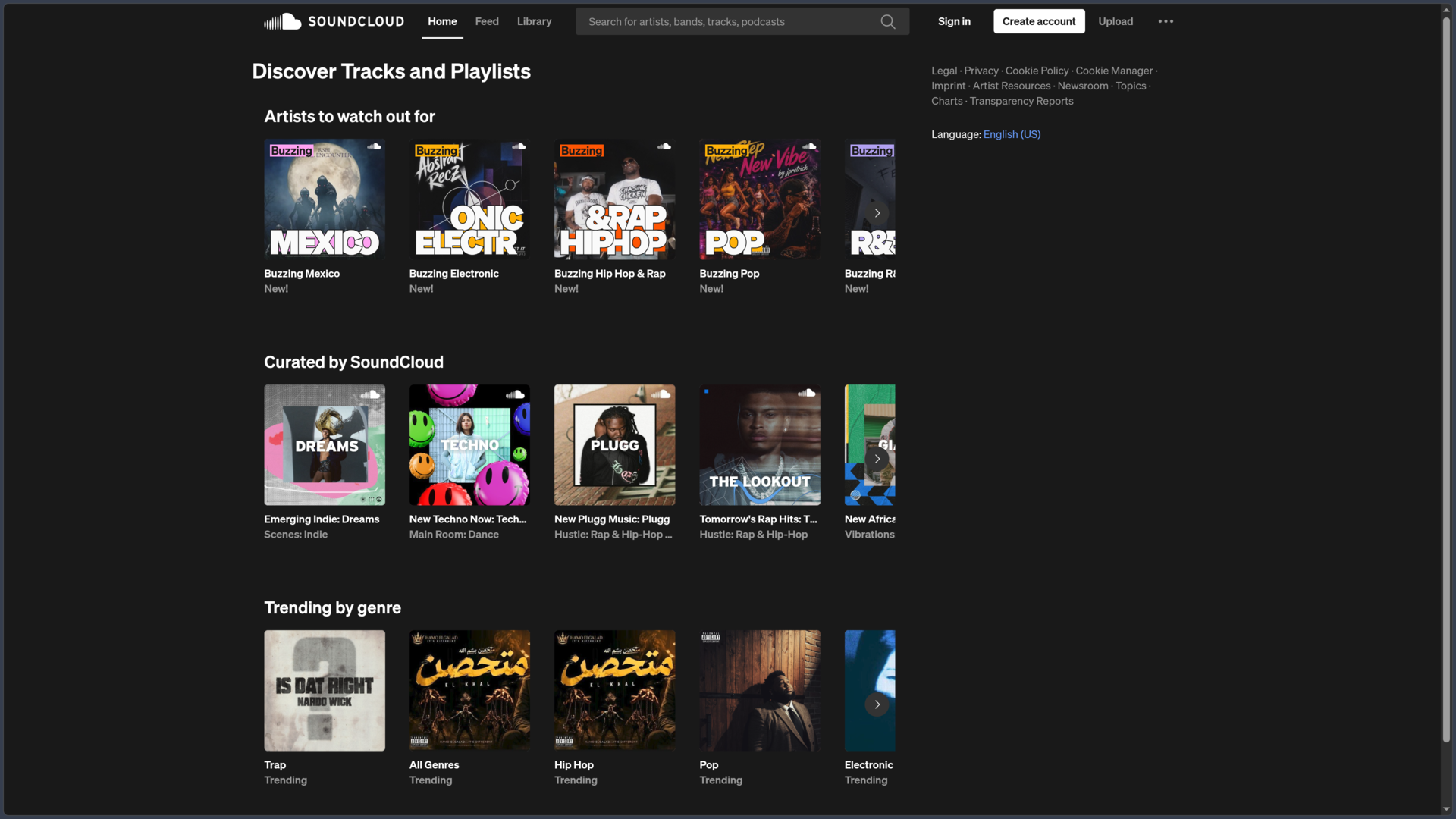
The home page displays personalized selections, stations, charts, similar tracks and various spaces designed to extend listening.
The Feed can also distinguish discovery of new content from activity generated by followed accounts.
This separation makes two logics visible that are often mixed together elsewhere: what the platform thinks the user might like and what the people they deliberately chose to follow have actually just published or reposted.
SoundCloud has a particular advantage when it comes to discovering new artists: many creators publish their music on the platform before they have complete distribution or a significant audience elsewhere.
The algorithm can therefore work with a pool of content that is not limited to the same releases simultaneously available across every major service.
The quality of the results naturally depends on the music scenes and the user’s habits. SoundCloud can feel extraordinarily rich to someone searching for independent electronic music or remixes, and much less structured to someone who simply wants to browse the official discography of a well-known artist cleanly.
SoundCloud Go and Go+ for everyday listening
SoundCloud remains widely accessible for free, but offers several subscriptions for listeners.
SoundCloud Go removes advertising and notably enables offline listening across a significant part of the catalog.
SoundCloud Go+ adds full access to the catalog available in the user’s territory as well as high-quality audio.
In France, at the time of this verification, a direct subscription through the website costs €5.99 per month for Go and €11.99 per month for Go+.
Prices offered through mobile app stores may differ from the amount charged directly by SoundCloud. It is therefore useful to check the subscription channel before signing up.
Go+ also has a student offer in eligible territories, subject to verification.
These plans bring SoundCloud closer to a traditional music service, but its logic remains different: users benefit from both the licensed catalog and the enormous collection of content published directly by the community.
Higher audio quality with Go+, but no Lossless
SoundCloud offers a High Quality mode to Go+ subscribers.
Eligible files can be streamed in 256 kb/s AAC when high quality is enabled. SoundCloud presents this level as comparable in practical use to a high-quality MP3.
For a track to properly benefit from this quality, the source uploaded by the creator must itself be of sufficient quality. SoundCloud accepts formats including WAV, FLAC, AIFF and ALAC for uploads.
A file that has already been heavily compressed obviously cannot recover information removed during its initial compression.
The terminology needs to be very clear: SoundCloud Go+ currently does not provide Lossless streaming to listeners. The fact that an artist can upload a FLAC file does not mean that this file is transmitted unchanged during playback.
On this specific criterion, SoundCloud therefore remains behind services that now offer FLAC or another form of lossless streaming.
For many users, 256 kb/s AAC nevertheless remains more than sufficient, particularly for mobile listening or over Bluetooth. For someone choosing a service primarily according to Lossless or Hi-Res quality, this limitation becomes important.
Offline listening without owning the files
Go and Go+ allow users to save content for offline listening in compatible mobile applications.
A playlist or series of tracks can therefore be prepared before a journey, flight or time spent somewhere without network coverage.
With Go+, downloads can use high quality when that setting is enabled.
As with Spotify or Deezer, this feature needs to be distinguished from a conventional file download. The copy stored by the application remains tied to SoundCloud and the corresponding subscription.
The user therefore does not automatically receive an MP3, WAV or FLAC file that can be archived, copied to another player or kept independently from the service.
SoundCloud does, however, have an interesting additional feature: creators themselves can allow the original file of certain tracks to be downloaded.
When an artist enables this option, the user can retrieve the file made available under the conditions chosen by its creator.
This coexistence clearly illustrates SoundCloud’s two sides: a streaming platform on one hand and a direct sharing infrastructure between creator and audience on the other.
Artist and Artist Pro to go beyond simple uploads
SoundCloud offers a range of professional tools grouped under SoundCloud for Artists.
The free account allows creators to start publishing and provides access to essential functions.
Artist and Artist Pro progressively add greater upload capacity, analytics, mastering, promotional tools, monetization and distribution.
Artist Pro extends these possibilities further with features aimed at creators who publish regularly and want to use SoundCloud as a genuine component of their music activity.
Replacing an already published audio file can be particularly useful when this function is available. An artist can correct a master or an error without necessarily starting completely from scratch with a new upload.
Highlighting tools also make it possible to control more precisely which tracks or playlists appear first on the profile.
SoundCloud does not become a digital audio workstation or music production application as a result. Its tools mainly operate after or around creation: hosting, presentation, publishing, audience understanding, distribution and monetization.
Distributing music to other platforms from SoundCloud
Paid creator plans include music distribution to major external platforms.
An artist can prepare a release in SoundCloud for Artists and then distribute it to Spotify, Apple Music, Amazon Music, YouTube Music, TikTok and other supported services.
This function changes SoundCloud’s historical role. The platform could previously serve mainly as a step before using a separate distributor; it can now cover part of that chain itself.
SoundCloud also states that it pays out the distribution royalties it receives from its partners according to the conditions of its program, excluding any applicable processing fees.
External distribution should nevertheless not be confused with revenue generated directly on SoundCloud. Other platforms retain their own payment systems.
SoundCloud for Artists therefore mainly makes it possible to centralize part of the distribution work without changing the economic rules of the destination services.
Revenue more closely tied to fans
For certain eligible independent artists who monetize directly on the platform, SoundCloud uses Fan-Powered Royalties.
The principle aims to connect the money generated by a listener more closely to the artists they actually listen to.
In a conventional system based on a large shared pool, revenue is distributed according to the overall share of streams generated by each artist.
SoundCloud’s model takes more account of each individual fan’s activity. When a listener spends a large proportion of their listening time on a particular artist, the value generated by that listener can benefit that artist more directly.
The calculation naturally still depends on numerous factors and does not guarantee that a musician will earn significant amounts.
This logic nevertheless creates a more direct connection between the loyalty of a community and the creator’s revenue, which fits SoundCloud’s social dimension quite naturally.
An environment particularly suited to DJs
SoundCloud has long maintained an important relationship with DJ cultures.
The presence of mixes, sets, edits and remixes already creates a major difference from services mainly structured around official singles and albums.
SoundCloud also offers integrations with certain compatible DJ applications, depending on the subscription used.
A DJ can therefore access part of the SoundCloud catalog from their mixing environment rather than preparing an exclusively local collection.
This possibility remains dependent on partner software, rights associated with the tracks and the chosen subscription.
For someone who simply listens to music, this aspect is secondary. For a DJ or producer who already uses SoundCloud as a primary source of discovery, it can instead create a very natural continuity between searching and performing.
A service available on many devices
SoundCloud is directly accessible through the Web and provides official mobile applications for Android, iPhone and iPad.
An application for Windows is also available.
On macOS and Linux, the browser remains the main access method rather than an official desktop client equivalent to Spotify’s.
SoundCloud is also available or integrated into various environments such as Sonos, Chromecast, Xbox, Apple CarPlay, Android Auto, Apple Watch and Wear OS, depending on supported devices and features.
Bluetooth, AirPlay and Chromecast also make it possible to send playback to different audio devices.
Coverage therefore remains broad, but SoundCloud does not provide exactly the same universal continuity between devices as a system such as Spotify Connect. Operation depends more heavily on the application and technology being used to transmit the audio.
Use cases
Discovering artists before they reach traditional catalogs
A listener who wants to go beyond releases already heavily exposed on major platforms can follow producers, small labels, collectives, DJs or curators on SoundCloud.
The Feed gradually fills with their new uploads and reposts.
A discovered track may have only a few hundred plays and come from an artist who has not yet released any official album.
A few months later, the same musician may appear on Spotify, Deezer or Apple Music with a professionally distributed release.
SoundCloud therefore makes it possible to follow not only finished works, but sometimes the trajectory that comes before their arrival in traditional channels.
This is probably one of its most interesting uses for listeners who see music discovery as exploration rather than simple automatic personalization.
Finding remixes, edits and DJ sets absent from other services
Searching around a familiar track can reveal different interpretations created by DJs and producers.
Some are officially authorized, while others involve more complex rights situations and may be removed if they do not comply with platform rules.
It nevertheless remains common to encounter alternative versions, mixes and sets on SoundCloud that traditional streaming services do not offer.
This richness is particularly visible in electronic music, where the DJ set itself represents an important form of distribution and discovery.
A listener can therefore move from one track to a one-hour mix and then discover the producers whose music was used in that selection.
Publishing first creations without waiting for a distributor
A musician who is just starting out does not necessarily need to immediately prepare a worldwide release with an official date and distribution across every platform.
They can upload a first track to SoundCloud, share its link and begin observing reactions.
The track can remain private during a work phase, become public when ready and potentially be distributed more widely as the project develops.
This gradual approach is particularly useful for beatmakers, electronic producers, DJs or artists who create many tracks before deciding which ones deserve a full release.
SoundCloud then becomes a public laboratory between creation and distribution.
Getting feedback at exactly the right moment in a track
A band can send a private demo to several people.
Instead of receiving vague messages about the middle or end of the track, listeners can comment directly on the waveform at the relevant point.
The musician therefore finds each remark associated with the precise moment in the song.
This approach does not replace specialized review and collaboration tools used in professional production, but it is very practical for quickly obtaining contextual feedback.
Gradually building a community rather than only accumulating streams
An artist can follow other creators, reply to comments, observe their most active listeners and participate in the circulation of tracks through reposts.
This activity gives the statistics more of a human face.
One hundred plays from people who comment, repost and return regularly can represent a different signal from one thousand anonymous plays generated by an external playlist.
Fan-Powered Royalties reinforce this logic because the individual loyalty of listeners plays a greater role in the remuneration of certain eligible artists.
SoundCloud can therefore be especially relevant for someone trying to build a small, identifiable community rather than focusing only on increasing the raw number of streams.
Hosting a DJ set or long-form audio creation
SoundCloud allows creators to publish content much longer than a traditional single.
A DJ can share a recorded set, a producer can upload a long ambient performance or a creator can publish a music show.
These formats are often less natural on services structured almost entirely around albums and distributed tracks.
The waveform also makes navigation through these longer durations easier and allows listeners to comment on specific passages.
Music rights naturally remain essential for mixes containing third-party works. Publishing a set does not remove copyright obligations, and SoundCloud can block or remove content when an infringement is detected or reported.
Turning SoundCloud into a primary listening service with Go+
A user attracted by the community catalog may not want to maintain another platform solely for everyday listening.
Go+ removes advertising, provides access to the full catalog available in the user’s territory, enables offline listening and activates HQ audio.
The combination of the licensed catalog and the millions of pieces of content unique to SoundCloud can therefore replace a traditional platform for certain profiles.
This choice nevertheless comes with a clear compromise: maximum quality currently remains 256 kb/s AAC rather than Lossless.
A listener who prioritizes discovering remixes and emerging artists may easily accept this difference. Someone whose absolute priority is Lossless or Hi-Res quality will probably make a different choice.
Distributing music from the same place where it finds an audience
An artist can begin by publishing tracks directly on SoundCloud and then move to a creator plan when they want to professionalize their releases.
The same tools can then be used to monetize certain creations and distribute them to Spotify, Apple Music, Amazon Music and other platforms.
The value lies less in SoundCloud being the only distributor available than in the continuity of the workflow.
The artist no longer has to completely separate the place where they build their community from the service that sends their releases into the broader streaming industry.
Conclusion
SoundCloud superficially resembles Spotify or Deezer because all three allow users to search for a track, create playlists and listen to music. Yet its deeper structure is very different. SoundCloud is not merely a catalog to listen to: it is a space where music can appear, circulate, be commented on, tested and eventually become a professional release.
This distinction explains its enormous catalog. More than 400 million tracks do not simply mean more commercial albums. They include an enormous quantity of music published directly by millions of creators: first tracks, remixes, mixes, experiments, alternative versions and content that may never appear on other platforms.
This openness makes SoundCloud more disorderly than a traditional library, but that disorder is precisely what can make it exciting. Spotify and Deezer excel at organizing an enormous professional catalog; SoundCloud makes it easier to stumble across something that has not yet been placed inside that catalog.
The social dimension reinforces this difference. Comments placed directly on the waveform, reposts, the Feed and fan-focused tools create a much stronger sense of proximity between the person publishing and the person listening.
For creators, SoundCloud’s transformation is equally important. The platform is no longer limited to hosting: its artist plans add analytics, promotion, distribution and monetization. Fan-Powered Royalties simultaneously attempt to establish a more direct relationship between a listener’s engagement and the remuneration of the artists they actually listen to.
Several compromises remain. SoundCloud Go+ currently does not provide Lossless audio, the quality and organization of community uploads are necessarily variable, some functions are divided across several subscriptions and user-uploaded content can disappear when it violates copyright or platform rules.
For someone primarily looking for a perfectly organized music library with the best possible audio quality, other platforms will probably be better suited. For someone who enjoys searching for remixes, following emerging scenes, listening to DJs, directly commenting on artists’ work or publishing their own music without waiting to go through the entire traditional distribution chain, SoundCloud retains an almost unique place.
Its real strength is therefore not simply having more tracks. It is being one of the few major services where listener and creator still genuinely use the same platform.
Points to consider
-
SoundCloud is both a streaming service and a platform for user-uploaded content: the catalog therefore mixes official releases, content published directly by artists, DJ sets, remixes, demos and other formats whose presentation and quality can vary.
-
SoundCloud announces more than 400 million tracks from more than 40 million artists across 193 countries. This considerable volume is largely explained by the platform’s direct openness to creator uploads.
-
SoundCloud Free remains usable without a subscription, but includes advertising and does not provide every feature or full access to the licensed content available with Go+.
-
In France, SoundCloud Go currently costs €5.99/month and Go+ €11.99/month when subscribed to directly through the website. Prices offered through app stores may differ.
-
Go and Go+ are not equivalent: Go mainly improves ad-free and offline listening, while Go+ unlocks the full catalog available in the territory and high-quality audio.
-
SoundCloud Go+ HQ audio is not Lossless: it currently uses 256 kb/s AAC for eligible tracks.
-
A FLAC file uploaded by an artist is not streamed unchanged to a Go+ subscriber: the presence of FLAC among upload formats therefore does not mean that SoundCloud provides FLAC streaming.
-
Offline downloads remain tied to the application and subscription: they do not automatically become unrestricted music files that users can keep or export.
-
A creator can nevertheless separately authorize downloading the original file. This direct-sharing feature must be distinguished from the offline mode associated with listener subscriptions.
-
Artist and Artist Pro are distinct from Go and Go+: the first two are aimed at creators who want to publish, analyze, promote, distribute and monetize their music; the latter mainly improve the listening experience.
-
Monetization is not automatic simply because a track has been uploaded: creators must use the relevant SoundCloud for Artists features and hold the necessary rights to the content.
-
Creators must hold the necessary rights for what they publish: remixes, bootlegs and DJ sets are not exempt from copyright simply because they are hosted on SoundCloud.
-
Public comments can be attached to precise points on the waveform. This is highly useful for interaction, but can also lead to spam or distracting discussions on certain tracks.
-
Likes, follows, reposts and messages are subject to anti-abuse mechanisms designed to limit automated behavior and spam.
-
The Windows application exists, but some features may differ from those available in the mobile applications or web player.
-
SoundCloud does not provide an official macOS or Linux client equivalent to Spotify’s: the web player remains the main access method on these systems.
-
SoundCloud works with many third-party devices and services, but exact features depend on the device, territory and subscription used.
-
Track availability is not permanent: a creator may delete content, make it private or have a track removed because of rights issues. A like or playlist therefore never amounts to owning the work.