Overview

DeepSeek is an artificial intelligence assistant developed by the Chinese company Hangzhou DeepSeek Artificial Intelligence Co., Ltd.

It allows users to interact in natural language to:

  • answer questions;
  • explain a concept;
  • write and rephrase;
  • solve problems;
  • search for information on the Web;
  • analyze files;
  • work with code;
  • support mathematical and technical tasks.

The DeepSeek ecosystem includes several elements that should not be confused:

  • DeepSeek – AI Assistant, the consumer service available on the Web and mobile devices;
  • DeepSeek Open Platform, the API intended for developers;
  • DeepSeek models, some of whose weights can be downloaded and run through third-party tools;
  • DeepSeek technical repositories, which contain models, libraries, and research published under different licenses.

This entry mainly covers the official DeepSeek assistant while also explaining the API and open models when they directly complement the service.

The official assistant operates in the cloud. It is accessible through a browser, Android, iPhone, and iPad.

There is currently no clearly offered official desktop application for Windows, macOS, or Linux.

DeepSeek models can nevertheless be used on these systems through third-party software such as Ollama, LM Studio, Open WebUI, or different inference engines.

This possibility does not turn the official application into a local or offline solution.

The Web service, mobile applications, accounts, history, and cloud infrastructure remain proprietary.

DeepSeek nevertheless publishes several models, weights, libraries, and technical components under open licenses. The status of the service must therefore be distinguished from that of each model or repository.

Features

Conversation and writing

DeepSeek allows users to interact with an artificial intelligence model through a relatively simple interface.

It can notably:

  • answer questions;
  • explain a topic;
  • write text;
  • rephrase a passage;
  • correct wording;
  • summarize content;
  • translate;
  • generate an outline;
  • produce a list or table;
  • compare several arguments;
  • prepare a synthesis;
  • support brainstorming;
  • adapt text to a tone or audience.

Responses can contain text, tables, and code.

DeepSeek can produce detailed results for technical or structured requests, but it remains a generative model. Its responses may contain errors, approximations, nonexistent references, or incorrect conclusions.

Reasoning mode

DeepSeek provides an in-depth reasoning mode, historically presented in the application under the name DeepThink.

This mode allocates more computation to solving the request before producing the final answer.

It is particularly useful for:

  • mathematics;
  • logical problems;
  • software development;
  • technical analysis;
  • requests involving several steps;
  • comparing hypotheses;
  • solving complex problems;
  • explaining reasoning.

Depending on the models and interface used, reasoning can be enabled or disabled.

The current API models support both a reasoning mode and a non-reasoning mode.

In-depth mode can improve quality for certain tasks, but it does not guarantee accuracy. Long and coherent reasoning can still lead to a false conclusion.

The official assistant provides a Web search feature.

It can be used to:

  • search for recent information;
  • find documentation;
  • follow current events;
  • compare several sources;
  • prepare ongoing monitoring;
  • research a company or product;
  • find references;
  • enrich a response with online data.

DeepSeek may use third-party services and APIs to provide certain search features.

Entered keywords may be transmitted to the providers required for the search to operate.

Results should be checked against the original sources.

A response produced from a Web search may still:

  • invent a reference;
  • attribute a claim to the wrong source;
  • mix several pieces of information;
  • use outdated content;
  • summarize a page incorrectly;
  • present a hypothesis as a fact.

File uploads

DeepSeek allows users to upload files into a conversation.

The assistant can notably:

  • extract text from a document;
  • summarize a file;
  • answer questions about its content;
  • search for specific information;
  • transform a document into an outline;
  • produce a synthesis;
  • explain a passage;
  • compare several elements;
  • analyze code contained in a file.

Exact formats, sizes, and limits may vary depending on the application, model, and state of the service.

It is preferable not to include a fixed limit in a long-term directory entry without stable official documentation.

Results should be checked against the original files, particularly for:

  • contracts;
  • financial reports;
  • legal texts;
  • scientific documents;
  • medical records;
  • technical files;
  • sensitive professional data.

Long-document analysis

Current DeepSeek models have a very large context capacity.

This capacity can make it easier to work with:

  • long reports;
  • several chapters;
  • a codebase;
  • extensive documentation;
  • conversation histories;
  • textual datasets;
  • several files combined within one request.

A long context does not mean that every piece of information will be correctly remembered, understood, or used.

The model may ignore certain passages, confuse distant elements, or produce an overly general synthesis.

Visual inputs

DeepSeek’s current terms provide for the possibility of submitting images, photographs, and other files as inputs.

Depending on the version and platform, DeepSeek can notably help to:

  • describe an image;
  • read a screenshot;
  • interpret a photographed document;
  • extract text;
  • comment on a chart;
  • analyze an interface;
  • answer a question about a visual element.

The precise availability of these features may vary depending on the application, region, and model used.

Image analysis should not be confused with image generation.

No image generation in the main assistant

DeepSeek publishes multimodal research and models capable of processing or generating different types of content.

This does not mean that the official DeepSeek assistant systematically provides an image-generation feature comparable to ChatGPT, Gemini, Copilot, or specialized tools.

This entry therefore does not present DeepSeek as a consumer image generator.

Third-party services using DeepSeek models may add their own multimedia features, interfaces, or generators.

Mathematics and scientific reasoning

DeepSeek is particularly known for its mathematical and technical reasoning capabilities.

It can notably:

  • solve an equation;
  • explain a formula;
  • detail a method;
  • examine several strategies;
  • assist with an exercise;
  • produce a proof;
  • verify certain steps;
  • generate code to test a calculation.

Mathematical results should nevertheless be checked.

DeepSeek may:

  • make a calculation error;
  • apply an incorrect assumption;
  • overlook a constraint;
  • produce an incorrect proof;
  • present a plausible answer without sufficient evidence.

Software development

DeepSeek can generate, explain, and modify code.

It can notably:

  • write a function;
  • create a script;
  • explain an error;
  • suggest a correction;
  • comment on code;
  • generate tests;
  • convert a program to another language;
  • prepare an architecture;
  • explain a library;
  • produce a SQL query;
  • assist with an algorithmic exercise;
  • help refactor a passage.

Current DeepSeek models are also optimized for agentic tasks and can be integrated into development tools capable of reading a repository, modifying several files, and executing commands.

The Web assistant nevertheless remains different from a complete programming agent integrated into a development environment.

Generated code should be:

  • reviewed;
  • executed;
  • tested;
  • checked against the actual versions of libraries;
  • audited before production use.

History synchronization

The official application synchronizes conversation history across platforms connected to the same account.

The user can therefore start a conversation on the Web and retrieve it on a mobile device.

History can be managed from the account settings.

Depending on the available options, the user may notably:

  • view conversations;
  • copy them;
  • delete them;
  • delete the account;
  • share a conversation.

Deleting an account may result in the permanent loss of associated conversations and content.

Conversation sharing

DeepSeek allows certain conversations to be shared through a URL.

This feature can be useful for:

  • showing a response;
  • sharing an explanation;
  • forwarding an exchange;
  • collaborating on research;
  • keeping a public example.

A shared conversation may nevertheless become accessible to anyone who has the link.

When the link is published on a public website, its content may be retrieved or indexed by automated tools.

Before sharing, users should remove:

  • personal data;
  • professional information;
  • trade secrets;
  • credentials;
  • customer data;
  • confidential information;
  • content belonging to other people.

Mobile applications

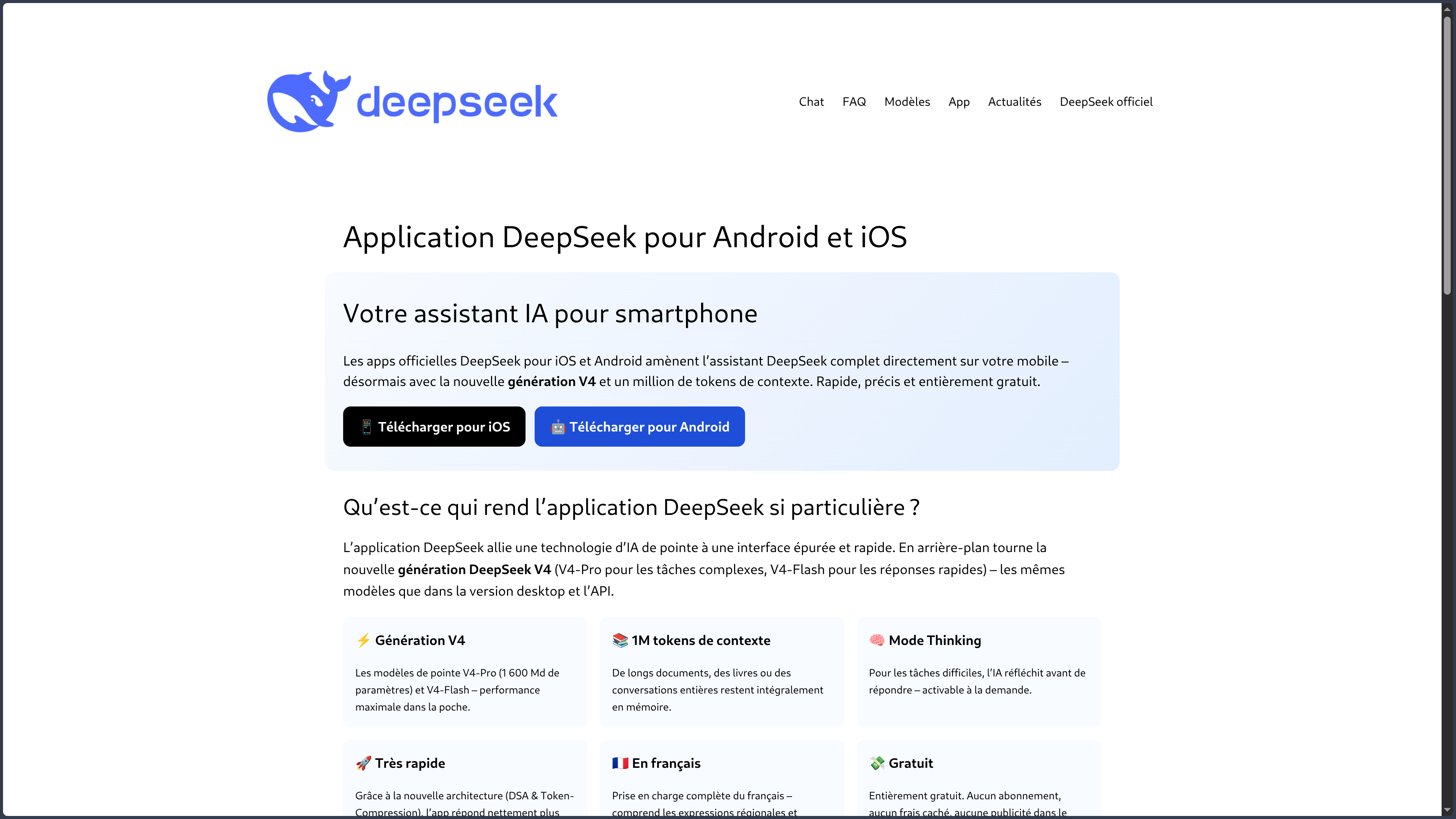
The official application is available on Android, iPhone, and iPad.

It notably allows users to:

  • chat with DeepSeek;
  • enable reasoning mode;
  • launch a Web search;
  • upload files;
  • view history;
  • resume a conversation;
  • use the assistant from a phone or tablet.

The official application is provided free of charge.

In its official presentation, DeepSeek states that its consumer application contains no advertisements or in-app purchases.

This free access does not apply to the developer API.

Current models

At the time of the latest verification, DeepSeek’s official services mainly use the DeepSeek-V4 generation.

Two models are available through the API:

  • DeepSeek-V4-Flash, focused on speed and lower cost;
  • DeepSeek-V4-Pro, focused on quality, reasoning, and complex tasks.

In the official interface, these two orientations may appear under modes such as:

  • Instant Mode;
  • Expert Mode.

Both models support:

  • a reasoning mode;
  • a non-reasoning mode;
  • a very long context;
  • tool calls;
  • JSON outputs;
  • streaming;
  • multi-turn conversations;
  • formats compatible with certain existing APIs.

Names, models, and modes can change rapidly.

A public directory entry should therefore prioritize general capabilities and retain the verification date.

Long context

DeepSeek announces a context of up to one million tokens for its V4 models within official services.

This capacity can be useful for:

  • analyzing several documents;
  • working on a large codebase;
  • processing a lengthy report;
  • combining many notes;
  • retaining a significant history;
  • producing a large-scale synthesis.

The theoretical limit does not guarantee perfect use of every element.

Quality also depends on:

  • the prompt structure;
  • the relevance of the documents;
  • the amount of contradictory information;
  • the position of elements within the context;
  • the selected model;
  • the complexity of the task.

DeepSeek API

DeepSeek Open Platform allows the company’s models to be integrated into software, services, and automations.

The API can notably be used to create:

  • a conversational assistant;
  • a text-generation feature;
  • a document-analysis tool;
  • a programming agent;
  • a classification system;
  • an editorial automation;
  • a structured-data generator;
  • a specialized interface;
  • an internal service.

The API notably provides:

  • a format compatible with the OpenAI API;
  • a format compatible with the Anthropic API;
  • streaming;
  • reasoning;
  • function calls;
  • tool calls;
  • JSON outputs;
  • prefix completion;
  • code infilling;
  • context caching.

Compatibility with an existing API makes certain migrations easier, but it does not guarantee identical behavior between models.

Parameters, responses, limits, and tool calls should be tested against the DeepSeek documentation.

Use with development agents

DeepSeek models can be used in different programming agents and assistants compatible with their API.

They can notably be integrated into:

  • Claude Code through a compatible configuration;
  • OpenCode;
  • OpenClaw;
  • editor extensions;
  • tools using an OpenAI-compatible API;
  • custom agents.

In this context, the model can participate in more autonomous tasks:

  • exploring a codebase;
  • modifying several files;
  • running commands;
  • executing tests;
  • preparing a correction;
  • producing a patch.

Actual capabilities depend as much on the agentic software as on the model.

DeepSeek does not necessarily control the security, permissions, or behavior of third-party tools.

Open-weight models

DeepSeek publishes several open-weight models.

Depending on the model, it may be possible to:

  • download the weights;
  • run the model on private infrastructure;
  • integrate it into a local tool;
  • perform certain adaptations;
  • build a derived service;
  • conduct research;
  • deploy a version on private servers.

Licenses vary between models and repositories.

The exact license of each project should be reviewed before:

  • commercial use;
  • redistribution;
  • modification;
  • derivative training;
  • integration into a product;
  • public availability.

Open models do not automatically make the official DeepSeek application open source.

Local use

DeepSeek models or derived versions can be run locally with third-party tools.

Possible solutions notably include:

  • Ollama;
  • LM Studio;
  • Open WebUI;
  • llama.cpp;
  • vLLM;
  • different engines compatible with Hugging Face.

The local experience depends on the chosen model.

Available variants may be:

  • older;
  • distilled;
  • quantized;
  • reduced;
  • specialized;
  • hosted by a community or third-party provider.

The most powerful full models require very significant hardware resources and are not suited to a conventional personal computer.

A smaller local version may differ considerably from the official service in terms of:

  • quality;
  • context;
  • speed;
  • reasoning;
  • languages;
  • tool calls;
  • safety;
  • filtering.

Public code and repositories

DeepSeek also publishes libraries, kernels, training methods, research work, and technical components.

The official repositories notably cover:

  • language models;
  • mathematical reasoning;
  • code generation and understanding;
  • vision;
  • OCR;
  • inference optimization;
  • compute kernels;
  • distributed training;
  • Mixture-of-Experts architectures.

These publications strengthen DeepSeek’s relevance to research and the open-source ecosystem.

Each repository nevertheless has its own level of maturity, license, and constraints.

Assistant pricing

The Web assistant and mobile applications are provided free of charge.

There is currently no consumer subscription comparable to the premium plans offered by ChatGPT, Claude, Gemini, or Microsoft Copilot.

Free access may nevertheless be subject to:

  • capacity limits;
  • slowdowns;
  • queues;
  • temporary restrictions;
  • regional differences;
  • model changes.

The current free model does not guarantee that the business model will remain unchanged.

API pricing

The API is billed according to the number of tokens processed.

The price notably depends on:

  • the model;
  • input tokens;
  • generated tokens;
  • cache usage;
  • possible pricing changes.

DeepSeek-V4-Flash is intended for fast and economical use cases.

DeepSeek-V4-Pro is more expensive but targets more demanding tasks.

Caching can significantly reduce the cost of repeated inputs.

Prices should be checked on the official page before preparing an estimate or moving to production.

Personal data

DeepSeek may collect different types of information when its services are used.

This may notably include:

  • email address;
  • phone number;
  • date of birth when requested;
  • username;
  • prompts;
  • responses;
  • uploaded files;
  • photographs;
  • voice inputs;
  • user feedback;
  • conversation history;
  • IP address;
  • device identifiers;
  • operating system;
  • usage logs;
  • approximate location;
  • payment information for the API.

DeepSeek states that it uses certain interactions to develop, train, and improve its models and technologies.

Depending on the region and applicable rights, users may request to object to the use of their personal data for model training or technology optimization.

Data storage

DeepSeek states that it directly collects, processes, and stores personal data in the People’s Republic of China.

Data may therefore be stored outside the user’s country of residence.

This location should be considered before submitting:

  • professional documents;
  • customer data;
  • confidential information;
  • contracts;
  • medical data;
  • biometric data;
  • data relating to minors;
  • trade secrets;
  • private code;
  • credentials or passwords.

The privacy policy states that the service is not designed to process sensitive personal data.

Use cases

Questions and explanations

DeepSeek can answer general questions and explain complex concepts.

It can be used to:

  • understand a concept;
  • obtain an initial definition;
  • compare several approaches;
  • prepare a synthesis;
  • explore a topic;
  • rephrase an explanation;
  • create examples.

Important facts should be verified in reliable sources.

Reasoning and problem solving

Reasoning mode is suited to requests involving several steps.

It can notably be used to:

  • solve a logical problem;
  • examine several hypotheses;
  • detail a method;
  • compare strategies;
  • construct a proof;
  • explain a calculation;
  • analyze a technical situation.

Generated reasoning should remain subject to review, even when it appears detailed and convincing.

Mathematics and science

DeepSeek can assist with mathematical or scientific exercises and problems.

It can notably:

  • explain a formula;
  • solve an equation;
  • detail a calculation;
  • produce verification code;
  • compare several methods;
  • help users understand a proof.

It does not replace formal verification, specialized calculation software, or the advice of a teacher or expert.

Web research and monitoring

Web search can be used to:

  • follow current events;
  • find documentation;
  • prepare ongoing monitoring;
  • compare products;
  • research companies;
  • gather several sources;
  • build an initial overview.

Responses should not be used as the only source.

Document analysis

DeepSeek can help users read, summarize, and query documents.

It is notably suitable for:

  • summarizing a report;
  • extracting information;
  • preparing reading notes;
  • transforming a document into an outline;
  • comparing passages;
  • explaining technical text;
  • analyzing a file containing code.

Results should be compared with the original content.

Writing and translation

DeepSeek can support the production of:

  • messages;
  • emails;
  • outlines;
  • syntheses;
  • preparatory articles;
  • descriptions;
  • translations;
  • rewrites;
  • professional documents.

Generated text should be reviewed and adapted to the context.

Software development

DeepSeek is particularly relevant for:

  • generating code;
  • explaining an error;
  • creating a script;
  • preparing tests;
  • exploring an algorithmic solution;
  • documenting a function;
  • converting code;
  • supporting a prototype.

For important projects, code should be tested in the actual environment.

API integration

The API can be used to build:

  • a specialized assistant;
  • a chatbot;
  • a writing tool;
  • an analysis system;
  • an automation;
  • an agent;
  • an internal search feature;
  • a programming tool;
  • an application using structured text.

Billing, security, and data management should be planned before production deployment.

Local AI and model self-hosting

Open or derived models can be used to build a local or private solution.

This approach may be relevant for:

  • experimenting without sending every request to the official service;
  • keeping certain documents on controlled infrastructure;
  • integrating a model into local software;
  • testing different quantizations;
  • building a personal interface;
  • conducting research.

It nevertheless requires technical configuration and suitable hardware.

PANACHES review

DeepSeek stands out through an unusual balance between a free consumer assistant, an economical API, and significant activity publishing open models and components.

Its interface remains simpler than those of ChatGPT, Gemini, Microsoft Copilot, or Manus. It focuses mainly on conversation, reasoning, Web search, and files.

This simplicity can be an advantage for users who mainly want a fast text assistant without multiplying workspaces, agents, multimedia generators, or connectors.

DeepSeek is particularly interesting for mathematics, coding, and technical requests requiring structured reasoning.

The availability of open-weight models also strengthens its relevance to developers, researchers, and local AI users.

Three different realities should nevertheless not be confused:

  • the official cloud assistant;
  • the DeepSeek API;
  • models run locally or by third-party services.

A quantized local version does not necessarily provide the same performance as the official model. Conversely, the free Web service does not provide the privacy guarantees of a model genuinely running on a machine controlled by the user.

The data policy is the main point of concern. Prompts, files, and histories may be used to improve the technologies, and personal data is directly processed and stored in China.

DeepSeek is therefore particularly suitable for general research, experimentation, coding, and tasks that do not contain confidential data.

It is less suitable for organizations required to follow strict sovereignty, confidentiality, or data-location rules, unless they deploy a compatible model themselves under an appropriate license.

Points to consider

  • DeepSeek may produce false, incomplete, or fabricated answers.
  • Reasoning mode does not guarantee accuracy.
  • Detailed reasoning can lead to an incorrect conclusion.
  • Web searches should be checked against the original sources.
  • References and citations may be nonexistent or misinterpreted.
  • Recent information may be incomplete or outdated.
  • Uploaded files may contain sensitive data.
  • Analysis results should be compared with the original documents.
  • Prompts, files, photographs, voice inputs, and histories may be collected.
  • Interactions may be used to train and improve the technologies.
  • A right to object to the use of data for training may exist depending on the region.
  • Personal data is directly processed and stored in China.
  • The service is not intended for processing sensitive personal data.
  • Medical, biometric, judicial, or minors’ data should not be submitted.
  • Search keywords may be shared with third-party API providers.
  • Conversations shared by URL may become publicly accessible.
  • A public conversation may be retrieved by indexing robots.
  • Certain responses may be filtered or refused.
  • Features may vary depending on the region and jurisdiction.
  • The official assistant is proprietary.
  • The official applications are not open source.
  • Certain models and repositories are open, but their licenses vary.
  • An open-weight model is not necessarily open source under every definition.
  • Open models do not make the official cloud service local or open.
  • There is currently no clearly offered official desktop application.
  • The official assistant does not operate offline.
  • Local versions depend on third-party tools.
  • Full models may require considerable hardware resources.
  • Quantized or distilled versions may be less capable.
  • The API and consumer assistant may use different configurations.
  • Model names, limits, and prices change rapidly.
  • OpenAI- or Anthropic-compatible integrations should be tested.
  • Tool calls executed by a third-party agent may modify files or run commands.
  • Generated code should be reviewed, tested, and audited.
  • Free assistant access may be subject to capacity limits.
  • The API is billed separately based on usage.
  • DeepSeek is not a substitute for a qualified professional when making important medical, legal, or financial decisions.