
Overview
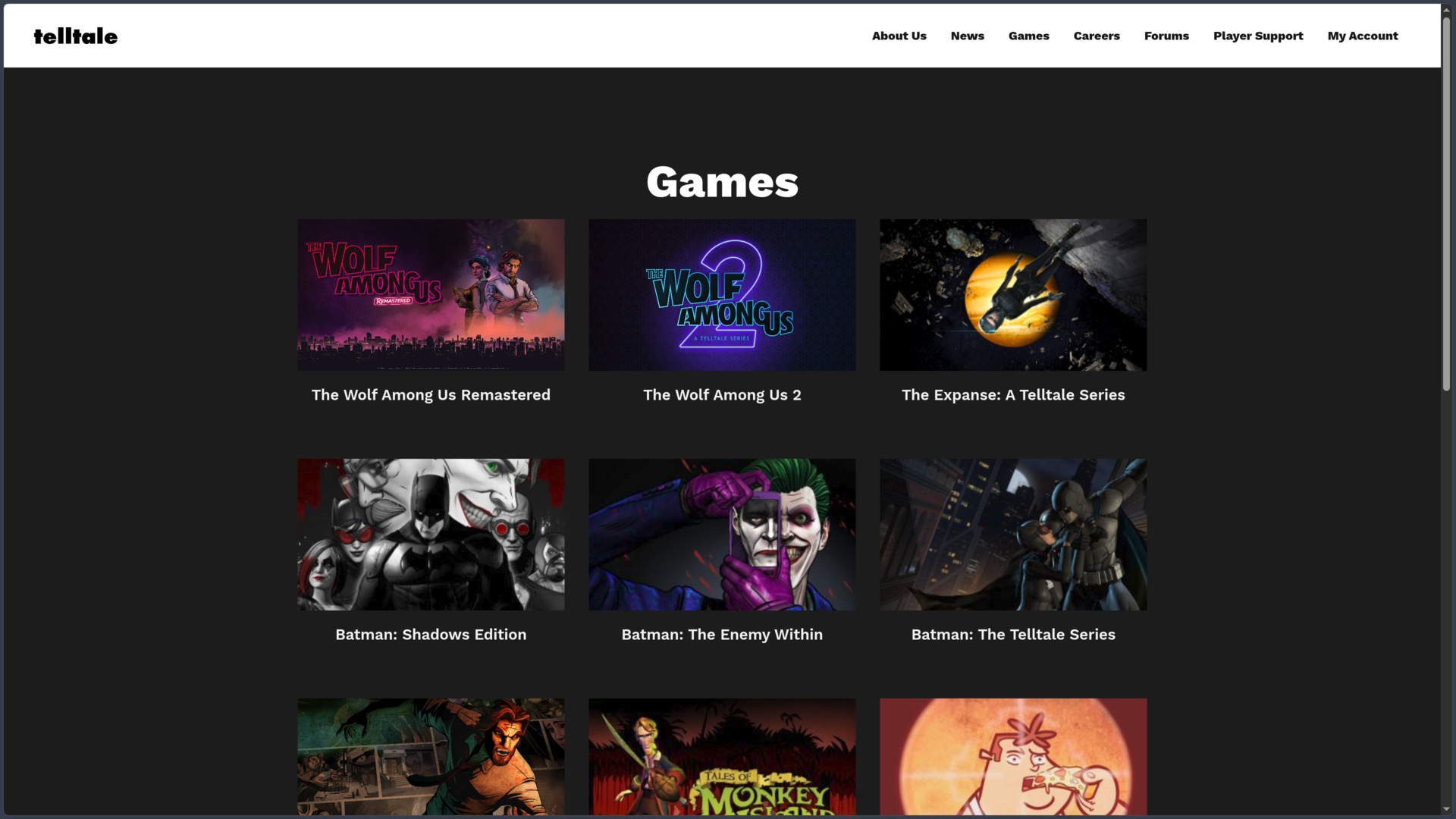
Founded in 2004 in California, Telltale Games is an American development studio that became one of the names most closely associated with the episodic narrative adventure game. Its history includes Sam & Max, Back to the Future, The Walking Dead, The Wolf Among Us, Tales from the Borderlands, Game of Thrones, Minecraft: Story Mode and Batman: The Telltale Series.
Its influence comes less from inventing an entirely new genre than from the way Telltale adapted graphic adventure games to digital distribution and the expectations of a broader audience.
The player explores environments, talks with characters, makes decisions under pressure and gradually builds relationships that the game remembers. Episodes are grouped into seasons and released successively, following a structure close to that of a television series.
The formula already existed in the studio’s early productions, but The Walking Dead gave it a new dimension in 2012. The relationship between Lee Everett and Clementine places the characters and their decisions at the center of the experience. The player’s choices can alter dialogue, relationships, certain scenes and several events, even when the main narrative paths eventually converge.
This approach became identifiable enough that, for part of the 2010s, the Telltale name almost came to represent a particular way of designing narrative adventures: cinematic staging, choice-based dialogue, timed decisions, persistent consequences and episodic releases.
The studio also uses an exceptional number of existing properties.
The Walking Dead comes from Skybound.
The Wolf Among Us adapts the Fables universe published by DC Comics under the Vertigo label.
Tales from the Borderlands uses Gearbox’s franchise.
Game of Thrones takes place within the universe of the HBO series.
Minecraft: Story Mode was developed in collaboration with Mojang.
Batman and Guardians of the Galaxy allowed Telltale to work with DC and Marvel respectively.
The studio therefore generally does not own the universes it adapts. Its specialty lies in finding a narrative angle that allows it to introduce new protagonists, new situations or an interpretation autonomous enough to work as an interactive experience.
This first chapter came to an abrupt end in 2018.
The Telltale founded in 2004 closed after a massive reduction in staff. The company ceased to exist legally and several licenses and projects left its control.
The current situation must therefore be distinguished from that first company.
In 2019, LCG Entertainment acquired the main assets of the former studio, its brand, certain technologies and several selected properties. LCG then began operating its activities under the Telltale Games name.
The current Telltale openly acknowledges this break, presenting itself as a rebuilt studio centered on the narrative legacy of the brand.
It operates as an independent developer and publisher, uses a distributed production model and abandoned the old studio’s technology environment to build its pipeline around Unreal Engine.
Its first new production released after the revival was The Expanse: A Telltale Series in 2023, co-developed with Deck Nine Games.
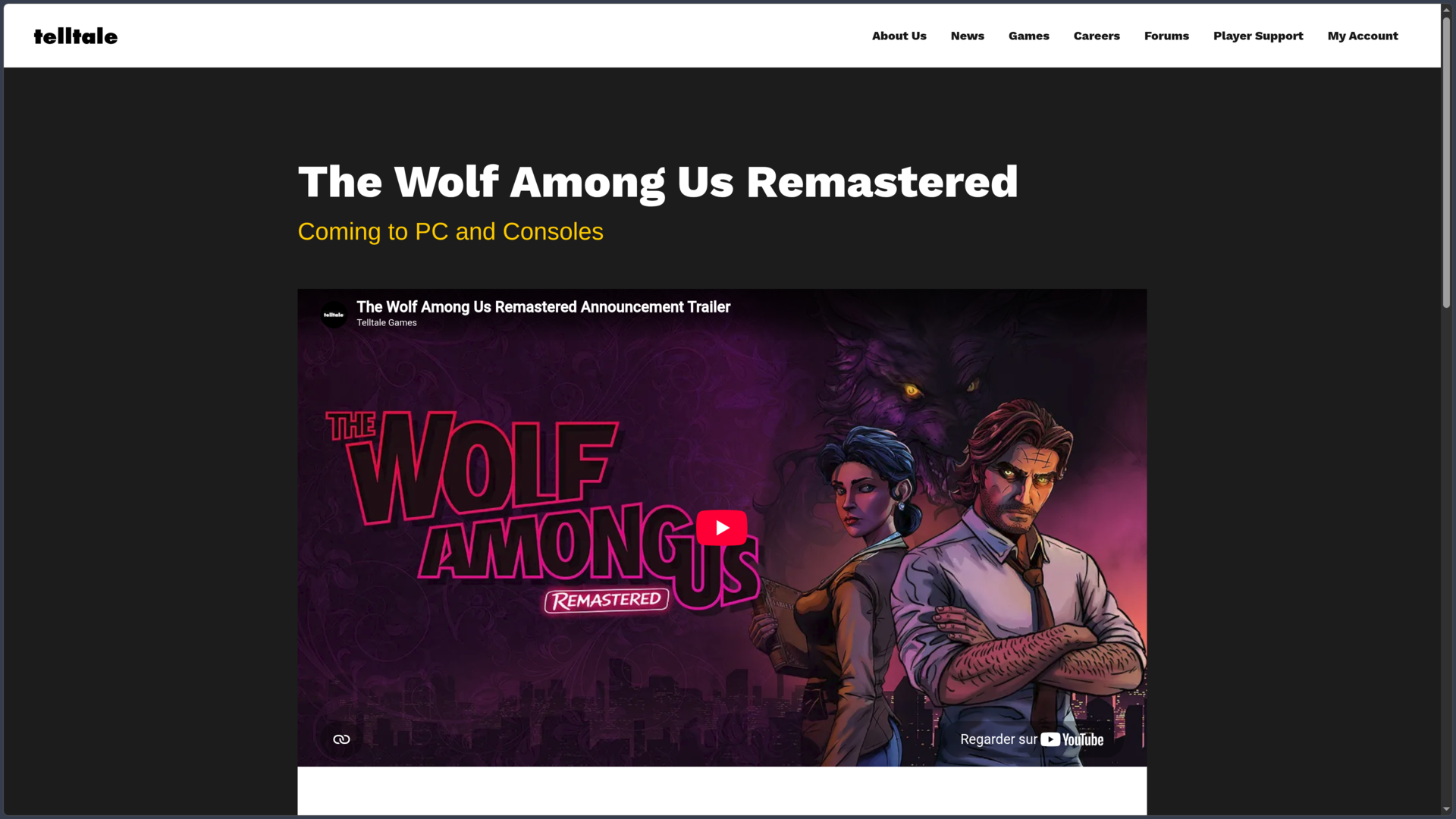
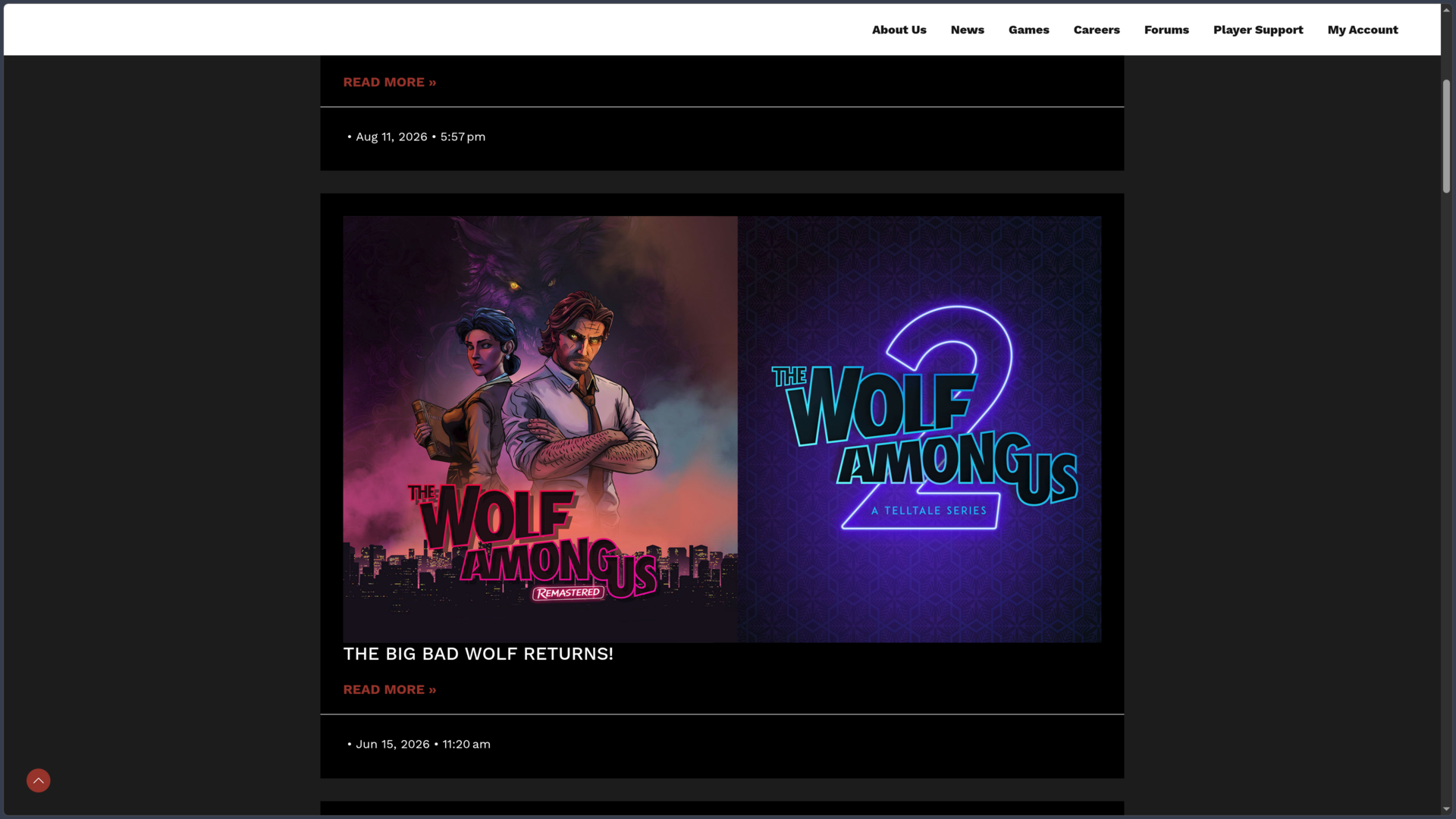
In 2026, the studio is focusing particularly on The Wolf Among Us. The Wolf Among Us Remastered is set to return on modern platforms during the 2026 holiday period, while The Wolf Among Us 2 is announced for 2027. Telltale retains creative and narrative direction of these projects, with PM Studios acting as co-publishing and distribution partner.
Telltale’s history should therefore be understood as that of a creative legacy spanning two different structures: the original studio from 2004 to 2018, then the company rebuilt from 2019 onward by LCG Entertainment.
History
2004: former LucasArts employees found a new adventure studio
Telltale Games was founded in 2004 by Dan Connors, Kevin Bruner and Troy Molander, three former LucasArts employees.
The context is important.
LucasArts had a long history in adventure games with Monkey Island, Grim Fandango, Day of the Tentacle and Sam & Max Hit the Road, but the company was gradually reducing its investment in the genre.
Connors, Bruner and Molander had notably worked around the Sam & Max: Freelance Police project, which LucasArts cancelled in 2004.
Telltale was created during this period of decline for the traditional adventure game.
The new studio did not, however, simply seek to reproduce the model of the 1990s.
Digital distribution was beginning to offer a different possibility: producing shorter adventures, releasing them progressively and establishing an ongoing relationship with players.
This logic would become the economic and creative foundation of Telltale.
Bone and the first experiments with an episodic model
The early years allowed the studio to test this strategy.
After Telltale Texas Hold’em, Telltale obtained the adaptation rights to Bone, the comic book by Jeff Smith.
Bone: Out from Boneville was released in 2005, followed by The Great Cow Race.
These productions already demonstrated the studio’s interest in existing narrative properties.
Telltale looked for universes with characters, dialogue and continuity rich enough to be adapted into adventure games.
But it was another license connected to LucasArts history that would truly allow the episodic model to work.
Sam & Max: turning episodes into a real production method
In 2006, Telltale launched Sam & Max: Season One.
The adventures of detective dog Sam and rabbit Max were published as relatively short episodes released at regular intervals.
This structure was not merely a different way of selling a game.
It changed production itself.
Teams could work on a season like a series, reuse characters and environments, gradually develop storylines and maintain a regular relationship with their audience.
Telltale continued this approach with other properties such as Strong Bad’s Cool Game for Attractive People, Wallace & Gromit’s Grand Adventures and Tales of Monkey Island.
The episode gradually became the studio’s signature.
Back to the Future and Jurassic Park: moving closer to major licenses
At the beginning of the 2010s, Telltale obtained much more widely known licenses.
Back to the Future: The Game, launched from 2010 onward, extended the film universe with a new adventure featuring Marty McFly and Doc Brown.
Jurassic Park: The Game followed in 2011.
These collaborations significantly increased the studio’s visibility.
They also demonstrated both the possibilities and limitations of its model.
Telltale had to quickly produce several episodes, respect extremely well-known universes and maintain enough consistency between writing, animation, staging and interactions.
The studio gradually built technology and a pipeline capable of reusing many elements from one episode to another.
But the real transformation came with its next project.
2012: The Walking Dead changes Telltale’s position
In 2012, Telltale launched The Walking Dead, based on the comic book created by Robert Kirkman.
Rather than directly using the main protagonists from the comic or television series, the game follows Lee Everett, a former professor facing the beginning of the outbreak, and Clementine, a young girl he decides to protect.
The relationship between the two characters becomes the heart of the season.
Traditional graphic adventure puzzles occupy a less central place than in several previous productions.
Dialogue, decisions, the reactions of other survivors and the handling of morally difficult situations become more important.
Some decisions must be made quickly.
The game also retains several choices from one episode to the next and regularly reminds players that certain characters will remember their actions.
Not every branch produces an entirely different story, but this system creates a personal continuity in which players experience events through the decisions they have made.
The success was considerable.
The first season received numerous awards, including Game of the Year at the 2012 Spike Video Game Awards, while Telltale received Studio of the Year.
The game transformed the scale of the company and made the studio an international reference for interactive storytelling.
The Wolf Among Us: applying the formula to noir detective fiction
Telltale then developed The Wolf Among Us, whose first season began in 2013.
The game adapts Fables, the comic series created by Bill Willingham and published by Vertigo.
The player controls Bigby Wolf, sheriff of a community of fairy-tale characters secretly living in New York.
The structure retains Telltale’s characteristic dialogue and decisions but applies them to a detective investigation influenced by film noir.
Players must question characters, interpret their behavior and decide how Bigby uses his authority or violence.
The strongly stylized visual identity and personality of Fabletown also distinguish the production from the studio’s other adaptations.
The Wolf Among Us became one of the creations most durably associated with the Telltale name and one of the main properties taken up again by the new studio after 2019.
2014-2015: multiplying universes
After the success of The Walking Dead, Telltale significantly increased the number of projects developed simultaneously.
Tales from the Borderlands transposes Gearbox’s universe into an adventure where dialogue, humor and relationships between characters matter more than the shooting that characterizes the main games.
Game of Thrones adapts the HBO television universe and develops its own family, the Forresters, caught in the political struggles of Westeros.
Minecraft: Story Mode, developed with Mojang, transforms a game primarily based on free-form building into a true narrative series with characters and a written storyline.
Telltale simultaneously continued The Walking Dead.
This period demonstrates the studio’s particular ability to take universes with highly established identities and identify what can become material for dialogue, decisions and staging.
But it also led to a multiplication of teams, schedules and licensing constraints.
Batman: allowing the player to shape Bruce Wayne as much as the hero
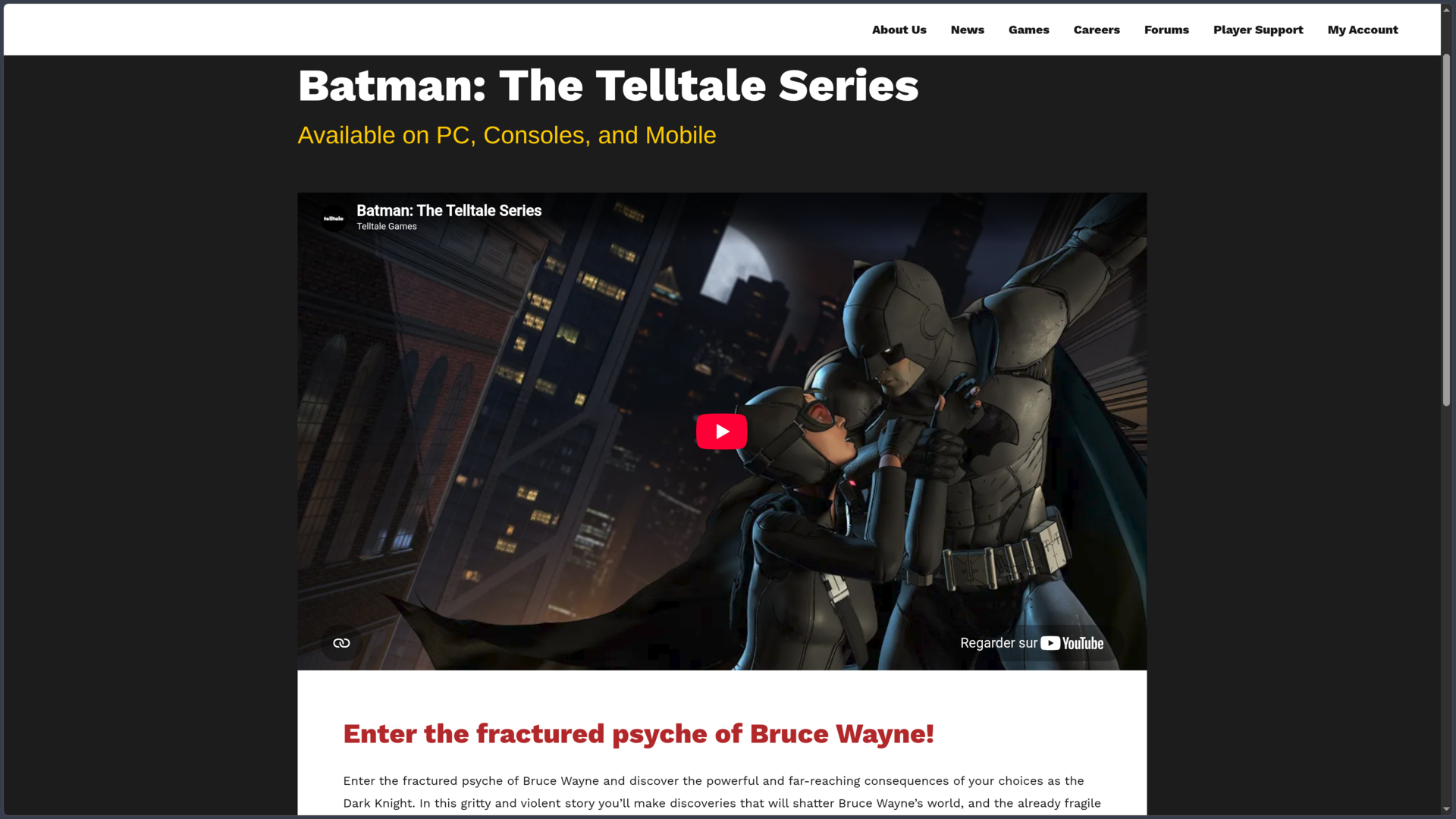
In 2016, Telltale launched Batman: The Telltale Series.
The studio once again chose not to simply reproduce an existing continuity.
Its version of Gotham, Bruce Wayne and several supporting characters was designed specifically for this adaptation.
A significant part of the game revolves around the relationship between Bruce Wayne and Batman.
The decisions therefore do not concern only how crime should be fought.
Players must also determine how Bruce behaves publicly, what relationships he maintains with his allies and how far Batman is willing to go.
Batman: The Enemy Within continued this continuity in 2017.
Alongside The Wolf Among Us, this series became one of the historical properties still directly highlighted by the current Telltale.
Growth that became difficult to sustain
The success of The Walking Dead transformed Telltale from a relatively compact specialized studio into a company managing several major licenses simultaneously.
Production had to follow tight episodic schedules.
Several seasons could be developed in parallel.
This activity also required adaptation across numerous platforms, localization, support and coordination with the owners of the different licenses.
In 2017, Telltale had already carried out a major staff reduction.
The studio attempted to review its organization while simultaneously announcing several new projects, including a new season of The Wolf Among Us.
But the financial difficulties continued.
2018: closure of the original studio
On September 21, 2018, Telltale announced a massive reduction in staff.
Around 250 employees left the company, while a very small group temporarily remained.
Projects in development were heavily disrupted and several were abandoned.
The Walking Dead: The Final Season, already underway, was directly affected.
Skybound, owner of The Walking Dead property, ultimately took over the project with former team members to allow the final episodes to be completed.
The original Telltale definitively closed in October 2018.
This disappearance created an unusual situation for its catalogue.
Some licenses returned to their owners.
Some games temporarily became unavailable.
Technologies, brands and properties actually owned by Telltale had to be treated separately from universes it had merely used under license.
The Telltale name remained well known, but the company that had created it no longer existed.
2019: LCG Entertainment acquires the brand and certain assets
In August 2019, a new company called LCG Entertainment announced that it had acquired essential assets from the defunct Telltale.
The transaction included the Telltale brand, certain technologies, catalogue assets and several selected intellectual properties.
LCG then began operating under the name Telltale Games.
This distinction is fundamental.
It was not simply an administrative reopening of the studio that had closed a few months earlier.
The legal company is different, the organization was rebuilt and only part of the former Telltale’s heritage was recovered.
Members of the former company could be rehired or work as contractors, but the new studio is a new structure.
LCG nevertheless chose to retain the brand precisely because it remained strongly associated with a form of interactive storytelling.
Taking back The Wolf Among Us as a symbol of the revival
Among the first projects announced after the reconstruction was The Wolf Among Us 2.
The choice was symbolic.
The first season was one of the most appreciated games in the historical catalogue and its sequel had already been considered before the 2018 closure.
The new project, however, did not simply consist of resuming files from the interrupted former production.
Telltale rebuilt its pipeline and adopted Unreal Engine, abandoning the historical technology environment that had supported previous productions.
The studio also adopted a distributed organization in which several teams and partners could participate in the same project.
This transformation directly reflected the new Telltale’s stated intention to rebuild its activity around more sustainable production methods.
The Expanse: the first new game from the revived Telltale
In 2021, Telltale announced The Expanse: A Telltale Series in partnership with Deck Nine Games and Alcon Entertainment.
The project was the first new property announced since the studio’s reformation.
Deck Nine contributed a full development team while Telltale participated in design and handled its publishing role.
The production retained several historical principles: the importance of dialogue, decisions, characters and episodic releases.
It nevertheless added more direct exploration, particularly through zero-gravity movement.
The first episode was released in July 2023, with the following four published at two-week intervals.
This method changed an important aspect of the former operating model.
The full season was already developed before the first episode was released, reducing dependence on production taking place almost simultaneously with distribution.
2026: fully relaunching The Wolf Among Us
After a long production period, Telltale presented The Wolf Among Us 2 again in June 2026.
The sequel is now announced for 2027.
At the same time, the studio revealed The Wolf Among Us Remastered, scheduled for the 2026 holiday period.
The remaster notably improves visual presentation, interface, accessibility, animation, audio, resolution and frame rate while retaining the original five-episode narrative structure.
For both productions, Telltale works with PM Studios, which acts as a co-publishing partner and supports worldwide distribution and commercialization.
Telltale nevertheless retains creative and narrative direction of the series.
This organization summarizes the new model quite well.
The studio no longer necessarily attempts to produce a large number of seasons simultaneously as it did in the mid-2010s.
It uses a distributed structure, production or publishing partnerships and a more focused catalogue centered on projects where storytelling remains the main common thread.
What sets it apart
Turning dialogue into a true gameplay mechanic
At Telltale, a conversation is not simply used to communicate information before gameplay resumes.
Dialogue is itself part of the gameplay.
The player must choose what their character says, sometimes within a limited amount of time, then accept the reactions produced by that decision.
Responding harshly, lying, remaining silent, supporting one character or abandoning another can alter a relationship and change how a later scene is experienced.
This mechanic allows Telltale to place part of the protagonist’s personality in the player’s hands.
Lee Everett, Bigby Wolf, Bruce Wayne and Rhys all have written identities, but the player can influence their behavior within those identities.
Giving choices continuity without creating entirely separate stories
Telltale’s choice system relies on a particular balance.
The games generally do not create dozens of completely independent stories.
Many events must converge so that the production remains compatible with a season that is written, animated and published in episodes.
But the game retains enough decisions to alter dialogue, relationships, which characters are present or how certain situations unfold.
The consequence is therefore not always a spectacular change in the storyline.
It can be emotional.
A character may trust the player, blame them for an earlier decision or interpret their behavior differently.
This memory gives the season a form of personal continuity even when several players go through the same major events.
Thinking of the game as a season
Telltale pushed the logic of episodic publishing particularly far.
A production can be built like a season composed of several episodes, each with its own dramatic tension while contributing to a broader arc.
This structure facilitates cliffhangers, reminders of previous decisions and the gradual evolution of relationships.
It also creates time between episodes during which players can compare their decisions and discuss possible consequences.
The model deeply contributed to Telltale’s identity, even though the new studio changed its operating method by seeking to complete more of the production before distribution begins.
Adapting a license without simply replaying its familiar story
Another Telltale specialty is using extremely well-known universes while often avoiding simply retelling the original works.
The Walking Dead follows Lee and Clementine rather than Rick Grimes.
The Wolf Among Us develops a story set before the main events of Fables.
Tales from the Borderlands transforms the Borderlands universe through an adventure centered on its characters and dialogue.
Minecraft: Story Mode invents a true narrative within a universe originally built around player freedom.
Batman offers its own version of Bruce Wayne and Gotham.
This approach gives writers enough freedom to surprise even an audience already familiar with the license.
Using staging as a bridge between games and television series
Telltale’s work also sits between several forms of language.
Scenes use framing, editing, music and dialogue in a way close to audiovisual production.
But the player remains involved within that staging.
They choose a response, examine an environment, trigger an action or decide how a character reacts to a situation.
This hybrid approach allowed the studio to reach an audience that was not necessarily looking for the mechanical complexity of other genres.
The main challenge shifts toward reading characters, making decisions and accepting their consequences.
Rebuilding the studio without exactly reproducing its former model
The current Telltale does not try to conceal the break of 2018.
LCG Entertainment explicitly speaks of a “reborn” studio and distinguishes its structure from that of the historical company.
The new model relies on distributed production, the use of Unreal Engine and more direct collaborations with other studios or publishing partners.
The Expanse was developed with Deck Nine.
The new The Wolf Among Us projects use PM Studios for part of their publishing and distribution.
This organization therefore preserves the most identifiable element of Telltale — interactive storytelling centered on characters and decisions — while profoundly changing the structure used to produce it.
Good to know
- Telltale Games was founded in 2004 in California by Dan Connors, Kevin Bruner and Troy Molander, three former LucasArts employees.
- From its earliest years, the studio developed a model based on adventures distributed in episodes, notably with Sam & Max.
- The Walking Dead, launched in 2012, transformed the scale of the studio and won Game of the Year at the Spike Video Game Awards, while Telltale received the Studio of the Year award.
- The historical catalogue notably includes Sam & Max, Back to the Future, The Walking Dead, The Wolf Among Us, Tales from the Borderlands, Game of Thrones, Minecraft: Story Mode and Batman: The Telltale Series.
- Most of these universes are licenses owned by other companies; their presence in Telltale’s history does not mean the studio owns the rights to them today.
- The historical studio underwent a massive staff reduction in September 2018 before closing in October.
- Skybound took over completion of The Walking Dead: The Final Season after the closure of the original Telltale and now manages this part of the catalogue.
- In August 2019, LCG Entertainment announced that it had acquired the Telltale brand, assets, certain technologies and several selected properties and began operating under the Telltale Games name.
- The current Telltale is therefore a new company using the brand and part of the legacy of the studio founded in 2004, not the direct legal continuation of the company that closed in 2018.
- The new Telltale uses Unreal Engine, a distributed development model and presents itself as both a developer and digital publisher.
- The Expanse: A Telltale Series, co-developed with Deck Nine and released in 2023, was the first new production released by the reformed Telltale.
- In 2026, Telltale is preparing The Wolf Among Us Remastered for the end of the year and The Wolf Among Us 2 for 2027, with PM Studios as co-publishing partner while Telltale retains creative and narrative direction.