
Presentation
A console doesn't really have personality until someone gives it something to play.
Then Gran Turismo, God of War, The Last of Us, Ghost of Tsushima, Horizon, Ratchet & Clank, or ASTRO BOT appear.
The machine then starts to tell something other than its spec sheet.
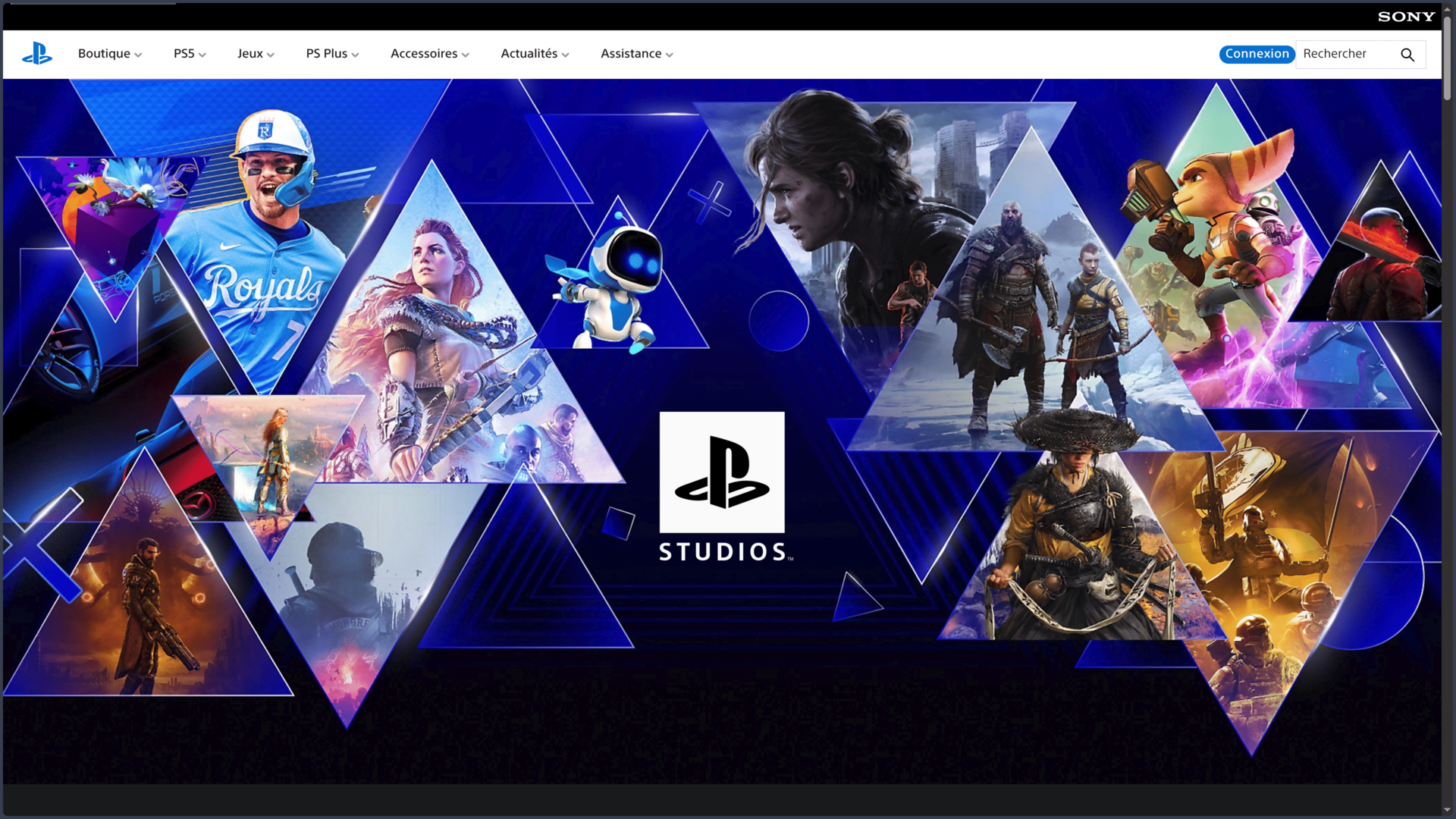
PlayStation Studios exists precisely in this space.
It is neither a single studio nor an independent company comparable to Square Enix or CD Projekt RED. It is the global collective of first-party studios and teams of Sony Interactive Entertainment, progressively built around PlayStation.
This nuance is essential.
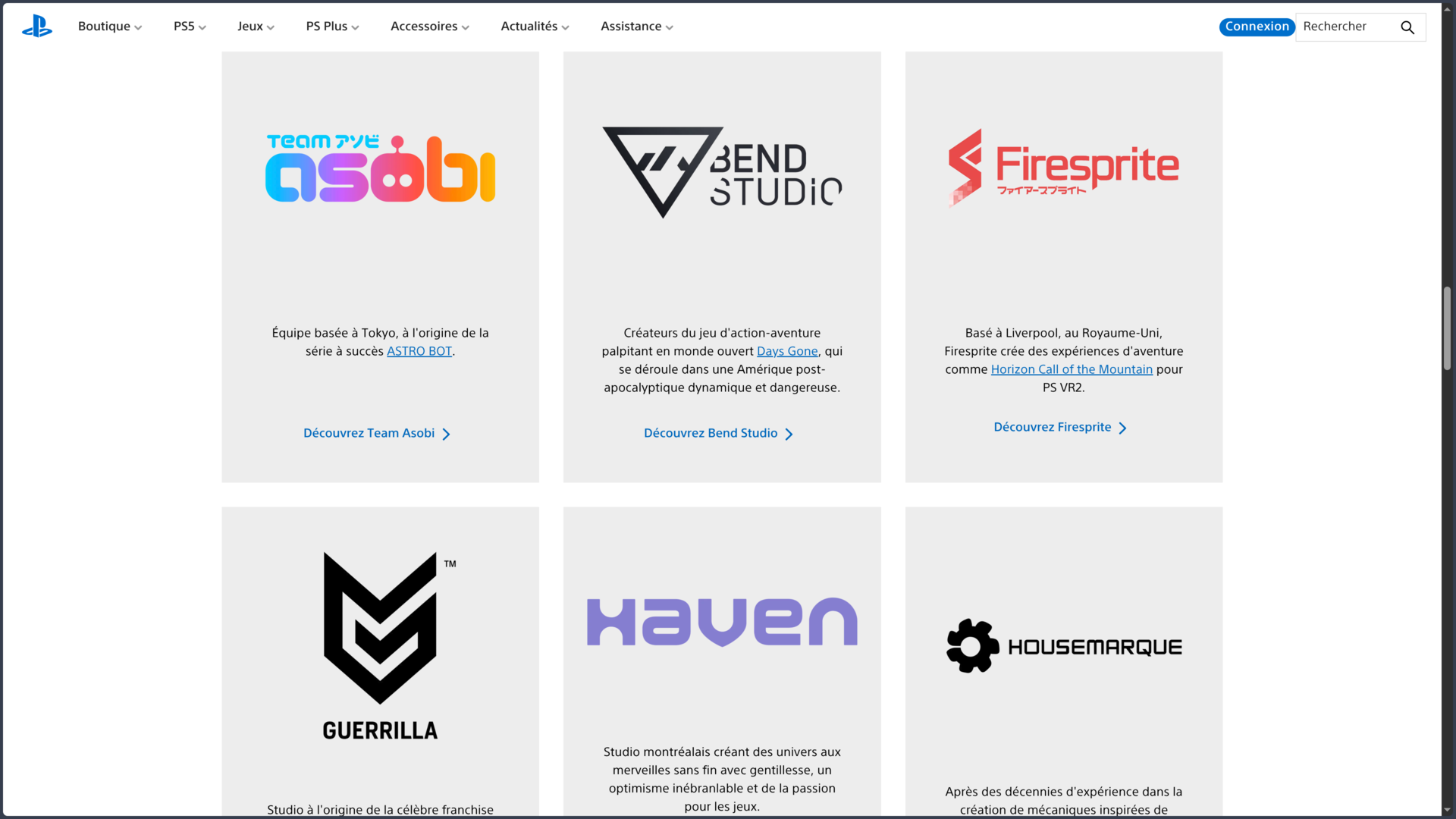
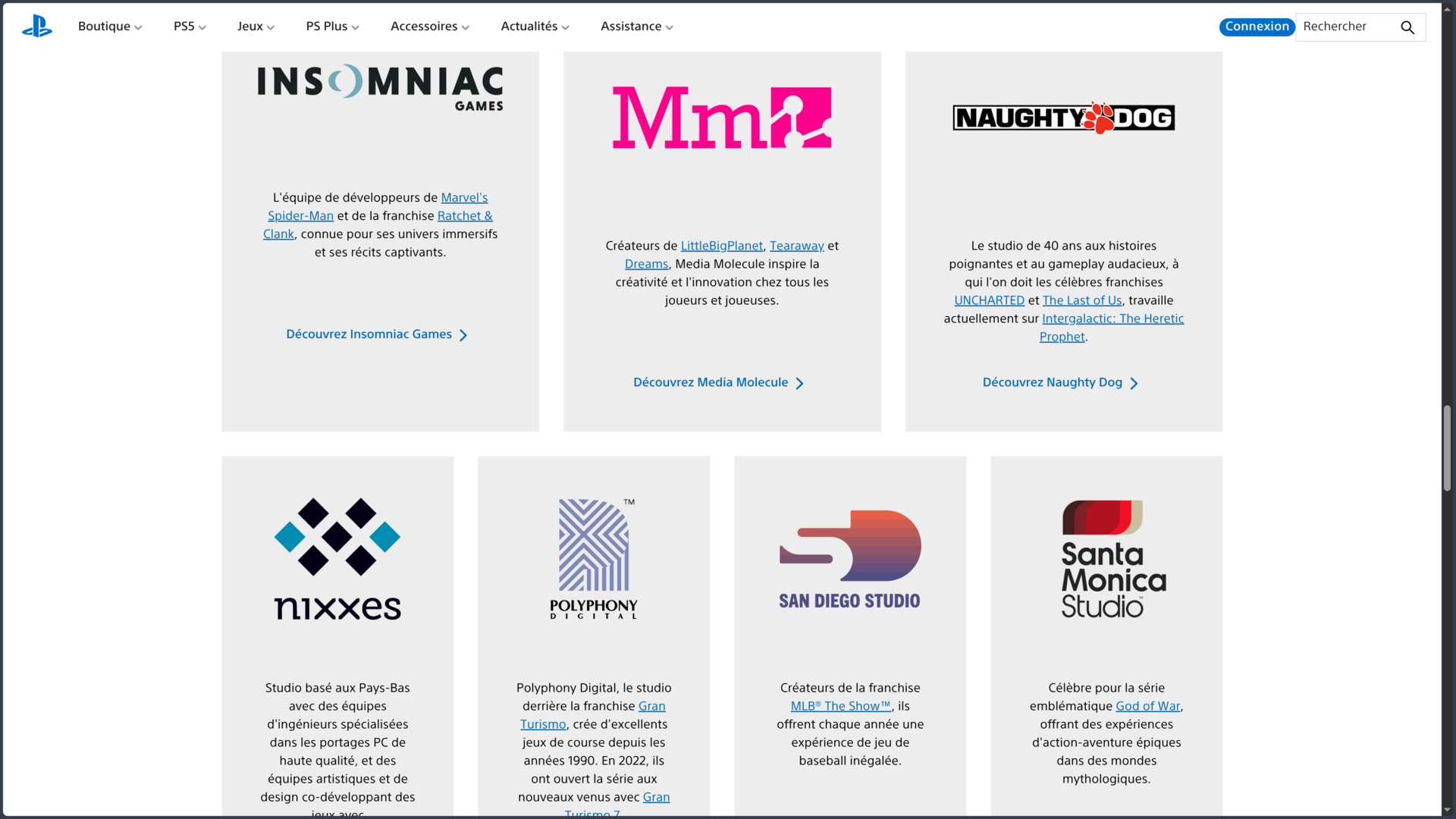
Naughty Dog does not work like Insomniac Games. Santa Monica Studio does not look like Housemarque. Guerrilla has a different culture from Team Asobi, while Sucker Punch or Polyphony Digital follow yet other traditions.
Yet all these teams participate in what the public ends up recognizing as a PlayStation production.
This common identity therefore does not rest on a gameplay formula.
It comes more from a level of ambition, a close relationship with PlayStation hardware and technologies, important care given to production, and above all the ability of certain works to become the faces of a generation.
The collective's history begins before its current name.
Sony officially brought its worldwide studios together under Worldwide Studios in 2005, then adopted the PlayStation Studios banner in 2019. The network then grew quickly with new acquisitions and teams with very different functions: auteur studios, porting specialists, co-developers, support structures, and external production partners.
This diversity is its real strength.
It also creates its main difficulty.
The more PlayStation tries to build a strong common identity, the more it must preserve the differences that make each of its studios interesting.
History
Before the collective: games already give PlayStation an identity
When the original PlayStation arrived in 1994, Sony had to solve a simple problem: a new console is not enough.
It needs games able to convince the public and developers that this new platform deserves to exist.
Sony therefore progressively built its own production capabilities while working with many external partners.
Some teams quickly became important in the ecosystem. The future Polyphony Digital, born from the Gran Turismo team, for example became a distinct subsidiary of Sony Computer Entertainment in 1998.
Other studios stayed independent for a long time while becoming culturally associated with PlayStation.
The principle appeared even before the organization that would officially carry it:
the console provides the platform; the games give it an identity.
2005: Worldwide Studios organizes the constellation
In September 2005, Sony Computer Entertainment created Worldwide Studios to bring together its development studios located in Japan, North America, and Europe.
The creation turned a constellation of studios into a more readable global organization.
The stake is not merely administrative.
A common structure lets more knowledge, technology, production methods, and experience be shared between teams that nevertheless keep making very different games.
This diversity quickly became one of the model's characteristics.
Polyphony Digital develops Gran Turismo.
Santa Monica Studio builds God of War.
Naughty Dog changes franchises several times.
Guerrilla moves from Killzone to Horizon.
Sucker Punch goes through Sly Cooper, inFAMOUS, then Ghost.
The collective therefore does not gain because all its members produce the same thing.
It gains when a common banner lets several strong studio cultures coexist.
Acquiring studios without stripping their identity
Sony also grew its network through acquisitions.
Guerrilla joined the group in 2005, Media Molecule in 2010, Sucker Punch in 2011, then Insomniac Games in 2019.
Several of these teams had already been working with PlayStation for a long time before their acquisition.
The integration therefore does not necessarily consist of inventing a new culture.
It rather consists of determining how an already identifiable studio can benefit from the collective without becoming a copy of the other teams.
This is one of PlayStation Studios' most important balances.
The developer's name must keep counting.
The public does not only expect "the next PlayStation game."
They can expect the next Naughty Dog, the next Insomniac, or the next Sucker Punch.
2019: a more visible banner
In 2019, Worldwide Studios became PlayStation Studios.
The change made the banner much more visible to the public.
Ahead of PlayStation 5, Sony increasingly presented its characters and franchises as members of the same family: Kratos, Aloy, Ratchet, Ellie, Spider-Man, or Astro can appear together despite very different origins.
The strategy works because it does not ask these universes to merge.
PlayStation Studios becomes the common house, not a shared universe.
This distinction also makes it possible not to confuse the collective with Sony Interactive Entertainment.
SIE covers hardware, services, technology, publishing, and PlayStation strategy.
PlayStation Studios mainly represents its creative network and the structures that support game production.
2021-2023: expanding the network with complementary skills
From 2021, Sony significantly accelerated its acquisitions.
Housemarque, Nixxes, Firesprite, Bluepoint, and Valkyrie notably joined the ecosystem, followed by other studios in the following years.
All these teams do not bring the same thing.
Housemarque has a strong action culture.
Bluepoint specializes in remasters and remakes.
Nixxes brings long experience in technical adaptations and PC.
Valkyrie works extensively in co-development.
This diversity shows an important evolution.
PlayStation Studios does not just become a collection of studios able to each create their own franchise.
It also becomes a network of skills able to circulate between several productions.
Support teams become part of the model
Modern major productions often go beyond the scope of a single studio.
Nixxes can support a PC version.
Valkyrie can participate in co-development.
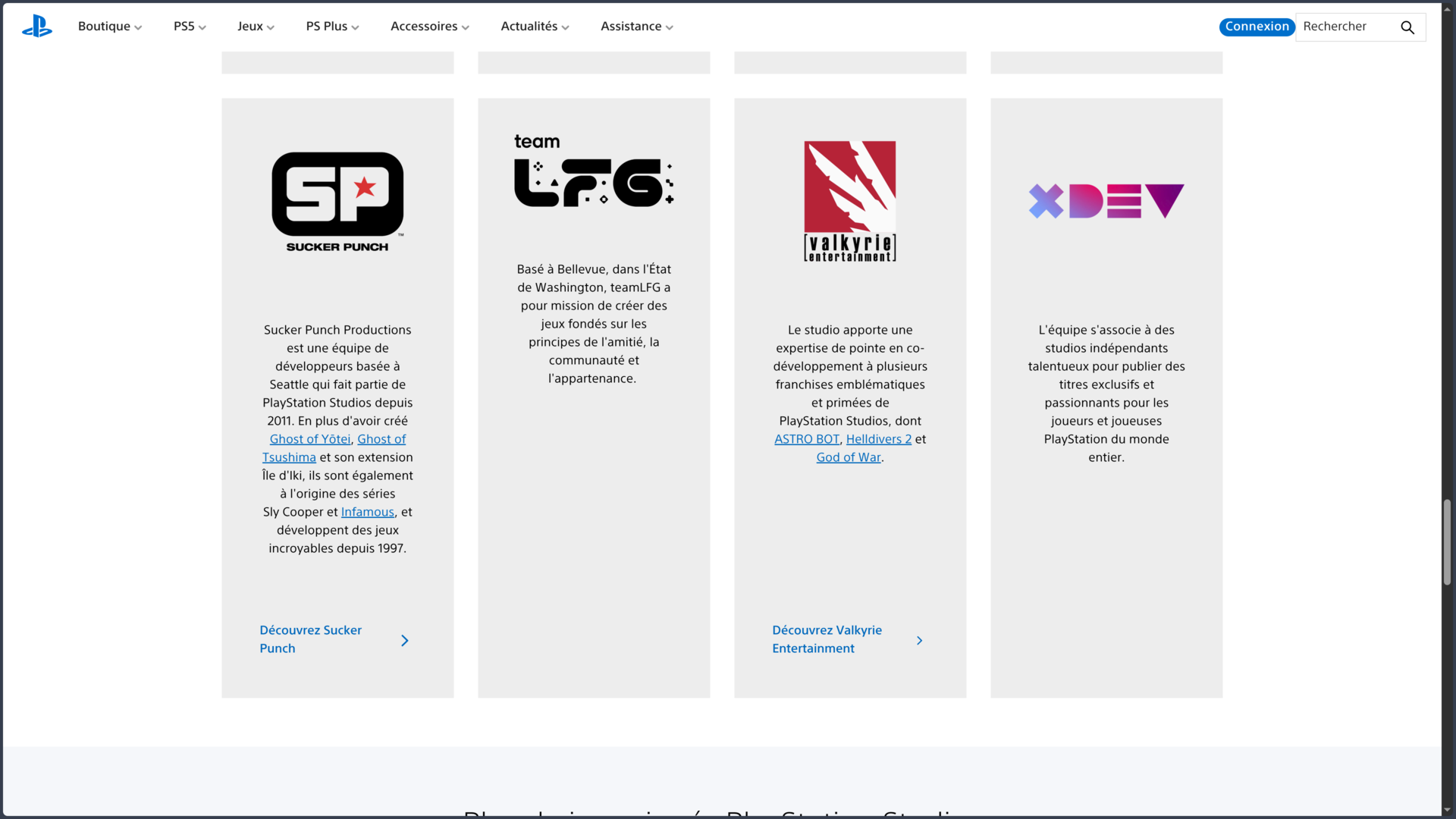
XDEV works with external partners.
Other teams intervene in technology, production, accessibility, localization, or quality assurance.
This infrastructure often remains much less visible than the main studio.
It nonetheless becomes essential as projects grow.
The value of the collective is therefore not only measured by the number of logos it owns.
It also depends on the quality of the connections between the teams.
PC changes the historical frontier of first-party
For a long time, the expression "PlayStation game" almost automatically meant you needed a PlayStation console to play it.
This relationship becomes more flexible when several first-party productions arrive on PC.
The change does not make the console disappear as historical center.
It above all transforms the meaning of the banner.
PlayStation Studios begins to represent a creative and industrial origin as much as a strict material frontier.
This evolution forces the collective to distinguish two goals that have long been almost identical: showcase the platform and grow its properties with a wider audience.
Growth, risks, and refocusing
The expansion of the network does not automatically produce successes.
The years 2024-2025 also show closures, restructurings, and projects that miss their goals.
This period reminds us of an obvious fact that growth can easily mask:
owning more studios does not guarantee a better portfolio.
Since 2024, the organization has put forward an approach presented as creator-led, while reassessing some ambitions and the way its resources are distributed.
PlayStation Studios' modern challenge is therefore no longer only to grow its network.
It consists of determining which teams, scales, and production forms really allow preserving the diversity that built its identity.
What Sets It Apart
Coherence based on difference
PlayStation Studios' paradox is simple.
For the collective to be recognizable, its studios must be able to stay different.
Naughty Dog, Polyphony Digital, Team Asobi, Housemarque, or Santa Monica Studio do not share a single genre.
Their value comes precisely from this contrast.
The banner provides coherence.
Personality comes from the studios.
The developer's name remains a creative brand
PlayStation keeps strong visibility for its teams.
A studio can build a reputation strong enough that its name becomes a promise to the public.
This situation protects part of the cultural autonomy of the collective's members.
The studio benefits from PlayStation's power.
PlayStation benefits from the studio's personality.
The balance works as long as neither makes the other invisible.
The network is also valuable for what circulates between its members
Technology, technical expertise, co-development, external production, and PC adaptation form an important part of the ecosystem.
A skill developed in one team can help another production.
This circulation turns PlayStation Studios into something other than a simple holding of developers.
It becomes a shared creative infrastructure.
Not all productions need to be the same size
PlayStation's first-party reputation has largely been built around particularly ambitious productions.
But every increase in scale also increases costs, risks, and the number of specialists needed.
A collective this large has precisely the advantage of being able to support several forms.
A big blockbuster, a more compact game, an experimental experience, a mainly technical studio, or a support team can all have a legitimate place in the same collective.
Preserving this diversity of scale can be as important as preserving artistic differences.
Being unified enough to share, not uniform enough to fade away
This is probably the best way to sum up PlayStation Studios.
The collective must be organized enough to pool resources, share certain technologies, and give common visibility to its productions.
But it must not become so homogeneous that Naughty Dog, Sucker Punch, Team Asobi, or Housemarque cease to have a reason to exist as separate cultures.
PlayStation Studios is interesting when its members can do more together without ceasing to be themselves.
Good to Know
- PlayStation Studios is the global collective of studios and first-party teams of Sony Interactive Entertainment.
- Its direct ancestor is Sony Computer Entertainment Worldwide Studios, created in September 2005.
- Worldwide Studios became PlayStation Studios in 2019.
- PlayStation Studios and Sony Interactive Entertainment are not the same entity: the collective mainly represents SIE's creative network.
- The network brings together studios with very different functions, from original creation to co-development and technical expertise.
- Nixxes plays an important role in PC adaptations and co-development.
- Valkyrie Entertainment brings long co-development experience.
- XDEV works with external studios, showing that the ecosystem goes well beyond productions developed entirely in-house.
- PlayStation Studios productions can now also be published on PC depending on the project.
- Since 2024, Sony has presented its first-party organization as more creator-led, while having entered a restructuring phase after several years of rapid expansion.